

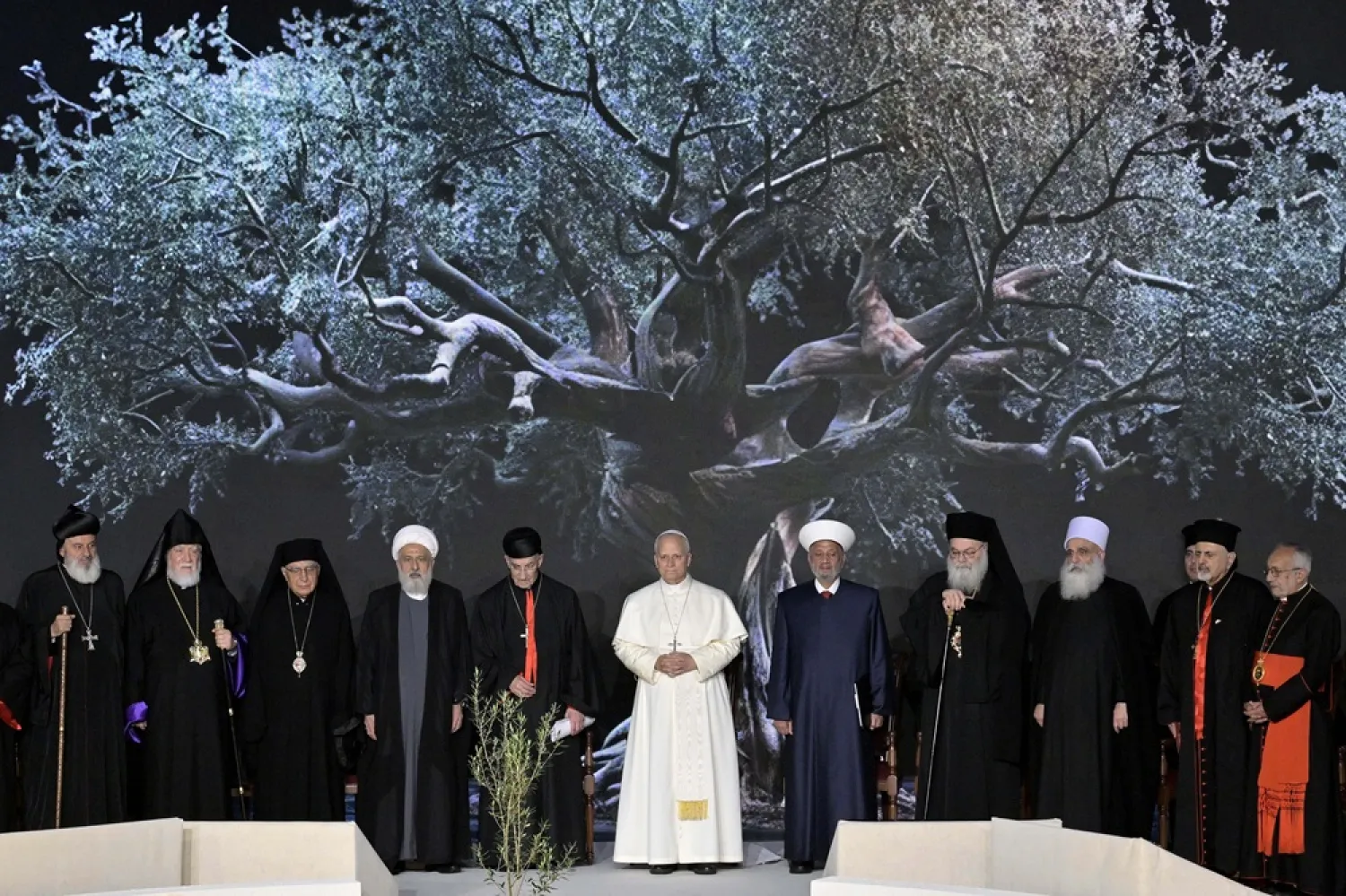

Pope Leo, in Crisis-Hit Lebanon, Urges Faith Leaders to Unite for Peace

01 December 2025, Lebanon, Beirut: Pope Leo XIV (C) poses for a picture with various Lebanese religious leaders during an interfaith and ecumenical meeting at the Martyrs' Square in Beirut, on the second day of his apostolic visit to Lebanon. (dpa)
TT

Pope Leo, in Crisis-Hit Lebanon, Urges Faith Leaders to Unite for Peace

01 December 2025, Lebanon, Beirut: Pope Leo XIV (C) poses for a picture with various Lebanese religious leaders during an interfaith and ecumenical meeting at the Martyrs' Square in Beirut, on the second day of his apostolic visit to Lebanon. (dpa)

Pope Leo gathered leaders of Lebanon's religious communities next to the old frontline of the country's sectarian civil war on Monday and urged peaceful coexistence in a region beset by bloodshed and tumult. 

"May every bell toll, every adhan, every call to prayer blend into a single, soaring hymn," he said, using the Arabic term for the Muslim call to prayer. 

Leo is near the end of his first overseas trip as pope, a visit to Türkiye and Lebanon, ancient biblical lands where he has championed the advancement of Christian and wider religious unity, and the cause of peace. 

HOPE AND PEACE 

On Tuesday, in the final appearances of his trip, he will pray at the site of a deadly 2020 port blast that shredded swathes of Beirut, then lead a Mass on the city's historic waterfront with an expected 100,000 people. 

Leo has described his trip to Lebanon, racked by years of conflict, political paralysis and economic misery, as a mission of peace, and in Türkiye he warned that humanity's future was at risk due to the world's ongoing bloody conflicts. 

The pope met faith leaders on Monday in the central Martyrs' Square, situated on the "green line" that divided Muslim west and Christian east Beirut during the 1975-90 civil war, and urged them to be "builders of peace". 

Lebanese representatives of the Alawite and Druze communities, which have suffered through bouts of sectarian violence in neighboring Syria this year, spoke at the event. 

Later on Monday about 15,000 young people gathered for an event with the 70-year-old pontiff outside the Maronite Catholic headquarters. 

"There is hope within you, a gift that we adults seem to have lost. ... You have more time to dream, to plan and to do good," he said. 

VISIT TO CATHOLIC SHRINE 

Leo also visited the tomb of St. Charbel, a Catholic saint revered across the region, before heading to Harissa, a Catholic shrine on a mountaintop overlooking the Mediterranean just north of Beirut. 

People at the shrine, known for its towering statue of the Virgin Mary looking out towards Beirut, ululated as the pope arrived, pressing in to greet him with shouts of "Viva il Papa" (Long live the pope). 

"We have really been waiting for the pope's visit because it is raising our hope now," said Rev. Toni Elias, a Maronite priest from Rmeich, a Christian town close to the Israeli border. The Maronites are an eastern-rite Catholic community and the largest Christian sect in Lebanon. 

"We believe that he brings with him the message of peace, which we really need." 

Before speaking at the shrine, Leo heard testimonies from people living in Lebanon. Loren Capobres, a Filipina migrant in the country for 17 years, told Leo about her experience living through war. 

The pope said stories like hers show the need to "take a stand to ensure that no one else will have to flee from his or her country due to senseless and cruel conflicts". 

CONFLICT 

Lebanon, which has the largest share of Christians in the Middle East, has been rocked by the spillover of the Gaza conflict, as Israel and the Lebanese group Hezbollah went to war, culminating in a devastating Israeli offensive. 

The country, which hosts 1 million Syrian and Palestinian refugees, is also struggling to emerge from a severe economic crisis following decades of profligate spending that sent the economy into a tailspin in late 2019. 

The deputy head of the Supreme Shiite Islamic Council, Sheikh Ali al-Khatib, thanked Leo for his visit during the interfaith meeting and said the country was riddled with wounds "as a result of Israel's continued attacks". 

Israel says its continued strikes since last year's ceasefire agreement are to prevent Hezbollah from re-establishing military capabilities and posing a renewed threat to communities in northern Israel. 

Leo's schedule on Tuesday includes a prayer at the site of the 2020 chemical explosion at the Beirut port that killed 200 people, an outdoor Mass on the Beirut waterfront and a visit to one of Lebanon's few mental health facilities.  



Sudan Drone Attack on Darfur Market Kills 10

Sudanese refugee girls carry water supplies near a polling station in the refugee camp of Zamzam, on the outskirts of el-Fasher, Darfur, Sudan, on April 13, 2010. (AP)
TT

Sudan Drone Attack on Darfur Market Kills 10

Sudanese refugee girls carry water supplies near a polling station in the refugee camp of Zamzam, on the outskirts of el-Fasher, Darfur, Sudan, on April 13, 2010. (AP)

A drone attack on a busy market in Sudan's North Darfur state killed 10 people over the weekend, first responders said on Sunday, without saying who was responsible.

The attack comes as fighting intensified elsewhere in the country, leading aid workers to be evacuated on Sunday from Kadugli, a besieged, famine-hit city in the south.

Since April 2023, Sudan's army and the paramilitary Rapid Support Forces have been locked in a conflict which has killed tens of thousands of people, displaced nearly 12 million and created the world's largest displacement and hunger crisis.

The North Darfur Emergency Rooms Council, one of hundreds of volunteer groups coordinating aid across Sudan, said a drone strike hit Al-Harra market in the RSF-controlled town of Malha on Saturday.

The attack killed 10 people, it said.

The council did not identify who carried out the attack, which it said had also sparked "fire in shops and caused extensive material damage".

There was no immediate comment from either the Sudanese army or the RSF.

The war's current focal point is now South Kordofan and clashes have escalated in Kadugli, the state capital, where a drone attack last week killed eight people as they attempted to flee the army-controlled city.

A source from a humanitarian organization operating in Kadugli told AFP on Sunday that humanitarian groups had "evacuated all their workers" from the city because of the security conditions.

The evacuation followed the United Nations' decision to relocate its logistics hub from Kadugli, the source said on condition of anonymity, without specifying where the staff had gone.

- Measles outbreak -

Kadugli and nearby Dilling have been besieged by paramilitary forces since the war erupted.

Last week, the RSF claimed control of the Brno area, a key defensive line on the road between Kadugli and Dilling.

After dislodging the army in October from the western city of el-Fasher -- its last stronghold in the Darfur region -- the RSF has shifted its focus to resource-rich Kordofan, a strategic crossroads linking army-held northern and eastern territories with RSF-held Darfur in the west.

Like Darfur, Kordofan is home to numerous non-Sudanese Arab ethnic groups. Much of the violence that followed the fall of el-Fasher was reportedly ethnically targeted.

Communications in Kordofan have been cut, and the United Nations declared a famine in Kadugli last month.

According to the UN's International Organization for Migration, more than 50,000 civilians have fled the region since the end of October.

Residents have been forced to forage for food in nearby forests, according to accounts gathered by AFP.

Doctors without Borders (MSF) said on Sunday that measles was spreading in three of the four states in Darfur, a vast region covering much of western Sudan.

"A preventable measles outbreak is spreading across Central, South and West Darfur," the organization said in a statement.

"Since September 2025, MSF teams have treated more than 1,300 cases. Delays in vaccine transport, approvals and coordination, by authorities and key partners are leaving children unprotected."


Foreign Press Group Welcomes Israel Court Deadline on Gaza Access

A Palestinian man carries the body of his 5-month-old brother, Ahmed Al-Nader, who was reportedly killed the previous day along with other family members in an Israeli shelling on a school-turned-shelter in the Tuffah neighborhood of Gaza City, ahead of his funeral on December 20, 2025. (AFP)
TT

Foreign Press Group Welcomes Israel Court Deadline on Gaza Access

A Palestinian man carries the body of his 5-month-old brother, Ahmed Al-Nader, who was reportedly killed the previous day along with other family members in an Israeli shelling on a school-turned-shelter in the Tuffah neighborhood of Gaza City, ahead of his funeral on December 20, 2025. (AFP)

The Foreign Press Association in Jerusalem on Sunday welcomed the Israeli Supreme Court's decision to set January 4 as the deadline for Israel to respond to its petition seeking media access to Gaza.

Since the start of the Gaza war in October 2023, sparked by Palestinian group Hamas's attack on Israel, Israeli authorities have prevented foreign journalists from independently entering the devastated territory.

Israel has instead allowed, on a case-by-case basis, a handful of reporters to accompany its troops into the blockaded Palestinian territory.

The Foreign Press Association (FPA), which represents hundreds of foreign journalists in Israel and the Palestinian territories, filed a petition to the supreme court last year, seeking immediate access for international journalists to the Gaza Strip.

On October 23, the court held a first hearing on the case, and decided to give Israeli authorities one month to develop a plan for granting access.

Since then, the court has given several extensions to the Israeli authorities to come up with their plan, but on Saturday it set January 4 as a final deadline.

"If the respondents (Israeli authorities) do not inform us of their position by that date, a decision on the request for a conditional order will be made on the basis of the material in the case file," the court said.

The FPA welcomed the court's latest directive.

"After two years of the state's delay tactics, we are pleased that the court's patience has finally run out," the association said in a statement.

"We renew our call for the state of Israel to immediately grant journalists free and unfettered access to the Gaza Strip.

"And should the government continue to obstruct press freedoms, we hope that the supreme court will recognize and uphold those freedoms," it added.


One Dead in Israeli Strikes on South Lebanon

Smoke rises from the site of a series of Israeli airstrikes that targeted the outskirts of the southern Lebanese village of al-Katrani on December 18, 2025. (AFP)
TT

One Dead in Israeli Strikes on South Lebanon

Smoke rises from the site of a series of Israeli airstrikes that targeted the outskirts of the southern Lebanese village of al-Katrani on December 18, 2025. (AFP)

Israeli strikes in south Lebanon on Sunday killed one person and wounded another, the Lebanese health ministry said, as Israel's military said it targeted Hezbollah members.

Israel has kept up regular strikes on Lebanon, usually saying it is targeting Hezbollah infrastructure or operatives, despite a November 2024 ceasefire that sought to end more than a year of hostilities with the Iran-backed group that erupted over the Gaza war.

It has also kept troops in five south Lebanon areas that it deems strategic.

The health ministry in Beirut said "two Israeli enemy strikes today, on a vehicle and a motorbike in the town of Yater" killed one person and wounded another.

Yater is around five kilometers (three miles) from the border with Israel.

In separate statements, the Israeli military said it "struck a Hezbollah terrorist in the area of Yater", adding shortly afterwards that it "struck an additional Hezbollah terrorist" in the same area.

Also on Sunday, Lebanon's army said in a statement that troops had discovered and dismantled "an Israeli spy device" in Yaroun, elsewhere in south Lebanon near the border.

Under heavy US pressure and amid fears of expanded Israeli strikes, Lebanon has committed to disarming Hezbollah and plans to do so south of the Litani River, about 30 kilometers from the border with Israel, by year end.

Israel has questioned the Lebanese military's effectiveness and has accused Hezbollah of rearming, while the group itself has rejected calls to surrender its weapons.

During a visit to Israel on Sunday, US Senator Lindsey Graham also accused Hezbollah of rearming.

"My impression is that Hezbollah is trying to make more weapons... That's not an acceptable outcome," Graham said in a video statement issued by Israeli Prime Minister Benjamin Netanyahu's office.

More than 340 people have been killed by Israeli fire in Lebanon since the ceasefire, according to an AFP tally of Lebanese health ministry reports.

This week at talks in Paris, Lebanon's army chief agreed to document the military's progress in disarming Hezbollah, the French foreign ministry said.

On Friday, Lebanese and Israeli civilian representatives took part in a meeting of the ceasefire monitoring committee for a second time, after holding their first direct talks in decades earlier this month under the committee's auspices.

Israel said Friday's meeting was part of broader efforts to ensure Hezbollah's disarmament and strengthen security in border areas.