


Israeli Fire Kills 4 Palestinians in Gaza and West Bank

28 November 2025, Palestinian Territories, Hebron: Israeli forces block Palestinian farmers trying to access to their agricultural fields in the town of Tarqumiyah. Photo: Mamoun Wazwaz/APA Images via ZUMA Press Wire/dpa
TT

Israeli Fire Kills 4 Palestinians in Gaza and West Bank

28 November 2025, Palestinian Territories, Hebron: Israeli forces block Palestinian farmers trying to access to their agricultural fields in the town of Tarqumiyah. Photo: Mamoun Wazwaz/APA Images via ZUMA Press Wire/dpa

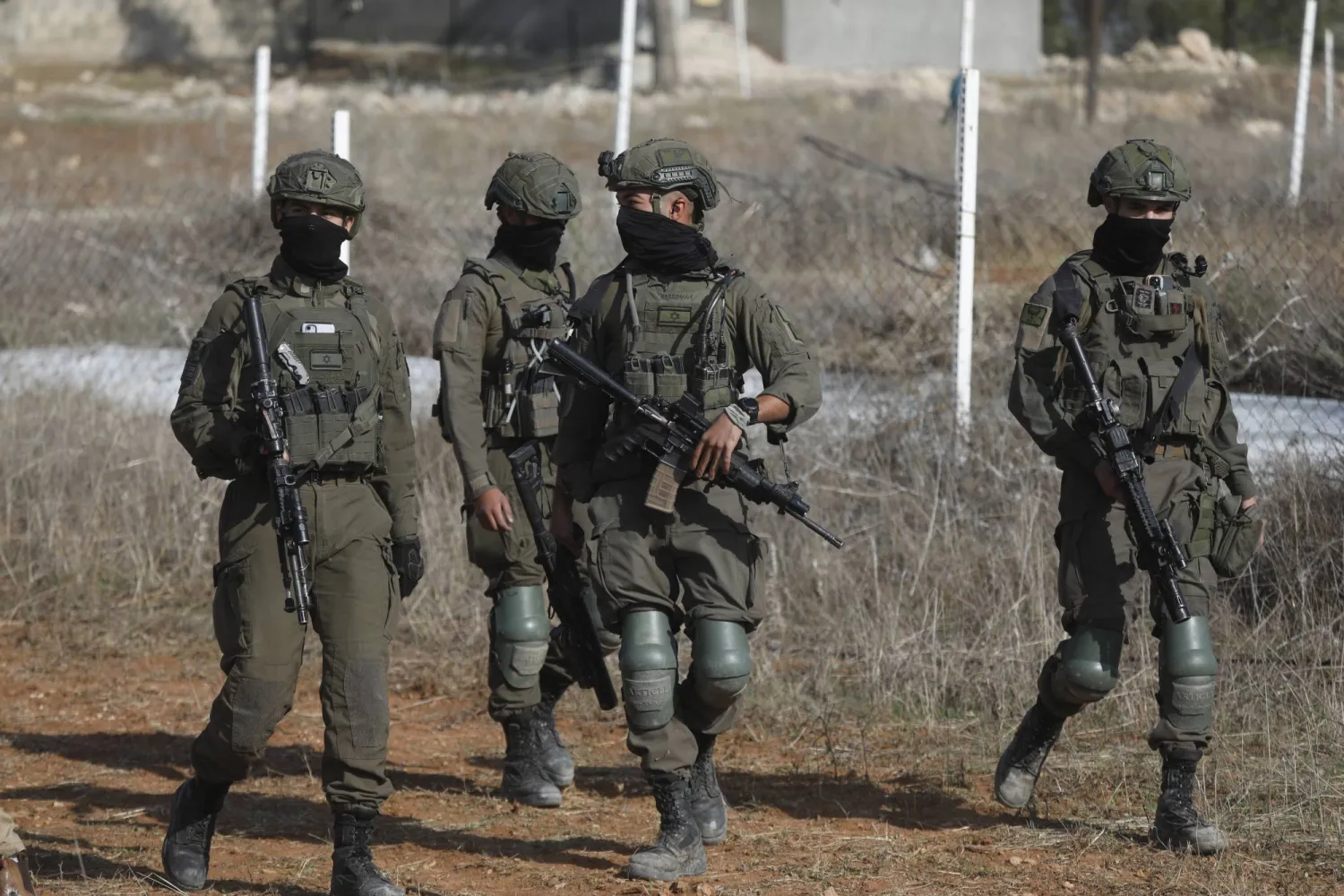
Israeli forces on Tuesday killed a journalist and a man near a refugee camp in Gaza, health workers said, and shot dead two suspected Palestinian assailants in the West Bank wanted in a pair of attacks that wounded three Israelis. 

It was the latest burst of violence in the Palestinian territories, fueling concerns that unrest could spill over and undermine the fragile truce in Gaza. 

Palestinians killed in Gaza  

An Israeli drone strike killed a journalist in southern Gaza on Tuesday, officials at Nasser Hospital, which received the body, said. 

The journalist, Mohamed Wadi, who used to film through a drone, was killed in the southern city of Khan Younis, the hospital said. The conflict in Gaza has had a heavy toll on Palestinian journalists working on the front lines. 

Also Tuesday, a man in Gaza was fatally shot near the eastern side of the Bureij refugee camp in central Gaza, according to Al-Awda Hospital. 

The Gaza Health Ministry said that more than 350 Palestinians have been killed across the territory since a ceasefire on Oct. 11 stopped the Israel-Hamas war. Israel's military did not immediately comment on either deaths, but has said that killings have often been in response to firing at their forces by militants. 

Both Hamas and Israel have accused the other of breaking the terms of the ceasefire. 

Violence flares in the West Bank 

At the same time, Israel’s military has pushed forward its operations in the occupied West Bank. 

On Tuesday morning, the military said troops shot and killed a suspect who stabbed two soldiers as they were confronting him near Ateret, an Israeli settlement north of Ramallah in central West Bank. It said the incident was under review. 

The Palestinian Health Ministry said Israeli forces killed an 18-year-old Palestinian north of Ramallah, but it wasn't immediately clear if it was the same incident. 

Israel's Mada rescue service said two soldiers were lightly wounded. In the southern West Bank, the army said it fatally shot a Palestinian who had earlier carried out a car-ramming attack that wounded a soldier.  

The army said the man attempted to flee as they tried to arrest him near the city of Hebron “while endangering the soldiers” and he was shot dead. The Palestinian Health Ministry identified the suspect as a 17-year-old resident of Hebron. 

In a statement late Monday, Hamas celebrated the ramming attack near Hebron, saying that it came “in the context of the legitimate response of our people” to Israel’s ongoing raids in the West Bank. The group didn’t claim the attack. 

The Israeli army has stepped up its activities in the West Bank since Hamas' Oct. 7, 2023, attack triggered the war in Gaza. Israel says the offensive is aimed at rooting out militants. But Palestinians say scores of stone throwers, protesters and uninvolved civilians have been killed. 

In recent weeks, Israeli settlers have stepped up attacks on Palestinian civilians. Palestinian assailants killed an Israeli man in a stabbing and car ramming attack last month. 

On Tuesday, Israeli forces demolished the home of Abdul Karim Sanoubar, a suspected Palestinian militant currently in detention who has been accused by Israel of planting bombs on buses in central Israel last February. Troops evacuated 13 homes around the building in the city of Nablus and a plume of smoke billowed out after the home was destroyed. 

Also Tuesday, Israel’s military launched another round of strikes on southern Lebanon, which has become an almost daily occurrence as Israel accuses the Hezbollah group of failing to disarm following a US-brokered ceasefire last year that halted two months of war. 


Evacuation Warnings Expand South Lebanon ‘Red Zone’, Strikes Raise Toll

Residents from southern Lebanon hold signs bearing the names of their occupied towns and those at risk of Israeli destruction during a sit-in in Martyrs’ Square in central Beirut (AFP)
TT

Evacuation Warnings Expand South Lebanon ‘Red Zone’, Strikes Raise Toll

Residents from southern Lebanon hold signs bearing the names of their occupied towns and those at risk of Israeli destruction during a sit-in in Martyrs’ Square in central Beirut (AFP)

Israel has expanded the scope of the “red zone” in southern Lebanon to areas about 22 kilometers from the border in Tyre and Nabatieh, issuing successive evacuation warnings covering more than 20 towns.

The warnings triggered a new wave of displacement toward the city of Sidon, before Israel followed them with a series of intensive strikes that raised the human toll and widened the scale of destruction, while imposing a new field reality beyond the limits of the “yellow line.”

Successive warnings and geographic expansion

The Israeli army on Thursday issued a series of urgent warnings ordering residents of southern towns to evacuate immediately. The warnings came in two stages and included villages in Tyre and Nabatieh, reflecting a clear expansion of the area of operations.

The first warning included the towns of al-Samaaiyeh, al-Hinniyeh, al-Qlayleh, Wadi Jilo, al-Kaniseh, Kafra, Majdal Zoun and Siddiqin, before these areas were directly hit after the warning.

In a second warning, the Israeli army expanded the alerts to include Jebchit, Habboush, Harouf, Kfar Jouz, Nabatieh al-Fawqa, Abba, Adchit al-Shqif, Arab Salim, Toul, Houmine al-Fawqa, in Nabatieh district, as well as al-Majadel, Arzoun, Dounine, al-Hamiri and Maaroub, in Tyre district.

Israeli army spokesperson Avichay Adraee called on residents to move at least 1,000 meters away.

Southern Lebanese sources told Asharq Al-Awsat that an expanded “red zone” had emerged alongside the “yellow line,” stretching to the outskirts of Nabatieh across an area more than 35 kilometers wide and extending about 25 kilometers into Lebanese territory.

The zone includes dozens of villages now exposed to shelling or evacuation warnings, triggering large waves of displacement.

The road from the south toward Sidon and Beirut witnessed a new wave of displacement, especially from Nabatieh and its surroundings, after Adraee’s latest threat.

Strikes accompany warnings

The warnings were accompanied by direct strikes, with raids targeting several of the towns included in them. A drone also struck a motorcycle in the town of al-Shahabiyeh, killing two people and wounding one, while warplanes raided the Al Hamza neighborhood between Nabatieh al-Fawqa and Kfar Rumman.

Israeli forces carried out a dawn explosion in the town of Khiam, as raids continued on several areas, including Toulin and al-Jmayjmeh. Shelling also hit Safad al-Batikh, Zebqine, Jabal al-Batm, Qabrikha and Khirbet Selm.

In Bint Jbeil, explosions hit homes and infrastructure in the Khallet al-Mashta area, while a raid destroyed a heritage house in Nabatieh al-Fawqa that was more than 100 years old. A strike on Batouliyeh also destroyed the water station, halting water pumping to residents.

High human toll

Figures showed that 42 people were killed in 24 hours, raising the number of casualties since March 2 to 2,576 dead and 7,962 wounded.

In a detailed toll, the Health Emergency Operations Center said nine people were killed, including two children and five women, and 23 were wounded, including eight children and seven women.

Seven people were also killed in a raid that targeted the town of Zebdine, as strikes continued on villages in Nabatieh.

Civil defense teams resumed search operations in the town of Jouaya for missing people after retrieving five bodies, while a house in al-Hinniyeh collapsed on its residents amid difficulties for rescue teams trying to reach the site.

Israeli warplanes also broke the sound barrier over the Bekaa region, causing a loud boom in the afternoon.

Drone escalation on both sides

Hezbollah, meanwhile, said it targeted four Merkava tanks in Bint Jbeil and Qantara with attack drones, saying they scored direct hits. It also said it targeted artillery south of the town of Yarine.

The group said it downed an Israeli Hermes 450 drone with a surface-to-air missile over Nabatieh airspace, which the Israeli army acknowledged.

The Israeli army said 12 soldiers were wounded after a military vehicle was targeted by an attack drone in Shomera. It said it had carried out operations against Hezbollah members and dismantled rocket-launching sites.

No real ceasefire

On the ground, Israeli army Chief of Staff Eyal Zamir said during a tour near Taybeh that Israeli forces would remain positioned at the “yellow line” and would not withdraw before ensuring the security of northern settlements.

He stressed that “there is no ceasefire on the fighting front.”

Israel’s public broadcaster reported a discussion between US President Donald Trump and Israeli Prime Minister Benjamin Netanyahu, in which Trump called for more caution in operations inside Lebanon, warning that targeting buildings harms Israel’s image internationally.

It pointed to efforts to prevent the collapse of the ceasefire over the next two weeks, while Israel requested a time frame for negotiations until mid-May, considering that Hezbollah is the problem, and ending Iran’s influence could open the door to Lebanon’s stability.


Zamir Says Army Completed Iran, Lebanon Missions, Eyes Gaza

Two Israeli soldiers walk through rubble in southern Lebanon (AP)
TT

Zamir Says Army Completed Iran, Lebanon Missions, Eyes Gaza

Two Israeli soldiers walk through rubble in southern Lebanon (AP)

As Israel faces intensifying domestic criticism over the war, with opponents saying the government has failed to achieve its goals in Lebanon, Iran, and Gaza, scrutiny has also turned to the military, accused of not telling the truth.

In that context, Chief of Staff Eyal Zamir said in closed-door meetings on Wednesday in southern Lebanon, remarks later leaked by the army, that “everything defined for us by the political echelon regarding the current campaign in Iran and Lebanon has been achieved and even beyond that.”

“In doing so, we have created the operational conditions for the processes now being led by the political echelon,” said Zamir.

But a newly launched drone by Hezbollah targeting Israeli artillery in the town of Shomera, wounding 12 soldiers, including two seriously, shifted Zamir’s calculations.

Shomera, a Jewish town built on the ruins of Tarbikha, captured at the end of 1948, is considered Lebanese by Beirut, which granted citizenship to its displaced residents.

Israel destroyed most of its homes and two mosques and turned it into a Jewish locality. In the current war, it has been evacuated, with Israeli forces establishing positions there.

Retaliatory strikes

Following Hezbollah’s attack, the Israeli Air Force launched retaliatory strikes, calling it a serious attack that cannot be ignored.

It hit several sites and ordered residents of 16 villages in southern Lebanon to evacuate ahead of their destruction, including Bchit, Habboush, Harouf, Kfar Jouz, Nabatieh al-Fawqa, Aba, Aadchit, Shaqif, Arab Salim, Toul, Houmine al-Fawqa, Majadel, Arzoun, Dounine, Hmeiri, and Maaroub.

This came as sources close to the government said it is seeking to impose a two- to three-week deadline for negotiations with Lebanon, ending by mid-May, warning it could revert to what it described as the “original plan” for the war if no progress is made.

According to Channel 12, the approach was raised in a Wednesday evening call between Prime Minister Benjamin Netanyahu and US President Donald Trump, following what was described as an urgent Israeli request to set a time frame for US-mediated direct talks between Tel Aviv and Beirut.

The sources said the current “limited response” policy is eroding deterrence and harming civilians and operational readiness.

Gaza not over

The Channel 12 report said the Israeli army is operating under political directives to restrain operations in Lebanon, avoiding deep strikes, with any action north of the Litani River requiring special approval.

It said the current posture, limiting the army to response rather than initiative, benefits Hezbollah and gives it room to regroup, exposing Israeli forces to added risks.

Amid the criticism, Zamir toured areas held by Israeli forces in Lebanon on Wednesday, saying the army is carrying out political directives and awaiting further decisions.

“In Lebanon, the mission assigned to us by the political echelon is to position ourselves along the line to prevent direct fire on the communities. We have achieved this; this is the line we are on. We may be required to remain on it,” said Zamir.

The report questioned the cost Israel is paying at this stage, citing what it described as consideration for US interests in the confrontation with Iran.

Zamir also said the next battle could be in Gaza, stressing the war there is not over. If Hamas obstructs disarmament efforts, he said, the army would resume the war with full force.


France to Host International Meet on Palestinian-Israeli Conflict in June

15 April 2026, Berlin: French Foreign Minister Jean-Noel Barrot, gives a statement at the International Sudan Conference at the Federal Foreign Office in Berlin. (dpa)
TT

France to Host International Meet on Palestinian-Israeli Conflict in June

15 April 2026, Berlin: French Foreign Minister Jean-Noel Barrot, gives a statement at the International Sudan Conference at the Federal Foreign Office in Berlin. (dpa)

France will host an international meeting in June dedicated to the long-touted two-state solution to the Palestinian-Israeli conflict, the French foreign minister announced on Thursday.

"On September 22 last year, France took the momentous decision to recognize the State of Palestine and will host an international conference in Paris on June 12 so that Israeli and Palestinian civil societies can make their voices heard," Jean-Noel Barrot said in a video message played to a gathering of peace activists in the Israeli city of Tel Aviv.

The "People's Peace Summit" in Tel Aviv was organized by the "It's Time" coalition, a grouping of more than 80 peacebuilding organizations working to end the Palestinian-Israeli conflict through a political agreement guaranteeing both peoples' right to self-determination and secure lives.

Several hundred people attended the meeting in Tel Aviv, AFP journalists reported.

"While the Middle East remains deeply scarred by the terrorist attacks of October 7 (2023) in Israel, by more than two and a half years of devastating war in Gaza and by a humanitarian crisis that, sadly, shows no sign of abating, your presence here is an act of resistance against fatalism and resignation," Barrot said.

Palestinian movement Hamas's October 7, 2023 attack on Israel sparked the war in Gaza, where a ceasefire in effect since October has largely halted fighting.

Barrot's remarks come as the government of Prime Minister Benjamin Netanyahu, one of the most right-wing in Israel's history, vehemently opposes the emergence of a sovereign and fully independent Palestinian state in the occupied West Bank and Gaza, and is working on the ground to undermine the possibility of a two-state solution.

Meanwhile, the Palestinian Authority led by President Mahmoud Abbas appears extremely weakened and deeply unpopular.
