
Karam Steers South Lebanon into New Phase as Mechanism Chief

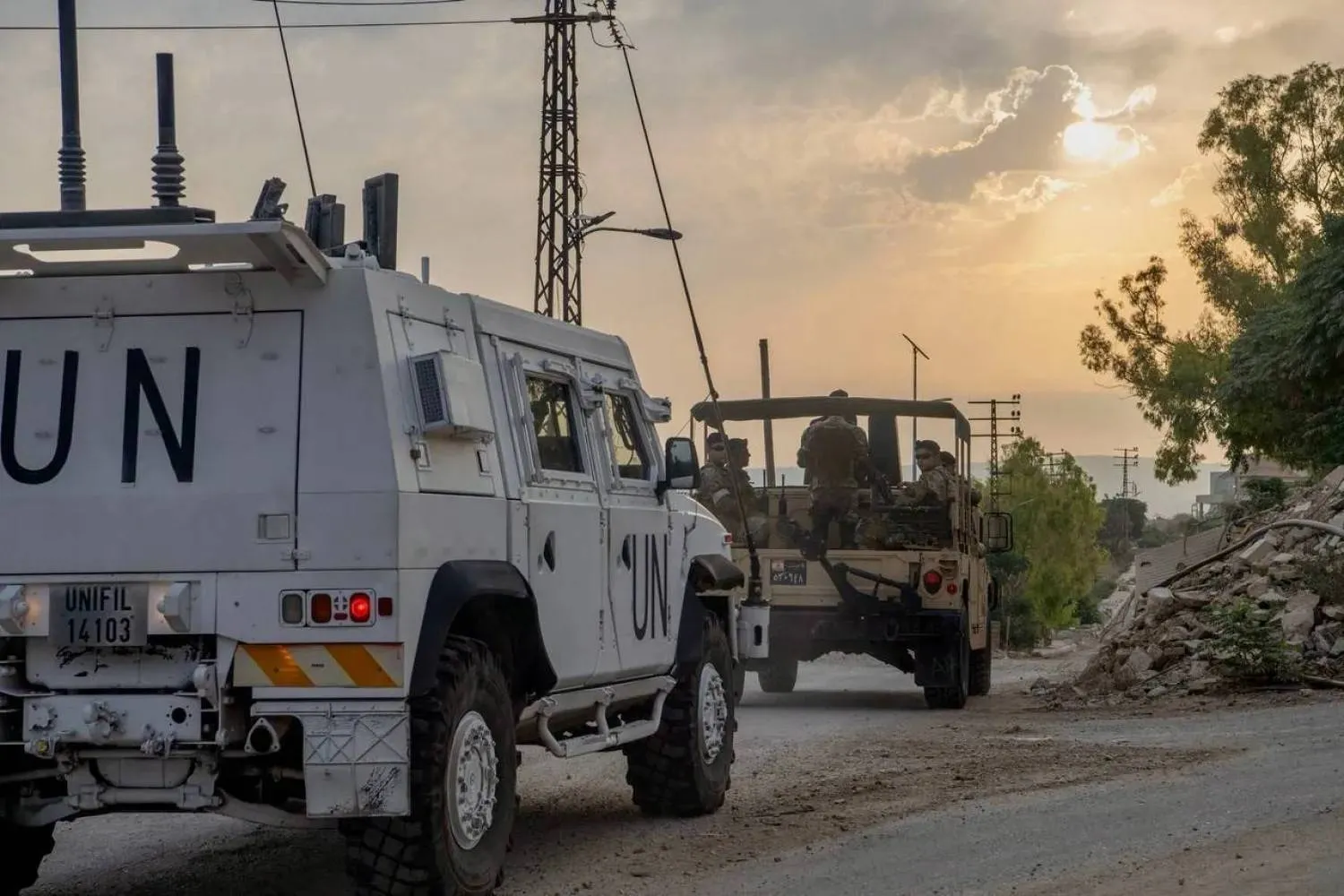
A UNIFIL military vehicle bearing the United Nations emblem moves ahead of a Lebanese army car during a joint patrol (UNIFIL)
TT

Karam Steers South Lebanon into New Phase as Mechanism Chief

A UNIFIL military vehicle bearing the United Nations emblem moves ahead of a Lebanese army car during a joint patrol (UNIFIL)

South Lebanon is bracing for a new political stage after President Joseph Aoun appointed former ambassador to the United States, attorney Simon Karam, to head Lebanon’s delegation to the committee overseeing the implementation of the cessation of hostilities, known as the Mechanism.

Karam joined the committee’s meeting in Naqoura on Wednesday alongside United States envoy Morgan Ortagus.

Ortagus will represent Washington in meetings held by the United Nations mission at the ambassadorial level for Security Council members in Beirut on Friday. She is scheduled to meet the three leaders, President Joseph Aoun, Parliament Speaker Nabih Berri, and Prime Minister Nawaf Salam, as well as Army Commander General Rodolphe Haykal, before travelling south the next day to meet the Mechanism and UNIFIL command.

Karam’s appointment followed a United States request to add a civilian to the Lebanese team amid escalating Israeli threats to expand the war at the end of this year in an attempt to enforce exclusive weapons control from north of the Litani to Lebanon’s border with Syria.

The expectation, according to Lebanese US contacts, is that such threats would recede under Washington’s guarantee, diffusing Israeli pressure in tandem with Karam’s designation.

Coordinated Step

Ministerial sources told Asharq Al-Awsat that Aoun’s decision to appoint Karam was coordinated with Prime Minister Nawaf Salam and Speaker Nabih Berri with authorization from the latter’s ally, Hezbollah.

They said Aoun withheld the announcement until he secured American guarantees preventing Israel from widening the war.

The sources added that Aoun informed Ortagus of Karam’s appointment before her trip to Tel Aviv to meet Prime Minister Benjamin Netanyahu and Defense Minister Israel Katz.

They said Aoun also contacted Washington directly to ensure its readiness to provide guarantees curbing Israeli actions and preventing any expansion of hostilities while keeping the current rules of engagement intact.

The sources said the significance of Karam’s appointment lies in the political cover Aoun secured for the mission, blocking populist criticism, particularly from Hezbollah.

This, they noted, was achieved through Aoun’s communication with the party in parallel with Berri’s efforts to rule out any imminent expansion of the war before the announcement.

They pointed as well to the historic visit of Pope Leo XIV to Lebanon, describing it as having softened positions, with the mass public receptions during the visit serving as a popular mandate by tens of thousands of Lebanese calling for peace and stability.

Opening to Restart Negotiations

According to the sources, Lebanon’s international and Arab partners were informed of Karam’s appointment in line with Beirut’s intention to engineer a breakthrough that could revive negotiations and push Israel, through United States mediation and Mechanism oversight, to halt hostilities.

Discussions are meant to proceed under the framework of paving the way for the implementation of Resolution 1701, contingent on the state’s full authority over its territory.

They added that Karam’s appointment effectively signaled to the incoming United Nations mission that Lebanon was responding to international demands for peaceful negotiations with Israel, consistent with exclusive weapons control.

United Nations Mission Arrives Saturday

The sources said the United Nations mission will arrive in Beirut on Thursday evening, coming from Damascus after meeting Syrian President Ahmed al-Sharaa and inspecting conditions in Syria.

They will travel to the south on Saturday to meet the Mechanism and UNIFIL command to review the army’s deployment in the liberated zone south of the Litani and the removal of Hezbollah’s military installations and infrastructure, and to discuss the post–UNIFIL mandate period after its scheduled end next year, including support for the army in implementing Resolution 1701.

They added that UNIFIL’s leadership would continue its mission through 2026 in line with Resolution 1701 despite funding shortages, but did not rule out a possible extension if United States-mediated Lebanese-Israeli negotiations make progress.

UNIFIL has already begun reducing its personnel and equipment and is preparing a new withdrawal phase.

Exclusive Weapons Control

The sources said that reactivating Mechanism meetings, if Israel responds to United States pressure to halt any expansion of the war, should help lower public fears in Lebanon despite continuing threats.

At the same time, Lebanon will be compelled to launch internal negotiations with Hezbollah, with Berri playing a constructive role, to draw up a timeline for completing exclusive weapons control from north of the Litani to the international border.

The first phase, ending this year, is considered on track according to Mechanism and UNIFIL assessments of the army’s deployment in the liberated area.

They said Lebanon has no objection to verifying Israeli claims that Hezbollah stores weapons in homes south of the Litani.

The problem, they argued, is that Israel has been bombing such homes instead of filing complaints to the Mechanism, which would refer them to the army and UNIFIL for verification under legal procedures.

Several Israeli strikes flattened homes south and north of the Litani that, according to the army, contained no Hezbollah weapons, prompting the army to submit detailed reports to the Mechanism.

Army Requirements and Filling UNIFIL’s Gap

A Western diplomatic source told Asharq Al-Awsat that the United Nations mission’s visit to the south is not limited to reviewing the situation on the ground or the army’s deployment amid Israel’s continued occupation of several frontline hills and its construction of two concrete walls that annexed about 4,500 square meters of Lebanese land.

The visit, the source said, is also meant to assess the army’s needs to fill the gap once UNIFIL withdraws.

The source asked whether an extension of UNIFIL’s mandate is possible in light of the mission’s ground assessment and the Security Council’s ability to reconsider ending its mission without full implementation of Resolution 1701, provided the United States refrains from vetoing such an extension.

UNIFIL remains, the source said, the only international witness for southerners on the resolution’s implementation unless the Mechanism’s mandate is expanded to allow Washington to directly oversee Lebanese Israeli negotiations should the resolution remain unimplemented.

Grace Period

The sources cautioned against prematurely drawing conclusions ahead of UNIFIL’s mandate expiry while Hezbollah appears to be buying time.

They said Karam’s appointment effectively extended Lebanon’s grace period, giving the government an opportunity to finalize the exclusive weapons framework and produce a timeline that would push Hezbollah to “Lebanonize” its stance and weapons in line with Lebanese rather than Iranian timing, as critics argue.

Failure to do so, they warned, could revive Israeli threats with American backing. Lebanon, they said, cannot afford to waste the opportunity granted to it, which should instead be used to secure the south and oblige Hezbollah to accept a phased handover of its weapons to the state.


Türkiye Calls Israel’s Recognition of Somaliland ‘Illegitimate’

This handout photograph taken and released by the Turkish presidential press service on December 30, 2025, shows Türkiye’s President Recep Tayyip Erdogan (R) and Somalia's President Hassan Sheikh Mohamud (L) shaking hands before their meeting in Istanbul. (Photo by Handout / Turkish Presidential Press Service / AFP)
TT

Türkiye Calls Israel’s Recognition of Somaliland ‘Illegitimate’

This handout photograph taken and released by the Turkish presidential press service on December 30, 2025, shows Türkiye’s President Recep Tayyip Erdogan (R) and Somalia's President Hassan Sheikh Mohamud (L) shaking hands before their meeting in Istanbul. (Photo by Handout / Turkish Presidential Press Service / AFP)

Türkiye’s president on Tuesday called Israel's recognition of Somaliland "illegitimate and unacceptable" as he hosted a visit by his Somali counterpart.

"Preserving the unity and integrity of Somalia in all circumstances holds special importance in our view. Israel's decision to recognize Somaliland is illegitimate and unacceptable," Turkish leader Recep Tayyip Erdogan said in a press conference alongside Somali President Hassan Sheikh Mohamud.

Israel sparked criticism last Friday when it said it was officially recognizing Somaliland -- a breakaway territory in Somalia's north.

The declaration was a first for the territory, which in 1991 had unilaterally declared secession from Somalia.

Israel's move has drawn widespread criticism from the African Union, Egypt and the European Union, which insist on war-torn Somalia's sovereignty.

Türkiye has frequently clashed with Israel over a range of issues, especially over the conflict in Gaza and Israeli obstruction of aid to the Palestinian territory.

Mohamud said Israeli Prime Minister Benjamin Netanyahu's "aggressive position, which also includes Somalia, is unacceptable".

He called Netanyahu's Somaliland declaration "a violation of international law" and "the start of insecurity and instability, especially for Somalia and the African region".


10 Countries Warn of ‘Catastrophic’ Gaza Situation

 Palestinians stand next to a tent set up on the rubble of buildings destroyed during Israeli air and ground operations in the Sheikh Radwan neighborhood, in Gaza City, Tuesday, Dec. 30, 2025. (AP)
Palestinians stand next to a tent set up on the rubble of buildings destroyed during Israeli air and ground operations in the Sheikh Radwan neighborhood, in Gaza City, Tuesday, Dec. 30, 2025. (AP)
TT

10 Countries Warn of ‘Catastrophic’ Gaza Situation

 Palestinians stand next to a tent set up on the rubble of buildings destroyed during Israeli air and ground operations in the Sheikh Radwan neighborhood, in Gaza City, Tuesday, Dec. 30, 2025. (AP)
Palestinians stand next to a tent set up on the rubble of buildings destroyed during Israeli air and ground operations in the Sheikh Radwan neighborhood, in Gaza City, Tuesday, Dec. 30, 2025. (AP)

The foreign ministers of 10 nations on Tuesday expressed "serious concerns" about a "renewed deterioration of the humanitarian situation" in Gaza, saying the situation was "catastrophic". 

"As winter draws in, civilians in Gaza are facing appalling conditions with heavy rainfall and temperatures dropping," the ministers of Britain, Canada, Denmark, Finland, France, Iceland, Japan, Norway, Sweden and Switzerland said in a joint statement released by the UK's Foreign Office. 

"1.3 million people still require urgent shelter support. More than half of health facilities are only partially functional and face shortages of essential medical equipment and supplies. The total collapse of sanitation infrastructure has left 740,000 people vulnerable to toxic flooding," the statement added. 

The ministers said they welcomed the progress that had been made to end the bloodshed in Gaza and secure the release of Israeli hostages. 

"However, we will not lose focus on the plight of civilians in Gaza," they said, calling on the government of Israel to take a string of "urgent and essential" steps. 

These included ensuring that international NGOs could operate in Gaza in a "sustained and predictable" way. 

"As 31 December approaches, many established international NGO partners are at risk of being de-registered because of the government of Israel's restrictive new requirements," the statement said. 

It also called for the UN and its partners to be able to continue their work in Gaza and for the lifting of "unreasonable restricts on imports considered to have a dual use". 

This included medical and shelter equipment. 

The foreign ministers also called for the opening of crossings to boost the flows of humanitarian aid into Gaza. 

While welcoming the partial opening of the Allenby crossing, they said other corridors for moving goods remained closed or severely restricted for humanitarian aid, including Rafah. 

"Bureaucratic customs processes and extensive screenings are causing delays, while commercial cargo is being allowed in more freely," the statement said. 

"The target of 4,200 trucks per week, including an allocation of 250 UN trucks per day, should be a floor not a ceiling. These targets should be lifted so we can be sure the vital supplies are getting in at the vast scale needed," it added. 


UN Condemns Israel's Moves against Agency for Palestinian Refugees

UNRWA center targeted by Israeli shelling in northern Gaza (DPA)
TT

UN Condemns Israel's Moves against Agency for Palestinian Refugees

UNRWA center targeted by Israeli shelling in northern Gaza (DPA)

The United Nations warned Tuesday that recent actions by Israel against the UN agency for Palestinian refugees risked depriving millions of people of basic services such as education and healthcare.

Israel's parliament passed new legislation on Monday formally stripping the United Nations Relief and Works Agency (UNRWA) of diplomatic immunity, and barring Israeli companies from providing water or electricity to the agency's institutions, AFP reported.

According to UNRWA, the legislation also grants the Israeli government the authority to expropriate the agency's properties in East Jerusalem, including its headquarters and main vocational training center.

UNRWA chief Philippe Lazzarini condemned the legislation as "outrageous", decrying it on social media as "part of an ongoing, systematic campaign to discredit UNRWA and thereby obstruct the core role that the agency plays providing human-development assistance and services to Palestine refugees".

Filippo Grandi, the outgoing head of the UN refugee agency, UNHCR, and a former UNRWA chief, also criticised the move as "very unfortunate".

In an interview with AFP, he highlighted that UNRWA, unlike other UN agencies, provides basic public services such as education and healthcare to the millions of registered Palestinian refugees it serves across Gaza and the West Bank, as well as in Lebanon, Jordan and Syria.

"If you deprive those people of those services... then you had better find a substitute," he said, warning: "I think it would be very difficult."

"At the moment, there is a great risk that millions of people will be deprived of basic services if UNRWA is further deprived of space to work, and resources to work."

Israel has been ratcheting up pressure on UNRWA over the past two years.

It has accused the agency of providing cover for Hamas militants, claiming that some UNRWA employees took part in the militant group's October 7, 2023 assault on Israel, which sparked the war in Gaza.

A series of UN-linked internal and external investigations found some "neutrality-related issues" at UNRWA, but stressed Israel had not provided conclusive evidence for its headline allegation.

Grandi criticised the torrent of accusations that have swirled around the agency.

"UNRWA is a very indispensable organization in the Middle East," he said.

"Contrary to much of the frankly baseless rhetoric that we have heard in the past couple of years, UNRWA is a force for peace and stability," he added.

"In a region in which you need every bit of stability and efforts towards peace, it would be really irresponsible to let such an important organization decline further."