


Le Drian Holds Talks in Lebanon to Consolidate Ceasefire with Israel

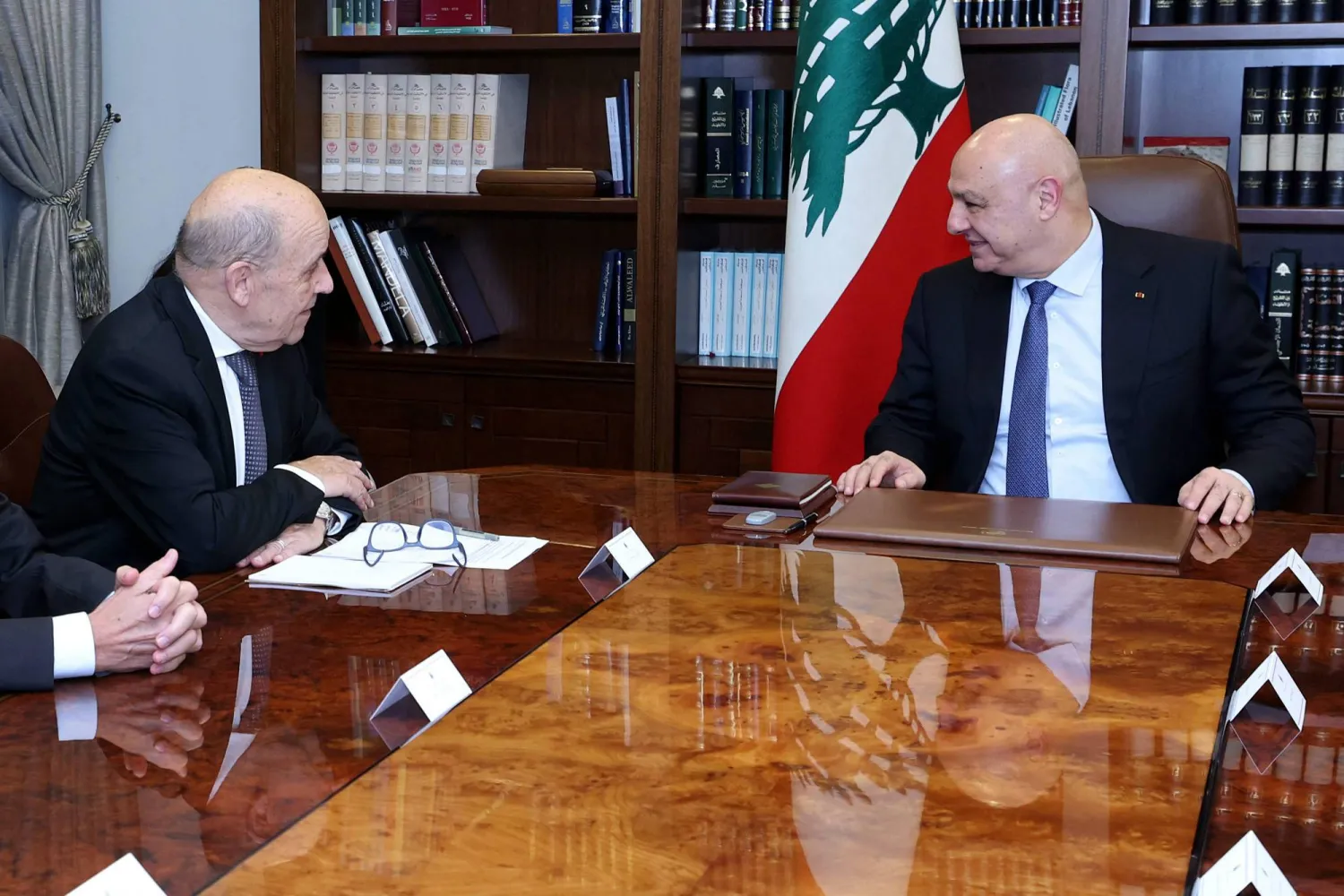
A photograph released by the Lebanese Presidency Press Office on December 8, 2025, shows Lebanese President Joseph Aoun (R) meeting with French Envoy Jean-Yves Le Drian (L) at the Presidential Palace in Baabda, east of Beirut. (Lebanese Presidency)
TT

Le Drian Holds Talks in Lebanon to Consolidate Ceasefire with Israel

A photograph released by the Lebanese Presidency Press Office on December 8, 2025, shows Lebanese President Joseph Aoun (R) meeting with French Envoy Jean-Yves Le Drian (L) at the Presidential Palace in Baabda, east of Beirut. (Lebanese Presidency)

French presidential envoy Jean-Yves Le Drian continued his meetings with Lebanese officials on Tuesday over consolidating the ceasefire between Israel and Hezbollah.

Le Drian held talks on Monday with President Joseph Aoun and parliament Speaker Nabih Berri, Prime Minister Nawaf Salam, Foreign Minister Youssef Rajji, Army Commander Rodolphe Haykal and former Progressive Socialist Party leader Walid Jumblatt and his son MP Taymur Jumblatt on Tuesday.

Aoun told Le Drian that Lebanon welcomes any role France can play within the Mechanism committee overseeing the ceasefire, rejecting accusations that the Lebanese army was not doing enough to meet its end of the agreement.

The committee aims to end the hostilities, ensure Israel’s withdrawal from regions it is occupying in southern Lebanon and release Lebanese detainees held by Israel.

A Lebanese presidency statement said Aoun welcomed French President Emmanuel’s constant support for Lebanon, stressing that they reflect the depth of Lebanese-French ties.

Aoun revealed to Le Drian that the Mechanism will meet again on December 19.

“Our desire to activate the Mechanism meetings reflects our willingness to negotiate to reach diplomatic solutions because we never want to adopt war rhetoric,” Aoun added.

Lebanese and Israeli civilian representatives held their first direct talks in decades last week under the auspices of a year-old ceasefire monitoring mechanism.

The two sides met at the UN peacekeeping force's headquarters in Lebanon's Naqoura near the border with Israel, where the guarantors of the November 2024 ceasefire between Israel and Hezbollah regularly convene.

Former Lebanese ambassador to the US Simon Karam and Israeli National Security Council official Uri Resnick were included as civilian representatives in the ceasefire mechanism for the first time.

Aoun told Le Drian that “the positive stances from fraternal and friendly states that followed last week’s meeting reflect their support for this step and will inevitably ease the pressure” that Lebanon was under.

He reiterated his rejection of criticism that the army was not doing enough to enforce the ceasefire agreement.

He instead accused Israel of continuing its attacks against Lebanon in violation of the ceasefire. He said it has destroyed homes and properties, preventing the army, United Nations Interim Force in Lebanon (UNIFIL) and Mechanism from completing their duties.

He stressed that the army and UNIFIL were acting in complete coordination, while urging the need to provide the military with the necessary equipment to allow it to fulfill its mission in full.

The mission, he remarked, is not limited to regions south of the Litani River, but includes all of Lebanon.

Le Drian, for his part, conveyed to Aoun Macron’s support for Karam’s appointment to the Lebanon’s negotiating team, adding that Paris “will always stand by Beirut’s national choices.”

Talks between Berri and the envoy, which lasted over an hour, tackled the situation in Lebanon and the region, especially Israel’s ongoing violations of the ceasefire.

Paris is set to hold next week a meeting between France, the United States and Saudi Arabia in preparation for a conference aimed at backing the Lebanese army and support a roadmap for a long-term ceasefire.


Strikes in Gaza Kill 4, Including 2 Children, a Week After US Asked Israel to Curb Attacks

A Palestinian inspects the old Abu Salim mosque a day after it was hit by an Israeli airstrike in Deir al-Balah in the central Gaza Strip on August 25, 2026. (AFP)
TT

Strikes in Gaza Kill 4, Including 2 Children, a Week After US Asked Israel to Curb Attacks

A Palestinian inspects the old Abu Salim mosque a day after it was hit by an Israeli airstrike in Deir al-Balah in the central Gaza Strip on August 25, 2026. (AFP)

Palestinian residents of war-battered Gaza fled homes and businesses as Israeli strikes and tank fire killed at least four people Monday, including two children, hospital officials said, a week after a US delegation asked Israel to draw down attacks.

After evacuation warnings by Israel's military, a strike hit a building in the Bureij refugee camp in central Gaza. One family was unable to flee and a 4-year-old child was killed, according to Awda Hospital, where he was taken. His mother and sister were wounded. There was no Israeli military comment.

Israeli strikes hit three other buildings across the territory after residents said they received evacuation warnings. Some people sprinted away, with mothers carrying children, while others moved amid the rubble in wheelchairs or with canes.

Smoke rose over the already devastated landscape.

Israel's military said it carried out strikes in the Shati refugee camp in Gaza City and in Deir al-Balah after issuing warnings, targeting what it described as two Hamas weapons storage facilities inside mosques. The military did not provide evidence but said the facilities contained dozens of “Kalashnikov rifles, magazines and additional military equipment.”

An earlier Israeli strike on a tent in Deir al-Balah killed a man, according to Al-Aqsa Hospital, where his body was taken. Israel’s military said it killed a militant affiliated with Hamas’ special forces unit.

A man was killed and five others were wounded in an Israeli strike in Khan Younis in southern Gaza, according to Nasser Hospital, which received the casualties.

And Israeli tank fire hit an area east of Khan Younis, killing a 10-year-old girl, according to the hospital, where her body was taken.

Israel's military did not immediately comment on the strike in Khan Younis and said it was not aware of the incident with the child.

Israel has continued to carry out targeted killings in the week since a US delegation met with Prime Minister Benjamin Netanyahu in an effort to push last year's ceasefire deal forward.

US negotiator Jared Kushner asked Netanyahu to draw down Israel’s attacks in Gaza, a person familiar with the meeting said last week, speaking on condition of anonymity because they weren’t authorized to brief journalists.

Israel has announced strikes on six of the seven days since that meeting.

While the heaviest fighting in Gaza has subsided since the ceasefire took hold in October, Israeli airstrikes have killed at least 1,288 Palestinians, according to Gaza's health ministry. The ministry, part of the Hamas-led government, maintains detailed casualty records that are seen as generally reliable by UN agencies and independent experts. It does not give a breakdown of civilians and fighters.

Gunmen have carried out shooting attacks on Israeli troops, and Israel says its strikes are in response to that and other ceasefire violations. Five Israeli soldiers have been killed since the ceasefire.

Palestinian officials have reported strikes on homes and police stations, and Hamas has claimed that attacks are designed to destabilize Gaza and prevent progress on the ceasefire's next steps, which include demilitarizing and reconstructing the territory and the deployment of an international stabilization force.

Israel warns against kites sent from Gaza

In the period before the Hamas-led Oct. 7, 2023, attack on southern Israel that sparked the war, burning kites and balloons were sent from Gaza into Israel, causing fires and other damage.

Now Israeli officials are expressing concern after several kites were found in a kibbutz near Gaza. No weapons or dangerous materials were attached.

Netanyahu and Defense Minister Israel Katz in a statement Sunday threatened to ramp up strikes on Gaza unless Hamas ensures the kites stop flying toward Israel.

Hamas spokesperson Hazem Qassem has called the kites “essentially children’s toys” and accused Israel of using them as “an attempt to justify the continuation of aggression and violations against our people.”

The Oct. 7 attack killed some 1,200 people and saw 251 taken hostage. All hostages or their remains were later released. Israel’s retaliatory offensive in Gaza has killed more than 73,422 Palestinians, according to Gaza’s health ministry.


Al-Zaidi: Iraq Will Not Become a Platform to Harm Others

Iraqi Prime Minister Ali al-Zaidi delivers his speech at the event in Baghdad. (INA)
TT

Al-Zaidi: Iraq Will Not Become a Platform to Harm Others

Iraqi Prime Minister Ali al-Zaidi delivers his speech at the event in Baghdad. (INA)

Iraqi Prime Minister Ali al-Zaidi stressed on Monday that his government is forging ahead in building a “free” and “sovereign” Iraq, adding that international coalition forces will complete their withdrawal on September 30.

“Since assuming responsibility for the government, we have pledged to move toward building a fully sovereign Iraq in which the people enjoy all the foundations of respect, dignity and security, and whose citizens cooperate in protecting the country and safeguarding its wealth and the future of its generations,” he said during a speech at an event in Baghdad marking the Prophet Muhammed’s birthday.

Iraq will declare the completion of its sovereignty over its entire territory on September 30, he announced, reported Iraq’s state news agency INA.

Moreover, he said: “Iraq should not be a platform for harming others.”

“Our region has lived for decades amid ongoing tensions that have led to divisions in the approaches and governing visions of the countries of the Arab and Islamic world,” remarked al-Zaidi.

“Our government program included a clear approach to construction and reform, combating corruption and strengthening a productive working environment, alongside building security institutions operating under the framework of the Constitution.”

Earlier, al-Zaidi received in Baghdad Commander of German Forces Deployed Abroad Gunter Schneider.

The PM highlighted “the importance of transitioning toward multidimensional relations with the coalition countries.”

The meeting reviewed preparations for completing the withdrawal of coalition forces from Iraq.

Al-Zaidi commended Germany’s longstanding role in assisting Iraq in its fight against terrorism, particularly during the war on ISIS.


Sharaa Says Syria 'Shakes Off Dark Stain' with Removal from US Terror List

FILE PHOTO: US President Donald Trump shakes hands with Syrian President Ahmed al-Sharaa during a bilateral meeting alongside the NATO leaders summit at the Bestepe Presidential Compound in Ankara, Türkiye, July 8, 2026. REUTERS/Jonathan Ernst/File Photo
TT

Sharaa Says Syria 'Shakes Off Dark Stain' with Removal from US Terror List

FILE PHOTO: US President Donald Trump shakes hands with Syrian President Ahmed al-Sharaa during a bilateral meeting alongside the NATO leaders summit at the Bestepe Presidential Compound in Ankara, Türkiye, July 8, 2026. REUTERS/Jonathan Ernst/File Photo

Syrian President Ahmed al-Sharaa hailed early on Tuesday the United States' removal of his country from the state sponsors of terror list, a major sanctions relief step.

"Today, Syria shakes off a dark stain and tears away a painful chapter of its past to embark on a path of development, reconstruction and rebuilding," Sharaa said in a speech.

Washington's decision on Monday rescinded a decades-old designation that came with severe economic restrictions, marking another step in warming ties between the countries following the 2024 ouster of Bashar al-Assad.

The Treasury Department announced corresponding sanctions relief.

Sharaa expressed his "many thanks to the President of the United States of America, Donald Trump, and to all the friendly and supportive nations that stood by us.”

The US Department of State also revoked its designation of the al-Nusra Front -- latterly known as Hay'at Tahrir al-Sham (HTS) -- as a global terrorist organization.

The United States had initially announced in July its intent to delist Syria as a state sponsor of terrorism, a move seen as a vote of confidence in Sharaa.

Monday's move gave Syria's "a path to prosperity,” according to US Secretary of State Marco Rubio.

The action "eliminates the final major barriers for private sector investment in Syria and promotes Syria's economic recovery and reintegration into the global economy," he said in a statement.

Syrian Foreign Minister Assad al-Shaibani described Washington's delisting as a "historic milestone" and said it reflected "the new Syrian state's commitment to international peace and security.”

Finance Minister Mohammed Barnieh described the move as a "success for Syrian diplomacy," according to the official news agency SANA.

It "opens a major and long-awaited door to strengthening Syria's integration into the global economic and financial system, attracting investment and modern technologies, and supporting development opportunities.”
