


Washington’s Opening Toward Damascus Clashes with Israel’s Ground Strategy

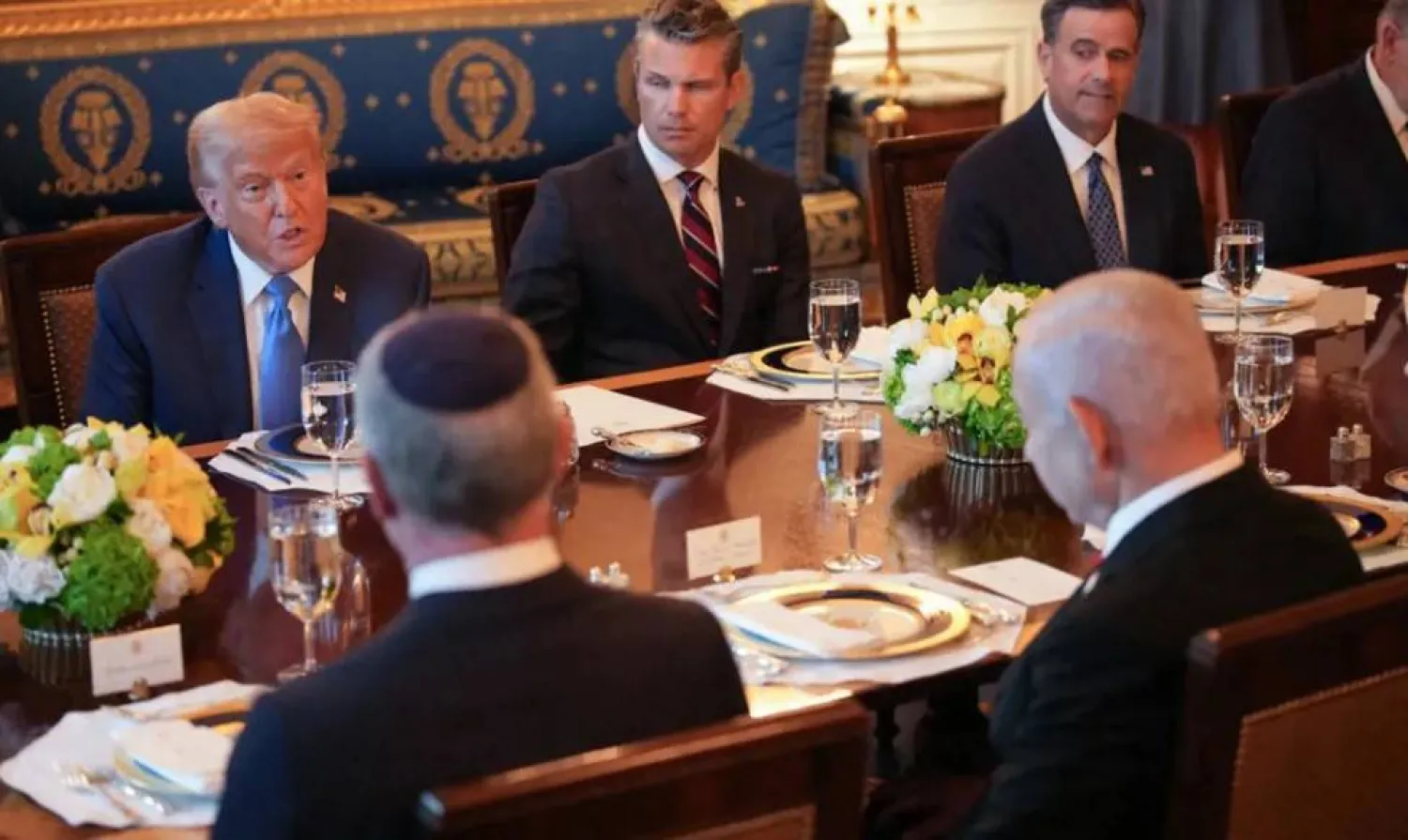
A meeting between Trump and Netanyahu at the White House, July 2025 (AFP). 
TT

Washington’s Opening Toward Damascus Clashes with Israel’s Ground Strategy

A meeting between Trump and Netanyahu at the White House, July 2025 (AFP). 

Washington’s recent openness toward Damascus is increasingly colliding with Israel’s assertive on-the-ground approach, highlighting a widening rift between the two traditional allies over the future of Syria following the fall of Bashar al-Assad’s regime.

The United States now appears to be pushing for expanded security cooperation with the new Syrian government led by President Ahmed al-Sharaa, aiming to confront shared security threats and stabilize the country.

At a conference convened to assess the new phase in Syria, Admiral Brad Cooper, commander of US Central Command (CENTCOM), placed future cooperation with Damascus at the center of discussions about US policy toward “post-Assad Syria.”

Cooper stressed that Washington is working “increasingly” with the Syrian army to counter common security threats, asserting that integrating the Syrian Democratic Forces (SDF) into the national army would enhance internal stability, improve border control, and strengthen Syria’s ability to pursue Daesh.

Cooper added that since last October, US forces have provided advice, assistance, and enablement to Syrian authorities in more than twenty operations against Daesh and in thwarting weapons shipments bound for Hezbollah, noting that such gains are only possible through close coordination with Syrian government forces.

This American trajectory, however, now overlaps with an expanding disagreement between Washington and Tel Aviv over the contours of a “new Syria,” according to the Wall Street Journal. The paper reported an unusually sharp divergence between the two allies over Syria’s future one year after Assad’s fall, as President Donald Trump pushes a more open approach toward Damascus with Saudi and Turkish backing.

Trump has lifted sanctions on al-Sharaa, praising him as a “young, attractive, tough guy" with a “real shot at doing a good job", which signaled Washington’s readiness for a major policy shift.

In contrast, Israel quickly moved after the regime’s collapse to establish a military presence in southern Syria, taking control of an estimated 250 square kilometers.

The area became a launchpad for an expanded Israeli security posture that has included arrests, weapons seizures, airstrikes deep inside Syrian territory, and even a strike on the military command headquarters in Damascus, actions justified as protection of the Druze community.

The WSJ attributes this assertive field strategy to a shift in Israel’s security mindset after the Oct. 7, 2023 attacks, noting that Israeli decision-makers now believe any security concession could open a dangerous breach.

Former Israeli national security adviser Yaakov Amidror remarked that making decisions from Washington is far easier than making them from the Golan Heights, reflecting Israel’s preference to secure its interests unilaterally.

While the US administration works to broker security negotiations between Damascus and Tel Aviv - parallel to de-escalation efforts in Gaza and Ukraine - Trump is urging Israel to engage in a “strong, honest dialogue” with Syria. Yet these efforts face obstacles, chief among them al-Sharaa’s rejection of Israel’s proposal for a demilitarized zone stretching from southern Damascus to the border, which he argues would create a dangerous security vacuum.

Within Israel, influential voices warn against overreliance on force, fearing conflict with Washington’s desire to rehabilitate the new Syrian state and potentially integrate it into the Abraham Accords framework.

Some Israeli experts propose allowing Syrian army deployment near the border while banning heavy weapons and Turkish forces, shifting from displaying military power to building diplomatic power. Diplomats predict any future agreement may resemble the 1974 disengagement framework, albeit updated for current realities.

The Wall Street Journal concluded that the US–Israeli dispute over Syria is no passing episode but a test of the resilience of their longstanding alliance amid a reshaped regional landscape.

“The new Syria” has become an open arena for redefining Middle Eastern power balances, as Washington attempts to merge counterterrorism efforts with rebuilding the Syrian state and crafting a new security formula between Damascus and Tel Aviv.




Lebanese Foreign Minister Declines Invitation to Tehran, Proposes Meeting in Neutral Country

Lebanese Foreign Minister Youssef Raji receives his Iranian counterpart Abbas Araghchi in Beirut in June 2025 (File – IRNA)
TT

Lebanese Foreign Minister Declines Invitation to Tehran, Proposes Meeting in Neutral Country

Lebanese Foreign Minister Youssef Raji receives his Iranian counterpart Abbas Araghchi in Beirut in June 2025 (File – IRNA)

Lebanese Foreign Minister Youssef Raji has declined an invitation from his Iranian counterpart Abbas Araghchi to visit Tehran, proposing instead that the two meet in a mutually agreed-upon neutral country.

In a post on X on Wednesday, Raji said he was “unable to accept” the invitation at this time, citing unspecified “current circumstances.”

He stressed that his reply “does not mean rejecting dialogue,” rather “the proper atmosphere is not appropriate.”

He added that any renewed engagement with Iran must rest on clear principles, including respect for Lebanon’s sovereignty, non-interference in its internal affairs, and adherence to international norms governing state-to-state relations.

Araghchi had recently invited Raji to Tehran for talks on bilateral relations.

Official Lebanese sources told Asharq Al-Awsat that the invitation was sent personally to the minister, not to the Lebanese state, and that Raji’s response “expresses his own position.”

Lebanon and Iran continue diplomatic engagement despite Beirut’s repeated warnings - conveyed directly to visiting Iranian officials - that Lebanon rejects any foreign meddling in its internal affairs.

Tensions between Raji and Tehran were visible during the August visit of Ali Larijani, secretary-general of Iran’s Supreme National Security Council.

Larijani said he lacked the time to meet Raji; the minister replied: “Even if I had the time, I would not have met him.”

Former Lebanese foreign minister Fares Boueiz said Raji’s latest stance is a clear diplomatic message that relations between Beirut and Tehran are “incomplete.”

When differences arise, Boueiz noted, first meetings are often held in a third country to establish a framework for resolving disputes.

Boueiz added that a foreign minister rarely deviates from the official position of the state. He argued that Raji’s move reflects the views of President Joseph Aoun and Prime Minister Nawaf Salam, and implicitly signal that Iran should halt its support for a particular Lebanese faction and stop its interference.

Lebanon has repeatedly accused Iran of meddling in its internal affairs. During his meeting with Larijani in August, Aoun reiterated that no group in Lebanon may carry weapons or rely on external backing.

While open to cooperation with Iran, Lebanon insists such engagement remains within the limits of sovereignty and mutual respect.

Boueiz recalled that Lebanese-Iranian diplomatic relations stabilized after 1990, when he restored protocol-based engagement in line with the Vienna Convention. During the civil war, Iranian delegations routinely entered Lebanon via Syria without coordinating with the Lebanese government and met directly with Hezbollah.

After Boueiz confronted Tehran’s ambassador in 1990, then-foreign minister Ali Akbar Velayati agreed to normalize diplomatic procedures, leading to formal exchanges and signed agreements.

Some Lebanese observers view Raji’s stance as evidence of diminishing Iranian influence in Lebanon, long bolstered by Tehran’s support for Hezbollah.

Boueiz, however, argues that Iran’s role is closely tied to its evolving relationship with Washington. US-Iran dynamics, including ongoing discussions over sanctions relief and frozen assets, inevitably ripple into Lebanon: “Whenever US-Iran negotiations worsen, tensions rise in Lebanon; when talks calm down, Lebanon feels the relief.”


UN Condemns Houthi Referral of UN Staff to Court

Houthi gunmen display their strength during a gathering north of Sanaa (AFP).  
TT

UN Condemns Houthi Referral of UN Staff to Court

Houthi gunmen display their strength during a gathering north of Sanaa (AFP).  

The United Nations on Tuesday condemned a referral by Yemen's Houthis of some of the dozens of UN staff they have detained to a special criminal court.

The condemnations came while officials in the Yemeni government stressed the need to strengthen military coordination to face the Iran-backed group, enhance the presence of state institutions and improve the operational environment for humanitarian organizations.

UN Secretary-General Antonio Guterres said the Houthis have arbitrarily detained 59 Yemeni UN personnel, who have been held “incommunicado - some for years - without any due process, in violation of international law,” according to his spokesperson Stephane Dujarric.

He said, “United Nations personnel, including those who are nationals of Yemen, are immune from legal process in respect of all acts performed by them in their official capacity.”

The United Nations has repeatedly rejected Houthi accusations that UN staff or UN operations in Yemen were involved in spying.

“We call on the de facto authorities to rescind the referral and work in good faith toward the immediate release of all detained personnel,” Dujarric said.

“The United Nations remains committed to supporting the people of Yemen and delivering principled humanitarian assistance.”

Meanwhile, the Yemeni Social Affairs Ministry welcomed the decision of UN children’s agency UNICEF to relocate its main headquarters from Sanaa to the temporary Yemeni capital, Aden.

In a statement, the ministry said the move comes in response to its repeated calls for the relocating of UN headquarters from the Houthi-controlled capital, Sanaa, to maintain the safety of their staff.

“The Yemeni government, represented by Social Affairs Minister, Mohammed Al-Zaouri, will provide all forms of support and facilities to enable UNICEF perform its tasks more effectively from its new headquarters.”

Strengthen Military Efforts

In Aden, member of the Presidential Leadership Council (PLC) Abdul-Rahman al-Mahrami held a meeting Tuesday with Defense Minister Gen. Mohsen Mohammed al-Daeri to discuss “the latest military conditions on various fronts, the level of combat readiness, the discipline of military units, as well as the ministry's efforts in the fields of training, rehabilitation and raising defense capabilities,” according to state-run news agency, SABA.

While Al-Daeri said Yemen’s armed forces “act in complete harmony in the face of Houthis,” al-Mahrami stressed the “need to strengthen coordination between military axes, and mobilize forces to face a common enemy (Houthis) and protect liberated areas.”

Meanwhile in Mareb, member of the Presidential Leadership Council Lieutenant General Sultan Al-Arada chaired a meeting with senior security officials, and stressed that a robust national security apparatus is crucial for the country's recovery.

“The recovery of state institutions from the Iran-backed Houthi militias is today an irreplaceable national priority,” he said.

The General also underscored the Presidential Leadership Council's commitment to supporting the armed forces and security agencies, enhancing their capabilities, and raising a culture of accountability and transparency.


Trump Says He Plans to Name Gaza Board of Peace Early Next Year

US President Donald Trump speaks during a roundtable discussion in the Roosevelt Room of the White House in Washington, DC, on December 10, 2025. (Photo by ANDREW CABALLERO-REYNOLDS / AFP)
TT

Trump Says He Plans to Name Gaza Board of Peace Early Next Year

US President Donald Trump speaks during a roundtable discussion in the Roosevelt Room of the White House in Washington, DC, on December 10, 2025. (Photo by ANDREW CABALLERO-REYNOLDS / AFP)

US President Donald Trump said on Wednesday that an announcement about which world leaders will serve on the Gaza Board of Peace should be made early next year.

Trump told reporters during an economic event in the White House Roosevelt Room that a variety of leaders want to be on the board, which was established under a Gaza plan that set up a fragile ceasefire between Israel and Hamas group, reported Reuters.
