


A Winter Storm Chills Gaza and Floods Tent Camps, Exposing Aid Failures

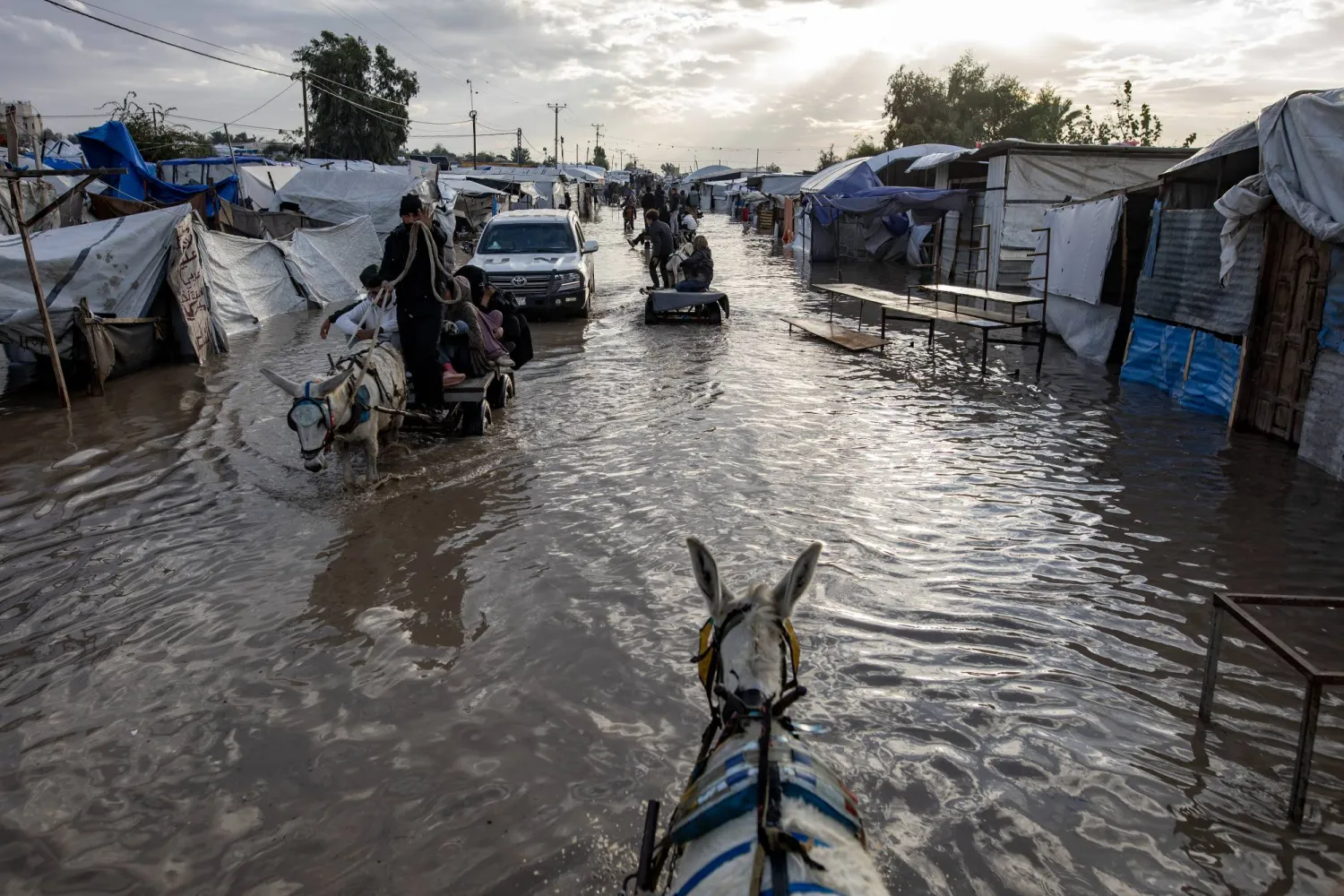
Displaced Palestinians make their way on animal-drawn carts through a flooded street following heavy rainfall in Khan Younis in southern Gaza, 11 December 2025. EPA/HAITHAM IMAD
TT

A Winter Storm Chills Gaza and Floods Tent Camps, Exposing Aid Failures

Displaced Palestinians make their way on animal-drawn carts through a flooded street following heavy rainfall in Khan Younis in southern Gaza, 11 December 2025. EPA/HAITHAM IMAD

Rains drenched Gaza’s tent camps and dropping temperatures chilled Palestinians huddling inside them Thursday as winter storm Byron descended on the war-battered territory, showing how two months of a ceasefire have failed to sufficiently address the spiraling humanitarian crisis there.

Families found their possessions and food supplies soaked inside their tents. Children’s sandaled feet disappeared under opaque brown water that flooded the camps, running knee deep in some places. Dirt roads turned to mud. Piles of garbage and sewage cascaded like waterfalls, reported The Associated Press.

“We have been drowned. I don’t have clothes to wear and we have no mattresses left,” said Um Salman Abu Qenas, a displaced mother in a Khan Younis tent camp. She said that her family couldn't sleep the night before, because of the water in the tent.

Aid groups say not enough shelter materials are getting into Gaza during the truce. Figures recently released by Israel's military suggest it hasn't met the ceasefire stipulation of allowing 600 trucks of aid into Gaza a day, though Israel disputes that finding.

“Cold, overcrowded, and unsanitary environments heighten the risk of illness and infection,” the UN agency for Palestinian refugees, UNRWA, said on X. “This suffering could be prevented by unhindered humanitarian aid, including medical support and proper shelter."

Rains wreak havoc

Sabreen Qudeeh, also in the Khan Younis camp, in a squalid area known as Muwasi, said that her family woke up to rain leaking from their tent's ceiling and water from the street soaking their mattresses.

“My little daughters were screaming,” she said.

Ahmad Abu Taha, also living in the camp, said there wasn't a tent that escaped the flooding. “Conditions are very bad, we have old people, displaced, and sick people inside this camp,” he said.

Floods in south-central Israel trapped more than a dozen people in their cars, according to Hebrew media. Israel's rescue services, MDA, said that two young girls were slightly injured when a tree fell on their school.

The contrasting scenes with Gaza made clear how profoundly the Israel-Hamas war had damaged the territory, destroying the majority of homes. Gaza’s population of around 2 million is almost entirely displaced, and most people live in vast tent camps stretching along the coast, or set up among the shells of damaged buildings without adequate flooding infrastructure and with cesspits dug near tents as toilets.

At least three buildings in Gaza City already damaged by Israeli bombardment during the war partially collapsed under the rain, Palestinian Civil Defense said. It warned people not to stay inside damaged buildings, saying they too could fall down on top of them.

The agency also said that since the storm began, they have received more than 2,500 distress calls from people across Gaza whose tents and shelters were damaged.

With buckets and mops, Palestinians laboriously scooped water out of their tents.

Aliaa Bahtiti said her 8-year-old son "was soaked overnight, and in the morning he had turned blue, sleeping on water.” Her tent floor had an inch of water on it “We cannot buy food, covers, towels, or sheets to sleep on.”

Baraka Bhar was caring for her 3-month-old twins inside her tent as the rain poured outside. One of the twins has hydrocephalus, a build-up of fluids in the brain.

“Our tents are worn out ... and they leak rain water,” she said. “We should not lose our children this winter.”

Not enough aid

Aid groups say that Israel isn't allowing enough aid into Gaza to begin rebuilding the territory after years of war.

Under the agreement, Israel agreed to comply with aid stipulations from an earlier January truce, which specified that it allow 600 trucks of aid each day into Gaza, It maintains it's doing so, but The Associated Press found that some of its own figures call that into question.

The January truce also specified that Israel let in a number of caravans and tents. No caravans have yet entered Gaza during the ceasefire, said Tania Hary, executive director of Gisha, an Israeli group advocating for Palestinians’ right to freedom of movement.

The Israeli military body in charge of coordinating aid to Gaza, called COGAT, said on Dec. 9 it had “lately" let 260,000 tents and tarpaulins into Gaza and more than 1,500 trucks of blankets and warm clothing.

Shelter Cluster, an international coalition of aid providers led by the Norwegian Refugee Council, sets the number lower. It says the UN and international nongovernmental organizations have gotten 15,590 tents into Gaza since the truce began, and other countries have sent about 48,000. Many of the tents aren't properly insulated, it says.

Amjad al-Shawa, Gaza chief of the Palestinian NGO Network, told Al Jazeera on Thursday that only a fraction of the 300,000 tents needed had entered Gaza. He said that Palestinians were in dire need of warmer winter clothes and accused Israel of blocking the entry of water pumps to help clear flooded shelters.

"All international sides should take the responsibility regarding conditions in Gaza,” he said. “There is real danger for people in Gaza at all levels.”

Khaled Mashaal, a Hamas leader, said in an interview with Al Jazeera that Gaza needs the rehabilitation of hospitals, the entry of heavy machinery to remove rubble, and the opening of the Rafah crossing — which remains closed after Israel said last week it would shortly open.

COGAT didn’t immediately respond to a request for comment on the claims that Israel wasn’t allowing water pumps or heavy machinery into Gaza.

Amnesty accuses Hamas of crimes against humanity

Amnesty International said in a report released Thursday that Hamas and other militant groups committed crimes against humanity in the Oct. 7, 2023 attack on southern Israel that triggered the war in Gaza.

In the 173-page report, Amnesty pointed to what it found to be widespread and systematic killing of civilians in the attack, as well as torture, hostage-taking and sexual abuse.

In the attack, Hamas fighters and other militants rampaged through southern Israel, killing some 1,200 people and taking around 250 others hostage. Israel's campaign in Gaza has since killed more than 70,300 Palestinians, roughly half of them women and children, according to the territory’s Health Ministry, which does not distinguish between militants and civilians in its count. Last year, Amnesty accused Israel of committing genocide in Gaza, a charge Israel denied.

Amnesty said it conducted interviews with 70 people, including 17 survivors of the attack and family members of some of those killed. It also reviewed hundreds of open-source videos and photos from the day of the attack.

Contrary to Hamas claims it was targeting the military, it said, the attack was intentionally “directed against a civilian population” and met international law standards for crimes against humanity.

It said sexual assaults were also committed, though it said it could not reach a conclusion on their “scope or scale.” It interviewed one man who testified he was raped by armed men at the Nova music festival, as well as a therapist who said she provided intensive treatment to three other survivors of rape.

Hamas condemned the report, saying it “echoed false claims” by Israel.

Israeli Foreign Minister spokesperson Oren Marmorstein derided the report in a posting on X, saying it took more than two years for Amnesty to address the attack “and even now its report falls far short of reflecting the full scope of Hamas’s horrific atrocities.”
Series of Israeli Strikes Hit Lebanon

A convoy of Lebanese army vehicles drives near the border with Israel in the village of Alma al-Shaab during a Lebanese army media tour in south Lebanon, Friday, Nov. 28, 2025. (AP Photo/Bilal Hussein)
TT

Series of Israeli Strikes Hit Lebanon

A convoy of Lebanese army vehicles drives near the border with Israel in the village of Alma al-Shaab during a Lebanese army media tour in south Lebanon, Friday, Nov. 28, 2025. (AP Photo/Bilal Hussein)

A series of Israeli strikes hit south and east Lebanon on Friday, state media reported, as Israel's army said it was targeting Hezbollah sites, the latest such raids despite a year-old ceasefire.

Lebanon's state-run National News Agency (NNA) reported strikes in around a dozen locations, including up to around 30 kilometers (20 miles) from the Israeli border, citing at times "heavy raids".

Israel has kept up strikes on Lebanon despite a November 2024 ceasefire that was supposed to end more than a year of hostilities with the Iran-backed militant group Hezbollah, and has also kept troops in five areas it deems strategic, reported AFP.

The Israeli military said in a statement that its forces "struck a training and qualification compound" used by Hezbollah's elite Radwan Force where operatives "underwent shooting exercises and additional training on the use of various types of weapons".

The army also "struck additional Hezbollah military infrastructure in several areas in southern Lebanon", it said.

According to the ceasefire, Hezbollah was required to pull its forces north of the Litani River, some 30 kilometers from the border with Israel, and have its military infrastructure there dismantled.

Under a government-approved plan, Lebanon's army is to dismantle Hezbollah's military infrastructure south of the Litani by the end of the year, before tackling the rest of the country.

The sites struck on Friday were generally north of the river.

Earlier this week, Israel launched a series of strikes on southern Lebanon, also saying it hit a Hezbollah training center and other targets.


Lavrov Offers Russian Mediation on Political Settlement in Sudan

An orphaned Sudanese child eats at a refugee camp in eastern Chad, November 22, 2025 (Reuters).
TT

Lavrov Offers Russian Mediation on Political Settlement in Sudan

An orphaned Sudanese child eats at a refugee camp in eastern Chad, November 22, 2025 (Reuters).

Russian Foreign Minister Sergei Lavrov has renewed Moscow’s offer to mediate efforts aimed at launching a political process to end the ongoing conflict in Sudan.

Lavrov said Russia is prepared, with the consent of the Sudanese government, to “facilitate the search for practical solutions,” calling on all parties to refrain from public condemnations and instead focus on advancing political dialogue.

He made the remarks during a meeting with a group of ambassadors convened to outline Russia’s positions on efforts to resolve the war in Ukraine, while also addressing a number of regional crises, including the situation in Sudan.

Lavrov stressed that Moscow is “ready to continue assisting in identifying practical steps to resolve Sudan’s internal crisis.”

Responding to a question on Sudan, he said Russia has consistently urged dialogue and negotiations between the warring parties, noting that several proposals had previously been put forward by countries seeking to help end the conflict.

Addressing the Sudanese representative attending the meeting, Lavrov said proposals had been presented to the Sudanese government to engage in dialogue with what it described as external actors. “Unfortunately, this effort did not succeed, as no genuine dialogue took place,” he said.

Despite this, Lavrov said specific proposals had been conveyed, adding that the priority now should be to move away from continued public blame and toward practical solutions.

“Russia is ready to facilitate this search for solutions and has the necessary capabilities,” he said, adding: “If your government agrees, we will seek to make use of this opportunity.”

Lavrov also urged Sudanese authorities to call on the Ukrainian government to halt the deployment of mercenaries to African countries. Moscow and Kyiv have repeatedly exchanged accusations over sending mercenaries to parts of Africa, while Western sources have alleged that Russia has provided weapons and expertise to Sudan’s Rapid Support Forces (RSF).

Russia has reiterated its offer of mediation on several occasions this year. In February, during talks with his Sudanese counterpart, Lavrov said Moscow was ready to cooperate with other external actors to help normalize the situation in Sudan, stressing that the resumption of bilateral cooperation depends entirely on security conditions.

The issue was also discussed on the sidelines of the Antalya Diplomacy Forum in mid-April, where Russia’s Foreign Ministry said both sides underscored the need for an immediate halt to the fighting between the Sudanese army and the RSF, and called for an inclusive national dialogue aimed at achieving lasting peace.

Separately, Russia’s embassy in Sudan said no Russian nationals were among the crew of a military Ilyushin Il-76 transport aircraft that crashed earlier this week near Port Sudan, killing all those on board.


UN Appeals for $2.5 Billion to Confront Humanitarian Crisis in Yemen

Displaced children gather in a camp in Sanaa. EPA
TT

UN Appeals for $2.5 Billion to Confront Humanitarian Crisis in Yemen

Displaced children gather in a camp in Sanaa. EPA

The United Nations has warned of an unprecedented rise in humanitarian needs in Yemen during the coming year, saying the country is heading towards one of the worst humanitarian crises in the world unless urgent funding for a response plan is provided.

Latest data showed that in 2026, 23.1 million people, nearly 65.4 percent of the population, will need lifesaving humanitarian assistance and protection services to meet their basic needs and safeguard their well-being.

So, the UN launched an urgent appeal to fund the 2026 Yemen Humanitarian Response Plan, requesting the international community to raise $2.5 billion to confront the humanitarian crisis that is escalating in complexity and severity.

The plan aims to provide support to more than 10.5 million people in desperate need, with a special focus on life-saving interventions and combating hunger and malnutrition in the most deprived areas.

Yet the plan did not clarify how programs will be implemented in areas under Houthi control, which are witnessing increasing restrictions after the group closed offices belonging to the United Nations and international organizations since last September, and arrested dozens of their staff, including 59 UN employees.

The UN said that a convergence of conflict, economic decline, and climate shocks, compounded by shrinking operational space in parts of the country and funding shortfalls, continues to exacerbate humanitarian needs.

Already, 18.1 million people face acute food insecurity, while 2.5 million children under five risk acute malnutrition, and 1.3 million pregnant and breastfeeding women are suffering from severe acute malnutrition.

Amid the massive collapse of basic systems, 8.41 million people lack access to healthcare, while 15 million suffer from water insecurity. With 17.4 million lacking adequate sanitation and hygiene, preventable waterborne diseases will surge, the UN warned.

Protection risks are escalating as resilience collapses, it said. Over 16 million people require protection assistance, of which 4.7 million are internally displaced.

Meanwhile, 6.2 million people need GBV services as women and girls, especially among displaced and marginalized communities, face escalating risks of gender-based violence.

About 2.6 million children remain out of class, while teachers continue to work without pay, while floods, weather events and droughts affected 1.5 million people in 2025.

The UN on Tuesday condemned a referral by the Houthis of some of the dozens of UN staff they have detained to a special criminal court.

UN Secretary-General Antonio Guterres said the Houthis have arbitrarily detained 59 Yemeni UN personnel, who have been held “incommunicado - some for years - without any due process, in violation of international law,” according to his spokesperson Stephane Dujarric.

“We call on the de facto authorities to rescind the referral and work in good faith toward the immediate release of all detained personnel,” Dujarric said.

“The United Nations remains committed to supporting the people of Yemen and delivering principled humanitarian assistance,” he added.
