


Hezbollah Creates New Entities to Evade Pressure on Al-Qard Al-Hasan

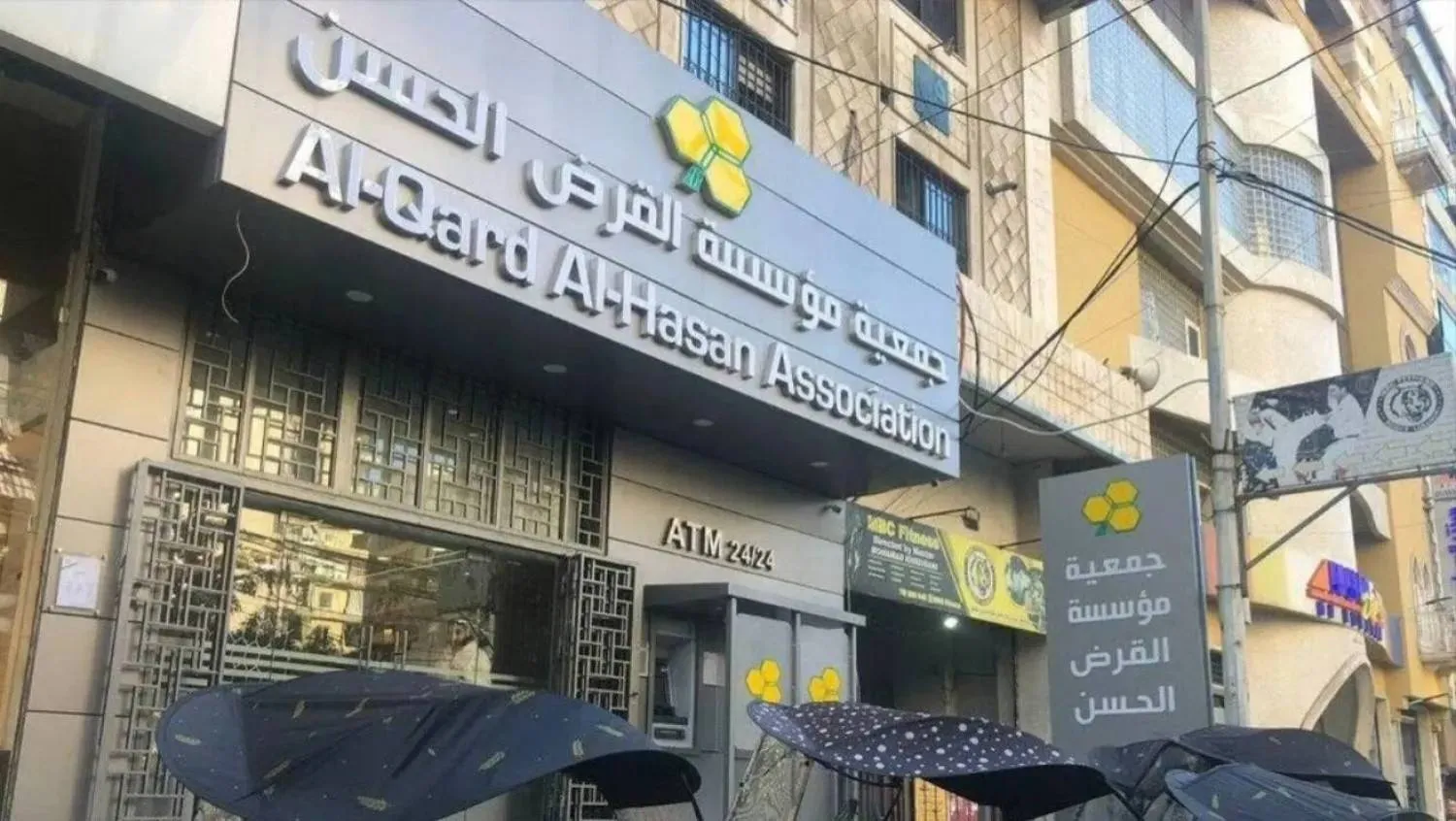
One of Al-Qard Al-Hasan’s buildings in Beirut’s southern suburbs. AP file photo
TT

Hezbollah Creates New Entities to Evade Pressure on Al-Qard Al-Hasan

One of Al-Qard Al-Hasan’s buildings in Beirut’s southern suburbs. AP file photo

Hezbollah in Lebanon has begun taking steps that appear likely to lead to the closure of its financial arm Al-Qard Al-Hasan, or to sharply curtail its role, after mounting US pressure and measures by Lebanon’s central bank. 

The moves are part of what sources describe as a legal repositioning inside the country, aimed at easing international and domestic pressure to shut the institution down.

As part of this shift, the group has established a licensed commercial entity that has begun carrying out part of Al-Qard al-Hasan’s activities by providing loans to its supporters. There are expectations that additional institutions could be created to take over other functions.

Hezbollah had previously rejected US demands conveyed through Lebanese authorities to close the institution, accusing Washington of seeking to “dry up financial resources in order to eliminate the party’s presence and prevent it from providing social services,” according to remarks by its Secretary-General Naim Qassem in a speech last month.

In recent years, Al-Qard Al-Hasan has been known as an institution that provides interest free loans, secured by gold or financial guarantees from other depositors. 

The number of its clients exceeded 300,000 people in 2024, benefiting from its concessional loans. It also provided agricultural, industrial, and commercial loans to small enterprises. 

The institution, which operated more than 34 branches across Lebanon, also distributed financial checks to those affected by the war, funded by Hezbollah after the latest conflict.

Amid international pressure on Lebanon to shut it down, the institution appeared to adopt what financial sources told Asharq Al-Awsat was a “legal repositioning policy,” seeking “legal alternatives that would allow it to continue operating,” following a series of domestic measures, including a decision by the Banque du Liban barring dealings with it.

Commercial entity

Al-Qard Al-Hasan has indeed begun to transform, with the first signs appearing in the form of a commercial company specializing in the buying and selling of gold on installment plans, which was established and began operating in early December. 

Two sources in Beirut’s southern suburbs told Asharq Al-Awsat they were surprised, after completing transactions at the institution, to receive invoices issued by an entity called “Jood,” rather than Al-Qard Al-Hasan.

One of them said they went to the institution to obtain a small loan of $1,800 secured by his wife’s gold, only to discover that procedures had changed. “They did not carry out a gold pledge transaction as before,” they said. 

“Instead, the process was conducted through two contracts. The first involved purchasing the gold in exchange for an official invoice, followed by another commercial transaction in which the same quantity of gold was sold back to us on installments, also against an official invoice.”

Under the purchase contract, he said, payments are made over 18 months in fixed monthly installments, with the gold delivered 15 days after the final installment is paid. “It is the same method used in the past, but the paperwork is different,” they added.

Promise of sale by installments

The second source said they were also able to obtain a loan in the same way and found that the installment purchase invoice included a contract with four conditions. They explained that the invoice was issued by “Jood” and included the company’s registration number and a fiscal invoice number, indicating it is subject to Lebanon’s commercial transaction laws and applicable regulations.

Asharq Al-Awsat reviewed the terms of the invoice included in the contract, which state that the invoice “constitutes a promise of sale by installments, and the sale is not considered final until the full value of the invoice is paid.”

The second clause states that all installments become immediately due if the buyer fails to pay two installments. It also authorizes the buyer, as the invoice holder, to make payment on his behalf. The fourth clause stipulates that the buyer must collect the gold within a period not exceeding 15 days from the date of paying the final installment, and that in the event of a delay, storage fees of $0.02 per gram per month will be added.

Fragmentation of services

This step is seen as part of a broader transformation plan by the institution in response to external and domestic pressure to shut it down. 

Lebanese sources familiar with international demands said the shift “signals the failure of all attempts to rescue it through talks between the party and Lebanese authorities.”

They added that “the party’s conviction has pushed it to fragment the services provided by the institution in a way that allows it to continue offering some services if it complies with demands to close it entirely.”

The association states online that it “aims to help people by granting loans for specified periods, contributing to solving some of their social problems,” and that it seeks to “strengthen the spirit of cooperation, mutual support, and solidarity among members of society.”

The sources said that following the fragmentation of services, gold pledging has been removed from the institution’s functions and transferred to the commercial entity, enabling it to continue providing services within the bounds of the law. This follows the suspension of other services, including ATM services. 

The move also sends a message to Lebanese authorities that these services are being offered within a legal framework, through official invoices, and are subject to taxes and commercial transaction regulations.

However, the same sources noted that in this arrangement, official financial disclosure applies to clients rather than depositors and sources of funds, “which complicates the assumption of international acceptance of this transformation.”

They said three proposals had previously been submitted to regularize the status of Al-Qard Al-Hasan, all of which were rejected by the United States. The first was to operate as a mutual aid association. 

The second was to become a licensed financial company, which was also rejected by the Banque du Liban. 

The third proposal was to operate as a financial cooperative providing concessional loans, similar to cooperatives that exist in Lebanon and abroad, subject to Lebanese law and declaring its clients. All proposals were “rejected outright,” the sources said.

US rejection

This assessment aligns with Lebanese financial estimates that any transformation by the institution is unlikely to gain US approval. A senior Lebanese financial source told Asharq Al-Awsat it was “unlikely that this repositioning will be accepted by the US Treasury Department, which scrutinizes tedious financial details in Lebanon.”

Lebanon, the source said under conditions of anonymity, is “under strict oversight by the US Treasury due to widespread cash circulation,” and US estimates indicate that cash outside the banking sector cannot be controlled. 

“This measure is part of the cash economy operating outside the banking sector,” they said.

They added that the repositioning would not satisfy the United States, which has decided the institution must be shut down and has conveyed that to the Lebanese state. 

“Changing the form will not satisfy them as long as the core remains,” they said, referring to the continued existence of Al-Qard Al-Hasan and the continuation of its services in another guise.

“From a legal standpoint, and under Lebanon’s prevailing laws, excluding the central bank, a commercial company can carry out buying and selling activities, including installment sales,” they said. 

“But that does not mean the fundamental problem has been resolved, which is US rejection, because liquidity will remain outside the banking sector and will continue, from the American perspective, to be viewed with suspicion under the current political circumstances.”


Syria, Israel to Set Up Joint Cell Under US on De-Escalation

Syrian soldiers make their way through the snow in the country's mountainous Qalamoun region, near the border with Lebanon, during a patrol to secure the frontier and prevent smuggling operations on January 1, 2026. (AFP)
TT

Syria, Israel to Set Up Joint Cell Under US on De-Escalation

Syrian soldiers make their way through the snow in the country's mountainous Qalamoun region, near the border with Lebanon, during a patrol to secure the frontier and prevent smuggling operations on January 1, 2026. (AFP)

Syria's new government and Israel will set up a joint group under US supervision to share intelligence and seek military de-escalation on the ground, they announced Tuesday after talks.

The Syrian foreign minister traveled to Paris in his country's first known meeting in months with Israel, which has pounded its historic adversary despite US unease over the pressure on the fragile government.

A joint statement issued by the US State Department after the talks in the French capital said that Syria and Israel were committed to "achieving lasting security and stability arrangements for both countries."

"Both sides have decided to establish a joint fusion mechanism -- a dedicated communication cell -- to facilitate immediate and ongoing coordination on their intelligence sharing, military de-escalation, diplomatic engagement and commercial opportunities under the supervision of the United States," the statement said.

"This mechanism will serve as a platform to address any disputes promptly and work to prevent misunderstandings."

The statement did not say Israel would refrain from further strikes or restore an agreement that was previously in place.

Israeli strikes

Israel has no diplomatic relations with Syria, which during the half-century of rule by the Assad family publicly championed the Palestinian cause and was the Arab world's key ally of Iran's clerical state, Israel's arch-enemy.

Bashar al-Assad was ousted in a lightning offensive in December 2024 by Ahmed al-Sharaa after more than a decade of brutal civil war.

President Donald Trump has met and praised Sharaa, now the interim president, brushing aside Israeli skepticism.

The talks in Paris were mediated by Tom Barrack, ambassador to Türkiye and an outspoken advocate of supporting Sharaa.

The United States recently fully removed remaining sanctions on Syria, hoping to give the country a chance to integrate into the global economy.

Since Assad's fall, Israel sent troops into a UN-patrolled buffer zone that had separated Israeli and Syrian forces on the Golan Heights, which Israel captured in the 1967 Six-Day War.

Israel, saying there was a power vacuum, also unilaterally declared void a 1974 disengagement agreement with Syria that had kept in effect a ceasefire.

Sharaa has sought to restore the agreement and avoid wider conflict with Israel, but he has also opposed Israel's insistence on maintaining a demilitarized zone in southern Syria.

Israeli Prime Minister Benjamin Netanyahu's office called for economic cooperation with Syria and "regional stability and security."

"It was agreed to continue the dialogue to advance shared objectives and safeguard the security of the Druze minority in Syria," it said.

Israel has cited violence against the Druze, who also have a presence inside Israel, as a reason to intervene in Syria.

Israel in July launched massive air strikes, including hitting the defense ministry in Damascus, leading some analysts to believe it was hoping to degrade military capacities of Syria while it was at a weak point.


Egypt Stresses Full Support for Somalia's Unity, Sovereignty

Residents wave Somali flags as they attend a rally denouncing Israel's recent announcement recognizing the breakaway Somaliland region, during a gathering calling for Somalia's territorial unity at Mogadishu Stadium in Mogadishu on December 30, 2025. (AFP)
TT

Egypt Stresses Full Support for Somalia's Unity, Sovereignty

Residents wave Somali flags as they attend a rally denouncing Israel's recent announcement recognizing the breakaway Somaliland region, during a gathering calling for Somalia's territorial unity at Mogadishu Stadium in Mogadishu on December 30, 2025. (AFP)

Egyptian Foreign Minister Badr Abdelatty underscored on Tuesday Cairo's full support for the unity, sovereignty, and inviolability of Somali territory, describing it as a fundamental pillar for the stability of the Horn of Africa and the Red Sea region.

He stressed Egypt's rejection of any unilateral measures or attempts to impose parallel entities or create a new political reality outside internationally recognized legal frameworks.

He made his remarks during his participation in the session of the African Peace and Security Council (PSC), held virtually at Egypt’s request, in support of the unity, sovereignty, and territorial integrity of Somalia.

Abdelatty said that Israel's unilateral and unlawful recognition of what is termed the "Somaliland region" is a flagrant violation of Somalia's sovereignty, unity, and territorial integrity.

It undermines the principles of international law, the United Nations (UN) Charter, and the Constitutive Act of the African Union (AU), he declared. Moreover, it sets a dangerous precedent threatening regional and international peace and security.

This demands a unified stance in support of Somalia and concerted efforts to achieve security and stability in Somalia and the Horn of Africa region, urged Abdelatty.

He called on the African PSC to adopt a strong and unified position condemning the recognition of so-called "Somaliland" and urged all AU member states to categorically reject any measures arising from the Israeli recognition.

He also underlined the need for full and unconditional support for the sovereignty, unity, and territorial integrity of Somalia.


Yemen's PLC Holds Emergency Meeting, Approves Measures to Protect Civilians, Facilities in Aden

This photo taken on January 4, 2026 shows Yemeni forces deployed in the city of Mukalla. (AFP)
TT

Yemen's PLC Holds Emergency Meeting, Approves Measures to Protect Civilians, Facilities in Aden

This photo taken on January 4, 2026 shows Yemeni forces deployed in the city of Mukalla. (AFP)

The Yemeni Presidential Leadership Council, chaired by President Dr. Rashad Al-Alimi, held an emergency meeting on Wednesday to review the latest security and military developments in the southern governorates,

The meeting was attended by members Sultan Al-Aradah, Tariq Saleh, Abdulrahman Al-Mahrami, Dr. Abdullah Al-Alimi, and Othman Majali.

According to the Yemeni News Agency (SABA), the meeting reviewed the developments following a statement from the Joint Forces Command of the Coalition to Restore Legitimacy in Yemen, which highlighted a serious escalation by some rebel leaders and their obstruction of de-escalation efforts.

The council was briefed on the consequences of one member’s failure to respond to an invitation from Saudi Arabia, as well as unilateral actions and movements that clearly deviated from the agreed framework for the transitional phase, undermining efforts to protect civilians and prevent the spread of violence.

In response, the council decided to expel Aidrous Al-Zubaidi from his position and refer him to the Attorney General on charges of high treason, harming the political and economic standing of Yemen, obstructing state efforts to confront the Houthi coup, and inciting internal strife.

The meeting also approved the dismissal of Minister of Transport Abdulsalam Hamid and Minister of Planning and International Cooperation Waed Badhib, referring both for investigation.

It further ordered the pursuit and arrest of individuals involved in distributing weapons and threatening civil peace, ensuring they face justice. The council emphasized that the state will act firmly against all violations to uphold the rule of law and protect public rights and freedoms.

The PLC reaffirmed that unity in military and security decision-making and respect for the chain of command are inviolable principles, stressing that any serious breach of these duties will be met with accountability under the constitution and the law.

Accordingly, the council approved a series of urgent measures, including instructing the relevant authorities to take all necessary steps to protect civilians and public facilities in the interim capital, Aden, and the liberated governorates, unify command and control over all military and security formations, and prevent any movements or mobilizations outside the framework of the state.

The council expressed its gratitude for Saudi Arabia's efforts and the leadership of the Coalition to Restore Legitimacy in Yemen in de-escalating tensions, protecting civilians, maintaining security and stability, and preventing a return to internal conflict. It underscored the state’s commitment to implementing its sovereign decisions and upholding its legal authority.

The council commended the national stance of the people of Aden and the liberated governorates in defending the republican system and legitimate state institutions during this critical stage. It renewed its call for citizens to cooperate with security and military agencies fully and report any actions or movements that could disrupt security or endanger civilian lives.
