


Bahbah to Asharq Al-Awsat: Second Phase of Gaza Ceasefire Begins Next Month

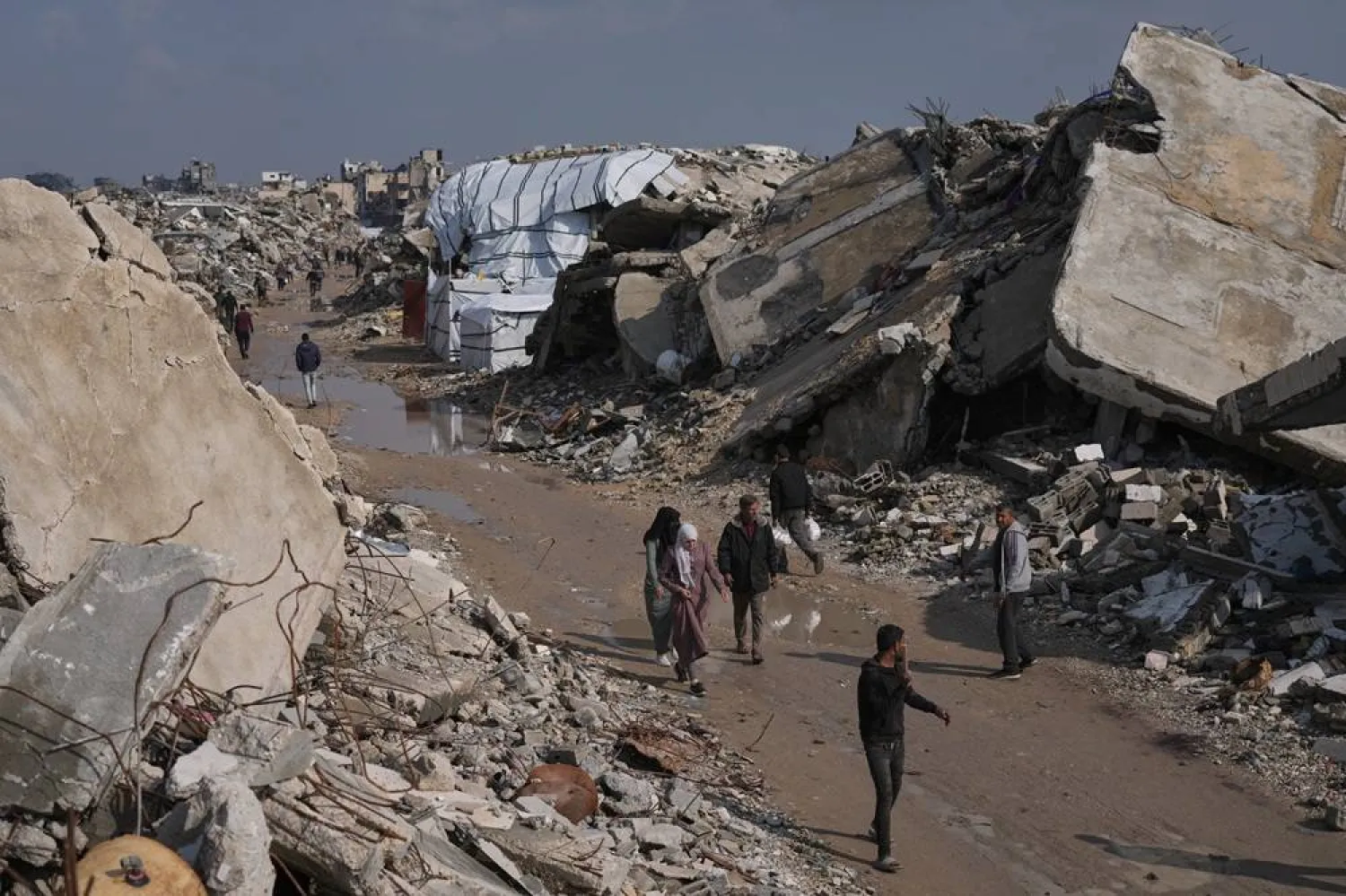
 Palestinians walk along a street surrounded by buildings destroyed during Israeli air and ground operations in Gaza City, Wednesday, Dec. 17, 2025. (AP)
Palestinians walk along a street surrounded by buildings destroyed during Israeli air and ground operations in Gaza City, Wednesday, Dec. 17, 2025. (AP)
TT

Bahbah to Asharq Al-Awsat: Second Phase of Gaza Ceasefire Begins Next Month

 Palestinians walk along a street surrounded by buildings destroyed during Israeli air and ground operations in Gaza City, Wednesday, Dec. 17, 2025. (AP)
Palestinians walk along a street surrounded by buildings destroyed during Israeli air and ground operations in Gaza City, Wednesday, Dec. 17, 2025. (AP)

The second phase of the Gaza ceasefire agreement is expected to begin in January, likely in the first or second week, according to Bishara Bahbah, head of the Arab Americans for Peace Committee and a mediator closely aligned with the US administration on the Gaza file.

Bahbah told Asharq Al-Awsat on Wednesday that preparations for managing Gaza are already complete, with the names of the prospective committee finalized and Palestinian Health Minister Majed Abu Ramadan emerging as the most likely candidate to lead the body.

Bahbah, who remains close to White House deliberations on Gaza, said Washington supports the presence of Turkish forces as part of an international stabilization force, viewing them as the most capable of maintaining stability in the enclave.

He said the anticipated meeting between US President Donald Trump and Israeli Prime Minister Benjamin Netanyahu later this month will be decisive for the second phase, noting that the United States will press for its launch next month and for a decision on Türkiye’s participation in the stabilization force.

Defining the mission

Bahbah disclosed details of a meeting held on Tuesday in the Qatari capital Doha on the formation of an international stabilization force for Gaza.

He said one of the main objectives was for Washington to clearly identify which countries are prepared to participate and to determine the nature of each country’s contribution, whether through troops, training, or technical and logistical support.

He said the second objective of the meeting was to clarify how the forces would coordinate with one another and establish a command structure, noting that one proposal under discussion is for a US general to lead the international force.

Discussions also covered deployment locations and whether the force would be stationed outside the so-called yellow line separating Israeli-controlled areas from Hamas-held zones, within that line, or inside densely populated areas, as well as which parties would provide funding, he added.

Rejection of Israel’s approach

On deployment plans, Bahbah said discussions are ongoing but that the model sought by Israel was rejected by an overwhelming majority of participating countries, indicating broad agreement on monitoring rather than combat roles.

On the nature of the mission, he stated that most participating states are unwilling to play any role related to disarmament, instead seeking to act as a buffer between Israeli forces and populated areas in order to protect civilians.

The ultimate objective of the force’s presence is Israel’s gradual withdrawal from the Gaza Strip, he stressed.

“These forces will not act on Israel’s behalf, particularly on disarmament,” Bahbah said, adding that Hamas leaders had expressed to him a willingness to negotiate on the issue.

“Using force will not work,” he warned, noting that Israel had failed to disarm Hamas by force over the past two years and that no international party would succeed in doing so militarily.
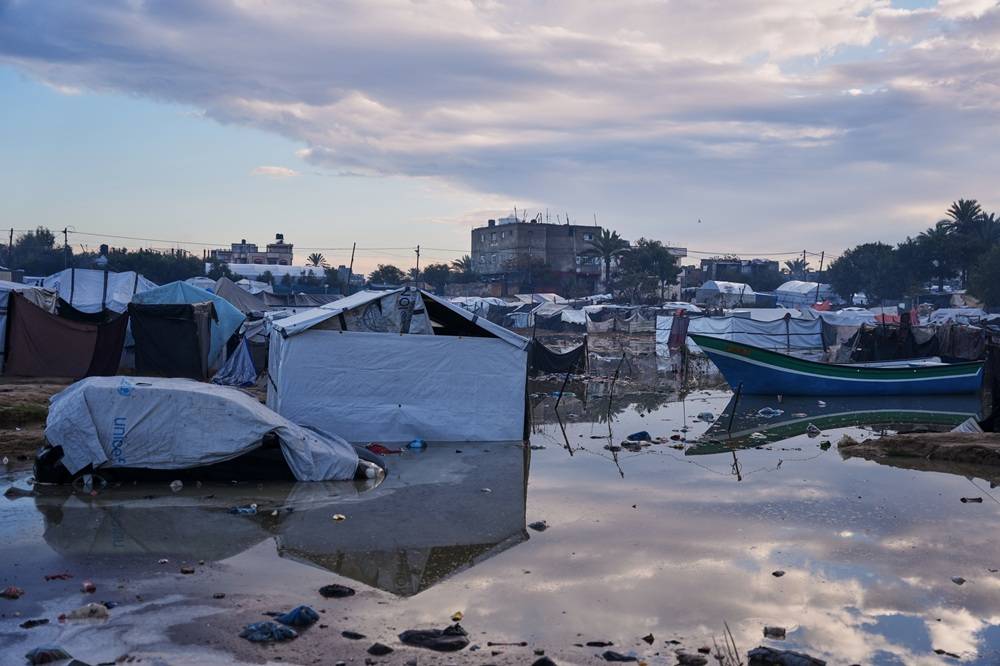
A car is seen partially submerged next to a small boat in a flooded area after heavy rains in a makeshift camp for displaced Palestinians in Zawaida, central Gaza Strip, Wednesday, Dec. 17, 2025. (AP)

Türkiye’s participation pivotal

On Türkiye’s role, Bahbah described Ankara’s participation as pivotal, saying Türkiye is the closest country to Hamas and the most capable of engaging with the group over its weapons, something other states struggle to do.

He said the presence of Turkish forces in Gaza would be essential and would lead to greater stability, adding that Washington supports their involvement.

Bahbah said Trump is expected to pressure Netanyahu during their upcoming meeting in the United States later this month to accept Turkish participation.

He added that Israel is likely to seek conditions, possibly pushing for a compromise in which Türkiye’s role would be technical rather than armed, but stressed that pressure from the US administration would be decisive.

Second phase commitments

On the so-called Peace Council, Bahbah noted that Trump has spoken of many world leaders wanting to join it, stressing that membership would not be free and would entail commitments, including funding, providing security forces, or other obligations.

Asked about potential members, he said names he has seen for the executive council include US envoys Steve Witkoff and Trump’s son-in-law Jared Kushner, former British prime minister Tony Blair, former US ambassador Richard Grenell, and former Bulgarian diplomat Nickolay Mladenov.

On Gaza’s administration, Bahbah revealed that a list of 42 candidates for a technocratic committee has been approved by Hamas, Fatah, and Egypt, adding that Health Minister Abu Ramadan is likely to chair the committee.

Despite talk of obstacles to moving to the second phase, Bahbah said he expects it to be launched in the first or second week of January, specifically after the Trump-Netanyahu summit resolves outstanding issues.

He denied knowledge of any arrangements for Egyptian President Abdel Fattah al-Sisi to attend the summit.

Trump will not allow the agreement to fail, he remarked, describing this as “100 percent certain” and adding that Hamas remains committed to the ceasefire despite continued Israeli violations.

Bahbah said the movement understands that Israel is seeking any pretext to resume what he described as acts of annihilation in Gaza and is therefore showing greater restraint to deny it that opportunity.



Yemen Minister Says Efforts Underway to Bring Capital Back to Hadhramaut

 Yemeni National Shield forces during the recapture of military camps in Hadhramaut and Al-Mahrah (Reuters)
Yemeni National Shield forces during the recapture of military camps in Hadhramaut and Al-Mahrah (Reuters)
TT

Yemen Minister Says Efforts Underway to Bring Capital Back to Hadhramaut

 Yemeni National Shield forces during the recapture of military camps in Hadhramaut and Al-Mahrah (Reuters)
Yemeni National Shield forces during the recapture of military camps in Hadhramaut and Al-Mahrah (Reuters)

At a critical moment when the Yemeni government is seeking to rebuild confidence in the national economy, official indicators suggest a tangible improvement in the investment climate, particularly in provinces where the internationally recognized government has regained control, most notably Hadhramaut and Socotra.

These moves come as part of a broader government effort to reassure traders and investors and to create a safe and stable environment for the return of capital that left the country in recent years, amid improving security conditions, the spread of state institutions, and growing interest among local and regional business leaders in resuming investment activity in liberated areas.

Monitoring stocks and price stability

Yemen’s Minister of Industry and Trade Mohammed al-Ashwal told Asharq Al-Awsat that the ministry issued official instructions the day before yesterday aimed at reassuring southern communities about the availability of essential commodities and price stability.

He stated that three separate memoranda were sent to the heads of the ministry’s offices in Mukalla, Seiyun, and al-Mahrah, containing clear directives to closely monitor commodity stocks and continuously track market activity on a daily basis.

Al-Ashwal said the instructions emphasized the importance of ensuring that Saudi aid reaches its intended beneficiaries and is not diverted or sold in markets, underscoring that the ministry gives this issue top priority due to its direct impact on market stability and food security.

Reassurances in three provinces

On security, the minister said conditions were reassuring and that security was stable in Hadhramaut, Seiyun, and Al Mahrah. He said the measures taken had helped boost confidence among citizens and traders alike, creating a sense of stability in market activity.

He pointed to ongoing communication with the Yemeni Saudi Business Council, noting that a meeting in Mecca resulted in a set of joint projects that reflect the strength of economic ties between the two countries and open new horizons for investment and cooperation across several vital sectors.

Normalizing the situation in Aden

Regarding the situation in Aden, the minister stated that the government is currently working to fully normalize conditions until security is firmly established, particularly in the temporary capital.

He added that the deployment of the National Shield forces would lead to the unification of the security authority in charge, which would have a positive impact on security and administrative stability and provide investors and traders with a clear counterpart to deal with.

Capital between flight and resilience

Regarding investors and business leaders in the south, al-Ashwal stated that following the Houthi coup, significant capital left the southern areas; however, some local businessmen remained resilient despite the volatility and challenges, continuing their commercial activities under extremely difficult conditions and helping to preserve a minimum level of economic activity.

He said local business leaders demonstrated honorable positions in the darkest circumstances and played a positive role in maintaining the economic cycle.

He called on traders who had left the country after the Houthi coup to return, especially to Hadhramaut, stating that the province would not be the same as it was before, given the expansion of state institutions and the consolidation of security through the army, security agencies, and local authorities.

Al-Ashwal said the country is witnessing notable economic momentum during a period in which conditions have stabilized in many southern provinces.

He said there is clear interest among business leaders who left Yemen about a decade ago and who now show a desire and readiness to return and invest again, amid improved security and economic conditions and an expanding area of stability.

Progress in Hadhramaut

He added that in recent hours, he had been in contact with the heads of chambers of commerce in Aden, Mukalla, and Taiz, reassuring them about security and stability.

He said he met with the governor of Hadhramaut on Monday, who confirmed that several practical steps had been taken to ensure the smooth functioning of commercial activity in the province.

Al-Ashwal said the impact of these steps is now clearly visible in Hadhramaut, where social and economic life has returned at a good pace, reflecting an improved business environment and a gradual revival of commercial activity.

Confidence signals to investors

Regarding government efforts to strengthen the local economy, al-Ashwal stated that the government, through the Ministry of Industry and Trade, is preparing to launch an industrial zone in Aden as a clear indicator of economic stability, alongside three other industrial zones in Hadhramaut and two in Socotra.

He said signing the contract for the Aden industrial zone would send a practical message that the economic situation is stable and developing dynamically.

Saudi role

In this context, al-Ashwal spoke at length about the importance of Saudi Arabia’s role, thanking the kingdom for its efforts to support stability in Yemen.

He said this support is ongoing and has directly contributed to strengthening economic stability and supporting state institutions.


Deadly Clashes in Syria’s Aleppo Deepen Rift Between Govt, Kurdish Forces

Smoke billows in the distance, in Aleppo, northern Syria, 07 January 2026. (EPA)
TT

Deadly Clashes in Syria’s Aleppo Deepen Rift Between Govt, Kurdish Forces

Smoke billows in the distance, in Aleppo, northern Syria, 07 January 2026. (EPA)

Fierce fighting in Syria's northern city of Aleppo between government forces and Kurdish fighters killed at least four people on Wednesday and drove thousands of civilians from their homes, with Washington reported to be mediating a de-escalation.

The violence, and statements trading blame over who started it, signaled that a stalemate between Damascus and Kurdish authorities that have resisted integrating into the central government was deepening and growing deadlier.

Clashes broke out on Tuesday, when at least six people were killed, including two women and a child, in an exchange of shelling between Syrian government troops and the Kurdish-led Syrian Democratic Forces (SDF).

After relative calm ‌overnight, shelling ‌resumed on Wednesday and intensified in the afternoon, Reuters reporters in ‌the ⁠city said. Aleppo's health ‌directorate said a further four people were killed and more than two dozen wounded.

By evening, fighting had subsided, the Reuters reporters said.

Ilham Ahmed, who heads the foreign affairs department of the Kurdish administration, told Reuters that international mediation efforts were underway to de-escalate. A source familiar with the matter told Reuters the US was mediating.

THOUSANDS OF CIVILIANS FLEE

The Syrian army announced that military positions in the Kurdish-held neighborhoods of Sheikh Maqsoud and Ashrafiyah were "legitimate military targets." Two Syrian security officials told Reuters that they expected a ⁠significant military operation in the city.

The government opened humanitarian corridors for civilians to flee flashpoint neighborhoods, ferrying them out on city buses. A ‌source from the government's civil defense rescue force said an ‍estimated 10,000 people had fled.

"We move them ‍safely to the places they want to go to according to their desire or to ‍displaced shelters," said Faisal Mohammad Ali, operations chief of the civil defense force in Aleppo.

The latest fighting has disrupted civilian life in what is a leading Syrian city, closing the airport and a highway to Türkiye, halting operations at factories in an industrial zone and paralyzing major roads into the city center.

The Damascus government said its forces were responding to rocket fire, drone attacks and shelling from Kurdish-held neighborhoods.

Kurdish forces said they held Damascus "fully and directly responsible for ... the dangerous escalation that threatens ⁠the lives of thousands of civilians and undermines stability in the city."

During Syria's 14-year civil war, Kurdish authorities began running a semi-autonomous zone in northeast Syria, as well as in parts of Aleppo city.

They have been reluctant to give up those zones and integrate fully into the government that took over after ex-President Bashar al-Assad's ousting in late 2024.

Last year, the Damascus government reached a deal with the SDF that envisaged a full integration by the end of 2025, but the two sides have made little progress, each accusing the other of stalling or acting in bad faith.

The US has stepped in as a mediator, holding meetings as recently as Sunday to try to nudge the process forward. Sunday's meetings ended with no tangible progress.

Failure to integrate the SDF into Syria's army risks further violence and ‌could potentially draw in Türkiye, which has threatened an incursion against Kurdish fighters it views as terrorists.


Presidential Adviser to Asharq Al-Awsat: Security Stable in Yemen’s Aden

Presidential Leadership Council member Abdul Rahman Al-Mahrami Abou Zaraa during a previous meeting with the Hadhramaut governor, attended by adviser Jaber Mohammed. (Photo courtesy of Abu Zaraa’s office)
TT

Presidential Adviser to Asharq Al-Awsat: Security Stable in Yemen’s Aden

Presidential Leadership Council member Abdul Rahman Al-Mahrami Abou Zaraa during a previous meeting with the Hadhramaut governor, attended by adviser Jaber Mohammed. (Photo courtesy of Abu Zaraa’s office)

Security in Yemen’s interim capital, Aden, was stable on Wednesday, a senior official said, after security forces moved swiftly to deploy across the city and secure key government institutions.

Jaber Mohammed, a presidential adviser and director of the office of Presidential Leadership Council member Abdul Rahman Al-Mahrami, also known as Abou Zaraa, told Asharq Al-Awsat that the security plan had been implemented within hours.

Since the early morning, brigades of the Giants Forces have deployed across Aden’s main streets, securing vital government institutions. “The security situation is calm and stable,” Mohammed said.

Meanwhile, Mohammed al-Ghaithi, a member of the Southern Transitional Council delegation that arrived in Riyadh, said the atmosphere was positive and that preparations were underway to launch a series of meetings related to intra-Southern dialogue.

In a post on X, he stated that he arrived with colleagues from Aden in Riyadh.

“In a positive atmosphere, we will begin a series of meetings to prepare for intra-southern dialogue under the sponsorship of our brothers in the Kingdom of Saudi Arabia,” he added.

Earlier, Presidential Leadership Council member Abdullah al-Alimi said that developments in the south represented a restoration of the state's authority, its institutions, legitimacy, and reference frameworks.

Al-Alimi said this was aimed at preserving stability and public calm, and clarifying the truth, free from the logic of conflicts and illusory victories.

The Presidential Leadership Council had decided to revoke the membership of Aidarous al-Zubaidi and refer him to the public prosecutor over accusations including high treason, undermining Yemen’s political and economic standing, obstructing state efforts to confront the coup, and fueling internal strife.

In another post on X, al-Alimi stated that the responsibility for maintaining security and stability rested with state institutions, local authorities, and all loyal citizens, in a manner that ensured the rule of law and protected civilians.

“What is happening today in the southern governorates after the rebellion of Aidrous al-Zubaidi, despite all the sincere efforts made by our brothers in the Kingdom of Saudi Arabia and the Presidential Leadership Council to prevent reaching this stage, is not what we had hoped for, and we are not happy with what has happened,” he said.

The Saudi-led coalition backing Yemen’s legitimate government later announced new details surrounding the movements of al-Zubaidi, following military escalation by forces affiliated with the council in Hadhramaut and Al-Mahra.

Coalition spokesman Major General Turki al-Maliki stated that the coalition had informed al-Zubaidi on January 4 to travel to Saudi Arabia within 48 hours to meet with Presidential Leadership Council Chairman Rashad al-Alimi and coalition leaders to discuss the reasons behind the recent military escalation.

He said arrangements had been made for al-Zubaidi to travel on a Yemenia Airways flight, but the flight was delayed for several hours before being canceled, followed by heightened tensions and the appearance of gunmen and military vehicles near civilian facilities around the airport.

Al-Maliki added that forces affiliated with the Southern Transitional Council then moved to impose measures in Aden, including a military deployment, obstruction of movement inside the airport, the closure of some roads, and armed deployments across the city, which the coalition described as an “unjustified escalation” that threatened security and stability.