US Hits More Than 70 ISIS Targets in Syria with Large Retaliatory Strikes

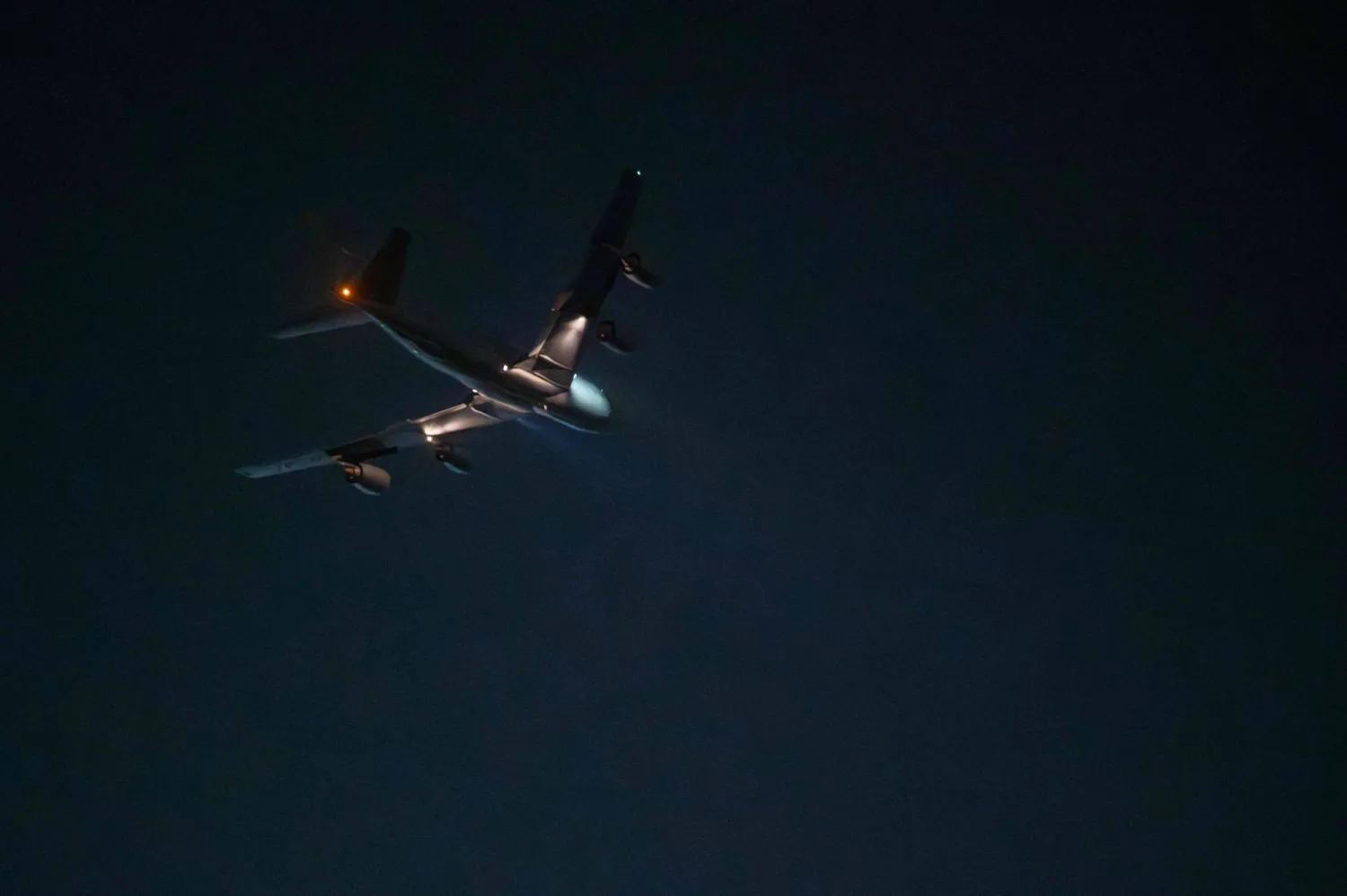
In this US Army photo taken from an undisclosed location on December 19, 2025, a KC-135 Stratotanker aircraft takes off from a base in the US Central Command area of responsibility, in support of Operation Hawkeye Strike.  (Photo by US AIR FORCE / AFP)
In this US Army photo taken from an undisclosed location on December 19, 2025, a KC-135 Stratotanker aircraft takes off from a base in the US Central Command area of responsibility, in support of Operation Hawkeye Strike. (Photo by US AIR FORCE / AFP)
TT

US Hits More Than 70 ISIS Targets in Syria with Large Retaliatory Strikes

In this US Army photo taken from an undisclosed location on December 19, 2025, a KC-135 Stratotanker aircraft takes off from a base in the US Central Command area of responsibility, in support of Operation Hawkeye Strike.  (Photo by US AIR FORCE / AFP)
In this US Army photo taken from an undisclosed location on December 19, 2025, a KC-135 Stratotanker aircraft takes off from a base in the US Central Command area of responsibility, in support of Operation Hawkeye Strike. (Photo by US AIR FORCE / AFP)

US fighter jets, attack helicopters and artillery hit more than 70 targets across central Syria on Friday, the Pentagon said, in a major military operation against ISIS.

"We will continue to relentlessly pursue terrorists who seek to harm Americans and our partners across the region," said Admiral Brad Cooper in a statement after strikes that US President Donald Trump described as "very serious retaliation" for a recent attack that killed three Americans.

Defense Secretary Pete Hegseth said the strikes targeted "ISIS fighters, infrastructure, and weapons sites" and that the operation was "OPERATION HAWKEYE STRIKE."

"This is not the beginning of ⁠a war — it is a declaration of vengeance," Hegseth said. "Today, we hunted and we killed our enemies. Lots of them. And we will continue," he added.

Trump said on social media that the Syrian government fully supported the strikes and that the US was inflicting "very serious retaliation."

At a speech in North Carolina on Friday night, Trump called it a "massive" blow against the ISIS members that the US blames for the Dec. 13 attack on ⁠coalition forces.

"We hit the ISIS thugs in Syria. ... It was very successful," Trump said at a rally in Rocky Mount, North Carolina.

US Central Command said the strikes hit more than 70 targets across central Syria, adding that Jordanian fighter jets supported the operation.

One US official said the strikes were carried out by US F-15 and A-10 jets, along with Apache helicopters and HIMARS rocket systems.

Syria reiterated its steadfast commitment to fighting ISIS and ensuring that it has "no safe havens on Syrian territory," according to a statement by the foreign ministry.

Two US Army soldiers and a civilian interpreter were killed on Saturday in the central Syrian town of Palmyra by an attacker ⁠who targeted a convoy of American and Syrian forces before being shot dead, according to the US military. Three other US soldiers were also wounded in the attack.

About 1,000 US troops remain in Syria.

The Syrian Interior Ministry has described the attacker as a member of the Syrian security forces suspected of sympathizing with ISIS.


Lebanon: Return of Residents Dominates Naqoura Ceasefire Mechanism Meeting

Lebanese President Joseph Aoun met with Simon Karam at Baabda Palace. Photo: Lebanese presidency
TT

Lebanon: Return of Residents Dominates Naqoura Ceasefire Mechanism Meeting

Lebanese President Joseph Aoun met with Simon Karam at Baabda Palace. Photo: Lebanese presidency

The committee overseeing the ceasefire between Israel and Lebanon, known as the “mechanism,” convened its 15th meeting in Naqoura, the second to include civilian representatives, with renewed focus on the return of residents to their homes on both sides of the border.

The statement issued after the meeting highlighted the importance of the return of residents on both sides of the border to their homes, and said Lebanese and Israeli representatives reaffirmed their commitment to continue efforts to support stability and work toward a permanent halt to hostilities, according to the US Embassy in Beirut.

Earlier this month, two civilian representatives, one Lebanese and one Israeli, joined the committee’s meetings in the first direct talks between the two countries in decades. The committee is led by the United States and includes representatives from France and the United Nations Interim Force in Lebanon (UNIFIL).

Aoun: Return of residents is the entry point for further talks

Lebanese President Joseph Aoun met with the head of the Lebanese delegation, Simon Karam, after he took part in the meeting in Naqoura.

Aoun stressed that “the priority is the return of residents of the border villages to their towns, homes and land as an entry point to discussing all other details.”

He added that the meeting included a detailed presentation of what the Lebanese army has achieved, supported by documentation. It was agreed that Jan. 7, 2026, would be the date of the next meeting.

Netanyahu’s office: Discussion on boosting economic projects

While the US Embassy said participants focused on strengthening military cooperation between the two sides, the office of Israeli Prime Minister Benjamin Netanyahu said the deputy head of the National Security Council represented Israel at the Naqoura meeting to discuss the disarmament of Hezbollah.

It added that talks also covered ways to boost economic projects to demonstrate the shared interest in removing the Hezbollah threat and ensuring lasting security for residents on both sides of the border.

US Embassy: Political and economic progress is essential

In its statement, the US Embassy in Beirut said military participants in the mechanism meeting “offered operational updates and remained focused on deepening the cooperation” between the two sides “by finding ways to increase coordination.”

“All agreed a strengthened Lebanese Armed Force, the guarantors of security in the South Litani Sector, is critical to success.”

“Civilian participants, in parallel, focused on setting conditions for residents to return safely to their homes, advancing reconstruction, and addressing economic priorities. They underscored that durable political and economic progress is essential to reinforcing security gains and sustaining lasting peace,” the statement added.

The embassy also said “participants reaffirmed that progress on security and political tracks remain mutually reinforcing and essential to ensuring long-term stability and prosperity for both parties. They look forward to the next round of regularly scheduled meetings in 2026.”

Lebanese authorities had approved earlier this month the appointment of former ambassador Simon Karam as a civilian representative to the committee’s meetings, in a move aimed at “warding off the specter of a second war” on Lebanon amid Israeli threats and continued airstrikes that Israel says target Hezbollah positions.

The authorities stressed the technical nature of the talks with Israel, aimed at halting its attacks and securing the withdrawal of its forces from areas they advanced into during the latest war.

Hezbollah described the appointment of a civilian delegate at the time as a “misstep” added to what it called the government’s “sin” of deciding to disarm the group under the ceasefire agreement.

Lebanon is facing mounting pressure from the United States and Israel to accelerate the disarmament of Hezbollah under a plan approved by the government as part of implementing the ceasefire agreement.

The Lebanese army is expected to complete the first phase of the plan in the border area south of the Litani River by the end of the year.


Israel Turns Gaza ‘Yellow Line’ into Deadly Boundary

Palestinians carry the body of a person killed in an Israeli military strike as they arrive at Shifa Hospital in Gaza City, Friday, Dec. 19, 2025. (AP Photo/Yousef Al Zanoun)
TT

Israel Turns Gaza ‘Yellow Line’ into Deadly Boundary

Palestinians carry the body of a person killed in an Israeli military strike as they arrive at Shifa Hospital in Gaza City, Friday, Dec. 19, 2025. (AP Photo/Yousef Al Zanoun)

Israel has effectively turned the “yellow line” marked on the Gaza withdrawal map, part of a phased pullback agreed under the October ceasefire, into a de facto firing line, where approaching civilians are routinely shot, according to Palestinian officials, underscoring a widening pattern of Israeli violations of the truce.

Gaza’s health ministry and other local authorities report almost daily at least one fatal shooting near the line, whether in the north or south of the enclave, with fewer incidents in central Gaza. The highest number of cases has been recorded in the south.

Over the past 24 hours, from Thursday afternoon to Friday, four Palestinians, including a woman, were killed in the town of Bani Suheila, east of Khan Younis in southern Gaza, after repeated attacks on people trying to reach their homes. Most of the town lies at least 200 meters from the yellow line defined under the ceasefire.

Medical teams, civil defense crews and even international organizations were unable to retrieve the bodies, which remained on the ground, similar to cases reported previously.

Field sources told Asharq Al-Awsat that Israeli forces first shot and killed a woman. When a young man tried to recover her body, he was also killed. Two others were then shot dead while attempting to reach the bodies.

The sources said the number of casualties is rising due to ongoing violations around the yellow line, which Israeli forces have deliberately advanced further into Gaza.

This has caused confusion among residents trying to access what remains of their homes, areas they had previously reached safely before the line was moved deeper into the enclave.

Israel has effectively turned the yellow line into a “death trap,” the sources said, adding that most of those killed there were shot from a distance of at least 200 meters.

Nearly 400 Palestinians have been killed since the ceasefire came into force on Oct. 10 as a result of Israeli violations.

At least 220 were killed in airstrikes carried out during several major military escalations that included targeted killings of armed Palestinian faction members in homes, vehicles or gatherings.

Israel said those attacks were in response to Palestinian violations of the ceasefire, including shooting incidents in Rafah and elsewhere.

Most of the remaining deaths, about 150, resulted from gunfire and drone strikes or artillery shelling targeting Palestinians who approached the yellow line. Others were killed by unexploded ordnance or from complications related to earlier injuries.

Israel continues daily violations of the ceasefire through airstrikes, demolitions and live fire on both sides of the yellow line.

An Israeli security official told the Hebrew-language newspaper Israel Hayom on Thursday that the yellow line is now considered the new border and that Israel will not withdraw from it unless Hamas is disarmed.

The official said Israeli forces are preparing to remain there for an open period, allowing them to control roughly half of Gaza’s territory and impose new security arrangements. He added that any withdrawal would depend on political decisions determining the next phase.

A meeting is due to be held on Friday in Miami between the US president’s Middle East envoy, Steve Witkoff, and officials from Egypt, Qatar and Türkiye to discuss Gaza, including ceasefire violations and the second phase of the truce.

Hamas hopes the talks will lead to an end to the violations. Senior Hamas official Bassem Naim told AFP that Palestinians expect the participants to agree on stopping what he described as ongoing Israeli rampages, halting all violations and obliging Israel to adhere to the Sharm el-Sheikh agreement.

Hamas sources in Gaza told Asharq Al-Awsat that the movement and other Palestinian factions are counting on mediators to persuade the United States to pressure Israel to halt violations, allow the entry of aid including tents and prefabricated housing, begin genuine reconstruction and fully comply with humanitarian commitments under the agreement.

The sources said restraining Israel must be more effective on the part of Washington and the guarantor mediators to allow progress toward the second phase of the deal, warning that continued Israeli backtracking on the first phase could derail the next stage.

Humanitarian conditions

On the humanitarian front, the World Health Organization said more than 1,000 patients in Gaza have died while waiting for evacuation since July 2024.

WHO Director-General Tedros Adhanom Ghebreyesus said on X that 1,092 patients died while awaiting medical evacuation between July 2024 and November 2025, adding that the actual number was likely higher.

Doctors Without Borders (MSF) reported high rates of respiratory infections among Gaza’s population due to harsh winter conditions and worsening living standards, as the humanitarian crisis continues.

The organization said hundreds of thousands of Palestinians remain in makeshift, deteriorating tents flooded by rainwater, heightening health risks, particularly for children and the elderly.

It urged Israeli authorities to immediately allow a significant increase in humanitarian aid deliveries to Gaza, warning of further deterioration in health and humanitarian conditions if restrictions on essential supplies persist.


Detainee Imad Amhaz Case Highlights Hezbollah’s Maritime Activities

Detainee Imad Amhaz Case Highlights Hezbollah’s Maritime Activities
TT

Detainee Imad Amhaz Case Highlights Hezbollah’s Maritime Activities

Detainee Imad Amhaz Case Highlights Hezbollah’s Maritime Activities

Israel’s disclosure of a naval commando operation in the northern Lebanese town of Batroun has thrust back into focus a case that straddles security, political, and legal fault lines.

The announcement, accompanied by Israeli claims surrounding Imad Amhaz, comes at a delicate moment, coinciding with ceasefire arrangements, meetings of the monitoring mechanism committee, and ongoing efforts to resolve the files of detainees and missing persons.

The Israeli announcement and security narrative

Israeli army spokesman Avichay Adraee said Israeli forces carried out an operation around a year ago in Batroun, far from the Lebanese Israeli border, during which Imad Amhaz was transferred to Israel for interrogation.

According to the Israeli account, Amhaz is linked to Hezbollah’s secret maritime file and its coastal missile unit, received military training inside and outside Lebanon, and acquired maritime expertise related to operational missions.

Adraee said the interrogation of Amhaz enabled, according to his statement, the acquisition of information related to organized maritime activities run under a secret framework and using civilian fronts.

He said this information helped obstruct the progress of this file at what he described as a sensitive stage, adding that Iran provided support for these activities.

A broader political and security context

In an analytical reading, security and defense researcher Riad Kahwaji told Asharq Al-Awsat that the case of Imad Amhaz and the timing of its disclosure could not be separated from the broader political and security context, particularly the meeting of the ceasefire monitoring mechanism committee and the ongoing negotiations.

He said Israel was trying through this timing to justify its refusal to withdraw from five points by arguing that Hezbollah remained present and continued to conduct military activity.

Kahwaji said the Israeli messages also aimed to show that Hezbollah’s role was far greater than perceived inside Lebanon, arguing that the group was no longer merely a local organization but part of a broad regional project led by Iran.

He said the issue was not related to a trench or one or two military positions, but rather to an integrated structure that included maritime capabilities, infrastructure, and strategic preparations.

He added that Iran had invested tens of millions of dollars in this project, saying Israel was seeking to highlight the scale of military investment in a country whose population was suffering severe internal pressures.

Kahwaji said the file went beyond the area south of the Litani River, noting that the issue was not limited to that region but included the maritime dimension and other areas, particularly since Amhaz was in Batroun in northern Lebanon at the time of the operation.

He said Israel was speaking about tunnels, weapons depots, and equipment in an attempt to show a contradiction between what the Lebanese state declared regarding the disarmament track and what Israel considered a continuation of Hezbollah’s military activity and armament.

He said attempts to strip Imad Amhaz of his civilian status fell within this context, explaining that Israel had from the outset sought to present him as linked to what it called Hezbollah’s naval weapons.

He added that the Lebanese state, in contrast, said the core problem lay in Israel’s continued occupation of the five points, while Israel responded that the main reason was that Hezbollah had not stopped arming itself and that the threat remained.

The Lebanese position and legal dimension

For his part, Nabih Awada, a member of the committee representing detainees and former prisoners in Israeli jails, told Asharq Al-Awsat that the case of Imad Amhaz was, from a legal perspective, that of a civilian abducted from a Lebanese area far from the border. He said his detention did not fall under military arrest.

Awada said this also applied to other documented cases, stressing that the file was being followed up with official Lebanese authorities and with the International Committee of the Red Cross.

He said the Lebanese state was dealing with Imad Amhaz on the basis that he was a civilian and considered that the location of his detention, its circumstances, and its nature did not fall within any military engagement or combat activity. He said this description was what the state relied on in addressing the file before international bodies.

Presidential stance regarding the detainees

Awada said the full details of the file were raised during a meeting with the president of the republic, who he said was fully convinced that the priority of the current stage was the release of Lebanese detainees.

He said the president stressed the need to start at least with civilians detained after the war, given that hostilities had stopped and there was no longer any legal justification for holding them.

He said the president had acted on this basis by communicating with the International Committee of the Red Cross, as well as international and US parties.

The Amhaz family’s stance

Alongside official positions, sources close to the family of Imad Amhaz told Asharq Al-Awsat they denied any knowledge of military activity attributed to him, saying Amhaz had been leading a normal civilian life and that the family had never been informed of any link between him and any military or security activity.

They said the information published did not reflect the family’s account.

Detainees and missing persons figures

On figures, Awada said the file submitted to the president included 20 Lebanese detainees whose presence in Israeli prisons had been confirmed, half of whom were arrested during the war and half afterward.

He said among those detained during the war were seven fighters and three civilians, including Imad Amhaz, who was considered a civilian.

Those detained after the ceasefire were all civilians, in addition to three people missing before the war and around 40 missing since it began.