Algeria Passes Law Declaring French Colonization a Crime

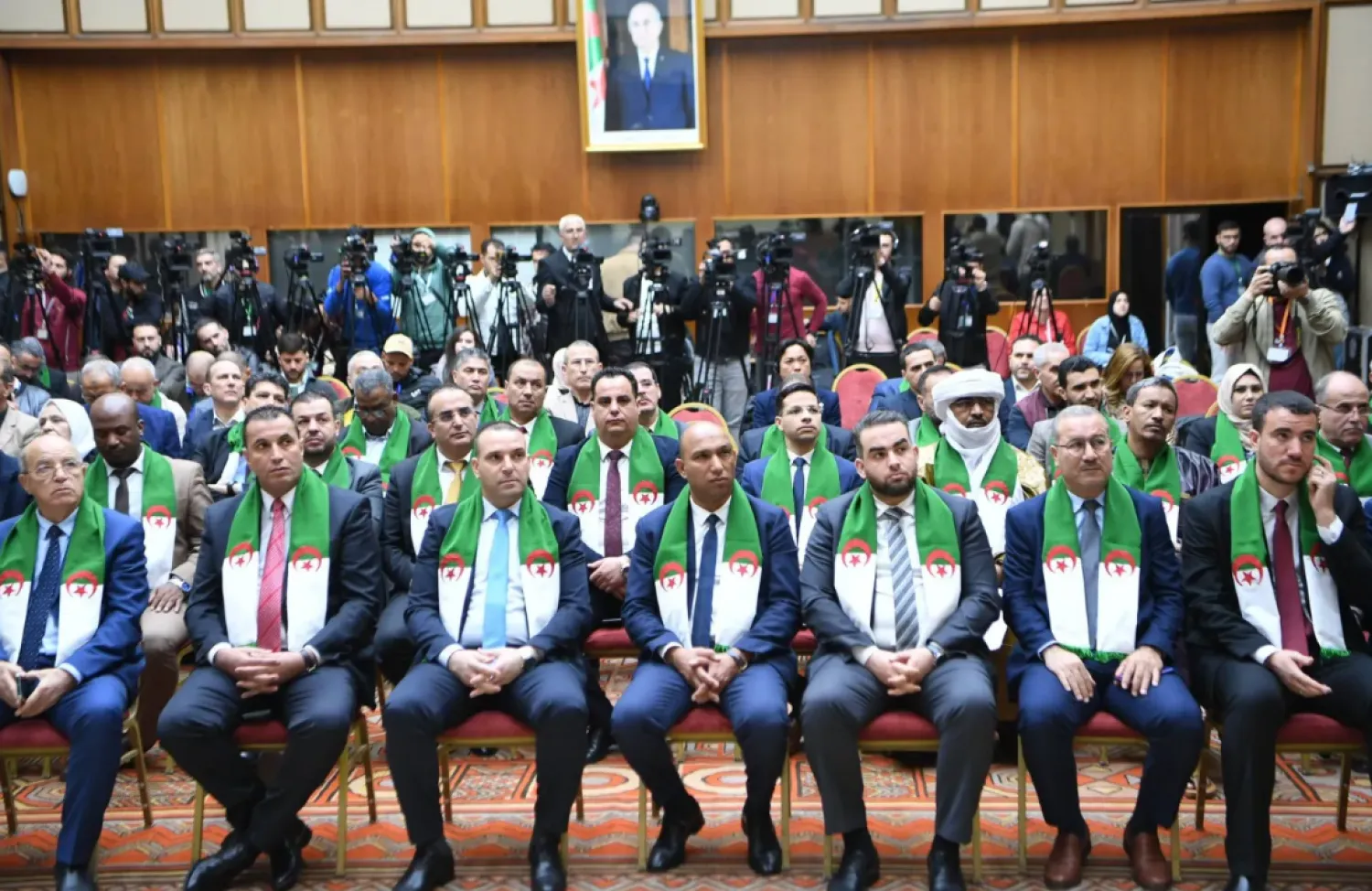
Members of the committee drafting the law criminalizing colonialism (File Photo/ Algerian Parliament)
TT

Algeria Passes Law Declaring French Colonization a Crime

Members of the committee drafting the law criminalizing colonialism (File Photo/ Algerian Parliament)

Algeria's parliament unanimously approved on Wednesday a law declaring France's colonization of the country a crime, and demanding an apology and reparations.

Standing in the chamber, lawmakers wearing scarves in the colors of the national flag chanted "long live Algeria" as they applauded the passage of the bill, which states that France holds "legal responsibility for its colonial past in Algeria and the tragedies it caused".

The vote comes as the two countries are embroiled in a major diplomatic crisis, and analysts say that while Algeria's move is largely symbolic, it is still politically significant, AFP reported.

Parliament speaker Brahim Boughali told the APS state news agency before the vote that it would send "a clear message, both internally and externally, that Algeria's national memory is neither erasable nor negotiable".

The legislation lists the "crimes of French colonization", including nuclear tests, extrajudicial killings, "physical and psychological torture", and the "systematic plundering of resources".

It states that "full and fair compensation for all material and moral damages caused by French colonization is an inalienable right of the Algerian state and people".

France's rule over Algeria from 1830 until 1962 remains a sore spot in relations between the two countries.

The period was marked by mass killings and large-scale deportations, all the way up to the bloody war of independence from 1954-1962.

Algeria says the war killed 1.5 million people, while French historians put the death toll lower at 500,000 in total, 400,000 of them Algerian.

French President Emmanuel Macron has previously acknowledged the colonization of Algeria as a "crime against humanity", but has stopped short of offering an apology.

Asked last week about the vote, French foreign ministry spokesman Pascal Confavreux said he would not comment on "political debates taking place in foreign countries".

Hosni Kitouni, a researcher in colonial history at the University of Exeter in the UK, said that "legally, this law has no international scope and therefore is not binding for France".

But "its political and symbolic significance is important: it marks a rupture in the relationship with France in terms of memory," he said.


Lives Being Upended on Massive Scale in Lebanon, Says UN Refugee Agency

A boy looks on while lying under a blanket alongside family belongings in a makeshift encampment along the waterfront in Beirut on March 10, 2026, as civilians who fled the city's southern suburbs due to Israeli bombardment remain displaced. (AFP)
TT

Lives Being Upended on Massive Scale in Lebanon, Says UN Refugee Agency

A boy looks on while lying under a blanket alongside family belongings in a makeshift encampment along the waterfront in Beirut on March 10, 2026, as civilians who fled the city's southern suburbs due to Israeli bombardment remain displaced. (AFP)

‌Lives have been upended on a massive scale in Lebanon amid a wider conflict in the Middle East, with more than 667,000 people now registered as displaced within the country - an increase of ‌100,000 in ‌just one day - the ‌UN ⁠refugee agency said ⁠on Tuesday.

Lebanon was dragged into the US-Israeli war on Iran this month when Iran-backed Hezbollah launched rockets ⁠and drones into Israel, which ‌has ‌responded with heavy bombardment across the ‌country.

Some 120,000 people are ‌staying in government designated shelters, while others are still looking for somewhere to stay, the ‌UNHCR said, citing government figures.

"Many others are ⁠staying ⁠with relatives or friends or still searching for accommodation, and we see cars lined along the street with people sleeping in them and also on the sidewalks," said Karolina Lindholm Billing, UNHCR representative in Lebanon.


Syrian Interior Ministry Airs Confessions of ‘Saraya al-Jawad’ Members

The February operation targeted hideouts in the villages of Beit Alouni and Basniya in Latakia province. (SANA)
TT

Syrian Interior Ministry Airs Confessions of ‘Saraya al-Jawad’ Members

The February operation targeted hideouts in the villages of Beit Alouni and Basniya in Latakia province. (SANA)

The Syrian Interior Ministry released a video showing confessions from members of the "Saraya al-Jawad" armed group, nearly two weeks after announcing a raid on one of its main strongholds in the countryside of Jableh in the Latakia province.

According to the ministry, the February 23 operation targeted hideouts in the villages of Beit Alouni and Basniya in Latakia province. The raid killed the group’s coastal leader Bashar Abdullah Abu Ruqayya and two other commanders, and led to the arrest of six members.

The video released Monday includes footage from the twin operation carried out by the Interior Ministry’s Internal Security Directorate.

Authorities said the raid followed several days of surveillance and resulted in the destruction of a weapons depot and explosives storage site belonging to the group.

One member of the Syrian special task forces was killed and another was lightly wounded during the operation.

In the recorded confessions, detainees said they took part in attacks along the Syrian coast in March 2025. One suspect admitted to ambushing a General Security patrol and killing one officer during a clash.

The confessions also described the establishment of an operations room in a residential house that doubled as an arms depot. According to the detainees, the group received financial support from businessmen Ayman Jaber and Mohammad Jaber, while supplies were smuggled in from Lebanon.

Mohammad Jaber, a businessman close to the former government of Bashar al-Assad and a commander in the Desert Hawks militia founded by his brother Ayman, previously appeared in a television interview acknowledging his role in organizing attacks by pro-regime remnants along the Syrian coast on March 6, 2025.

Documents and recordings obtained by Al Jazeera’s investigative program Al-Mutahari suggested that senior figures linked to the former government sought to form armed groups to carry out attacks on Syrian security forces and the army.

The Interior Ministry said it is pursuing members of those networks and attempting to curb their activities.

Saraya al-Jawad has been active in Syria’s coastal region — particularly in Latakia, Jableh and Tartus — since August 2025, when activists circulated a video showing a car bomb targeting a General Security vehicle in rural Jableh.

Earlier this month, security forces in Tartus also arrested three suspects — Ali Zuhair Idris, Ammar Madin Youssef and Mousa Mazhar Mia — accused of planning attacks targeting the province’s security and civilians.

Officials said intelligence showed the group had received explosives training abroad before infiltrating back into Syria.


Hezbollah Pressure on Military Court Undermines Lebanon’s Weapons Ban

Blankets are distributed at a school converted into a shelter in Beirut, where a banner displaying images of leaders and members of Hezbollah can be seen (EPA). 
TT

Hezbollah Pressure on Military Court Undermines Lebanon’s Weapons Ban

Blankets are distributed at a school converted into a shelter in Beirut, where a banner displaying images of leaders and members of Hezbollah can be seen (EPA). 

Lebanon’s government decision to prohibit any military or security activity by Hezbollah has yet to translate into meaningful enforcement.

Hezbollah has continued to escalate its military operations, launching rockets and drones toward Israeli territory, while signs of deteriorating security have appeared inside Lebanon, particularly among displaced residents who have fled southern Lebanon and Beirut’s southern suburbs.

Security agencies have struggled to identify those responsible for launching rockets toward Israel. However, Lebanese forces recently recorded a notable development with the arrest of around 30 individuals affiliated with or supportive of Hezbollah.

The detainees were apprehended while fleeing alongside civilians from southern areas and the southern suburbs of Beirut after being found carrying individual weapons, including assault rifles, pistols and grenades.

The arrests appeared to signal a tentative shift in how Lebanon’s security and judicial institutions handle the issue of illegal weapons. Yet the move quickly ran up against what officials say is Hezbollah’s continuing influence over judicial decisions.

Last week, the military court tried three Hezbollah members detained days earlier. The court imposed a fine of 900,000 Lebanese pounds —about $10 — on each of them for possessing unlicensed military weapons and waived any prison sentence.

The ruling diverges sharply from typical sentences in similar cases, where possession or transport of unlicensed weapons usually carries at least a one-month prison term.

Judicial sources say the unusually lenient sentence reflects pressure exerted by Hezbollah on the military court to secure the release of its detained members.

According to the sources, the group sought their release last Thursday and pushed for their trial to be held the following day. The military prosecutor’s office objected, resulting in the hearing being postponed until Monday.

The verdict also drew criticism from the government commissioner to the military court, Judge Claude Ghanem, who promptly appealed the ruling before the Military Court of Cassation, requesting tougher penalties.

A judicial source told Asharq Al-Awsat that the ruling was “extremely lenient and failed to account for all the legal provisions under which the suspects were charged.” The source added that the commissioner had received preliminary investigation files concerning four additional detainees and was preparing to file charges against them in the coming hours while seeking stricter sentences.

Only hours after the verdict was issued, Lebanese Justice Minister Adel Nassar ordered that the civilian adviser to the military tribunal, Judge Abbas Jaha, be referred to the Judicial Inspection Authority for investigation.

A Justice Ministry source told Asharq Al-Awsat that the referral stemmed from “the circumstances surrounding the trial and his failure to object to this suspicious ruling.” The source noted that another member of the court panel, a military officer, had opposed the decision while Jaha approved it without reservation.

Weapons and rising tensions in host communities

Legally, the arrest of armed Hezbollah members represents a direct application of the government decision banning any military or security activity by the group. In principle, the ruling applies to anyone carrying weapons outside state authority and places them under threat of prosecution.

The more pressing challenge, however, lies in dealing with armed individuals among displaced populations.

Several neighborhoods in Beirut, including Hamra, Ras Beirut, Sakiat al-Janzir and Ain al-Remmaneh, as well as the towns of Aramoun and Kfarshima in Mount Lebanon, have witnessed repeated incidents involving gunfire, displays of weapons and confrontations with local residents.

Videos circulating on social media show armed men threatening residents, including footage recorded Sunday in Aramoun.

These incidents have heightened anxiety among host communities already grappling with mounting social and economic pressures.

Some residents say the security measures in place remain “below the required level,” arguing that the absence of deterrent action risks encouraging further incidents and creating the impression that the law is applied hesitantly when those involved are linked to Hezbollah.

A Lebanese security source, however, insisted that authorities treat all security incidents seriously. Delays in reaching certain locations, the source said, often result from limited personnel and the difficulty of maintaining coverage across all displacement areas.

Security forces maintain a near-permanent presence at the entrances of schools and facilities housing displaced people, the source added, while most incidents occur in nearby streets and neighborhoods. Patrols respond immediately to reports of gunfire or clashes, detaining suspects or pursuing them if they leave the scene.

Nevertheless, the official acknowledged that the continued incidents could lead to broader friction between displaced populations and local residents — particularly in densely populated areas — at a time when host communities are already under severe economic strain and displacement is expected to continue for months.