


Freed Prisoner Close to Sinwar Leading ‘Revolution’ Within Hamas in Gaza

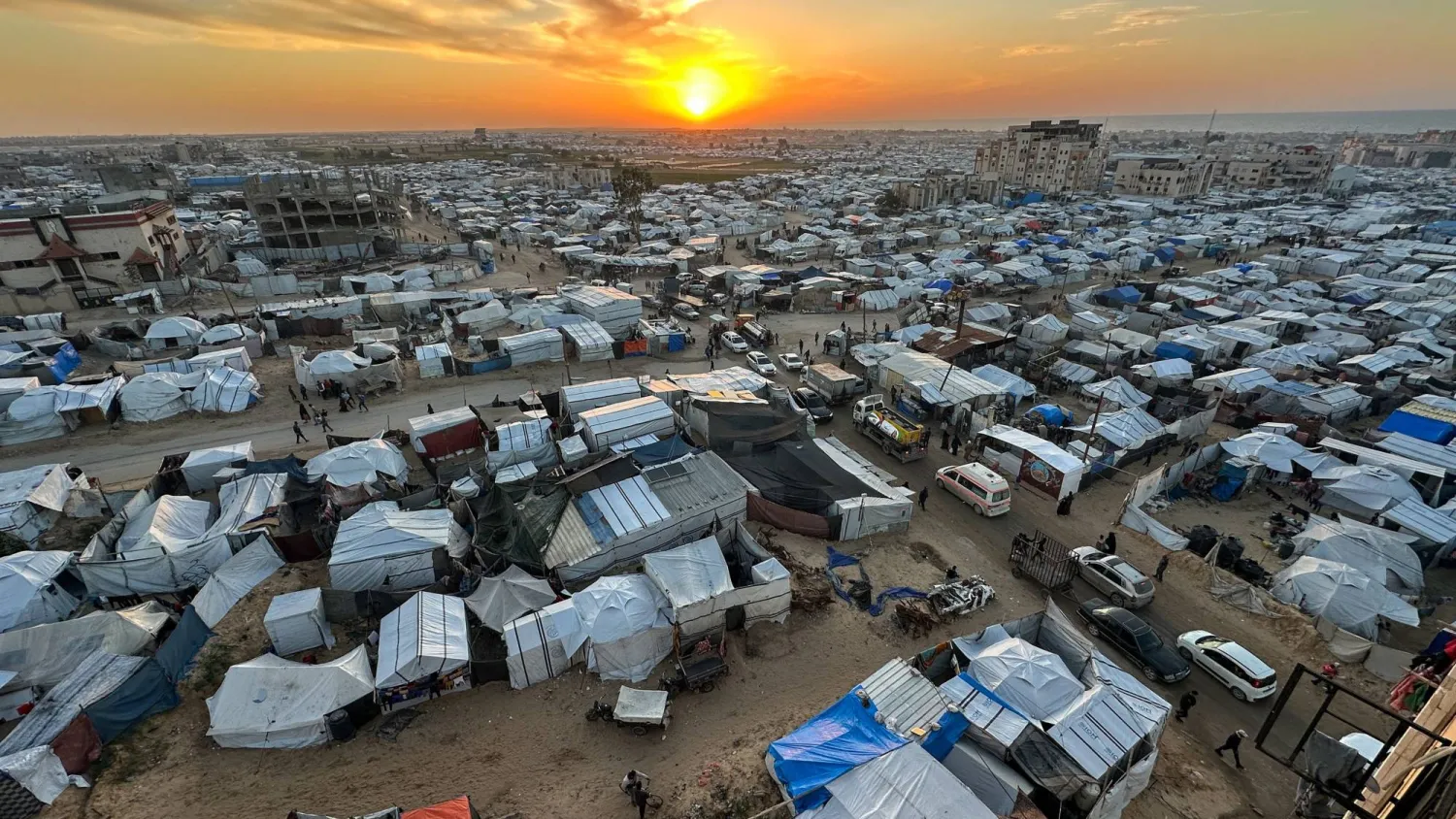
The sun sets over a tent camp sheltering Palestinians displaced by the Israeli offensive, on New Year’ Eve in Khan Younis, southern Gaza Strip, December 31, 2025. REUTERS/Ramadan Abed
TT

Freed Prisoner Close to Sinwar Leading ‘Revolution’ Within Hamas in Gaza

The sun sets over a tent camp sheltering Palestinians displaced by the Israeli offensive, on New Year’ Eve in Khan Younis, southern Gaza Strip, December 31, 2025. REUTERS/Ramadan Abed

Hamas has undergone a series of leadership changes in the Gaza Strip following the assassination of several senior figures during the two-year Israeli war, increasing the influence of individuals close to the movement’s former leader, Yahya Sinwar, who was killed in clashes with the Israeli army in Rafah in October 2024.

According to Hamas sources, freed prisoner Ali al-Amoudi, a member of the political bureau and former head of the movement’s media department, has assumed the role of acting head of Hamas’ political bureau in Gaza.

Al-Amoudi was tasked, along with several figures close to Sinwar, with managing the movement’s affairs in the Palestinian enclave, most of whom are based in Khan Younis in southern Gaza.

Al-Amoudi, who was released as part of the Israeli soldier Gilad Shalit prisoner exchange deal in 2011, has become the central figure in managing the impoverished territory. He was among those very close to Sinwar during their imprisonment in Israeli jails and after their release, accompanying him frequently to meetings and events.

Several sources told Asharq Al-Awsat that no elections took place for the political bureau. Rather, the process was carried out through appointment and consultation.

While some sources said the process took place “by circumventing by-laws,” others explained that the aim was “to fill internal gaps,” saying “all those chosen - such as Tawfiq Abu Naim, Salah Abu Sharkh - are close to Sinwar.”

The sources say that al-Amoudi is currently leading what can be described as a “revolution” within Hamas in Gaza. He has moved to replace some local leaders, especially officials of regional administrative bodies who were wounded in Israeli attacks.

Yet, he is still seeking to appoint replacements for former leaders who were assassinated, removed from their posts, or transferred to other positions.

According to some sources, his policies have angered local Hamas leaders in the Gaza Strip, as well as leaders abroad.

Members of the political bureau outside the territory reportedly informed local leaders that what happened “violates internal regulations, and that it is necessary to wait for the election of the movement’s head in the coming days, so that agreement can be reached on temporarily filling vacancies within the leadership of some regions until general elections are held after a year.”

The sources said that the “state of chaos” prevailing at the political level within Hamas in the Gaza Strip contrasts with a state of stability within the military wing, which continues to reorganize systematically.

They explained that Izz al-Din al-Haddad, the new leader of al-Qassam Brigades, is holding a series of meetings to appoint leaders who would replace figures assassinated or killed during the war.

According to the sources, al-Haddad is working to fill vacancies in various leadership positions, including commanders of brigades in some areas, while retaining others who had been chosen to run those brigades after their commanders were killed.

During the war, Israel assassinated most of the brigade commanders in the Gaza Strip (Northern, Central, Khan Younis, and Rafah), with the exception of the Gaza City Brigade, which was led by al-Haddad, who was replaced by Muhannad Rajab.



UN Chief Condemns Israeli Law Blocking Electricity, Water for UNRWA Facilities

A girl stands in the courtyard of a building of the United Nations Relief and Works Agency for Palestine Refugees (UNRWA) in the Askar camp for Palestinian refugees, east of Nablus in the Israeli-occupied West Bank, on December 31, 2025. (AFP)
TT

UN Chief Condemns Israeli Law Blocking Electricity, Water for UNRWA Facilities

A girl stands in the courtyard of a building of the United Nations Relief and Works Agency for Palestine Refugees (UNRWA) in the Askar camp for Palestinian refugees, east of Nablus in the Israeli-occupied West Bank, on December 31, 2025. (AFP)

United Nations Secretary-General Antonio Guterres condemned on Wednesday a move by Israel to ban electricity or water to facilities owned by the UN Palestinian refugee agency, a UN spokesperson said.

The spokesperson said the move would "further impede" the agency's ability to operate and carry out activities.

"The Convention on the Privileges and Immunities of the United Nations remains applicable to UNRWA (United Nations Relief and Works Agency for Palestine Refugees in the Near East), its property and assets, and to its officials and other personnel. Property used ‌by UNRWA ‌is inviolable," Stephane Dujarric, spokesman for the ‌secretary-general, ⁠said while ‌adding that UNRWA is an "integral" part of the world body.

UNRWA Commissioner General Phillipe Lazzarini also condemned the move, saying that it was part of an ongoing " systematic campaign to discredit UNRWA and thereby obstruct" the role it plays in providing assistance to Palestinian refugees.

In 2024, the Israeli parliament passed a law banning the agency from operating in ⁠the country and prohibiting officials from having contact with the agency.

As a ‌result, UNRWA operates in East Jerusalem, ‍which the UN considers territory occupied ‍by Israel. Israel considers all Jerusalem to be part ‍of the country.

The agency provides education, health and aid to millions of Palestinians in Gaza, the West Bank, Jordan, Lebanon and Syria. It has long had tense relations with Israel, but ties have deteriorated sharply since the start of the war in Gaza and Israel has called repeatedly for UNRWA to ⁠be disbanded, with its responsibilities transferred to other UN agencies.

The prohibition of basic utilities to the UN agency came as Israel also suspended of dozens of international non-governmental organizations working in Gaza due to a failure to meet new rules to vet those groups.

In a joint statement, Canada, Denmark, Finland, France, Iceland, Japan, Norway, Sweden, Switzerland and the United Kingdom said on Tuesday such a move would have a severe impact on the access of essential services, including healthcare. They said one in ‌three healthcare facilities in Gaza would close if international NGO operations stopped.


Israel Says It ‘Will Enforce’ Ban on 37 NGOs in Gaza

The sun sets behind the ruins of destroyed buildings in the Nuseirat refugee camp in the central Gaza Strip on December 31, 2025. (AFP)
TT

Israel Says It ‘Will Enforce’ Ban on 37 NGOs in Gaza

The sun sets behind the ruins of destroyed buildings in the Nuseirat refugee camp in the central Gaza Strip on December 31, 2025. (AFP)

Israel said on Thursday that 37 international NGOs operating in Gaza had not complied with a deadline to meet "security and transparency standards," in particular disclosing information on their Palestinian staff, and that it "will enforce" a ban on their activities.

"Organizations that have failed to meet required security and transparency standards will have their licenses suspended," said spokesman for the Ministry of Diaspora Affairs and Combating Antisemitism, Gilad Zwick.

In March, Israel gave a ten-month deadline to NGOs to comply with the new rules, which expired on Wednesday night.

The UN has warned that the ban will exacerbate the humanitarian situation in Gaza.


Syria’s Interior Minister Warns Remnants of Former Regime

FILE PHOTO: Members of the Syrian Security forces stand guard near military vehicles on the day people protest in Latakia, Syria, December 28, 2025. REUTERS/Karam al-Masri/File Photo
TT

Syria’s Interior Minister Warns Remnants of Former Regime

FILE PHOTO: Members of the Syrian Security forces stand guard near military vehicles on the day people protest in Latakia, Syria, December 28, 2025. REUTERS/Karam al-Masri/File Photo

Syrian Interior Minister Anas Khattab has warned the remnants of the former regime against efforts to lead chaos, killing, and destruction as his ministry announced the arrest of several people in Latakia and Tartus for involvement in war crimes and instigations that threaten civil peace.

Khattab stressed on Wednesday that the state is the sole guarantor for all citizens, ensuring their security, preserving their dignity, and safeguarding their rights.

The minister said in a statement on X that since the early days following Syria’s liberation, the ministry has positioned itself as a central force in restoring order and safety across the country.

This effort has been carried out in coordination with other government agencies and local communities to confront a wide range of security challenges.

Khattab stressed that the ministry’s new approach to policing prioritizes public safety over intimidation. “Our goal is to protect citizens, not to frighten them,” he said, adding that a formal code of conduct has been introduced to ensure law enforcement operates within clear legal and ethical boundaries.

Despite these reforms, remnants of the deposed regime who have aligned themselves with wanted criminals have misinterpreted the ministry’s ethical approach as weakness. “We will protect the oppressed and hold accountable anyone who threatens our country’s security,” he said.

The minister warned the remnants of the defunct regime and their criminal gangs, who insist on continuing the path of chaos, killing, and destruction to “await their inevitable fate.”

“Let this message serve as a final warning to them to cease their actions,” he added.

Meanwhile, the ministry said on its Telegram channel that several people were arrested in operations in Latakia and Tartus after external calls by instigators have led to sectarian chaos and left many people dead and injured.

“The operation came in response to external inciting calls of a sectarian nature, which led to a state of chaos, the death of a number of people, the injury of others, and assaults on public and private property,” it said, noting that “operations are ongoing against these corrupt individuals.”

The ministry said in its statement that it has played an active role in restoring the social fabric and strengthening civil peace. However, “some parties have sought to exploit this stage to spread chaos, undermine security, and threaten stability.”