


Settlers Force Re-burial of Palestinian Man in West Bank, Family Says 

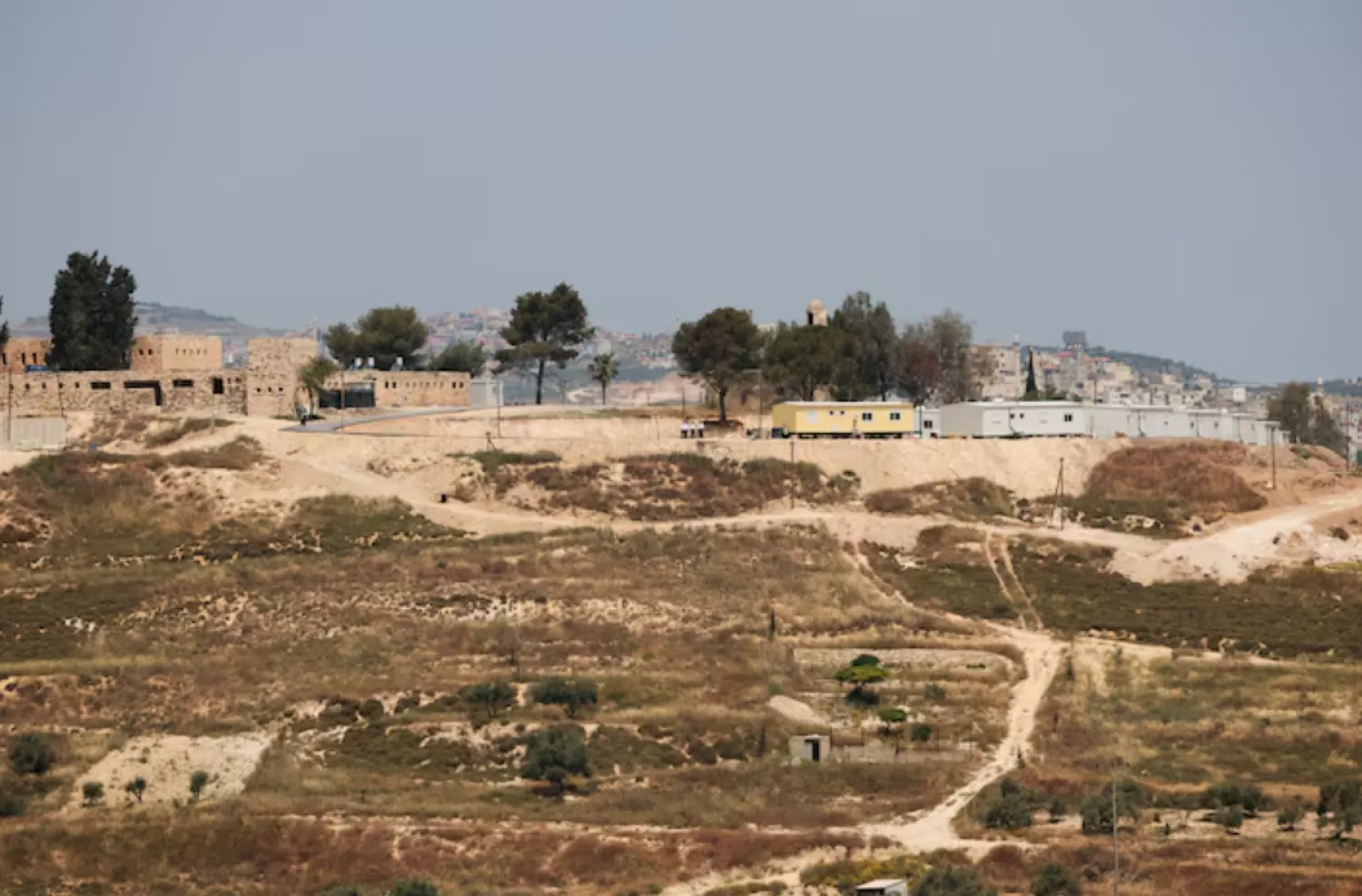
Israeli settlement structuers being installed in Sanur near Jenin, in the Israeli-occupied West Bank, May 9, 2026. REUTERS/Mohamad Torokman
TT

Settlers Force Re-burial of Palestinian Man in West Bank, Family Says 

Israeli settlement structuers being installed in Sanur near Jenin, in the Israeli-occupied West Bank, May 9, 2026. REUTERS/Mohamad Torokman

Israeli settlers in the occupied West Bank forced Palestinians to exhume the body of their father from his freshly dug village grave, his family said, near a settlement re-established by Prime Minister Benjamin Netanyahu's government.

Hussein Asasa, 80, died on Friday of natural causes and was buried that evening at the cemetery of Asasa village near Jenin, with all the necessary permits from Israel's military, whose forces were at the site, his son Mohammed said.

But shortly after the burial, the family was called back by some of the villagers, who said settlers were at the grave, ordering the grave be dug up.

"They said the land was for settlement and that burial was not allowed. We told them that this is the village's cemetery, not part of the settlement," said Asasa, Reuters reported.

The settlers then threatened to dig the grave up with a bulldozer, Asasa said, so the family decided to exhume their father's body themselves.

"We found that they already dug the grave and reached the body," Asasa said. "We continued digging and got the body and buried him in another cemetery," he said.

VIDEO SHOWS PEOPLE REMOVING A BODY

Video circulating on social media appeared to show settlers watching as people dig in the ground of a hill slope. They then carry away what looks like a body as Israeli troops walk behind them. Reuters verified the location as Asasa.

The Israeli military said that the funeral had been coordinated with it and that it had not instructed the family to rebury their father. Soldiers were sent to the scene following a report about a confrontation with settlers who were "digging in the area," the military said. "The soldiers confiscated digging tools from the Israeli civilians and remained at the location in order to prevent further friction," the military said. It added that it condemns actions that violate the "dignity of the living and the deceased".

The UN Human Rights Office condemned the incident.

"This is appalling and emblematic of the dehumanisation of Palestinians that we see unfolding across the OPT (Occupied Palestinian Territories). It spares no one, dead or alive," said Ajith Sunghay, head of the OHCHR Palestinian office.

Sa-Nur was one of 19 settlements evacuated under the 2005 Israeli disengagement plan, which also included Israel's withdrawal of settlers and troops from Gaza. Netanyahu's government approved Sa-Nur's re-establishment a year ago and construction has advanced rapidly, according to Peace Now, an Israeli settlement watchdog.

The West Bank is among the territories that Palestinians seek for an independent state. Israel cites historical and biblical ties to the land, as well as security needs.

Netanyahu's government, which staunchly opposes the establishment of a Palestinian state, has been accelerating settlement building, while a rise in attacks by settlers on Palestinians has drawn international alarm. The United Nations and most countries deem Israel's settlements on West Bank land captured in the 1967 war illegal, a view that Israel disputes.



Kataib Hezbollah Vows to Keep Arms as Iraq Faces US Pressure to Disarm Groups

Fighters carry flags of Iraq and paramilitary groups, including Kataib Hezbollah, during a funeral in Baghdad for five militants killed in a US strike in northern Iraq, on Dec. 4, 2023. (AFP via Getty Images)
TT

Kataib Hezbollah Vows to Keep Arms as Iraq Faces US Pressure to Disarm Groups

Fighters carry flags of Iraq and paramilitary groups, including Kataib Hezbollah, during a funeral in Baghdad for five militants killed in a US strike in northern Iraq, on Dec. 4, 2023. (AFP via Getty Images)

The influential Iraqi armed group Kataib Hezbollah pledged on Saturday to keep up its "action", as Baghdad faces mounting US pressure to disarm factions backed by Iran.

Following the outbreak of the US-Israeli war on Iran at the end of February, groups operating under the banner of the "Islamic Resistance in Iraq" carried out repeated drone and rocket attacks on US interests in the country.

Washington, in turn, bombed facilities and bases belonging to the groups, including Kataib Hezbollah, killing dozens of their members.

Since taking office in mid-May, Iraqi Prime Minister Ali al-Zaidi has pledged to restrict weapons to the hands of the state.

But in a statement on Saturday, Kataib Hezbollah security chief Abu Mujahid al-Assaf said "action is today a collective duty, and we will carry it out on behalf of the brothers who have decided to abandon it".

While some factions have shown willingness to operate under state institutions, others, like Kataib Hezbollah, refuse to discuss disarmament under US pressure.

Assaf suggested that Kataib Hezbollah was willing to work with those other groups, and was "also prepared to pay for" weapons they no longer needed.

He said his group was ready "to cooperate and play a constructive role" by supervising the transfer and storage of weapons, and receiving specialized weapons such as cruise missiles, for which "there are no experts within state agencies".

Kataib Hezbollah insists it will not discuss its weapons so long as foreign forces remain deployed in Iraq's northern Kurdistan region as part of a US-led international coalition formed in 2014 to fight the extremist ISIS group.

The coalition is scheduled to end its mission in the Kurdistan region by September.

Earlier this month, a senior US State Department official had demanded Iraq take "concrete actions" on pro-Iran armed groups, preconditioning renewed support on "expelling terrorist militias from any state institution" and cutting off payments to them.


Israeli Strike Kills Nurse in Gaza

 Mourners take the last look at the body of Jamal Abu Aoun, who was killed in an Israeli airstrike, during his funeral at al-Aqsa Hospital in Deir al-Balah, central Gaza Strip, Saturday May 30, 2026. (AP)
Mourners take the last look at the body of Jamal Abu Aoun, who was killed in an Israeli airstrike, during his funeral at al-Aqsa Hospital in Deir al-Balah, central Gaza Strip, Saturday May 30, 2026. (AP)
TT

Israeli Strike Kills Nurse in Gaza

 Mourners take the last look at the body of Jamal Abu Aoun, who was killed in an Israeli airstrike, during his funeral at al-Aqsa Hospital in Deir al-Balah, central Gaza Strip, Saturday May 30, 2026. (AP)
Mourners take the last look at the body of Jamal Abu Aoun, who was killed in an Israeli airstrike, during his funeral at al-Aqsa Hospital in Deir al-Balah, central Gaza Strip, Saturday May 30, 2026. (AP)

A Palestinian nurse was killed in an Israeli strike on Gaza Saturday, hospital authorities said, the latest death by Israeli fire since a shaky ceasefire halted major fighting in the enclave last year.

The strike late Saturday morning hit a Hamas-manned police point in the central city of Deir al-Balah. At least three other people were wounded, according to the city’s Al-Aqsa Martyrs hospital, which received the casualties.

The Israeli military didn’t immediately respond to a request for comment.

The dead nurse was identified as Jamal Abu Aoun, who worked at Yafa Hospital in Deir al-Balah. His funeral was held at noon in the Al-Aqsa Martyrs hospital’s courtyard.

He was the latest fatality among Palestinians in the coastal enclave since a fragile October ceasefire deal attempted to halt a more than two-year war between Israel and Hamas in Gaza.

While the heaviest fighting has subsided, the shaky ceasefire has seen almost daily Israeli fire. Israeli forces have carried out repeated airstrikes and frequently fire on Palestinians near military-held zones, killing at least 929 Palestinians, according to Gaza’s health ministry.

The ministry, which is part of the Hamas-led government, maintains detailed casualty records that are seen as generally reliable by United Nations agencies and independent experts. But it does not give a breakdown of civilians and militants.

Fighters have carried out shooting attacks on troops, and Israel says its strikes are in response to that and other violations. Four Israeli soldiers have been killed since the ceasefire.


Israeli Strikes Reportedly Pound Near Crusader Castle in Lebanon

30 May 2026, Lebanon, Arnoun: A general view of the Crusader-era Beaufort (Belfort) Castle, known locally as Qalaat al-Sheqif or Shaqif Arnoun. (dpa)
TT

Israeli Strikes Reportedly Pound Near Crusader Castle in Lebanon

30 May 2026, Lebanon, Arnoun: A general view of the Crusader-era Beaufort (Belfort) Castle, known locally as Qalaat al-Sheqif or Shaqif Arnoun. (dpa)

Israel’s air force and artillery struck areas close to a strategic mountain housing a Crusader-built castle in southern Lebanon Saturday as fighting raged in villages close to the southern city of Nabatieh. 

Israel’s military issued evacuation warnings for more than a dozen villages in southern Lebanon, a day after Lebanese and Israeli military officials held their first direct talks in decades at the Pentagon. 

The situation in southern Lebanon was discussed during a meeting Saturday between Lebanon’s president and prime minister who said in a statement later that they will intensify their contacts to make Israel stop demolition and bulldozing of homes and historical sites as well as its evacuation warnings. 

Lebanon’s state-run National News Agency reported Israeli airstrikes and artillery shelling near the Crusader-built Beaufort castle that is about 15 kilometers (9 miles) from the Israeli border and overlooks wide parts of southern Lebanon. The strategic castle was held by Israeli troops for 18 years until they withdrew from Lebanon in May 2000. 

Israeli troops have been advancing for days in villages close to the castle, including Yohmor and Zawtar al-Sharqieh near the city of Nabatieh after they crossed the strategic Litani River, which the Israeli military has used as a de facto boundary. 

Large areas to the south are under Israeli military control, despite an April 17, US-brokered ceasefire. 

NNA reported airstrikes on different parts of southern Lebanon including in the village of Ansar that killed three people. A drone strike on a road linking the village of Ebba with Nabatieh wounded two Lebanese soldiers, the army said in a statement. 

Hezbollah, meanwhile, said its fighters fired rockets at northern Israel’s largest city, Kiryat Shmona, on the border with Lebanon. The group said its attack was in retaliation for airstrikes that killed civilians in Lebanon. Hezbollah later said it also fired rockets toward the northern city of Safed. 

Among those killed in southern Lebanon on Friday were a Syrian family — Qais al-Bakir, his pregnant wife and their six children — who died in an Israeli airstrike on the coastal village of Adloun, north of the city of Tyre. 

The family, which belonged to Syria’s minority Alawite sect, had fled to Lebanon from the central province of Hama after the fall of Bashar al-Assad in Syria in December 2024.  

The family had been living in a sheep farm and they received no warning in advance of the strike on the village, said Ali al-Bakir the brother of the man killed. He said the family plans to send the bodies for burial in their hometown in Syria. 

“He worked in farming and all he cared about was to feed his children,” his brother said. 

The latest Israel-Hezbollah war started on March 2, when Hezbollah fired rockets into northern Israel two days after Israel and the US attacked Iran. 

It has left 3,350 people dead in Lebanon and over 1 million people displaced.