


Israel Resumes South Lebanon Strikes after Netanyahu-Trump Talks

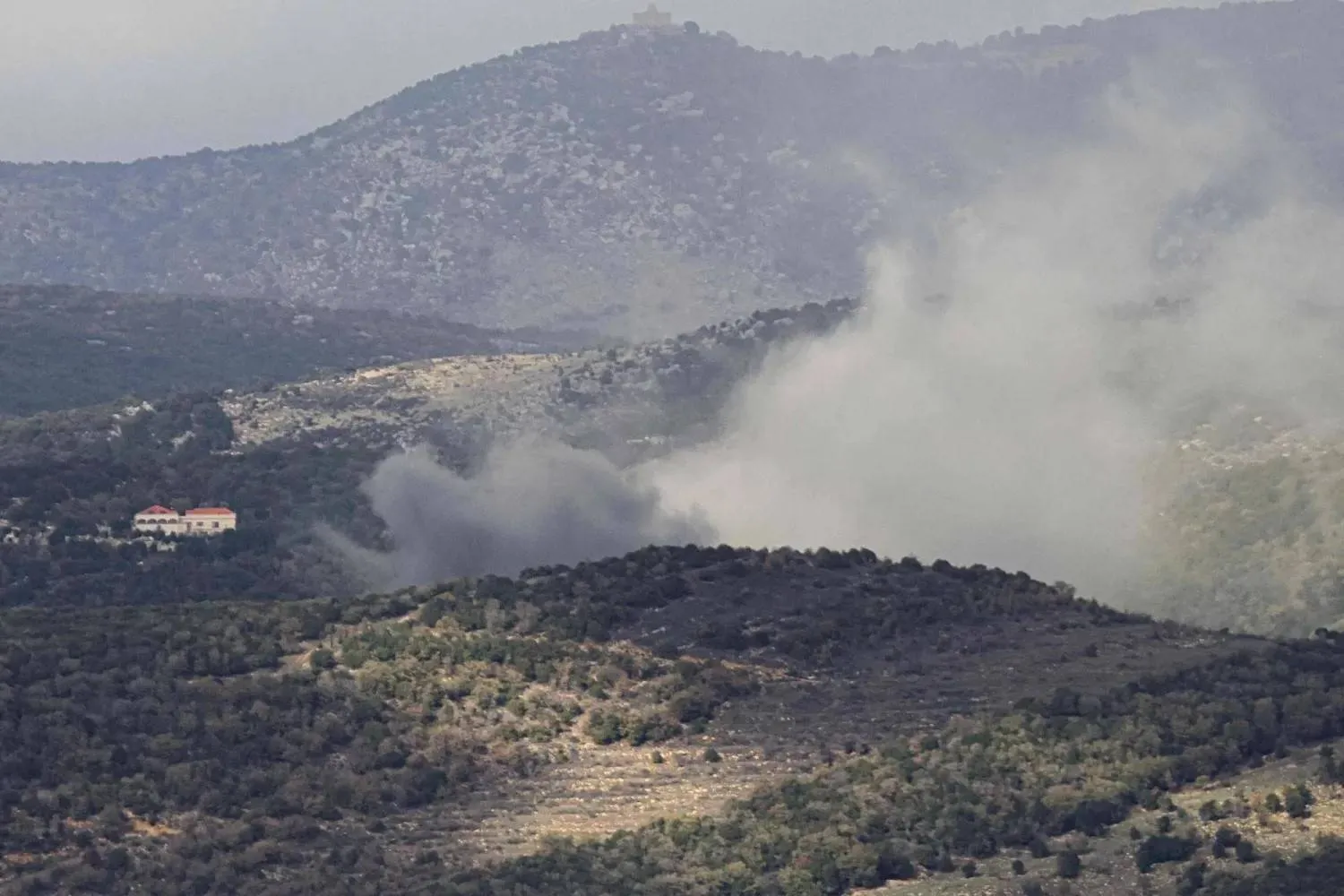
Smoke rises after Israeli airstrikes hit the Jabal al Rihan heights in southern Lebanon (AFP)
TT

Israel Resumes South Lebanon Strikes after Netanyahu-Trump Talks

Smoke rises after Israeli airstrikes hit the Jabal al Rihan heights in southern Lebanon (AFP)

Israel resumed airstrikes in southern Lebanon on Friday shortly after Prime Minister Benjamin Netanyahu returned from a visit to the United States, where he met US President Donald Trump, as Israeli officials signaled possible military action if Beirut fails to advance to the next phase of a plan to confine Hezbollah’s weapons north of the Litani River.

The ceasefire monitoring committee, also known as the mechanism, is tracking Lebanon’s political and diplomatic efforts, as well as local measures, aimed at preventing a renewed war.

The mechanism is expected to hold a military-level meeting next week to review developments.

Meanwhile, the Lebanese government is also due to receive a briefing next week from Lebanese Army Commander General Rodolphe Haykal on progress in implementing the state’s decision to contain the proliferation of weapons in stages.

Airstrikes resume

Israeli bombardment in Lebanon had eased after Netanyahu departed for the United States, with no intense airstrikes recorded as had been occurring on a weekly and repeated basis.

That situation changed following the end of the visit and Netanyahu’s return to Israel, where he is expected to meet Israeli officials on Saturday to brief them on his trip.

Lebanon’s state-run National News Agency reported that Israeli warplanes carried out airstrikes deep inside Lebanon, hitting the Louaizeh heights, the Mrouj Aqmata area in the Iqlim al Tuffah highlands, the Wadi Aazze Zefta area, the outskirts of Ansar in Nabatieh district, the Tabna area on the outskirts of Bissariyeh in the Zahrani region, and Mount Mashghara in the western Bekaa in eastern Lebanon.

The strikes totaled ten air raids, all within a contiguous geographic belt stretching from the coast to eastern Lebanon, north of the Litani.

Israeli army spokesman Avichay Adraee said on Friday that Israeli forces had carried out strikes on Hezbollah sites in several areas of southern Lebanon.

Writing on X, he said the army targeted what he described as terrorist infrastructure belonging to the group, including a training complex used by the Radwan Force, Hezbollah’s elite unit, and military buildings that he said were used to store weapons.

He said the presence of the targeted infrastructure and the conduct of military training constituted a violation of understandings between Israel and Lebanon.

North of the Litani

All the strikes hit deep valleys and uninhabited areas that have been repeatedly bombed since the ceasefire came into force in November 2024. The locations lie between about 20 kilometers east and 40 kilometers west of the border with Israel.

Earlier on Friday, an Israeli drone struck an excavator in the border town of Aita al Shaab.

Israeli warplanes also violated Lebanese airspace, flying at low altitude over villages in the Tyre district, while two Israeli aircraft breached the airspace over the city of Baalbek and surrounding villages in eastern Lebanon.

Israel has launched a new phase of military strikes since last month, focused on areas north of the Litani, after the Lebanese government announced the completion of the first phase of its plan to confine weapons to official military and security forces south of the river, and preparations to begin the second phase north of the Litani, extending to the Awali River, about 50 kilometers from the southern border.

Netanyahu’s deadline

The strikes followed the end of Netanyahu’s five-day visit to the United States.

Israel’s public broadcaster had reported earlier this week that Netanyahu instructed the military to suspend operations until his return, in order to avoid what it described as an unwanted entanglement during his meeting with Trump.

Israeli media reported on Friday that, upon Netanyahu’s return, security chiefs would be briefed on understandings and agreements reached with Trump.

Israeli media also suggested that Israel could act on its own if Lebanon fails to meet its commitments to implement weapons exclusivity north of the Litani, amid Hezbollah’s refusal to cooperate.

Hezbollah officials have said the priority should be for Israel to meet its obligations under the ceasefire, including withdrawing from occupied Lebanese points, halting attacks, releasing detainees, and launching reconstruction.

Hezbollah’s priorities

Hezbollah lawmaker Hassan Ezzedine said at a memorial event in southern Lebanon that the United States was trying, through politics, pressure and conspiracies, to achieve what Israel failed to accomplish militarily.

He said Lebanon and the resistance had fulfilled all obligations under the agreements, while Israel continued to evade any commitment.

He called on the Lebanese state and the sponsors of the agreement to compel Israel to stop its attacks, paving the way for an internal national dialogue on strategies to safeguard Lebanon’s strength and sovereignty, without foreign interference.

Ezzedine said the government had clear responsibilities outlined in its ministerial statement, foremost liberating land, stopping attacks, securing the release of detainees, and launching reconstruction.

He said inaction was unjustified, arguing the state could raise its voice in international forums, expose Israeli violations, issue a clear political decision mandating the Lebanese army to take all necessary measures to protect sovereignty, and ensure the return of citizens to their villages and properties, particularly in frontline areas.



MSF Says May Have to Halt Gaza Operations in March

Palestinians walk past destroyed buildings in the northern Gaza Strip, Friday, Jan. 2, 2026. (AP Photo/Jehad Alshrafi)
TT

MSF Says May Have to Halt Gaza Operations in March

Palestinians walk past destroyed buildings in the northern Gaza Strip, Friday, Jan. 2, 2026. (AP Photo/Jehad Alshrafi)

Banned from the Gaza Strip with 36 aid bodies, medical charity Doctors Without Borders said Saturday it will have to end its operations there in March if Israel does not reverse its decision.

UN secretary general Antonio Guterres called on Friday for Israel to end a ban on humanitarian agencies that provided aid in Gaza, saying he was "deeply concerned" at the development.

Israel confirmed on Thursday it is barring 37 major international humanitarian organizations from entering the Gaza Strip, accusing them of failing to provide the list of their employees' names, which is now officially required for "security" reasons.

MSF called this demand a "scandalous intrusion" but Israel says is needed to stop jihadists from infiltrating into humanitarian structures, AFP reported.

"To work in Palestine, in the occupied Palestinian territories, we have to be registered ... That registration expired on December 31, 2025," said Isabelle Defourny, a physician and president of MSF France, on France Inter.

"Since July 2025, we have been involved in a re-registration process and to date, we have not received a response. We still have 60 days during which we could work without being re-registered, and so we would have to end our activities in March" if Israel maintains its decision, she said.

MSF has around 40 international staff in the Gaza Strip and works with 800 Palestinian staff across eight hospitals.

"We are the second-largest distributor of water (in the Gaza Strip). Last year, in 2025, we treated just over 100,000 people who were wounded, burned, or victims of various traumas. We are second in terms of the number of deliveries performed," the president of MSF France said.

According to her, the Israeli decision is explained by the fact that NGOs "bear witness to the violence committed by the Israeli army" in Gaza.


Yemen Consultation, Reconciliation Body Says National Shield Camp Takeover is Peaceful

Yemen Consultation, Reconciliation Body Says National Shield Camp Takeover is Peaceful
TT

Yemen Consultation, Reconciliation Body Says National Shield Camp Takeover is Peaceful

Yemen Consultation, Reconciliation Body Says National Shield Camp Takeover is Peaceful

Akram al-Amri, deputy head of Yemen’s Consultation and Reconciliation Commission, stated that the operation to take over military camps, led by the National Shield forces under the command of Salem al-Khanbashi, Governor of Hadhramaut and head of the security committee, is not a military offensive operation.

Al-Amri said the move is peaceful in nature and aims to take over “military and security sites occupied by forces of the Southern Transitional Council (STC) that came from outside Hadhramaut.”

He said that all directives had been issued and all possible means had been exhausted to have the sites vacated voluntarily, in response to the demands of the people of the governorate.

Al-Amri, who also serves as secretary general of the Hadhramaut Inclusive Conference, called on the people of the governorate to stand by the National Shield forces and welcome them.

He also urged the STC leadership in Hadhramaut to opt for peace and preserve their land, saying, “There is no cause for concern. We are brothers, united by Hadhramaut.”

“Hadhramaut has launched a new political, economic, and development phase with comprehensive support from our brothers in the Kingdom of Saudi Arabia, which will be announced soon,” he revealed.

Separately, the Hadhramaut Inclusive Conference welcomed the announcement by al-Khanbashi, launching the “camp takeover” operation, describing it as a responsible step aimed at assuming control of military sites in a peaceful and orderly manner that strengthens state authority and preserves Hadhramaut’s security and stability.

In a statement, the conference stressed that the operation does not target any specific political or social group, does not impact civilians or citizens’ interests, and does not constitute an escalation or a declaration of war.

It stated that the move is a preventive measure to protect Hadhramaut from chaos and to prevent the use of military camps from threatening its security.

The conference commended the efforts of the legitimate state authorities, with the support of Saudi Arabia, to establish channels of dialogue and understanding, emphasizing that political solutions remain the most effective way to address disputes.

It added that obstructing these efforts compels the state to assume its constitutional responsibilities to protect citizens and prevent a slide into chaos.

The Hadhramaut Inclusive Conference reaffirmed its support for all prudent efforts that safeguard social peace and protect state institutions, and commended the Hadhramaut governor’s call on various social forces to play their national role during this sensitive phase.


UN Force in Lebanon Says Israeli Army Fired Near its Peacekeepers Twice

Joint patrol of the Lebanese army and UNIFIL (UNIFIL via Telegram)
TT

UN Force in Lebanon Says Israeli Army Fired Near its Peacekeepers Twice

Joint patrol of the Lebanese army and UNIFIL (UNIFIL via Telegram)

The United Nations Interim Force in Lebanon (UNIFIL) said gunfire from an Israeli position hit close to its peacekeepers twice on Friday, reporting no casualties but decrying a “concerning trend.”

UNIFIL has repeatedly reported Israeli fire near or towards its personnel in recent months, and last week said an Israeli attack near one of its positions lightly wounded a peacekeeper.

Personnel patrolling in south Lebanon on Friday “reported 15 rounds of small arms fire that struck no more than 50 meters away from them,” a UNIFIL statement said, according to AFP.

Shortly afterwards, “peacekeepers in a second patrol in the same area reported approximately 100 rounds of machine-gun fire struck approximately 50 meters from them,” it added, reporting no damage or injuries.

“Peacekeepers assessed that the fire came from an Israel army position south of the Blue Line in both cases,” the statement said, referring to the de facto border, and “sent a ‘stop fire’ request through its liaison channels.”

It said UNIFIL had informed the Israeli army about the peacekeepers’ activities in advance.

“Incidents like these are happening on a too-regular basis, and becoming a concerning trend,” the statement said.

“We reiterate our call to the Israeli army to cease aggressive behavior and attacks on or near peacekeepers working for peace and stability along the Blue Line.”

UNIFIL has acted as a buffer between Israel and Lebanon for decades, and recently has been working with Lebanon’s army to support a year-old ceasefire between Israel and Hezbollah.

The force on Friday noted that “attacks on or near peacekeepers are serious violations” of a 2006 UN Security Council resolution that formed the basis of the current ceasefire.

Under the November 2024 truce, Israel was to withdraw its forces from south Lebanon, but it has kept them at five areas it deems strategic and carries out regular strikes on Lebanon, usually saying it is targeting Hezbollah sites and operatives.

Under heavy US pressure and fears of expanded Israeli strikes, Lebanon has committed to disarming Hezbollah, starting in the south near the frontier.

Last August, the UN Security Council voted for the peacekeepers to leave Lebanon in 2027.