


Somalia Probes Use of Its Airspace, Territory in Al-Zubaidi’s Escape

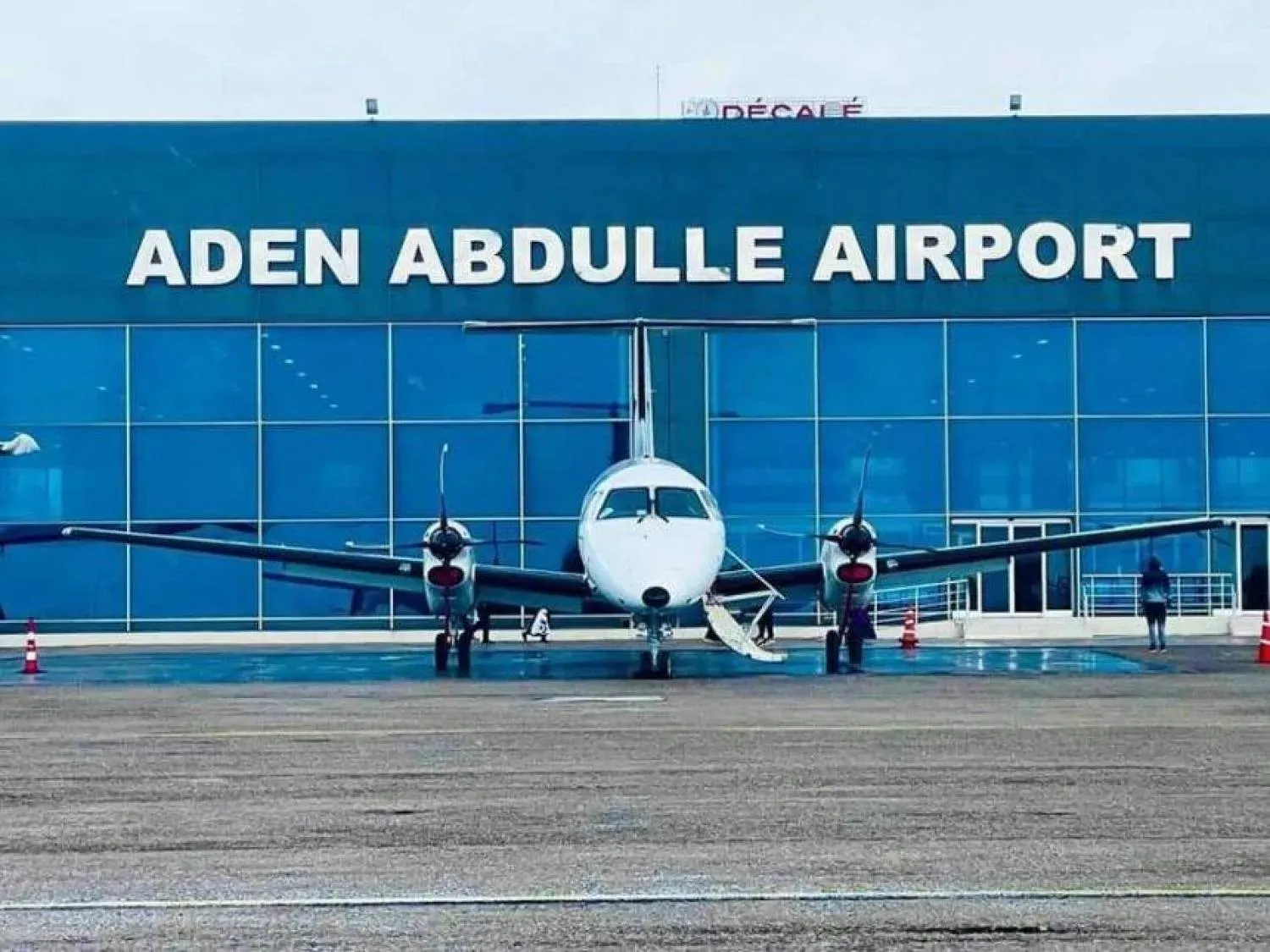
Aden Adde International Airport in Mogadishu. (SONNA)
TT

Somalia Probes Use of Its Airspace, Territory in Al-Zubaidi’s Escape

Aden Adde International Airport in Mogadishu. (SONNA)

Somalia opened an urgent investigation on Thursday into reports that its airspace and airports were used without authorization to facilitate the movement of Yemeni fugitive head of the Southern Transitional Council (STC) Aidrous al-Zubaidi in order to determine whether the alleged activity violated national law or established procedures and protocols.

A statement by Somalia’s Immigration and Citizenship Agency (ICA) emphasized that facilitating the entry of fugitives or undertaking unilateral actions on Somali territory without legal authorization is unacceptable.

It added that respect for sovereignty and adherence to national and international legal frameworks are principles that are not negotiable. Any such acts, if proven, would constitute a serious violation of national sovereignty and immigration laws, it said.

The statement said Somalia would take the necessary measures in line with the investigation’s findings to ensure full accountability for any confirmed violations, while reaffirming the country’s firm commitment to the rule of law, respect for international norms, and the protection of its sovereignty and territorial integrity.

It also confirmed Somalia’s support for Saudi Arabia’s call for southern dialogue in Riyadh as the appropriate political track to address the situation in Yemen, stating that any attempts to circumvent this process would directly undermine ongoing diplomatic efforts.

Earlier on Thursday, the Saudi-led coalition supporting Yemen’s legitimate government said al-Zubaidi and others had fled via a maritime vessel that departed the port of Aden toward Somaliland shortly after midnight on Wednesday, with its identification system switched off, arriving at the port of Berbera at around noon.

In a statement by its spokesman, Turki al-Maliki, the coalition stated, al-Zubaidi contacted Maj. Gen. Awad al-Ahbabi, commander of the UAE's joint operations, was to be informed of their arrival.

An Ilyushin Il-76 aircraft was waiting and took them on board under the supervision of Emirati officers, departing without specifying a destination before landing at Mogadishu airport at 3:15 p.m.

The statement said the aircraft waited at the airport for an hour before departing at 4:17 p.m. to travel via the Arabian Sea to the Arabian Gulf, without specifying a final destination.

The identification system was switched off over the Gulf of Oman and reactivated ten minutes before landing at Al Reef military airport in Abu Dhabi at 8:47 p.m. Saudi time.

The coalition said its forces were still tracking information on the fate of several individuals said to have been the last to meet al-Zubaidi before his escape from Aden, including Ahmed Lamlas, the former Aden governor, and Mohsen al-Wali, commander of the Security Belt Forces in the governorate, with whom contact has been lost.

On Wednesday, Yemen’s Presidential Leadership Council (PLC) Chairman Rashad al-Alimi issued a decree expelling al-Zubaidi from the council and referring him to the public prosecutor over accusations of crimes classified as high treason and acts undermining state security and unity.

The decree said investigations had established what it described as al-Zubaidi’s abuse of the southern cause and its exploitation to commit serious violations against civilians in southern governorates, in addition to harming the republic’s political and economic standing, attacking the constitution and constitutional authorities, and obstructing state efforts to confront the Houthi coup and rebellion.



Israel Scales Back from ‘Major Strike’ on Hezbollah, Opts for ‘Limited Attacks’

The Israeli flag, with part of the Israeli settlement of Ma’ale Adumim visible in the background in the occupied West Bank on August 14, 2025. (Reuters)
TT

Israel Scales Back from ‘Major Strike’ on Hezbollah, Opts for ‘Limited Attacks’

The Israeli flag, with part of the Israeli settlement of Ma’ale Adumim visible in the background in the occupied West Bank on August 14, 2025. (Reuters)

Informed sources in Tel Aviv said the Israeli strike on Lebanon on Friday was the response chosen by the military following remarks by Prime Minister Benjamin Netanyahu, who praised what he described as the Lebanese army’s “insufficient” efforts to disarm Hezbollah.

The strikes also followed a statement by the Lebanese government announcing the completion of the first phase of that mission.

Military sources, quoted across Israeli media, said Hezbollah “remains present in southern Lebanon and is seeking to restore its strength, reinforce its positions, resupply its forces with weapons, and maintain its tunnel network.”

These claims were used to justify a series of Israeli air strikes targeting southern and eastern Lebanon on Friday.

Despite Israel’s official skepticism toward the Lebanese army’s declaration that it had achieved the “objectives of the first phase” of disarming Hezbollah south of the Litani River — an announcement the Israeli military dismissed as “inaccurate and not reflective of the security reality on the ground” — Israeli thinking about launching a large-scale military response has cooled.

Political and military sources said Israel has “begun to retreat, for now, from the idea of a major strike and decided to settle for intense but limited attacks.”

Those same sources had previously said Netanyahu agreed with US President Donald Trump during a meeting in Florida last week to carry out a major strike against Hezbollah, in exchange for Netanyahu’s acceptance of most US demands regarding Gaza and Syria.

The rationale for striking Hezbollah is said to be ready and enjoys near consensus in Israel, with opinion polls showing 57 percent of the public in favor of an immediate attack.

On Wednesday, Netanyahu’s office issued an official statement asserting that the US-brokered ceasefire agreement between Israel and Lebanon “clearly stipulates the complete disarmament of Hezbollah,” describing this as “essential for Israel’s security and Lebanon’s future.”

According to Israel’s Haaretz newspaper, army sources say Hezbollah’s presence in the area “has not ended” and that the military “continues to monitor the group’s activities even now.”

While Israel views positively the Lebanese army’s acknowledgment that “tasks remain unfinished,” it doubts the army’s “ability to carry them out in practice.”

An Israeli military source said Tel Aviv’s assessment of the disarmament file “is not based on statements, but on operational data and results,” stressing that “as long as Hezbollah’s military infrastructure south of the Litani remains, there can be no talk of real disarmament.”

According to military sources cited by the Walla news site, Hezbollah has smuggled large quantities of weapons and bags containing millions of dollars across the Turkish border to rebuild its power and bolster its popular support.

While this underscores, in Israeli eyes, the inevitability of a major strike, the tone has shifted in recent hours.

Sources say Netanyahu fears such an operation now could divert attention from dramatic developments in Iran, where Israel, keenly interested in the regime’s collapse, does not want to distract from ongoing protests.


Mladenov Shuttle Talks between Israel and Ramallah Hasten Gaza Administration Committee

A general view shows the destruction in the Bureij refugee camp in central Gaza (AFP)
TT

Mladenov Shuttle Talks between Israel and Ramallah Hasten Gaza Administration Committee

A general view shows the destruction in the Bureij refugee camp in central Gaza (AFP)

Nickolay Mladenov, the man chosen to serve as the director-general for US President Donald Trump's Board of Peace in Gaza, discussed arrangements for the second phase of the ceasefire agreement with Palestinian Vice President Hussein al-Sheikh.

The meeting, which took place a day after Mladenov met with Israeli Prime Minister Benjamin Netanyahu, was viewed by experts speaking to Asharq Al-Awsat as increasing the chances of launching the second phase and announcing the formation of a body to administer Gaza.

Netanyahu had announced the selection of Bulgarian diplomat Mladenov, the former United Nations Middle East envoy from early 2015 until the end of 2020, to serve as director general of the Board of Peace, chaired by US President Donald Trump and tasked with overseeing the peace process in Gaza.

Al-Sheikh received Mladenov and his accompanying delegation on Friday at his office in the West Bank city of Ramallah, in the presence of Maj. Gen. Majed Faraj, head of the General Intelligence Service, according to the Palestinian News Agency, which did not describe Mladenov by his new American-appointed title.

The meeting discussed “the role of the Palestinian administrative committee and Palestinian police and security forces in assuming their duties and linking them to the Palestinian Authority, the holder of sovereignty and legitimacy, as well as ways to implement the second phase of President Trump’s plan as the announcement of the Board of Peace approaches.”

Al-Sheikh stressed the need to begin implementing the second phase, underlining the importance of a full Israeli withdrawal from the Gaza Strip as part of that phase, which includes ending Hamas rule, handing over its weapons, and moving toward reconstruction under President Trump’s plan.

He also stressed that the Gaza Strip is an integral part of the State of Palestine, highlighting the importance of political, administrative, and legal linkage between Palestinian institutions in Gaza and the Palestinian National Authority in the West Bank, and respect for the principle of one authority, one law, and one legitimate weapon.

Al-Sheikh said that while a transitional plan is being implemented in Gaza, there must be an urgent plan to halt all unilateral actions that violate international law, foremost among them settlement expansion, settler violence, and the release of withheld Palestinian funds.

On Thursday evening, the Israeli prime minister’s office said in a statement that Netanyahu insisted on the need to disarm Hamas and demilitarize Gaza, describing both as conditions under the Trump administration’s 20-point ceasefire plan.

Tarek Fahmy, a professor of political science specializing in Palestinian and Israeli affairs, said Mladenov is a professional diplomat with a good reputation and will be the board’s appointed director, despite being ranked second after former British Prime Minister Tony Blair, who did not enjoy widespread Arab acceptance.

Fahmy said Mladenov is “preparing the ground and accelerating steps toward announcing a technocratic committee under Palestinian leadership.”

Palestinian political analyst Abdul Mahdi Moutawe said Mladenov is not new to Gaza, noting his previous role at the UN in the Middle East.

He said Mladenov met Netanyahu and al-Sheikh to gauge positions and narrow differences in order to reach understandings leading to partial Palestinian administration of Gaza, which would expand as progress is made in the second phase, and depending on the ability to resolve obstacles, particularly those related to disarming Hamas and the enclave.

Under Trump’s 20-point peace plan for Gaza, the territory would be governed by a temporary Palestinian transitional committee composed of nonpartisan technocrats, under the supervision and oversight of the Board of Peace.

The US website Axios cited American officials and informed sources as saying Trump is expected to announce the Board of Peace this week as part of the second phase of the ceasefire agreement reached between Israel and Hamas, which took effect on Oct. 10.

Egyptian Foreign Minister Badr Abdelatty, in a phone call with UN Secretary-General Antonio Guterres on Thursday evening, stressed the importance of an Israeli withdrawal from Gaza, the announcement of a temporary Palestinian technocratic committee to administer the enclave, and the formation of an international stabilization force.

Fahmy expects the Board of Peace to be announced in the coming days, alongside pressure to announce the committee and avoid objections to proposed names, in order to begin implementing the second phase in earnest and away from any Israeli maneuvering or obstruction.

Moutawe believes the board and the administrative committee will be announced this week, allowing them to move forward with the second phase and begin its actual implementation.


Southern Transitional Council Dissolution Paves Way for Calm South Yemen Talks

A member of Yemeni government forces mans a machine gun on a pick-up truck while on patrol outside the headquarters of the Central Bank of Yemen in the southern port city of Aden, Yemen, 08 January 2026. (EPA)
TT

Southern Transitional Council Dissolution Paves Way for Calm South Yemen Talks

A member of Yemeni government forces mans a machine gun on a pick-up truck while on patrol outside the headquarters of the Central Bank of Yemen in the southern port city of Aden, Yemen, 08 January 2026. (EPA)

As Yemen’s government, led by the Presidential Leadership Council, moves to consolidate military and security authority in the south under the defense and interior ministries, it is seeking to contain the fallout from recent turmoil, prevent a return to rebellion, and avert a slide back into violence.

At the same time, political and social forces across the south face mounting pressure to revive a stalled political process capable of delivering practical and equitable solutions to crises, foremost among them the southern issue.

Recent developments, foremost among them the dissolution of the Southern Transitional Council itself, which occurred days after its head, Aidrous al-Zubaidi, fled Yemen have brought about a shift in the political and security power balances.

They have opened the way for a phase marked by the absence of major divisions, allowing space for calm arrangements and dialogue, with focus on the southern issue, amid fears of renewed unrest.

While Zubaidi’s exit and the folding of the Southern Transitional Council mark the end of a project that lasted more than eight years before sliding into chaos and violence in recent weeks, the legitimate government and the Saudi-led Arab coalition have shown significant flexibility toward its leaders.

Atiq Bahuqayba, a leader in the Socialist Party in Hadhramaut, has called for the implementation of what Rashad al-Alimi, chairman of the Presidential Leadership Council, stated during his visit to Hadhramaut in mid-2023, when he promised that the province would manage its own affairs fully.

Flexible governance

No southern settlement can pass without Hadhramaut playing an active role and having the most prominent voice in shaping it, especially in light of the events and developments it has witnessed, which explains the intensified political and security activity there in recent weeks.

Bahuqayba told Asharq Al-Awsat that the Hadhramaut Tribes Alliance remains committed to self-rule for the province, describing it as one of the core demands of its residents and its various political and social forces.

He said recent events involving forces from outside the province nearly dragged it into security and military chaos, were it not for the firmness of presidential decisions and Saudi intervention.

He added that the southern dialogue conference called for by Riyadh carries major importance for Hadhramaut and the south at this sensitive juncture, requiring all Hadhrami forces to participate effectively, while aligning with the local authority led by Governor Salem al-Khanbashi and the commander of the Nation Shield Forces in the province.

Once again, following the dissolution of the Southern Transitional Council, the southern issue has been returned to the fore. It opens the door to tangible gains on the ground, provided there is southern leadership capable of managing reality rather than retreating into violent rhetoric.

Developments over the years in Yemen have shown that engaging seriously with southern demands is more effective than ignoring or confronting them. Flexible governance enables stability and prevents the opening of new fronts, without undermining calls for justice and fairness.

Ali al-Khawlani, a Yemeni academic and political researcher, told Asharq Al-Awsat that the opportunity is now available for political action away from unilateral actions, after recent events demonstrated that there would be no tolerance for attempts to divide Yemen or for practices that harm the national security of neighboring countries, particularly those resembling the behavior of the Houthi group, which required a forceful response.

Al-Khawlani, who heads the Independent Yemeni Center for Strategic Studies, said that the dissolution of the Southern Transitional Council, following its leaders' agreement to participate in a south-to-south dialogue, places all southern forces under the responsibility of participating in decision-making.

He warned against any adventurism that could harm regional security or involve cooperation with forces seeking to sow chaos and instability.

Promoting a model

Political and social forces in Hadhramaut have pushed toward formulating solutions that are more sustainable, rejecting both the dismantling of the Yemeni state and a full return to pre-war centralization.

This has been prompted by calls for self-administration in southern provinces, led by the country’s largest province.

Hadhramaut plays a pivotal role in the country’s future, both generally and in the south in particular, as the province that has seen more stability than others during the war, despite complex circumstances. It is also the most attractive to governance models that move away from rigid centralization.

Ahlam Jaber, a political activist in the city of Mukalla, expects the upcoming dialogue conference in Riyadh to lead to a reordering of the southern political landscape on fair foundations that recognize realities on the ground, with Hadhramaut playing an effective role.

Jaber told Asharq Al-Awsat that Hadhramaut represents a model that could extend to other provinces, not only in the south, but across Yemen.

This, she said, would help untangle long-standing challenges and adjust approaches to managing crises. She pointed to the presence of a local authority that represents the province, a tribal alliance with significant social and security influence, as well as social, economic, academic, and administrative figures capable of shaping visions and setting strategies.

The post-Southern Transitional Council phase does not represent a political vacuum, but a repositioning. Backed by the firmness of the legitimate authority and support from the Saudi-led coalition, the south is moving toward a phase of stability that awaits a political resolution and a comprehensive settlement without renewed security tensions.