
Visiting EU Leaders Pledge to Support Syria’s Recovery After Years of Civil War

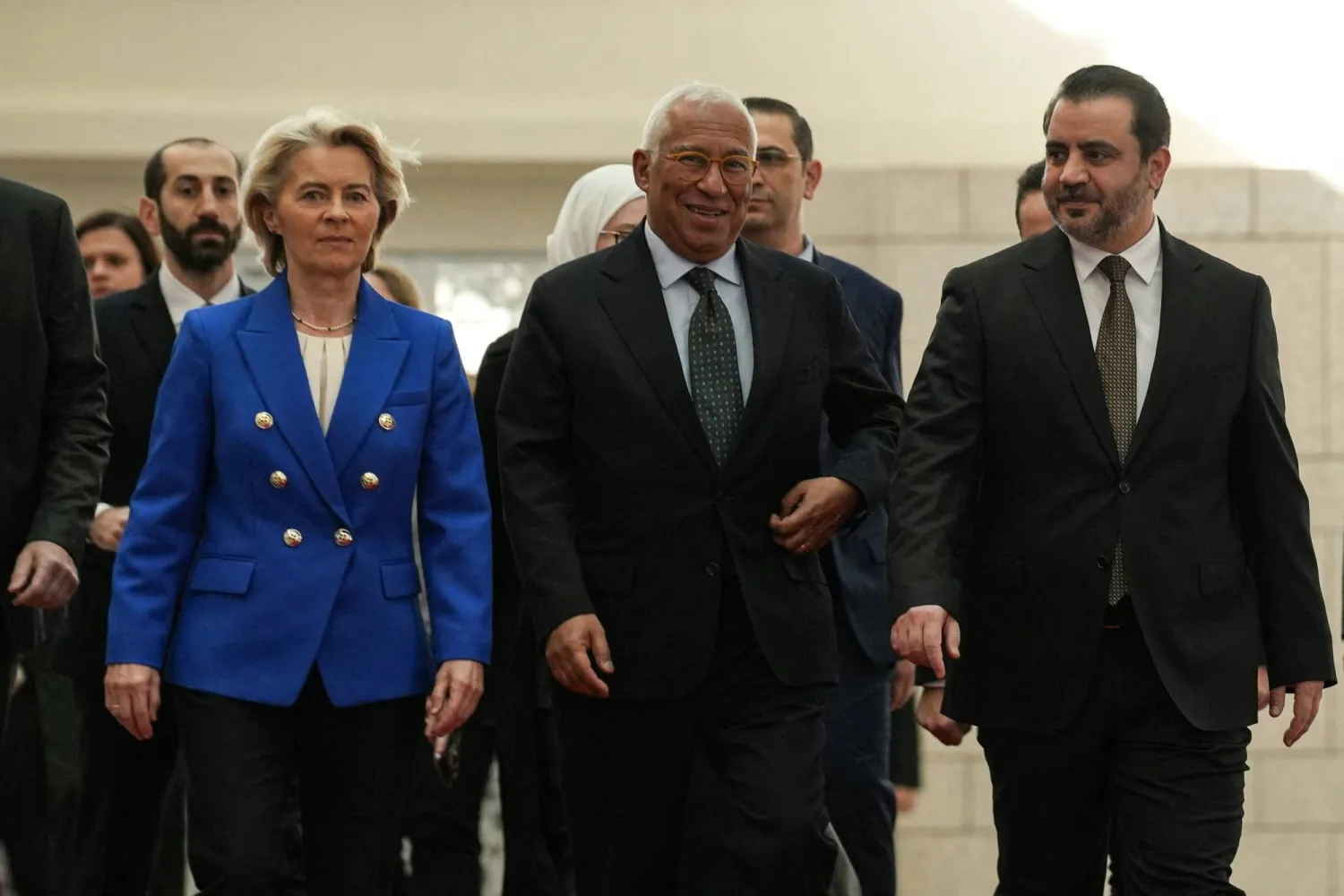
Syrian Minister of Foreign Affairs and Expatriates Asaad Al-Shaibani (R) receives European Council President Antonio Costa (C) and European Commission President Ursula von der Leyen, during an official visit to the People's Palace in the Syrian capital Damascus on January 9, 2026. (AFP)
TT

Visiting EU Leaders Pledge to Support Syria’s Recovery After Years of Civil War

Syrian Minister of Foreign Affairs and Expatriates Asaad Al-Shaibani (R) receives European Council President Antonio Costa (C) and European Commission President Ursula von der Leyen, during an official visit to the People's Palace in the Syrian capital Damascus on January 9, 2026. (AFP)

Senior officials from the European Union visited Syria for the first time Friday and met with Syrian interim President Ahmed al-Sharaa in the latest sign of the country’s improving relations with the West. 

European Commission President Ursula von der Leyen and the President of the European Council António Costa both made statements of support for Syria as it struggles to recover after nearly 14 years of civil war, which ended in December 2024 with the ouster of former President Bashar Assad in a lightning offensive led by Sharaa, then the leader of an opposition group. 

Sharaa has launched a largely successful diplomatic offensive and has restored relations with western and Arab countries that had shunned Assad’s government because of widespread reports of human rights abuses by his security forces before and during the war. 

During the visit, Costa said the EU will provide 620 million euros ($723 million) in financial support to Syria in 2026 and 2027, including humanitarian aid as well as assistance to begin with reconstruction. Aid for reconstruction was blocked by sanctions under Assad's rule, which have now been lifted. 

“After decades of fear and silence, Syrians began a long journey toward hope and renewal. Europe will do everything it can to support Syria’s recovery and reconstruction,” Von der Leyen posted on X. 

Since Assad’s fall, Syria has struggled economically and there have been several outbursts of sectarian violence. Sharaa’s government has also struggled to consolidate control over all of Syria. 

Clashes have broken out in recent days between Syrian government forces and Kurdish fighters in the northern city of Aleppo amid stalled negotiations for a merger between the new Syrian army and the Kurdish-led Syrian Democratic Forces that controls much of the country’s northeast. 

Syria's Defense Ministry announced a ceasefire Friday, though there was no public response from the SDF and it was not clear if Kurdish forces in Aleppo had agreed to the deal. 

Costa said during the visit that “the violent escalations of recent days are worrisome” and called for “continued dialogue.” 

“We know that the path to reconciliation and recovery remain difficult and long," he said. "Healing, rebuilding lives and creating trust in institutions takes time. 

The EU delegation continued a regional tour with a visit to Lebanon, where the army on Thursday announced it had completed the first stage of a plan to remove weapons from nonstate groups, including Hezbollah. 

Von der Leyen welcomed the announcement that the disarmament plan has been implemented in the border area south of the Litani River, adding that the EU was “ready to step up our cooperation" to support the cash-strapped military. 

She called for a ceasefire deal that ended the latest Israel-Hezbollah war in November 2024 to be “fully respected by all parties.” 

“Lebanon’s sovereignty and territorial integrity has to be upheld,” von der Leyen said. “And it is paramount to ensure that Hezbollah is fully disarmed.” 

Israel has continued to carry out near-daily airstrikes in Lebanon since the ceasefire, which it says target Hezbollah attempts to rebuild its capabilities, and has threatened to step up the attacks if the group does not fully disarm. 


Strike Kills 2 Academics at Lebanese University as Israel Bombs Central Beirut

People stand amid debris in front of damaged buildings in the aftermath of a reported Israeli strike in Zuqaq al-Blat, central Beirut, Lebanon March 12, 2026. REUTERS/Mohamed Azakir
TT

Strike Kills 2 Academics at Lebanese University as Israel Bombs Central Beirut

People stand amid debris in front of damaged buildings in the aftermath of a reported Israeli strike in Zuqaq al-Blat, central Beirut, Lebanon March 12, 2026. REUTERS/Mohamed Azakir

An Israeli strike that hit in the vicinity of Lebanon’s only public university killed the director of the faculty of sciences Hussein Bazzi and professor Mortada Srour.

The campus is in Hadath, on the outskirts of Beirut’s southern suburbs, which Israel had warned last week should be evacuated.

It was not clear whether the campus was directly targeted, but smoke could be seen rising near the building’s courtyard in the aftermath.

Lebanese President Joseph Aoun condemned the bombing, which he said targeted the campus, as a crime and a “violation of international laws and norms that prohibit attacks on educational institutions and civilians.”

Israel’s military said Thursday night it had begun another wave of strikes on Lebanon’s capital, saying it was targeting Hezbollah sites.

Israeli strikes hit two buildings in busy residential and commercial districts near central Beirut.


How Israel Crippled Gaza's Fishing

A Palestinian man stands on the door of a refrigerator that he uses as a makeshift rowing boat, as he throws his fishing basket into the sea at the port of Gaza City on March 9, 2025. (Photo by BASHAR TALEB / AFP)
TT

How Israel Crippled Gaza's Fishing

A Palestinian man stands on the door of a refrigerator that he uses as a makeshift rowing boat, as he throws his fishing basket into the sea at the port of Gaza City on March 9, 2025. (Photo by BASHAR TALEB / AFP)

Fishermen in Gaza say they are facing their toughest conditions since the start of the Israeli war, with Israeli forces preventing them from accessing the sea to earn a living and exposing them to gunfire or arrest, both during periods of truce and even after the ceasefire reached last October.

Israeli forces target Gaza fishermen with live ammunition or detain some for allegedly violating bans on fishing or even diving. Restrictions imposed on Gaza residents also leave them largely unable to swim.

Nafez Jarbou, 53, a fisherman from the Beach refugee camp west of Gaza City, told Asharq Al-Awsat that Israeli naval boats destroyed his fishing vessel during the war. He supports a family of 16, including four relatives who worked with him in fishing, all of whom lost their livelihoods.

“When the first truce began in January 2025, we tried to return to fishing using another boat belonging to neighbors whose sons, also fishermen, were killed by Israeli forces,” Jarbou said. “But we were surprised to find we were still barred from fishing.”

Hope briefly returned after the ceasefire was announced. But Jarbou said that, like thousands of other fishermen, he encountered “severe restrictions.” He later tried to resume fishing with his sons within less than one nautical mile from Gaza City’s shoreline.

Israeli naval boats continued to pursue them, opening fire or attempting to arrest them and confiscate their boats, he said.

Diving replaces fishing

With traditional fishing routes effectively closed despite the ceasefire, Gaza’s fishing activity has sharply declined. Even fishing within a one-nautical-mile range has become increasingly restricted.

Faced with these limits, fishermen have turned to diving with simple, rudimentary equipment to avoid being pursued or targeted.

But Jarbou said diving prevents them from catching most types of fish.

“All we can catch now is small sardines, which are not in high demand,” he said.

According to the Gaza Fishermen’s Union, more than 5,000 fishermen worked in the sector before the war.

At least 235 have been killed during Israeli military operations, most in airstrikes that hit their homes or the homes of relatives.

Another 40 fishermen were killed, and dozens were wounded while working at sea at extremely short distances from shore, sometimes less than 500 meters, and in some cases just 200 meters. Israeli forces have also arrested around 43 fishermen.

Mohammed al-Habil, 31, from the Beach refugee camp, was recently released after being detained off Gaza City’s coast.

“We went through a long ordeal in prison after I was arrested with two of my relatives while working at sea to make a living,” he told Asharq Al-Awsat.

Al-Habil said interrogators did not focus on his fishing work but instead sought “information about Hamas members in my area.”

He added that Israeli forces have long targeted fishermen, even before the latest war, attempting to arrest them and recruit them as informants.

“Words cannot describe our living conditions,” he said. “We have joined the large army of unemployed in Gaza.”

He questioned the role of mediators overseeing the ceasefire in ensuring safety for fishermen and allowing them to work at least within two or three nautical miles, an area he said “would not pose any security threat to Israel.”

“Starvation policy”

Zakaria Bakr, head of the Union of Workers in Gaza’s fishing sector, said Israel is “deliberately depriving fishermen of work at sea to starve them,” describing the move as part of a collective punishment policy against the enclave.

Preventing fishing, even within limited distances, despite the ceasefire shows the main goal is to destroy what remains of the fishing sector, which has already suffered heavy damage since the war began, he said.

“What is happening is the destruction of fishermen by depriving them of their livelihoods,” Bakr told Asharq Al-Awsat.

Each fisherman supports at least four family members who depend on the fish they sell, fish that are now largely unavailable under current restrictions imposed by Israel, he said.

The Gaza Center for Human Rights said Israel has imposed strict restrictions aimed at the comprehensive destruction of the fishing sector’s infrastructure and deepening a policy of starvation affecting thousands of fishermen’s families.

The group said Israeli forces destroyed trawlers and large fishing vessels, the backbone of Gaza’s fish production, inside the main Gaza port and the harbors of Khan Younis and Rafah, putting them permanently out of service.

More than 95% of small boats and more than 100 larger vessels have been destroyed, along with fishing equipment and boat-building workshops, it said.


UN: Over 200 Civilians Reported Killed in Sudan Drone Strikes Since March 4

Residents receive aid from World Food Programme (WFP) at Al-Omada neighbourhood of Omdurman, the twin city of Khartoum on March 11, 2026. (Photo by Ebrahim Hamid / AFP)
TT

UN: Over 200 Civilians Reported Killed in Sudan Drone Strikes Since March 4

Residents receive aid from World Food Programme (WFP) at Al-Omada neighbourhood of Omdurman, the twin city of Khartoum on March 11, 2026. (Photo by Ebrahim Hamid / AFP)

UN rights chief Volker Turk said Thursday he was "appalled" at reports that more than 200 civilians had been killed by drone attacks in Sudan since March 4.

"It is deeply troubling that despite multiple reminders, warnings and appeals, parties to the conflict in Sudan continue to use increasingly powerful drones to deploy explosive weapons with wide-area impacts in populated areas," Turk said in a statement.

Dozens of civilians have been killed in drone strikes across southern Sudan over the past two days, medical sources told AFP on Wednesday, as some of the heaviest fighting of the nearly three-year war grips the region.

Sudan has been riven by conflict since April 2023, when a power struggle between the regular army and the Rapid Support Forces (RSF) plunged the country into a war that has killed tens of thousands and displaced millions.

Since the war broke out, both sides have been accused of war crimes, including targeting civilians and indiscriminately shelling residential areas.