


Oil Prices Surge While Asian Share Prices Rise Moderately

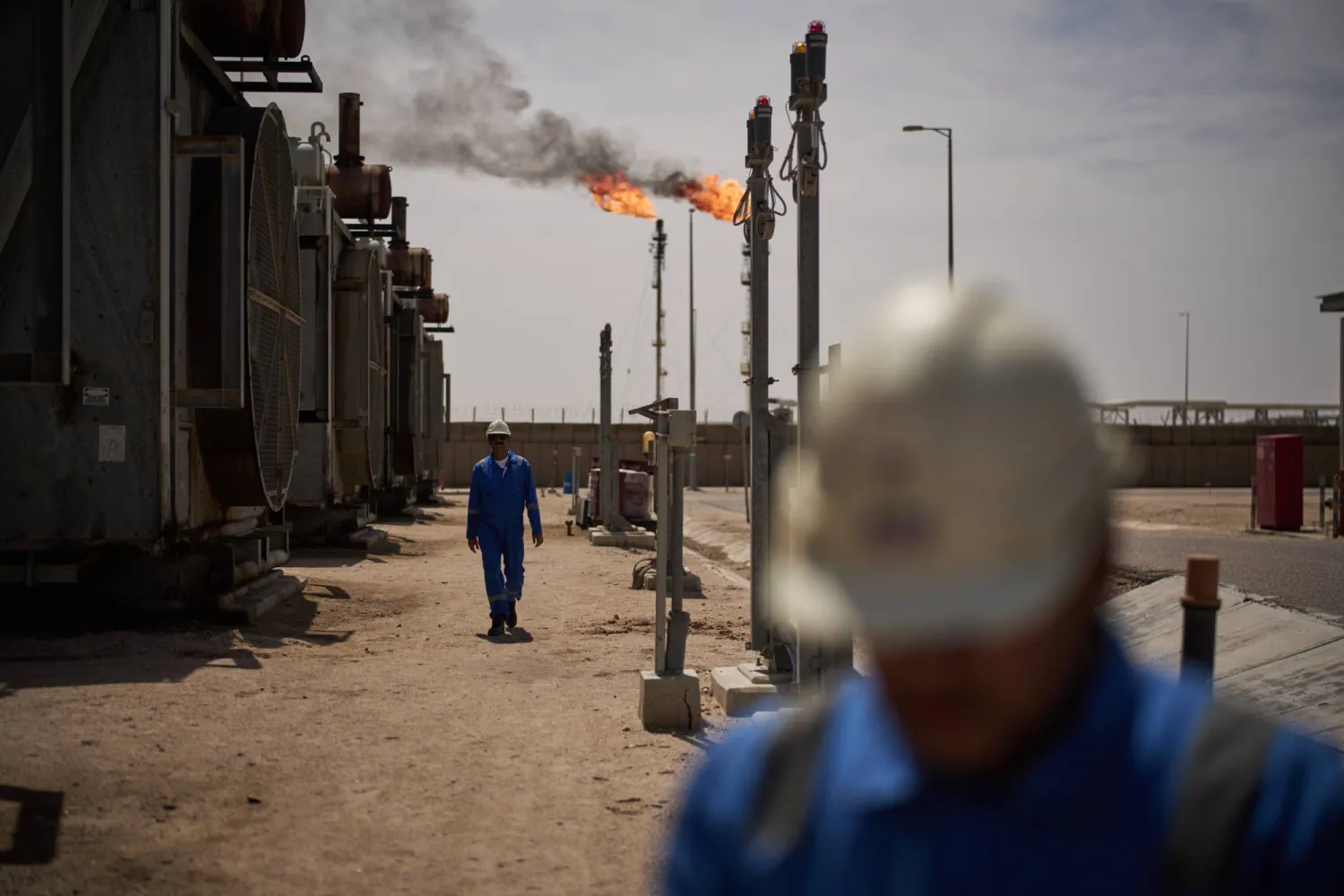
FILE - Workers walk in an area at a degassing station in Zubair oil field, whose operations have being reduced due to the Mideast war triggered by the US and Israeli attacks on Iran, near Basra, Iraq, March 28, 2026. (AP Photo/Leo Correa, File)
TT

Oil Prices Surge While Asian Share Prices Rise Moderately

FILE - Workers walk in an area at a degassing station in Zubair oil field, whose operations have being reduced due to the Mideast war triggered by the US and Israeli attacks on Iran, near Basra, Iraq, March 28, 2026. (AP Photo/Leo Correa, File)

Oil prices continued to surge on worries of a prolonged Iran war but the Asian markets that were open Friday rose moderately in cautious trading, while others were closed for the Good Friday holidays.

Benchmark US crude rose 11.4% to $111.54 a barrel. The price of Brent crude, the international standard, jumped 7.8% to $109.03 per barrel, The Associated Press said.

“A more extended conflict raises the threat to physical infrastructure, extends disruptions through the Strait of Hormuz, and will entail a longer post-war recovery period, with price impacts spilling over later into the year,” according to a report from BMI, a unit of Fitch Solutions.

The US only relies on the Arabian Gulf for a fraction of the oil it imports, but oil is a commodity and prices are set in a global market.

The situation is very different in Asia. Japan, for example, relies on access to the Strait of Hormuz for much of the nation’s oil import needs and would need to rely on alternative routes. But some analysts say Japan and other nations are counting on an agreement with Iran to allow transports.

Japan’s benchmark Nikkei 225 gained 0.9% in Friday morning trading to 52,938.62. South Korea’s Kospi jumped 2.1% to 5,344.41. The Shanghai Composite sank 0.5% to 3,899.57. Trading was closed in Hong Kong, Singapore, Australia, New Zealand, the Philippines, Indonesia and India.

Wall Street, where trading is closed Friday, finished its first winning week since the start of the Iran war, although trading started out with a decline driven by a surge in oil prices.

That came after US President Donald Trump late Wednesday vowed the US will continue to attack Iran and failed to offer a clear timetable for ending the conflict in the Middle East.

The S&P 500 rose 7.37 points, or 0.1%, to 6,582.69. Several days of solid gains this week helped the benchmark index notch a 3.4% gain for the week. The Dow Jones Industrial Average fell 61.07 points, or 0.1%, to 46,504.67. The Nasdaq composite rose 38.23 points, or 0.2%, to 21,879.18. Both indexes also notched weekly gains.

Treasury yields remained relatively steady in the bond market. The yield on the 10-year Treasury fell to to 4.30% from 4.32%.

In currency trading, the US dollar edged up to 159.66 Japanese yen from 159.53 yen. The euro cost $1.1535, inching down from $1.1537.




From Asia to the Americas: Governments Race to Contain Energy Shock

A gas station in Los Angeles, California (AFP) 
TT

From Asia to the Americas: Governments Race to Contain Energy Shock

A gas station in Los Angeles, California (AFP) 

Governments worldwide are moving swiftly to contain the fallout from a sharp rise in energy costs, as global supply disruptions linked to the US-Israeli war on Iran rattle markets.

Surging fuel and electricity prices have prompted urgent steps to protect consumers and secure supplies, with mounting pressure on economies.

In Asia, India has taken measures to safeguard domestic supply, signaling a potential review of fuel exports if needed while prioritizing the local market. Requests from neighboring countries for fuel will be met only if surplus is available.

Authorities have also barred consumers connected to piped gas networks from using liquefied petroleum gas cylinders to manage demand. New Delhi has invoked emergency powers, directing refiners to maximize cooking gas output while cutting industrial supplies to meet household needs.

South Korea is boosting domestic energy production by easing restrictions on coal-fired plants and increasing nuclear utilization to 80 percent of capacity. It is also considering additional support vouchers for vulnerable households. To bolster supply, Seoul has begun implementing a ban on naphtha exports.

China has imposed restrictions on refined fuel exports as a precaution against domestic shortages, while allowing drawdowns from fertilizer reserves to support agriculture ahead of the spring season.

In Southeast Asia, Singapore will accelerate previously announced budget support measures to ease pressure on households and businesses. Indonesia aims to increase coal output, is weighing export taxes, and plans a biofuel program using a diesel–palm oil blend. Cambodia is importing additional fuel from Singapore and Malaysia to offset shortages.

Japan will temporarily ease restrictions to expand coal-fired power generation for one year and has called for coordination through the Group of Seven and the International Energy Agency to stabilize markets. It has also asked Australia to boost liquefied natural gas output.

Elsewhere, the Philippines has suspended wholesale spot electricity trading due to price volatility and supply risks, while activating a 20 billion peso emergency fund.

Vietnam is accelerating a shift to ethanol-blended gasoline, and Australia is drawing on fuel reserves to address shortages, particularly in rural areas, while warning of prolonged economic impacts. Authorities have urged reduced fuel use, including greater reliance on public transport.

Europe acts

European Union institutions have called for temporary measures, including cuts to electricity taxes and network charges, alongside direct support for households.

Italy is considering reducing fuel levies and may impose windfall taxes on companies benefiting from the crisis. Spain is preparing aid and tax relief for households and hard-hit sectors.

In Eastern Europe, Romania has cut diesel excise duties. Serbia has reduced fees on crude oil and extended a ban on exports of oil and derivatives. Slovenia has imposed temporary limits on fuel purchases.

Greece announced 300 million euros in support for fuel and fertilizers, along with reduced maritime transport costs to ease pressure on consumers and farmers.

Americas, Africa respond

In Latin America, Argentina has postponed fuel tax increases. Brazil has scrapped federal diesel taxes, imposed a levy on oil exports and unveiled plans to support fuel imports at the state level.

In Africa, South Africa has temporarily reduced fuel taxes, Ethiopia has increased subsidies, and Namibia has cut fuel levies by 50 percent for three months. Other countries are considering similar steps.

In the Middle East and North Africa, Egypt has capped prices for unsubsidized bread and raised procurement prices for local wheat to strengthen strategic reserves.

Other measures include tax cuts in North Macedonia, energy-saving steps in Mauritius, efforts to secure additional supplies in Sri Lanka and a possible reduction in value-added tax on fuel in Poland.

The breadth of these actions underscores the scale of the global response, as governments seek to cushion households and economies from rising energy costs. Amid persistent geopolitical tensions, policymakers continue to adjust strategies to manage supply risks and price volatility.


IMF Urges BOJ to Keep Raising Rates Even as Iran War Poses New Risks

FILE PHOTO: Bank of Japan Governor Kazuo Ueda attends a press conference after a BOJ policy meeting in Tokyo, Japan, March 19, 2026. REUTERS/Kim Kyung-Hoon/File Photo
TT

IMF Urges BOJ to Keep Raising Rates Even as Iran War Poses New Risks

FILE PHOTO: Bank of Japan Governor Kazuo Ueda attends a press conference after a BOJ policy meeting in Tokyo, Japan, March 19, 2026. REUTERS/Kim Kyung-Hoon/File Photo

The International Monetary Fund urged the Bank of Japan to continue raising interest rates, even as the Middle East war posed "significant new risks" to the country's economic outlook.

The proposal comes amid market expectations the BOJ will raise interest rates as soon as April in the face of mounting inflationary pressure from the conflict-induced spike in oil prices, and higher import costs blamed on the weak yen, Reuters said.

While growth is expected ‌to moderate, due ‌partly to the Iran war, gradual wage gains will ‌underpin ⁠consumption, the IMF ⁠said in a statement issued from Washington on Friday after the conclusion of its policy consultation with Japan.

"Risks to the outlook and inflation are broadly balanced" with inflation expected to converge to the BOJ's 2% target in 2027, the IMF said.

In the statement, the IMF said its executive board commended Japan's "strong economic resilience" to global shocks and agreed the BOJ was appropriately withdrawing monetary accommodation.

"They noted ⁠that as underlying inflation converges toward the BOJ's target, ‌gradual rate hikes toward neutral should continue" in ‌a flexible, well-communicated and data-dependent approach, the statement said.

"Directors stressed the importance of maintaining ‌a flexible exchange rate as a credible shock absorber," it added.

The BOJ ‌ended a massive stimulus in 2024 and raised interest rates several times, including in December, on the view that Japan was on the cusp of durably hitting its 2% inflation target.

The central bank has stressed its readiness to keep raising rates on the ‌expectation that underlying inflation will converge to its 2% target sometime from the second half of fiscal 2026 into ⁠fiscal 2027.

Japan's ⁠fiscal year starts in April. While rising oil prices hurt Japan's import-reliant economy, BOJ policymakers have signaled their concern they will add to inflationary pressures from years of steady wage gains and broader price increases. The BOJ's slew of hawkish communication has prodded markets to price in a roughly 70% chance of a rate hike in April.

The yen's slide towards the key 160-per-dollar level has also kept markets on alert for the chance of currency intervention by Japanese authorities. Finance Minister Satsuki Katayama issued a fresh warning against yen bears on Friday, saying Japan stood ready to act against speculative moves in the currency market. "We're ready to take all available means that are legally feasible, be it conventional or non-conventional," she told an online program on Friday evening.


Iraq in Talks with Gulf States on Pipeline Exports beyond Hormuz

Workers carry out maintenance on a pipeline at a gas separation station in the Zubair oil field near Basra (AP). 
TT

Iraq in Talks with Gulf States on Pipeline Exports beyond Hormuz

Workers carry out maintenance on a pipeline at a gas separation station in the Zubair oil field near Basra (AP). 

Iraq is in talks with Gulf countries to use their pipeline networks to secure alternative oil export routes beyond the Strait of Hormuz, the state oil marketer SOMO said Thursday.

The move is part of an emergency strategy by the oil ministry to tap regional infrastructure and bypass maritime chokepoints, ensuring Iraqi crude continues to reach global markets while offsetting higher transport costs linked to the current crisis.

Ali Nizar al-Shatari, head of the State Organization for Marketing of Oil (SOMO), said the ministry is prioritizing negotiations to access Gulf pipeline systems extending beyond the Strait of Hormuz and into the Arabian Sea, allowing exports to avoid areas of military tension.

“The goal is to secure stable routes that guarantee efficient flows of Iraqi oil at lower transport costs,” Shatari said, adding that Iraq generated about $2 billion in oil revenues in March, up 28 percent from February.

He said SOMO exported around 18 million barrels of crude from Basra, Kirkuk and the Kurdistan region by using all available outlets, including southern ports that operated until early March and northern routes to Türkiye’s Mediterranean port of Ceyhan.

As part of efforts to diversify export options, Shatari revealed that the first shipments of fuel oil and Basra Medium crude successfully reached Syrian ports.

He noted that Iraq had signed a deal to export 50,000 barrels per day via this route, describing cooperation with Syria as “very significant,” with storage and security provided to ensure safe delivery to the port of Baniyas.

The route has proven effective and could become a permanent option after the crisis, he added.

Shatari further noted that the oil ministry is close to completing repairs on the Iraq-Türkiye pipeline, which suffered extensive damage in previous years.

Technical teams have inspected the most difficult terrain, with about 200 kilometers (125 miles) still to be assessed in the coming days before full pumping of Kirkuk crude resumes.

In a notable logistical move, Iraq has begun pumping Basra crude northwards for export via Ceyhan.

Flows started at 170,000 barrels per day and are expected to stabilize between 200,000 and 250,000 bpd, helping offset disrupted southern exports and supply energy-hungry markets in Europe and the Americas.

Shatari said Iraq has benefited from rising global prices by selling Kirkuk crude — a medium-grade oil — at strong premiums.

He also confirmed the reactivation of an agreement with the Kurdistan region to reuse the pipeline through the region to Ceyhan, helping lift total exports to 18 million barrels in March.

This came despite a drop in production in Kurdistan fields to about 200,000 bpd due to security threats, he added.
