


Egypt Unveils a Striking Trove of Ancient Artifacts as the Country Tries to Boost Tourism Industry

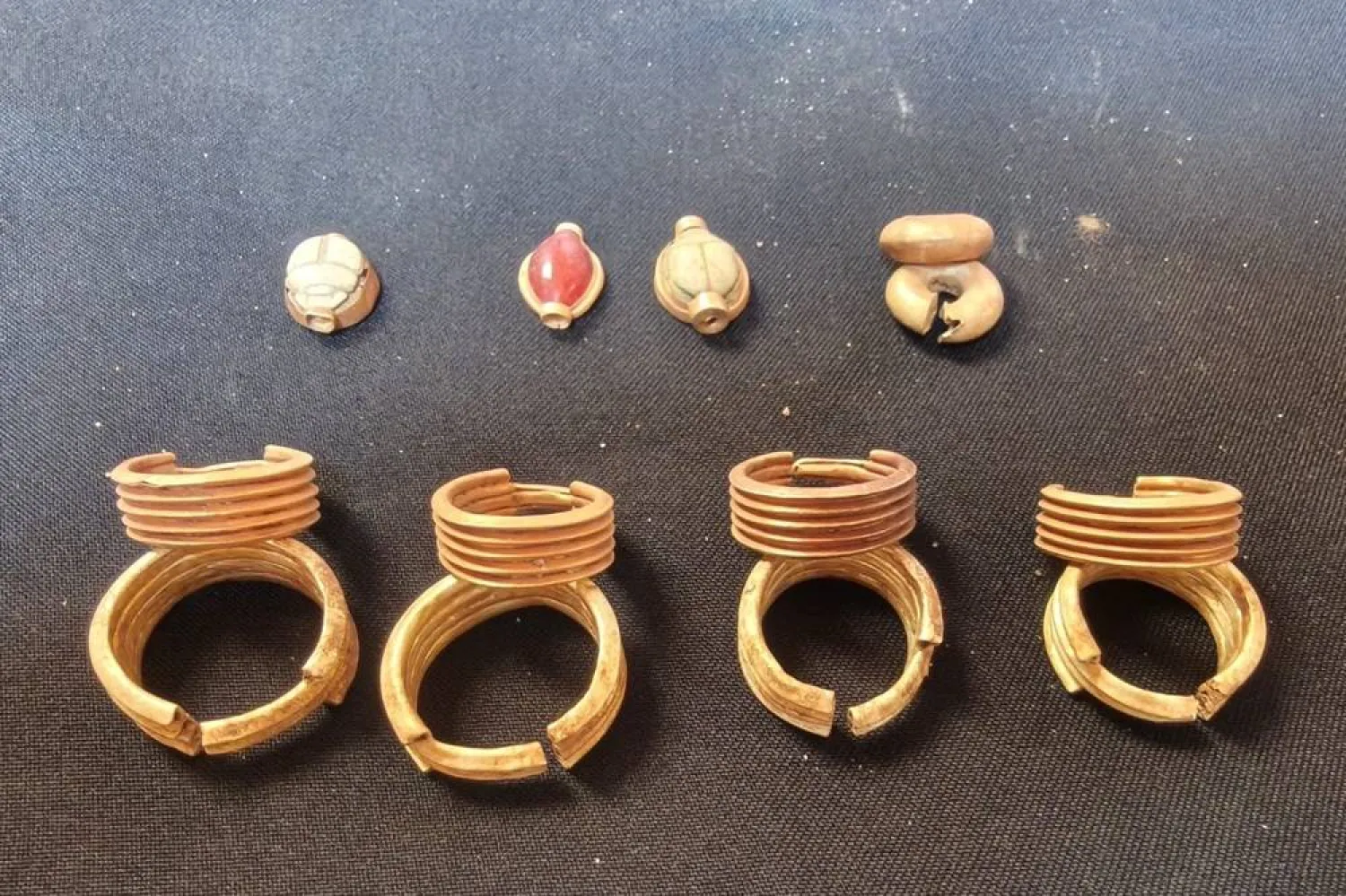
 In this photo provided by Ministry of Tourism and Antiquities, recently unearthed ancient artifacts are displayed on May 31, 2026, in Ehnasiya district in Beni Suef, 130 kilometers (80 miles) south of Cairo, Egypt. (Ministry of Tourism and Antiquities via AP)
In this photo provided by Ministry of Tourism and Antiquities, recently unearthed ancient artifacts are displayed on May 31, 2026, in Ehnasiya district in Beni Suef, 130 kilometers (80 miles) south of Cairo, Egypt. (Ministry of Tourism and Antiquities via AP)
TT

Egypt Unveils a Striking Trove of Ancient Artifacts as the Country Tries to Boost Tourism Industry

 In this photo provided by Ministry of Tourism and Antiquities, recently unearthed ancient artifacts are displayed on May 31, 2026, in Ehnasiya district in Beni Suef, 130 kilometers (80 miles) south of Cairo, Egypt. (Ministry of Tourism and Antiquities via AP)
In this photo provided by Ministry of Tourism and Antiquities, recently unearthed ancient artifacts are displayed on May 31, 2026, in Ehnasiya district in Beni Suef, 130 kilometers (80 miles) south of Cairo, Egypt. (Ministry of Tourism and Antiquities via AP)

Archaeologists unearthed a set of ancient artifacts in Egypt including Pharaonic funerary furniture, remains of a Roman basilica and a marble head of Aphrodite, the ancient Greek goddess of love and beauty.

The discoveries, announced Sunday, are part of the Egyptian government’s efforts to boost the country’s tourism industry and bring cash to the economy. At the center of these efforts was the November inauguration of the long-delayed Grand Egyptian Museum, a megaproject located near the famed Giza Pyramids and the Sphinx.

The remains of the basilica and Aphrodite’s head were found in an ancient necropolis in the province of Beni Suef, 130 kilometers (80 miles) south of Cairo, the Tourism and Antiquities Ministry said.

The Ehnasiya necropolis, which is also known by its ancient Roman name, Heracleópolis Magna, was one of the most significant cities of ancient Egypt.

Archaeologist Mohammed Abdel-Badei, head of the antiquities department at the Supreme Council of Antiquities, said that they found large stone blocks supporting columns, weighing up to 45 tons, that had been used in building the basilica. Three of the blocks remain standing in their original positions, he said.

Aphrodite’s head, measuring about 24 centimeters by 25 centimeters (9½ inches by nearly 10 inches), includes detailed features of the goddess' face and curly hair, reflecting the classical artistic traditions of the Greek and Roman periods, he said.
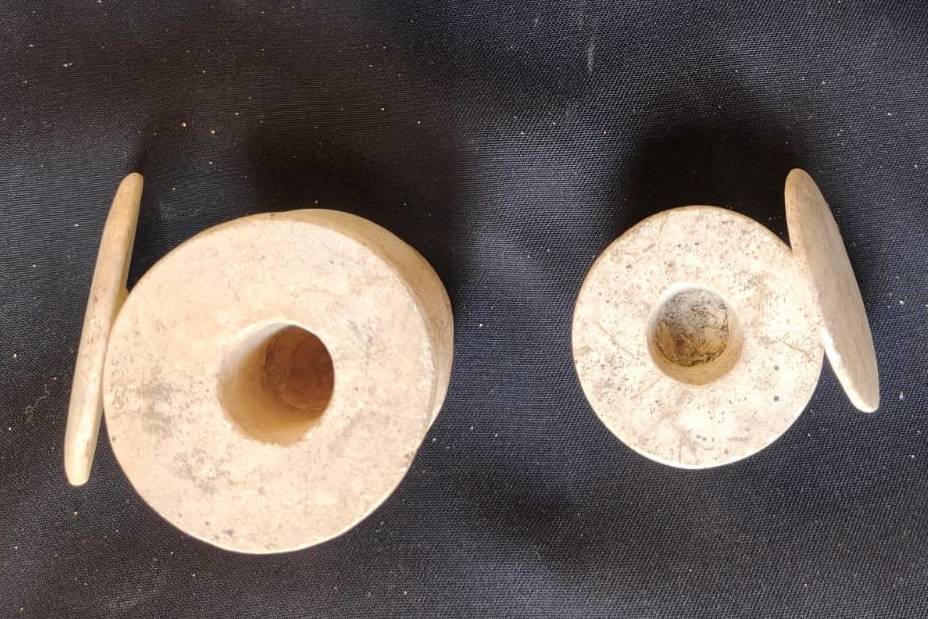
In this photo provided by Ministry of Tourism and Antiquities, recently unearthed ancient artifacts are displayed on May 31, 2026, in Ehnasiya district in Beni Suef, 130 kilometers (80 miles) south of Cairo, Egypt. (Ministry of Tourism and Antiquities via AP)

Archaeologists found inscriptions linked to Senusret III, who ruled between 1837 B.C. and 1819 B.C. during the ancient 12th Dynasty. The inscriptions include his throne, birth names of the Pharaoh, who is also known as Sesostris III, and was one of the most prominent rulers of Egypt’s Middle Kingdom.

Also unearthed were fragments of wall statues and terracotta molds, believed to have been used in coin crafting during the Roman period.

The findings show that Ehnasiya had been an active economic and commercial hub when Egypt was part of the Roman Empire between 30 B.C. and A.D. 395, Abdel-Badei said.

New findings in the ancient city of Heliopolis

In Cairo, archaeologists found a nearly complete set of funerary furniture in the Matariya neighborhood of Cairo, which was once part of the ancient city of Heliopolis, the ministry said.

Abdel-Badei, the head of the antiquities department, said that they unearthed a mudbrick burial with gilded remains in a coffin, believed to be for a military figure. They also found a cache of cosmetic tools, including a copper mirror and alabaster kohl containers.

Also found was a collection of yellow-colored metal earrings, consisting of five pairs of varying sizes, believed to be made of gold, he said.

The discoveries in Beni Suef and Cairo are the latest archaeological findings, which the government hopes will boost the vital tourism sector, partially driven by antiquities sightseeing.

A record number of about 19 million tourists visited Egypt last year, a 21% increase from 2024, according to official figures. The first four months of 2026 saw 6.1 million tourists visiting the country, compared with 5.7 million during the same period in 2025, the prime minister’s office said in May.



David Hockney, the British Artist Who Went in Search of Californian Color, Dies at 88

British artist David Hockney poses as he unveils his painting "Bigger Trees Near Water", the largest painting ever shown at the Royal Academy's Summer Exhibition, London, Friday, May 25, 2007. (AP)
TT

David Hockney, the British Artist Who Went in Search of Californian Color, Dies at 88

British artist David Hockney poses as he unveils his painting "Bigger Trees Near Water", the largest painting ever shown at the Royal Academy's Summer Exhibition, London, Friday, May 25, 2007. (AP)

As a child growing up in gloomy northern England, David Hockney noticed the sharply ‌defined shadows in the Hollywood films of comedy duo Laurel and Hardy.

"Strong shadows meant a lot of sun," the painter recalled to BBC television in 2009. "So I thought, well, wherever that is, it's always sunny."

Two decades later, Hockney moved to Los Angeles to immerse himself in that dazzling light.

The artist, whose brightly colored renditions of California would go on to make him one of the most celebrated artists of the 20th and 21st centuries, has died, Sky News reported on Friday. He was 88.

No cause of death was given.

'HERE I FELT FREE'

Initially, almost as much as his paintings, Hockney was known for his own image — thick-rimmed spectacles, peroxide hair, shiny gold jacket — which became a symbol of Britain's Swinging Sixties.

As an art student in the northern English city of Bradford — where he was born to an accountancy clerk father and a devout Methodist mother — Hockney rebelled against convention.

To continue his studies, in 1959 he moved to London where he had a meteoric rise in the British pop art movement and rubbed shoulders with stars from dancer ‌Rudolf Nureyev to ‌Mick Jagger.

But Hockney yearned for the excitement he saw in the work of American artists. Using money ‌from ⁠the sale of ⁠his art, he visited New York for the first time in 1961 — where he became a friend of Andy Warhol — and moved to California three years later.

"I thought people who produced such work must live in color, so I went in search of it," he is quoted as saying in a biography written by art critic and friend Peter Adam.

"I had spent the first 20 years of my life in the gothic gloom of the North. Here I felt free."

His pictures of swimming pools became icons of a sun-drenched lifestyle that he documented with luminous acrylic paint before dividing his time between Los Angeles, London and Paris in the late 1960s and 1970s.

He remained unpretentious despite his success.

"I am actually still a ⁠student," he told Adam. "I just happen to have quite a lot of credit cards in my pocket."

In ‌1985, when he was invited to the White House to dine with President Ronald Reagan, ‌Prince Charles and Princess Diana, he was held up for half an hour by security officers because he was the only guest to arrive on foot, ‌his biographer wrote.

'YOU DON'T RETIRE DOING THIS'

Hockney's images of love and material wealth led to claims by some art critics that ‌his work was trivial. But he won greater renown than any other British artist of the 20th century.

One of his most famous paintings, "Portrait of an Artist (Pool with Two Figures)" sold for $90.3 million in 2018, the most expensive work by a living artist sold at auction at the time.

As he grew older and his life turned more domestic, dogs replaced men in Hockney's work, at a time when many ‌of his friends were dying of AIDS.

He said he cried for two days when Stanley, one of his beloved dachshunds, died in 2001, having been immortalized in scores of paintings and sketches.

In the late ⁠1990s, Hockney began returning more frequently to ⁠visit his mother in the northern English county of Yorkshire, where he had grown up, and a terminally ill friend encouraged him to paint the local landscapes.

Feeling increasingly lonely, he moved from California to the seaside town of Bridlington on England's North Sea coast. For a decade he painted clumps of bare trees in winter, fields full of ripe crops and tracks stretching towards the gentle rolling hills of the Yorkshire Wolds region.

It was the most productive period of his entire career as he rushed to capture scenes that, he said, changed more dramatically with the seasons than did those of California.

"You don't retire doing this," he told the BBC in his broad Yorkshire accent when asked about his unflagging energy. "You just do it until you fall over."

The former enfant terrible of British art, a cigarette almost always in his hand, never stopped trying new techniques. He used faxes to share his work and then iPads to produce it. His Yorkshire paintings led to a stained-glass window for Westminster Abbey, in central London.

In 2018, Hockney bought a farmhouse in Normandy, in northern France, and turned his eye to the fields and flowers of his garden there. The 90-meter-long "A Year in Normandie" frieze was inspired by the nearly 1,000-year-old Bayeux Tapestry.

Hockney's work ethic — instilled in him from getting up daily at 6 o'clock to work in hospitals for two years, when he refused to do his military service in the army — barely relented in his later years.

"I tend to think that you should work every day," he said. "And I do."


Red Sea Museum Extends 'Sunken Treasures' Exhibition Until August 15

The exhibition offers a comprehensive educational and visual experience that traces the evolution of shipwrecks  - SPA
The exhibition offers a comprehensive educational and visual experience that traces the evolution of shipwrecks - SPA
TT

Red Sea Museum Extends 'Sunken Treasures' Exhibition Until August 15

The exhibition offers a comprehensive educational and visual experience that traces the evolution of shipwrecks  - SPA
The exhibition offers a comprehensive educational and visual experience that traces the evolution of shipwrecks - SPA

The Red Sea Museum is strengthening its cultural and educational offerings by extending its temporary exhibition, “Sunken Treasures: The Maritime Heritage of the Red Sea,” until August 15 at the Bab Al-Bunt building in Historic Jeddah.

The exhibition offers a comprehensive educational and visual experience that traces the evolution of shipwrecks from the remnants of maritime journeys into valuable historical archives and, ultimately, thriving natural habitats rich in coral reefs and marine life, SPA reported.

It reintroduces the Red Sea as a vital cultural and civilizational corridor that has long connected the Arabian Peninsula with Asia, Africa, and the Mediterranean, facilitating trade, cultural exchange, and human interaction across centuries.

The “Sunken Treasures” exhibition reflects the Red Sea Museum’s role as a knowledge platform dedicated to promoting public understanding and supporting scientific research in collaboration with the Heritage Commission and the Jeddah Historic District Program.


Saudi Film Commission Adds Kuwaiti Classic ‘Bas Ya Bahar’ to National Film Archive to Boost Cultural Cooperation

The Saudi Film Commission logo
TT

Saudi Film Commission Adds Kuwaiti Classic ‘Bas Ya Bahar’ to National Film Archive to Boost Cultural Cooperation

The Saudi Film Commission logo

The Film Commission of the Saudi Ministry of Culture announced the inclusion of the film "Bas Ya Bahar" (The Cruel Sea), one of the most prominent Gulf cinematic works, in the National Film Archive collection.

This step comes as part of the commission's efforts to preserve cinematic heritage, make these productions accessible to researchers, creators, and future generations, and highlight Arab cinematic works of cultural and historical significance, SPA reported.

Directed by Kuwaiti filmmaker Khalid Al-Siddiq in 1972, "Bas Ya Bahar" is the first full-length Kuwaiti feature film and one of the most important works in the history of Gulf cinema.

The film sheds light on the lives and hardships of pearl divers in their search for pearls before the discovery of oil, portraying the challenges faced by Gulf communities during that era.