


Hamas Rejects Exclusion from Gaza Political Scene

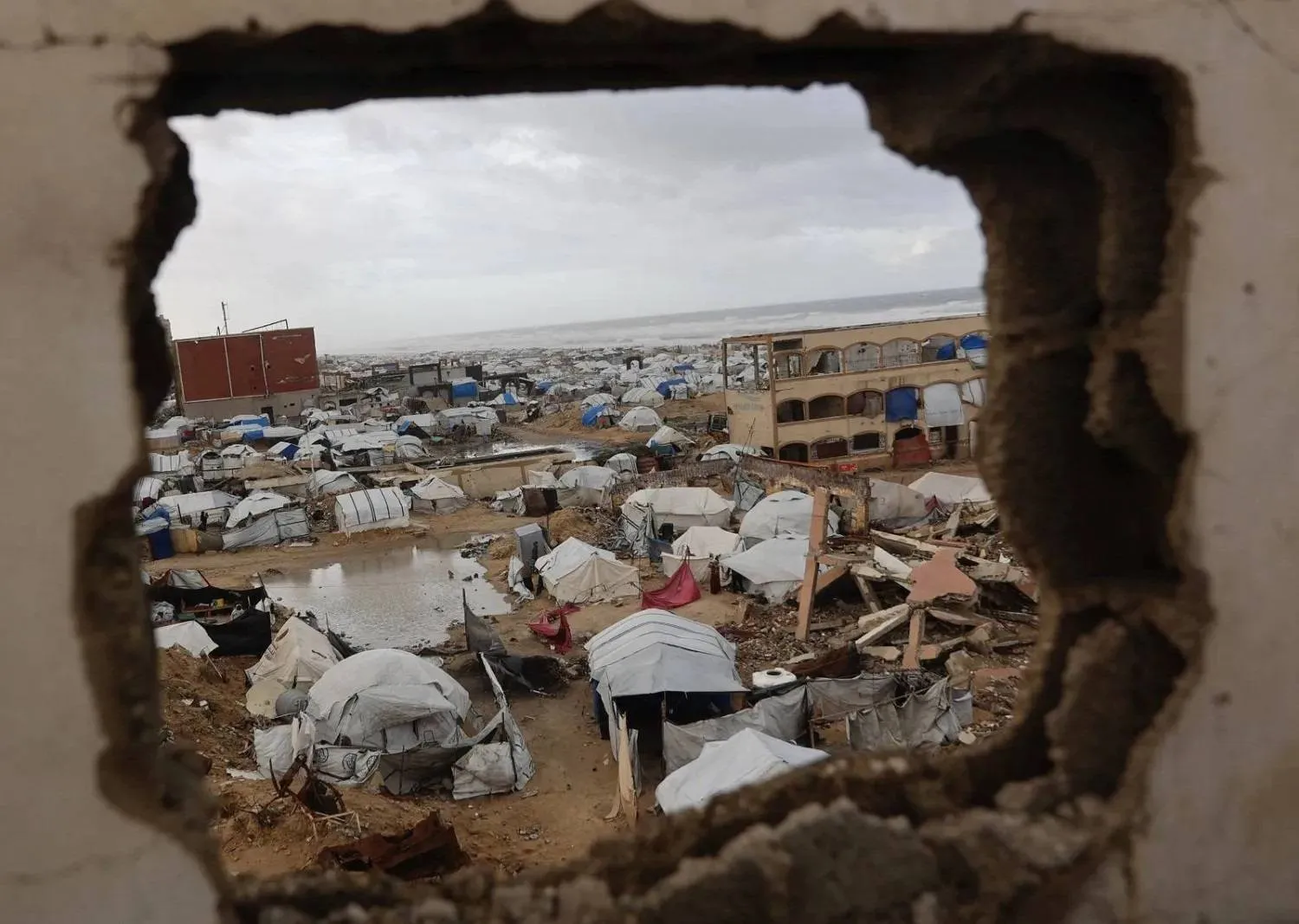
Tents sheltering displaced Palestinian families line Gaza City’s coastline as strong winter winds sweep the enclave (AFP)
TT

Hamas Rejects Exclusion from Gaza Political Scene

Tents sheltering displaced Palestinian families line Gaza City’s coastline as strong winter winds sweep the enclave (AFP)

A US announcement launched the second phase of a ceasefire agreement in the Gaza Strip, as questions swirl over the future of Hamas after nearly two years of an unprecedented war with Israel that has only partially subsided.

The ceasefire is part of a peace plan proposed by US President Donald Trump, which entered into force in October and stipulates an end to Hamas rule in Gaza and the disarmament of the movement.

Hamas believes there is a clear distinction between not governing Gaza, which it accepts, and being removed entirely from the political landscape, senior Hamas official Mohammed Nazzal said, accusing Israeli Prime Minister Benjamin Netanyahu of seeking to sabotage the ceasefire.

“There is a difference between Hamas not being part of governance and administration in Gaza, which we accept, and between its absence or exclusion from the political scene,” Nazzal told Asharq Al-Awsat.

“Hamas is deeply rooted in Palestinian society in general and Gazan society in particular. Anyone who believes Hamas can be erased from the political scene is delusional.”

Nazzal said that since Hamas joined negotiations to end what he described as a war of genocide in Gaza, representing Palestinian resistance factions, it had shown high flexibility and worked to facilitate mediators’ efforts.

He accused Netanyahu and his governing coalition of repeatedly derailing talks through stalling and maneuvering.

When a ceasefire was first reached in January 2025 under direct pressure from the new Trump administration, Netanyahu was forced to accept the deal but intended to undermine it, Nazzal said, adding that the agreement collapsed in March 2025.

Talks then returned to square one, he said, and stagnated until an attempted assassination of Hamas leaders in Doha in September 2025 embarrassed Washington, particularly after the operation failed and triggered regional and international repercussions.

According to Nazzal, Trump again pressured Netanyahu to reach a new deal, betting that Hamas would reject the plan. “The surprise was that Hamas accepted it as a negotiating framework,” he said.

“That left Netanyahu cornered and forced him to approve the plan against his will.”

Attempts to evade commitments

Nazzal warned that since the signing of the Sharm el-Sheikh agreement in October, Netanyahu has sought to evade and escape the deal through various pretexts.

He said Hamas and other resistance factions thwarted those efforts by maintaining constant communication with the three mediators and briefing them on Israeli violations, as well as keeping the US administration informed, while continuing along the political negotiating track.

“We know Netanyahu does not want to move to the second phase,” Nazzal said. “He is still obstructing the implementation of the first phase and working to undermine it.”

Low-intensity war

Nazzal said Netanyahu wants the war to continue, albeit at a lower intensity, for personal reasons linked to maintaining a wartime atmosphere until Israel’s parliamentary elections at the end of 2026.

He said this helps Netanyahu avoid, in practice, judicial accountability over corruption charges predating Oct. 7 and over the military and security failures of the Oct. 7 attack, for which the opposition holds him responsible.

Regarding the implementation of the first-phase provisions, particularly the Rafah crossing, Nazzal said that efforts by the mediators, led by Egypt, to reopen the crossing have not stopped.

He accused Netanyahu of seeking to open it in one direction only to enable what he described as the forced displacement of Palestinians from Gaza by allowing departures without returns.

Gaza committee

On consultations hosted by Cairo to form a Gaza administration committee, Nazzal said Hamas has made clear it is ready to hand over management of Gaza to a technocratic committee of Palestinian professionals.

He said Hamas, in coordination with other Palestinian factions, submitted 40 names to Egyptian authorities, with none of the proposed figures having any organizational ties to Hamas.

He said the issues of resistance weapons and an international stabilization force in Gaza remain under discussion, with ambiguity persisting on the US side.

Final decisions on both matters, he said, should be made within a comprehensive Palestinian national framework that includes all relevant factions.

Addressing Israeli claims over the remains of hostages, Nazzal said efforts are ongoing to recover the body of the last Israeli captive held by the resistance.

He said US sponsors and mediators are aware that Hamas has exerted intensive efforts and has no interest in withholding the remains, as Israel alleges, since Hamas seeks to prevent Israel from using the issue to avoid moving to the second phase.

Separately, the Gaza mediators Qatar, Egypt, and Türkiye welcomed on Wednesday the formation of a technocratic committee to administer Gaza, chaired by Ali Shaath, according to a joint statement issued by Qatar’s foreign ministry.

The statement described the move as an important step toward reinforcing stability and improving humanitarian conditions in the enclave.

At the same time, US special envoy Steve Witkoff announced the launch of the second phase of Trump’s 20-point plan to end the Gaza conflict, saying it shifts from a ceasefire toward disarmament, technocratic governance, and reconstruction.



Doctors Without Borders: Humanitarian Work in Sudan Hampered by Bureaucratic Hurdles

Dr. Javid Abdelmoneim, International President of Doctors Without Borders (AFP) 
TT

Doctors Without Borders: Humanitarian Work in Sudan Hampered by Bureaucratic Hurdles

Dr. Javid Abdelmoneim, International President of Doctors Without Borders (AFP) 

The health system in Sudan is suffering, with massive shortage of medical staff and supplies, said Dr. Javid Abdelmoneim, International President of Doctors Without Borders (MSF).

Speaking to Asharq Al-Awsat, Abdelmoneim said a large number of hospitals have been damaged, or completely out of service, amid widespread disease outbreaks like cholera and measles, pushing an already fragile health system to the brink.

Earlier, the World Health Organization said about 65% of the population lack access to healthcare and between 70 – 80% of health facilities are not functioning due to the ongoing conflict between the Sudanese army and the Rapid Support Forces in April 2023.

Abdelmoneim said assistance in Sudan is urgent, including in the fields of maternal and childcare, treatment of injuries, infant and childbirth, infectious diseases, and malnutrition.

Also, the population in Sudan is in urgent need of safe drinking water, sanitation services, psychological support, and assistance for survivors of sexual violence due to the ongoing humanitarian crisis.

He reported that access to health service facilities remains severely restricted due to insecurity and persistent bureaucratic obstacles.

Abdelmoneim noted that while MSF is not directly affected by these restrictions, other humanitarian organizations face an additional hurdle of limited funding and reduced aid.

Concerning the situation in El Fasher, the official said MSF treated residents who had been trapped in the city, which was under siege by the RSF for approximately 500 days.

After the RSF took control of the city, many survivors fled, often walking 60 km to the nearby town of Tawila, where MSF teams provided emergency medical care.

Abdelmoneim said the survivors arrived exhausted, malnourished, dehydrated, with traumatic injuries, gunshot wounds, and infected wounds.

On their journeys, they saw many dead bodies, and suffered torture, kidnappings for ransom, sexual violence, humiliation, and had everything they owned stolen, he said.

Concerning civilians who were still alive in El Fasher before 26 October, Abdelmoneim said they faced extreme violence including massacres, ethnic cleansing inside the city, and while escaping.

100 Violence Incidents

Abdelmoneim then mentioned the attacks on health care facilities, resulting in deaths and injuries.

He said that since April 2023, MSF has documented 100 incidents of violence targeting its staff, facilities, vehicles and supplies, including looting and destruction of clinics, theft of medicines, assaults, and threats to health workers.


Egypt Appeased after US Limits Suspension of Visas to ‘Immigrants’

A US flag and a US H-1B Visa application form are seen in this illustration taken, September 22, 2025. REUTERS/Dado Ruvic/Illustration 
TT

Egypt Appeased after US Limits Suspension of Visas to ‘Immigrants’

A US flag and a US H-1B Visa application form are seen in this illustration taken, September 22, 2025. REUTERS/Dado Ruvic/Illustration 

Egyptian experts and tourism workers expressed satisfaction on Friday after the administration of President Donald Trump said its decision to place new restrictions on visa applicants does not impact US visitor visas but only immigrant visas.

On Wednesday, Fox News reported that the State Department is pausing all visa processing for 75 countries, including Egypt.

But later, the US State Department clarified that the move does not impact US visitor visas, which have been in the spotlight given the United States is hosting the 2026 World Cup and 2028 Olympics.

The clarification from Washington came after widespread reactions. The Russian Union of Travel Industry (RST) said Wednesday the flow of Russian tourists to the United States will effectively cease for an indefinite period due to Washington's visa service suspension.

The State Department said it will suspend the processing of immigrant visas for citizens of 75 countries, including Brazil, Columbia, Egypt, Yemen, Algeria, Haiti, Iran, Russia and Somalia, whose nationals the Trump administration has deemed likely to require public assistance while living in the United States.

The pause will begin on January 21, according to CNN.

Magdi Sadiq, a member of Egypt’s Chamber of Tourism Companies said the visa suspension does not apply to visitor or tourist visas and therefore, will not affect the tourism activity between the US and Egypt or Egyptians studying in the US.

Rather, he said, the new move impacts individuals seeking to immigrate permanently to the United States due to the strict measures already applied by Washington for the issuance of visitor visas to Egyptians.

He told Asharq Al-Awsat that Egyptian students and tourists who already have a visitor visa can renew it.

State Department spokesperson Tommy Piggott said in a statement that, “The State Department will use its long-standing authority to deem ineligible potential immigrants who would become a public charge on the United States and exploit the generosity of the American people.”

He added, “Immigration from these 75 countries will be paused while the State Department reassess immigration processing procedures to prevent the entry of foreign nationals who would take welfare and public benefits.”

The State Department said exceptions to the new pause will be “very limited” and only allowed after an applicant has cleared public charge considerations.

Amari Abdul-Aziz, former head of Egypt’s tourism and aviation division of the Chamber of Commerce said the recent US decisions will not have an impact on tourism between Egypt and the US.

“Limiting the decision to immigration has surely comforted tourism applicants and businessmen, who need a US visa for temporary visits,” he said, adding that permanent residence visas for Egyptian investors would also not be affected.

But Abdul-Aziz told Asharq Al-Awsat that Egyptians applying for US tourist visas already face difficulties.

He explained that tourism companies liaise with foreign embassies and consulates and place pre-visit programs to facilitate the granting of such visas.

The case is different for Egyptians studying in the US. They rather coordinate with the educational institutions to receive a short-term entry visa, Abdul-Aziz said.

Bassel Halaqa, head of the Egyptian Independent General Tourism Workers Syndicate, said Egyptians face hurdles entering to the US often due to fears the applicants intent to stay “illegally” in the US and then seek asylum.

In November 2025, a State Department cable sent to posts around the globe instructed consular officers to deny visas to applicants deemed likely to rely on public benefits, weighing a wide range of factors including health, age, English proficiency, finances and even potential need for long-term medical care.


Muslim Brotherhood Faces Growing Int’l Isolation after Trump Decision

 A previous trial of Muslim Brotherhood members convicted on terrorism charges in Egypt (AFP)
A previous trial of Muslim Brotherhood members convicted on terrorism charges in Egypt (AFP)
TT

Muslim Brotherhood Faces Growing Int’l Isolation after Trump Decision

 A previous trial of Muslim Brotherhood members convicted on terrorism charges in Egypt (AFP)
A previous trial of Muslim Brotherhood members convicted on terrorism charges in Egypt (AFP)

The Muslim Brotherhood is facing growing international isolation after US President Donald Trump moved to designate its branches in Egypt, Jordan, and Lebanon as terrorist organizations.

Argentina has joined the list of countries banning the Brotherhood, announcing on Thursday that it had added the group’s branches in Egypt, Jordan, and Lebanon to its terrorist organizations list, a statement from the office of President Javier Milei said.

Experts and researchers said Trump’s decision would expand the international ban on Brotherhood branches, adding that more countries were likely to take similar steps, although the US measures would not affect all of the group’s branches abroad.

The Argentine move came two days after the US Treasury and State Departments announced on Tuesday the designation of the Muslim Brotherhood in Egypt, along with its branches in Jordan and Lebanon, as terrorist organizations.

Argentina’s government said its decision was based on official reports proving the existence of illicit cross-border activities, including terrorist acts and public calls for violent extremism, as well as links to other terrorist organizations and their potential impact on the Argentine Republic.

It added that the measure would strengthen mechanisms to prevent terrorism, detect it early, and punish its financiers, ensuring that members of the Brotherhood and their allies do not evade accountability.

Maher Farghaly, a researcher on Islamist movements, said the US president’s decision against the Brotherhood would encourage other countries to ban the group and its branches abroad.

He told Asharq Al-Awsat that countries in Latin America, such as Colombia and Venezuela, were expected to take similar steps to classify the group as a terrorist organization.

Farghaly said the successive bans on the Brotherhood were accompanied by similar European moves in Austria and Sweden.

He added that the key issue was the extent to which international decisions would affect the group’s activities abroad, noting that the US measures were partial because they targeted specific branches near Israel, while other Brotherhood-affiliated groups operating under different names were not covered.

In its official statement, Washington said branches of the Muslim Brotherhood claimed to be legitimate civil organizations while secretly and enthusiastically supporting terrorist groups such as Hamas.

Accordingly, the Office of Foreign Assets Control designated the Egyptian and Jordanian branches of the Brotherhood for providing material support to Hamas, classifying them as specially designated global terrorists under counterterrorism authority set out in Executive Order 13224, as amended.

International moves to isolate the Brotherhood confirm the validity of the Arab and Egyptian view of the group, Farghaly said, noting that Cairo had been among the first to designate the Brotherhood as a terrorist organization.

Egypt has classified the Brotherhood as a terrorist group since 2013.

Most of its leaders, including its supreme guide, Mohamed Badie, are imprisoned in Egypt on charges related to violence and killings that took place after the group was removed from power that year.

Other members have fled abroad and are wanted by the Egyptian judiciary, and are currently running the organization amid deep internal divisions, according to observers.

International counterterrorism expert Hatem Saber said the Brotherhood was facing international isolation following recent US decisions.

He said the designation would restrict the group’s movements, particularly in Egypt, Lebanon, and Jordan.

Speaking to Asharq Al-Awsat, he said the decision's impact included freezing the group’s funds, banning its members' travel, preventing them from receiving any support, and criminalizing any individual or institution that provides assistance to the group.

Saber said it would be difficult to impose a comprehensive cross-border ban on the entire organization because of legal challenges in classifying affiliated groups that operate under different names.

He added that Washington’s measures would not apply only within the United States but would also affect any external transactions involving the banned branches.