


Zalando Says AI Drives Productivity and Expects Higher Profit, Shares Jump

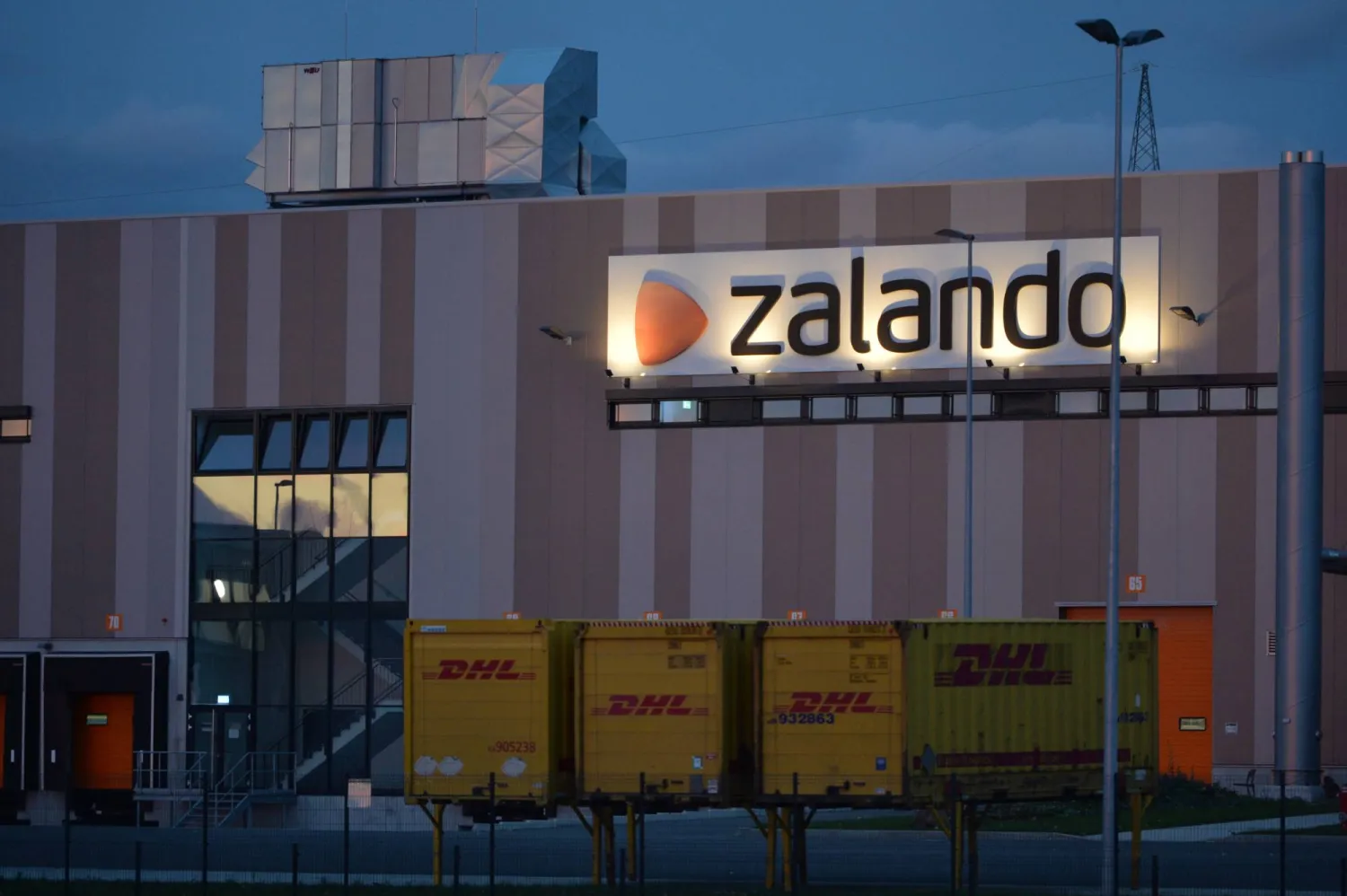
FILED - 22 October 2013, Thuringia, Erfurt: A general view of the logistics center of online retailer Zalando in Erfurt. Photo: Marc Tirl/dpa-Zentralbild/dpa
TT

Zalando Says AI Drives Productivity and Expects Higher Profit, Shares Jump

FILED - 22 October 2013, Thuringia, Erfurt: A general view of the logistics center of online retailer Zalando in Erfurt. Photo: Marc Tirl/dpa-Zentralbild/dpa

European online fashion retailer Zalando said on Thursday its use of artificial intelligence was making its business more efficient and productive, as it forecast full-year adjusted operating profit to grow in 2026 and launched an up to 300-million-euro ($346 million) share buyback.

Zalando shares jumped 7% in early trading as investors welcomed the positive outlook, providing some succour to the stock that had tumbled sharply from peaks in 2021 when the pandemic boosted online shopping.

Zalando ⁠said AI-generated product ⁠images were saving money and time on ad creation and enabling it to publish 70% more content, while an AI virtual try-on was also helping shoppers pick their correct size, reducing size-related returns - a major headache for online shopping platforms.

Analysts said concerns had been growing over the risk to Zalando from AI, with some worried consumers could use large-language models like ⁠ChatGPT to research products and shop online, bypassing the company's platform.

The Berlin-based company, which sells clothes, shoes and accessories from thousands of brands including Nike, Hugo Boss, and Coach, expects adjusted earnings before interest and taxes (EBIT) of 660 million to 740 million euros in 2026, compared with 591 million euros in 2025.

"We are providing our customers and partners with experiences and services that seemed impossible just a few years ago while making our own operations more efficient," Robert Gentz, co-CEO of Zalando, said in a statement.

Zalando, whose business-to-business arm sells services to other retailers and ⁠brands, also announced ⁠its software unit Scayle signed a deal with Levi's to run its worldwide ecommerce, which JP Morgan analysts said investors would welcome given the brand's status and size.

The company expects gross merchandise volume growth of 12% to 17% in 2026, after GMV - a key revenue metric measuring the value of all goods sold - grew 14.7% to 17.56 billion euros in 2025.

Zalando's active customer numbers increased to 62 million in 2025 from 51.8 million in 2024, while the average order value was 62.8 euros, up from 61 euros a year earlier.

The company said it would repurchase up to 20 million shares with a total price of up to 300 million euros.

Hugo Boss Shares Jump after Frasers' $2.3 Billion Takeover Bid

FILE PHOTO: Men's shoes are on display at the Boss store in London, Britain, May 30, 2024. REUTERS/Chris J. Ratcliffe/File Photo
TT

Hugo Boss Shares Jump after Frasers' $2.3 Billion Takeover Bid

FILE PHOTO: Men's shoes are on display at the Boss store in London, Britain, May 30, 2024. REUTERS/Chris J. Ratcliffe/File Photo

Shares in Hugo Boss rose about 7% on Thursday after Britain’s Frasers Group launched a $2.3 billion takeover offer for the German fashion brand.

Frasers, already the largest shareholder of Hugo Boss with a stake of just over 26%, is offering €38 per share in cash for the remaining shares, a 4.3% premium to Wednesday’s close, Reuters reported.

Hugo Boss said late on Wednesday the approach was not coordinated ⁠with the company ⁠and that its board would review the offer, which values the stake not yet owned by Frasers at about €1.98 billion ($2.3 billion).

The deal would bring Hugo Boss into the retail empire controlled ⁠by British billionaire Mike Ashley, whose Frasers Group owns Sports Direct and House of Fraser and holds stakes in Asos, Debenhams and Currys.

J.P. Morgan said the bid likely sets a near-term floor for the shares but flagged limited scope for further upside, adding it did not expect a rival bidder to emerge.

Hugo Boss, ⁠whose ⁠shares are about half their level of three years ago, has been struggling with weaker sales and is pursuing a turnaround strategy focused on store revamps, a streamlined product range and expanding women's wear.

By 0713 GMT, Hugo Boss shares were up 6.2% at €38.7, above Frasers' offer price, taking their year-to-date gains to 7.2%. Frasers shares fell 2.5%.


Primark Names Lucy Slinger as Finance Chief Ahead of AB Foods Split


A Primark store is pictured in the Bullring shopping center in Birmingham, Britain, November 4, 2020. REUTERS/Andrew Boyers
TT

Primark Names Lucy Slinger as Finance Chief Ahead of AB Foods Split


A Primark store is pictured in the Bullring shopping center in Birmingham, Britain, November 4, 2020. REUTERS/Andrew Boyers

Fashion retailer Primark named Lucy Slinger as its chief financial officer on Thursday, strengthening its leadership team ahead of its split from Associated British Foods.

Slinger joins Primark from IKEA franchisee ⁠Ingka Group, where she ⁠has served as deputy CFO.

Prior to Ingka Group, she spent over two ⁠decades at Shell in a range of senior finance leadership roles.

Slinger's appointment follows that of Eoin Tonge as Primark chief executive and Filip Ekvall as chief commercial officer in March, Reuters reported.

⁠AB ⁠Foods said in April it would spin off Primark from its food businesses, telling investors that it will be better positioned to grow on its own.


NASA to Wear Prada as Luxury Group Pushes Into Space Industry

The inner-layer liquid cooling and ventilation garment designed by Prada and Axiom Space is unveiled at a press event in New York City, US, June 7, 2026. REUTERS/Heather Khalifa
TT

NASA to Wear Prada as Luxury Group Pushes Into Space Industry

The inner-layer liquid cooling and ventilation garment designed by Prada and Axiom Space is unveiled at a press event in New York City, US, June 7, 2026. REUTERS/Heather Khalifa

Italian fashion house Prada unveiled on Sunday the inner-layer garment set to be worn by NASA astronauts heading into space, underscoring the brand's push to be the first major luxury player to make inroads in the space industry.

The body-hugging suit, created in collaboration with Houston-based space infrastructure developer Axiom Space, features ventilation tubes knitted into the garment.

"We have really a broad spectrum of capability and know-how," Lorenzo Bertelli, Prada's chief marketing officer, said at an event at Prada's Manhattan store, sitting beside a mannequin donning the new Liquid Cooling and Ventilation Garment.

Expertise for developing space exploration products "can come from lots of seemingly unrelated industries," Reuters quoted Jonathan Cirtain, CEO of Axiom Space, as saying.

The new product follows Prada's splashy foray into space fashion in 2024 with the ⁠unveiling of a ⁠spacesuit that is expected to be used for NASA's Artemis 3 Earth orbit, set to launch in 2027, and the anticipated Artemis 4 moon landing in 2028. Luxury brands have long drawn inspiration from space travel.

But Prada has gone "beyond inspiration into an actual partnership" as the space exploration and tourism industries develop, said Thomai Serdari, a luxury brand strategist and marketing professor at New York University's Stern ⁠School of Business. Serdari pointed to two factors motivating Prada's interest in the space industry: to gain access to affluent consumers who are contemplating space travel, and to align the brand with avant-garde thought.

Companies from Jeff Bezos' Blue Origin to Elon Musk's SpaceX have leaned into space tourism for the wealthy.

The resumption of space exploration and human travel to the moon is "bound to attract a lot of eyeballs," said Luca Solca, global head of luxury goods at Bernstein. Luxury brands need to stay relevant and visible, he said. Prada's push comes against a backdrop of a struggling luxury goods sector.

After two years of contraction, the ⁠industry was showing signs ⁠of stabilization until the Iran war began at the end of February, disrupting travel and denting luxury spending far beyond the Middle East.

WILL LUXURY PEERS FOLLOW? Other fashion and apparel companies have jumped on the space bandwagon. Under Armour has partnered with spaceflight company Virgin Galactic to create space apparel, while Columbia Sportswear has worked with space exploration company Intuitive Machines on space fabric technology.

But it remains unclear whether other luxury players might follow Prada's lead. "In luxury, it is important to be the first to do something, to be a trend-setter," Serdari said, noting that LVMH's Louis Vuitton, Hermès and Chanel are all interested in space travel but that they would likely find new ways to make inroads.

"You will never see the upper crust of the luxury sector copying each other," she added.