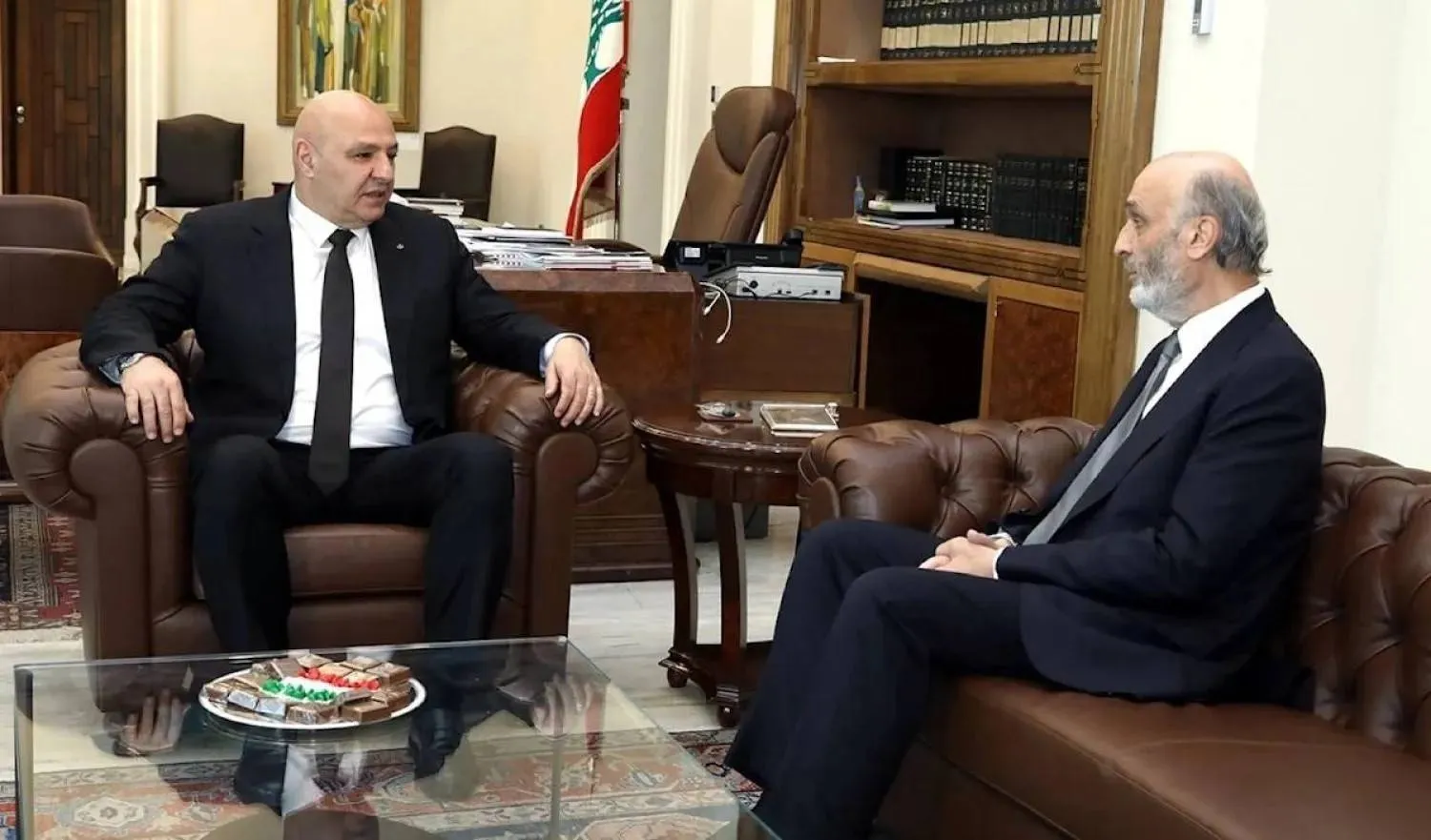

A phone call on Friday between Lebanese Forces leader Samir Geagea and President Joseph Aoun helped quell speculation of serious rifts between the two, after weeks of reports suggesting relations had deteriorated into what some described as a “shaky relationship.”
Geagea statement
The LF said on Friday that Geagea had spoken by phone with Aoun to congratulate him on the first anniversary of his election, saying the year had marked “a real launch for the process of restoring the state and putting it back on the right track, toward a real and capable state.”
Geagea praised positions voiced by Aoun on the anniversary of his election, saying they were “a clear extension of the oath speech,” particularly his emphasis on the exclusive right of the Lebanese state to bear arms and on war and peace decisions being the sole prerogative of the state, restoring respect for the constitution and the concept of national sovereignty.
According to the Lebanese Forces statement, the call also addressed regional developments, with emphasis on the need to shield Lebanon from regional conflicts to safeguard its stability, security, and the interests of its people.
The two sides also discussed a number of domestic issues, foremost parliamentary elections and the need to hold them on time, and to enable non-resident Lebanese to vote from their places of residence for all members of parliament.
No rupture, no disputes
Media remarks by LF officials in recent weeks had reflected differences between the two sides and pointed to an unstable relationship that began to surface publicly during Pope Leo XIV’s visit to Beirut in early December, when party leaders were not invited to the reception ceremony at the presidential palace in Baabda.
Lawmaker Strida Geagea described that at the time as “surprising,” while Samir Geagea did not attend the mass held on Beirut’s waterfront for security reasons.
Subsequent statements by Lebanese Forces officials highlighted political differences, fueling assessments of tensions and a rupture.
However, LF sources insisted there had been no rupture and no fundamental disputes, only differences that are “a right in politics,” reiterating that there were “no disagreements.”
The sources told Asharq Al-Awsat that “on the strategic track, we agree with President Aoun and Prime Minister Nawaf Salam, but there are files on which we oppose them,” citing most recently differences with the PM over a draft law on the financial gap.
They stressed that these differences “do not turn into a personal issue.”
Ongoing contacts
The sources said ties between Geagea and Aoun were maintained at four levels.
The first was direct personal contact between the two, which was not made public, except for this call to congratulate Aoun on his election anniversary and to follow up on his recent positions.
The second channel was through envoys sent by Geagea to the presidency. The third was through the two sides’ teams, who remain in constant coordination. The fourth level of communication was through Lebanese Forces ministers in the government.
They said the LF fully agree with Aoun’s strategic vision on exclusive state control of arms and state-building, adding, “We share with him the major national goals and the state project.
We never questioned his positions, and he has maintained the same stance since his election.”
The sources said the differences lay in the pace and method of implementing the strategic vision, acknowledging that this is the president’s prerogative, while the Lebanese Forces believe that implementation of the cabinet decisions taken on Aug. 5 and 7 on exclusive state control of arms should be accelerated.
They said some files need to be settled, such as enforcing exclusive state control of arms, so the process does not drag on, noting that the issue remains a key obstacle to state-building, even though both sides share the same objective of reaching an effective state.
Other differences were described by the sources as “situational” and part of daily politics, such as the LF’ call for the government to exert additional pressure on Speaker Nabih Berri to place its draft amendment to the electoral law on the agenda, among other day-to-day issues.