

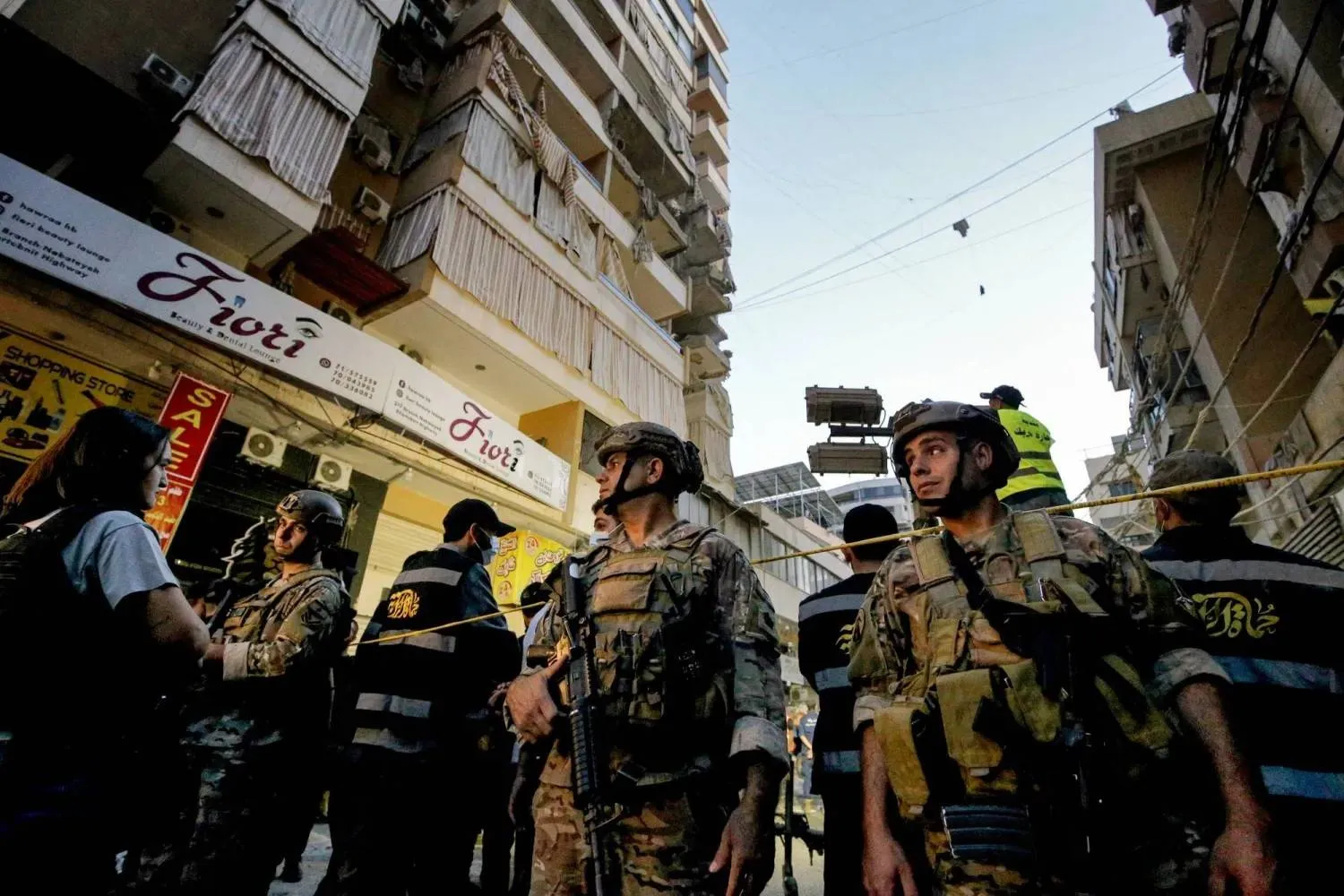

Lebanon Probes Syrian Over Suspected Funds for Assad Loyalist Fighters

Lebanese soldiers patrol a suburb of Beirut (dpa)
TT

Lebanon Probes Syrian Over Suspected Funds for Assad Loyalist Fighters

Lebanese soldiers patrol a suburb of Beirut (dpa)

A senior Lebanese security source said Lebanese military intelligence is questioning Syrian national Ahmad Dunya and examining the origins of funds seized in his possession and their presumed destinations, stopping short of saying they were intended to finance fighters as part of a plot to destabilize Syria’s newly installed leadership.

The source said Dunya is the only person still in custody from a group detained on suspicion of illegal activities. Investigators decided to keep him under questioning to determine how the funds were being used.

The amounts involved, the source said, are large enough to raise suspicion but too small to suggest large-scale financing aimed at threatening the new leadership in Syria.

Rejecting what he described as rushing to hasty conclusions, the source said the investigation is proceeding in the right direction. He also denied that Lebanon had received from Syrian authorities a list of 200 former regime officials allegedly involved in a similar plot.

He said tens of thousands of supporters of the former regime entered Lebanon after the collapse of the government, but there was no indication that senior former officials were among them.

Reuters cited two security sources and two of Dunya’s former partners as saying he was arrested earlier this week in Lebanon.

However, the Lebanese judiciary denied being informed of such an arrest. Two judicial sources involved in detentions and in coordination with Lebanese security agencies told Asharq Al-Awsat that the security services had not informed them of an incident of this kind.

Reuters also quoted two Lebanese security sources and two of Dunya’s former partners as confirming his detention. The security sources did not specify the charges against him or whether he would be handed over to Syria.

About a month ago, Reuters published an investigation detailing separate plans by aides of former Syrian President Bashar al-Assad to finance potential Alawite armed groups in Lebanon and along the Syrian coast through financial intermediaries.

The Reuters investigation said Dunya was one of those intermediaries and had transferred funds from billionaire Rami Makhlouf, Assad’s cousin, who is now living in exile in Moscow with the former Syrian ruler, to potential fighters in Lebanon and Syria.

A former partner of Dunya and a Syrian figure close to Makhlouf confirmed that Dunya was a key financial intermediary and that he had been detained in Lebanon.

The sources said Dunya managed extensive financial records, including payroll lists and receipts. They added that in recent months, he had been skimming a portion of Makhlouf’s transfers for himself.



US Names Rubio, Tony Blair, Kushner to Gaza Board under Trump's Plan

Palestinians move past the rubble of residential buildings destroyed during the war, in Gaza City, January 16, 2026. REUTERS/Dawoud Abu Alkas
TT

US Names Rubio, Tony Blair, Kushner to Gaza Board under Trump's Plan

Palestinians move past the rubble of residential buildings destroyed during the war, in Gaza City, January 16, 2026. REUTERS/Dawoud Abu Alkas

The White House on Friday announced some members of a so-called "Board of Peace" that is to supervise the temporary governance of Gaza, which has been under a fragile ceasefire since October.

The names include US Secretary of State Marco Rubio, President Donald Trump's special envoy Steve Witkoff, former British Prime Minister Tony Blair and Trump's son-in-law, Jared Kushner. Trump is the chair of the board, according to a plan his White House unveiled in October.

Israel and Hamas signed off on Trump's plan, which says a Palestinian technocratic body will be overseen by the international board, which will ⁠supervise Gaza's governance for a transitional period.

The White House did not detail the responsibilities of each member of the "founding Executive board." The names do not include any Palestinians. The White House said ⁠more members will be announced over the coming weeks.

The board will also include private equity executive and billionaire Marc Rowan, World Bank President Ajay Banga and Robert Gabriel, a Trump adviser, the White House said, adding that Nickolay Mladenov, a former UN Middle East envoy, will be the high representative for Gaza.

Army Major General Jasper Jeffers, a US special operations commander, was appointed commander of the International Stabilization Force, the White House said. A UN Security Council resolution, adopted in mid-November, authorized the board and countries working with it to establish that force in Gaza.

The White House also named an 11-member "Gaza Executive Board" that will include Turkish Foreign Minister Hakan Fidan, the UN special coordinator for the Middle East ⁠peace process, Sigrid Kaag, the United Arab Emirates minister for international cooperation, Reem Al-Hashimy, and Israeli-Cypriot billionaire Yakir Gabay, along with some members of the executive board.

This additional board will support Mladenov's office and the Palestinian technocratic body, whose details were announced this week, the White House said.

Israel and Hamas have accused each other of ceasefire violations in Gaza, where more than 450 Palestinians, including over 100 children, and three Israeli soldiers have been reported killed during the truce.

Israel's assault on Gaza since October 2023 has killed tens of thousands, caused a hunger crisis and internally displaced Gaza's entire population.


Israel Continues Targeting UN Peacekeepers in Southern Lebanon

A convoy from the Spanish contingent of the United Nations Interim Force in Lebanon (UNIFIL) passes through the town of Qlayaa in southern Lebanon, October 12, 2024. dpa
TT

Israel Continues Targeting UN Peacekeepers in Southern Lebanon

A convoy from the Spanish contingent of the United Nations Interim Force in Lebanon (UNIFIL) passes through the town of Qlayaa in southern Lebanon, October 12, 2024. dpa

Attacks on the United Nations Interim Force in Lebanon (UNIFIL) have continued in southern Lebanon, raising growing concern among Lebanese and diplomatic circles.

The latest incident occurred on Thursday in the border village of Adaisseh, where an Israeli drone dropped a grenade near a UNIFIL patrol despite prior coordination with the Israeli army. No injuries were reported.

In a statement, UNIFIL said that while its patrol was conducting routine operations, peacekeepers “were warned by locals about a potential danger at a home and discovered an explosive device connected to a detonating cord.”

“The peacekeepers set up a security cordon and prepared to check another house. Soon after, a drone that had been hovering overhead dropped a grenade about 30 meters from the peacekeepers,” said the statement.

Such Israeli activities on Lebanese territory put local civilians at risk and are a violation of Security Council Rresolution 1701, it added.

It warned that any actions that put peacekeepers at risk are serious violations of Resolution 1701, and undermine stability.

Lebanese sources familiar with UNIFIL’s operations said the incident was not an isolated event but part of a pattern of repeated Israeli targeting of UN peacekeeping patrols and positions over the past two years, including in areas subject to clear international security arrangements.

According to the sources, Israeli actions have continued despite advance notification of UNIFIL movements along the Blue Line.

UNIFIL patrols routinely inform the Israeli army of their routes, locations, and timing to avoid misunderstandings, weakening claims of accidental or mistaken targeting.

The sources said there is no convincing military or political explanation for the repeated incidents other than a deliberate effort to pressure or limit the presence of the international force in southern Lebanon.

Diplomatic sources warned that such attacks hinder UNIFIL’s ability to carry out its mandate to maintain stability and monitor the cessation of hostilities, despite repeated investigations that have yielded inconclusive results.


Lebanon: Geagea Call with Aoun Quells Reports of Rift

Lebanese President Joseph Aoun receives Lebanese Forces leader Samir Geagea at the presidential palace in June 2025. (File photo: Lebanese Presidency)
TT

Lebanon: Geagea Call with Aoun Quells Reports of Rift

Lebanese President Joseph Aoun receives Lebanese Forces leader Samir Geagea at the presidential palace in June 2025. (File photo: Lebanese Presidency)

A phone call on Friday between Lebanese Forces leader Samir Geagea and President Joseph Aoun helped quell speculation of serious rifts between the two, after weeks of reports suggesting relations had deteriorated into what some described as a “shaky relationship.”

Geagea statement

The LF said on Friday that Geagea had spoken by phone with Aoun to congratulate him on the first anniversary of his election, saying the year had marked “a real launch for the process of restoring the state and putting it back on the right track, toward a real and capable state.”

Geagea praised positions voiced by Aoun on the anniversary of his election, saying they were “a clear extension of the oath speech,” particularly his emphasis on the exclusive right of the Lebanese state to bear arms and on war and peace decisions being the sole prerogative of the state, restoring respect for the constitution and the concept of national sovereignty.

According to the Lebanese Forces statement, the call also addressed regional developments, with emphasis on the need to shield Lebanon from regional conflicts to safeguard its stability, security, and the interests of its people.

The two sides also discussed a number of domestic issues, foremost parliamentary elections and the need to hold them on time, and to enable non-resident Lebanese to vote from their places of residence for all members of parliament.

No rupture, no disputes

Media remarks by LF officials in recent weeks had reflected differences between the two sides and pointed to an unstable relationship that began to surface publicly during Pope Leo XIV’s visit to Beirut in early December, when party leaders were not invited to the reception ceremony at the presidential palace in Baabda.

Lawmaker Strida Geagea described that at the time as “surprising,” while Samir Geagea did not attend the mass held on Beirut’s waterfront for security reasons.

Subsequent statements by Lebanese Forces officials highlighted political differences, fueling assessments of tensions and a rupture.

However, LF sources insisted there had been no rupture and no fundamental disputes, only differences that are “a right in politics,” reiterating that there were “no disagreements.”

The sources told Asharq Al-Awsat that “on the strategic track, we agree with President Aoun and Prime Minister Nawaf Salam, but there are files on which we oppose them,” citing most recently differences with the PM over a draft law on the financial gap.

They stressed that these differences “do not turn into a personal issue.”

Ongoing contacts

The sources said ties between Geagea and Aoun were maintained at four levels.

The first was direct personal contact between the two, which was not made public, except for this call to congratulate Aoun on his election anniversary and to follow up on his recent positions.

The second channel was through envoys sent by Geagea to the presidency. The third was through the two sides’ teams, who remain in constant coordination. The fourth level of communication was through Lebanese Forces ministers in the government.

They said the LF fully agree with Aoun’s strategic vision on exclusive state control of arms and state-building, adding, “We share with him the major national goals and the state project.

We never questioned his positions, and he has maintained the same stance since his election.”

The sources said the differences lay in the pace and method of implementing the strategic vision, acknowledging that this is the president’s prerogative, while the Lebanese Forces believe that implementation of the cabinet decisions taken on Aug. 5 and 7 on exclusive state control of arms should be accelerated.

They said some files need to be settled, such as enforcing exclusive state control of arms, so the process does not drag on, noting that the issue remains a key obstacle to state-building, even though both sides share the same objective of reaching an effective state.

Other differences were described by the sources as “situational” and part of daily politics, such as the LF’ call for the government to exert additional pressure on Speaker Nabih Berri to place its draft amendment to the electoral law on the agenda, among other day-to-day issues.