


Lebanese Army Chief to Make Pivotal Visit to Washington Next Month

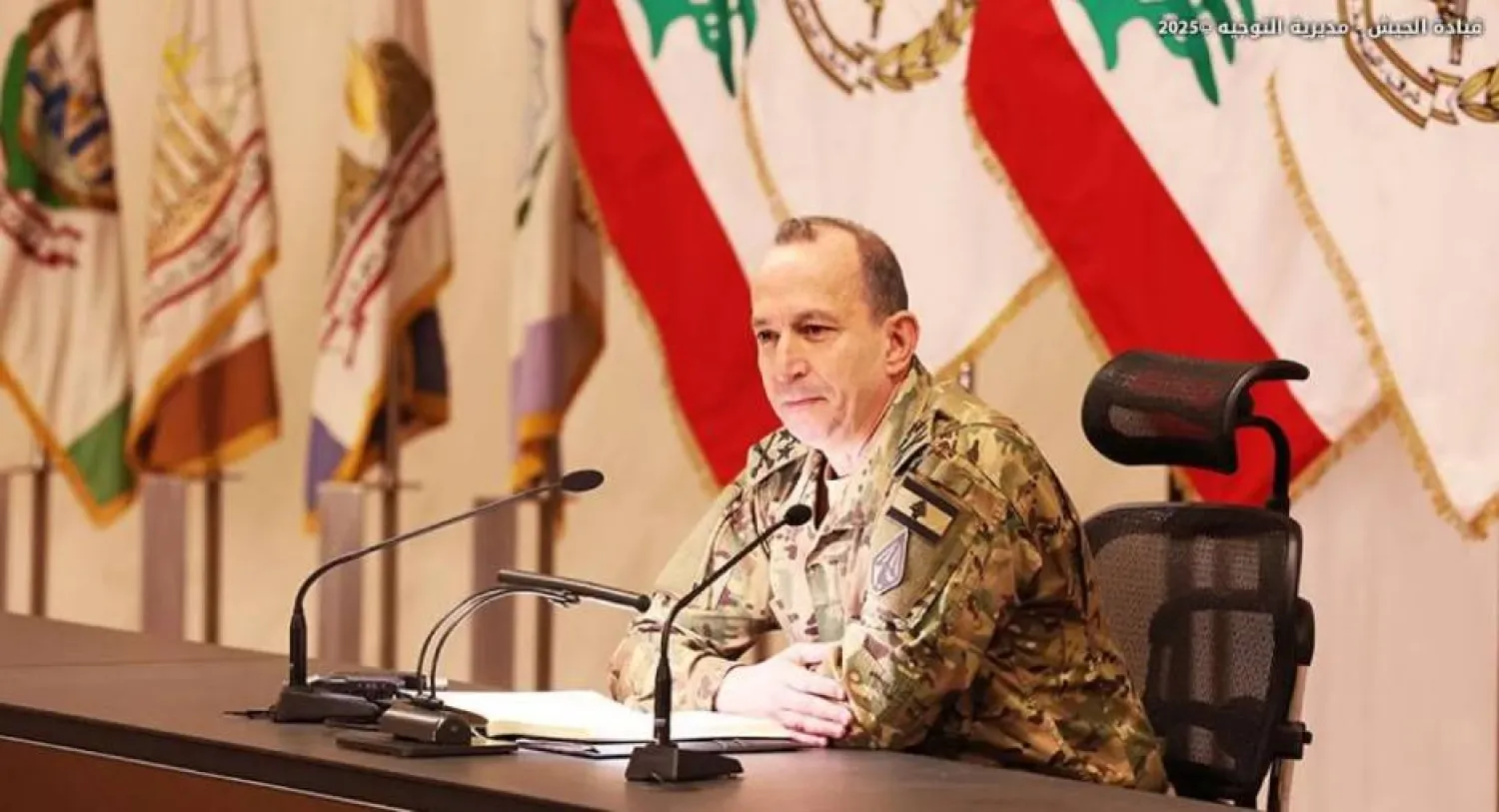
Lebanese army chief General Rodolphe Haykal. Photo: Army command
TT

Lebanese Army Chief to Make Pivotal Visit to Washington Next Month

Lebanese army chief General Rodolphe Haykal. Photo: Army command

Lebanese army chief General Rodolphe Haykal is gearing up for an official visit to Washington in early February, after the US cancelled meetings with him in November.

The visit comes at a sensitive time, preceding the Paris conference to supporting the Lebanese army in March.

Ministerial sources told Asharq Al-Awsat that Haykal’s visit to Washington has been set for between February 3 and 5, saying the army’s needs, cooperation between the US and Lebanese militaries, and continued American support for the Lebanese army will be high on the agenda of the talks.

Military sources said that the visit’s postponement in November has not frozen contacts between the two sides. On the contrary, intense contacts have since been made to reschedule the visit, resulting in setting a new date next month.

The army’s plan to confiscate all unauthorized arms and extend state authority over all Lebanese territory will most likely top the agenda of the visit. This plan has drawn broad international attention.

A statement issued by the army command on January 8 regarding the achievement of the objectives of the first phase of the weapons-control plan will constitute a key component of Haykal’s briefing to US officials.

The army said in that statement that it had achieved the initial goal to clear non-state weaponry from the southern area near the Israeli border by the end of 2025.

It said it secured areas south of the Litani River, excluding positions still held by Israeli forces, though there was more work to be done clearing unexploded ordnance and tunnels.

Haykal’s briefing will most likely refer to the challenges hindering the full implementation of the plan, foremost among them ongoing Israeli attacks and the occupation of a number of sites inside Lebanese territory, in addition to the establishment of buffer zones that restrict freedom of movement, as well as the daily violations of the ceasefire agreement of November 27, 2024.

The army chief will also stress continued close cooperation with the United Nations Interim Force in Lebanon (UNIFIL) and with the ceasefire monitoring committee known as the mechanism, which held its last meeting on January 7 at the military level in the absence of civilians.

Ministerial sources told Asharq Al-Awsat that the mechanism will not hold meetings this month. “We are awaiting the return of the US general who is abroad, as well as the appointment of a civilian representative to replace US envoy Morgan Ortagus, who has been relieved of her duties,” they said.

Meanwhile, Lebanon continues its preparations for the Paris conference to support the army, scheduled for March 5.

Lebanese President Joseph Aoun told a recent security meeting that the army and security forces should prepare accurate reports on their needs and brief the conferees to secure the required assistance for their institutions.



Iraq Seeking New Oil Export Routes after Hormuz Disruption

FILE PHOTO: Tankers are seen off the coast of Fujairah, as Iran vows to fire on ships transiting the Strait of Hormuz, amid the US-Israel conflict with Iran, in Fujairah, United Arab Emirates, March 3, 2026. REUTERS/Amr Alfiky/File Photo
TT

Iraq Seeking New Oil Export Routes after Hormuz Disruption

FILE PHOTO: Tankers are seen off the coast of Fujairah, as Iran vows to fire on ships transiting the Strait of Hormuz, amid the US-Israel conflict with Iran, in Fujairah, United Arab Emirates, March 3, 2026. REUTERS/Amr Alfiky/File Photo

Iraqi authorities are exploring alternative routes to export oil after transit through the Strait of Hormuz was disrupted by the Middle East war, an oil ministry spokesperson told AFP Tuesday.

Saheb Bazoun said that "much like other countries in the region, oil production and marketing have been severely impacted, leaving the government no choice but to seek alternative" export routes.

Iraq has several oil shipments stuck at sea, he said.

Iraq is a founding member of the OPEC cartel, and crude oil sales make up 90 percent of the country's budget revenues.

Before the war, it was exporting more than 3.5 million barrels per day.

The Strait of Hormuz remains closed to almost all oil tankers, and Iran has vowed that not one litre of oil would be exported from the Gulf while its war with the United States and Israel continues.

Iraq's oil production and exports have sharply decreased, Bazoun said.

Iraqi authorities are considering several options for exports, including a pipeline which runs thought Iraq's northern Kurdistan region to the port of Ceyhan in Türkiye.

They are also considering transporting oil by land, but many plans will require time to be implemented, according to Bazoun.

A senior official in Iraq's Kurdistan region told AFP talks are underway to facilitate oil exports from federal Iraq.

He said that Baghdad had requested to "export 200,000 bpd" via the Ceyhan pipeline, which has a capacity of 700,000 bpd.

But regional authorities asked for several measures in return, including that Baghdad facilitates the region's access to US dollars through banks.

"We have made it clear to Baghdad that the relief on dollars should happen first," the Kurdish official said, claiming that there is a "100 percent dollar embargo on Kurdistan."

Since the start of the year, Iraq has been dealing with a US dollar liquidity shortage that has affected many sectors across the country.

Oil production has also been disrupted in the Kurdistan region since foreign oil companies have halted production as a precautionary measure since the start of the war.


Syria Appoints Kurdish YPG Commander Sipan Hamo Deputy Defense Minister

Sipan Hamo, the commander of the Kurdish People's Protection Units (YPG)
TT

Syria Appoints Kurdish YPG Commander Sipan Hamo Deputy Defense Minister

Sipan Hamo, the commander of the Kurdish People's Protection Units (YPG)

Syria's defense ministry said on Tuesday that Sipan Hamo, commander of the Kurdish People's Protection Units (YPG), had been appointed deputy defense minister for the country's eastern territories.

The move is seen as part of implementing a US-brokered integration agreement signed on January 29 between Syrian Democratic Forces (SDF) commander Mazloum Abdi and Syrian President Ahmed al-Sharaa.

"Sipan Hamo has been appointed Assistant Minister of Defence for the eastern region," a defense ministry official said in a statement.


UN: Almost 700,000 Displaced, 84 Children Killed after Israeli Strikes on Lebanon

An explosion erupts following an Israeli airstrike on the village of Abbasiyeh in southern Lebanon on March 10, 2026 -  (Photo by KAWNAT HAJU / AFP)
An explosion erupts following an Israeli airstrike on the village of Abbasiyeh in southern Lebanon on March 10, 2026 - (Photo by KAWNAT HAJU / AFP)
TT

UN: Almost 700,000 Displaced, 84 Children Killed after Israeli Strikes on Lebanon

An explosion erupts following an Israeli airstrike on the village of Abbasiyeh in southern Lebanon on March 10, 2026 -  (Photo by KAWNAT HAJU / AFP)
An explosion erupts following an Israeli airstrike on the village of Abbasiyeh in southern Lebanon on March 10, 2026 - (Photo by KAWNAT HAJU / AFP)

The humanitarian crisis in Lebanon has deepened amid the wider Middle East war, with 84 children killed and more than 667,000 people displaced, two UN agencies said on Tuesday, as lives are upended on a massive scale across the country.

A total of 486 people have been killed in the war so far and 1,313 injured, of which 259 are children, according to the World Health Organization.

"This is only seven-days conflict, and we are already seeing that almost 100 children that have lost their lives," said Abdinasir Abubakar, WHO representative in Lebanon.

"One reason why we have a high number of children is that most of the attacks that we see actually is, it's urban centers, like in Beirut," he said, adding that Israel's airstrikes, which it says target Hezbollah infrastructure, are putting civilian lives at risk.

The current rate of displacement in Lebanon is outpacing levels seen during the 2023-24 war between Hezbollah and Israel, the UN Refugee Agency said on Tuesday. During that conflict, 886,000 people were internally displaced in Lebanon, while tens of thousands of Israelis were evacuated from northern towns near the Lebanese border.

ISRAEL ORDERS EVACUATION

Lebanon's sharp rise in displacement this week stems from large-scale evacuation orders issued by the Israeli army for southern Lebanon and Beirut's densely populated southern suburbs, which the UN human rights chief said on Friday raised serious concerns under international law.

The WHO warned that Lebanon's hospitals and frontline responders were under "extraordinary strain" trying to manage the rising number of patients.

Five hospitals are now out of service, four partially damaged, and 43 primary healthcare centers are closed - mostly in the south, which has been largely evacuated, Abubakar said.

"Many of the people fleeing were also fleeing back in 2024. We met many who then had their homes completely destroyed, family members killed and so on. So this means that people are not waiting to see what will happen next. They leave immediately," said Karolina Lindholm Billing, UNHCR representative in Lebanon.

Some 120,000 people are staying in government-designated shelters, while others are still looking for somewhere to stay, the UNHCR said, citing government figures.

"Many others are staying with relatives or friends or still searching for accommodation, and we see cars lined along the street with people sleeping in them and also on the sidewalks," Billing said.