


Syria Gives Kurds Four Days to Accept Integration as US Signals End of Support

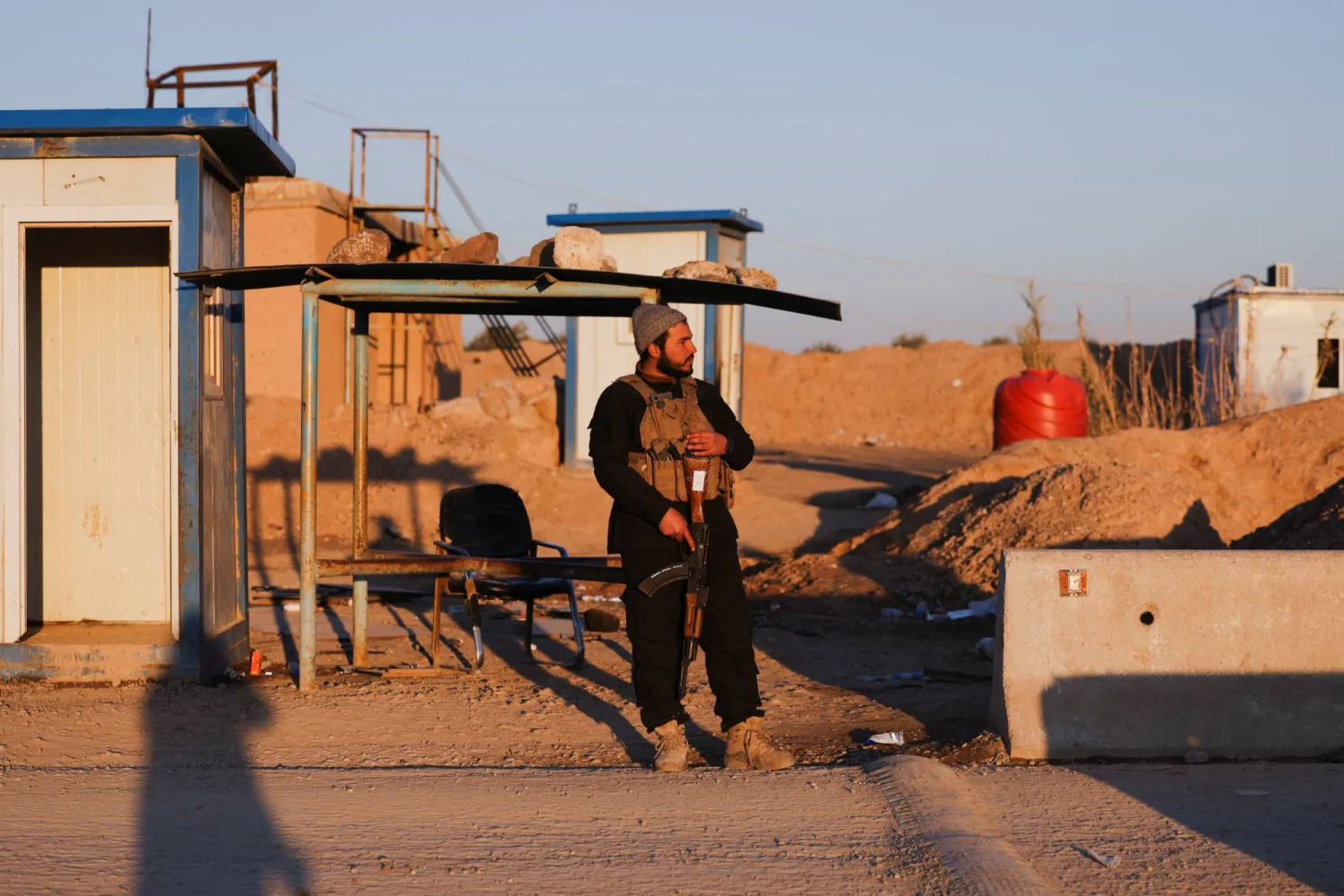
 A member of the Syrian army stands guard on the road towards Al-Hasakah, following the withdrawal of the Syrian Democratic Forces, Syria, January 20, 2026. (Reuters)
A member of the Syrian army stands guard on the road towards Al-Hasakah, following the withdrawal of the Syrian Democratic Forces, Syria, January 20, 2026. (Reuters)
TT

Syria Gives Kurds Four Days to Accept Integration as US Signals End of Support

 A member of the Syrian army stands guard on the road towards Al-Hasakah, following the withdrawal of the Syrian Democratic Forces, Syria, January 20, 2026. (Reuters)
A member of the Syrian army stands guard on the road towards Al-Hasakah, following the withdrawal of the Syrian Democratic Forces, Syria, January 20, 2026. (Reuters)

Syria's government set a four-day deadline on Tuesday for Kurdish-led forces to agree on integrating their last enclave into the central state as their former main ally, the United States, urged them to do so.

US envoy Tom Barrack in a social media post described integration as the "greatest opportunity" ‌the Kurds ‌now have in Syria.

He added that ‌the ⁠original purpose ‌of the Syrian Democratic Forces as a counterweight to ISIS militants had largely expired, and that the US had no long-term interest in retaining its presence in Syria, signaling the apparent end of Washington's backing.

The SDF, which has lost swathes of territory during government advances in ⁠recent days, said it accepted a ceasefire agreement with the Damascus government ‌and that it would not engage ‍in any military action ‍unless attacked.

A Syrian government statement said it had ‍reached an understanding with the SDF, long backed by the United States in the battle against ISIS, for it to devise an integration plan for Hasakah province or risk state forces entering two SDF-controlled cities.

The government announced a four-day ceasefire and said it had asked ⁠the SDF to submit the name of a candidate to take the role of assistant to the defense minister in Damascus as part of the integration.

The swift reversal for the SDF along one of Syria's main faultlines marks the biggest shift in territorial control in Syria since Sharaa toppled President Bashar al-Assad in 2024 and raises questions over the security of facilities holding ISIS detainees.



Hezbollah Escalates Politically and Militarily Over Lebanon-Israel Talks

A photograph taken from the Israeli side of the border with Lebanon shows destroyed buildings in southern Lebanon on April 15, 2026.(Photo by Jack GUEZ / AFP)
TT

Hezbollah Escalates Politically and Militarily Over Lebanon-Israel Talks

A photograph taken from the Israeli side of the border with Lebanon shows destroyed buildings in southern Lebanon on April 15, 2026.(Photo by Jack GUEZ / AFP)

Hezbollah is responding to direct negotiations between Lebanon and Israel, under US sponsorship, on two tracks: political and military. Politically, it is disavowing the talks and calling on the state to “reconsider its decision to negotiate with Israel,” describing the move as one that “will deepen divisions among Lebanese.” At the same time, it has intensified rocket fire toward Israel to signal that any response will play out on the battlefield.

On the political front, Hezbollah MP Hussein Fadlallah, a member of the party’s “Loyalty to the Resistance” parliamentary bloc, said “the authority in Beirut is unfit, with personal interests, and at times sectarian ones, prevailing over the national interest.” At a press conference in parliament, he said it was “continuing to make concessions to the enemy and has entered a misguided path that will widen the rift among Lebanese.”

He added: “The Lebanese authorities must reconsider their calculations and return to their people,” noting that “it was the authorities that withdrew the army from the south, leaving it exposed to occupation and granting it free opportunities.”

Fadlallah said that “despite the enemy destroying the Bint Jbeil stadium, it failed to capture any images inside it,” arguing that “the enemy tried to compensate for its battlefield defeat in the Washington negotiations.”

He called on the Lebanese government to “reconsider its decision to negotiate with Israel, as this step will increase divisions among Lebanese.”

His remarks came a day after Hezbollah political council member Wafiq Safa said the group was not concerned with the ongoing negotiations, telling The Associated Press the group would not abide by any agreements reached in the talks.

Field escalation

Hezbollah sought to reinforce that stance by launching around 40 rockets toward Israel within a single hour, particularly targeting northern settlements. It also released footage showing the launch of a cruise missile toward a military site in the Upper Galilee, saying it targeted a gathering of Israeli soldiers at the Misgav Am site. The group also announced additional operations, including the launch of drone swarms and rocket barrages at various positions.

A negotiation formula outside the state

Commenting on the implications of the escalation, retired brigadier general Saeed Qazah told Asharq Al-Awsat that “the party is trying at this stage to establish a clear equation for Israel: it is not concerned with any negotiations conducted through the Lebanese state, but is instead seeking to entrench itself as the sole party that can be addressed to reach a ceasefire, as happened in previous phases.”

He added that “the party effectively does not recognize the authority of the Lebanese state in this matter, nor its ability to negotiate with Israel, particularly on the security dimension along the southern border.”

Qazah said this approach aims, first, to consolidate its role as a party capable of imposing negotiation terms, and second, to keep this card in Iran’s hands for use within its broader negotiations with the United States.

He also linked the escalation to timing, noting that “military operations in the south are ongoing, and the party remains engaged in field clashes with the Israeli military.”

He said that “the launch of around 40 rockets this morning, coinciding with the reopening of schools in Israeli settlements, carries implications beyond the immediate military dimension. It falls within the framework of asserting presence and sending a message that the war has not stopped, and that any negotiating track in Washington does not automatically mean de-escalation on the Lebanese front.”

He added that “the party is seeking to reproduce the pattern of indirect negotiations that prevailed in earlier phases, such as in 1993, 1996, and 2000, up to the 2006 war, when communication channels were conducted through international mediators, without the Lebanese state being the effective party managing the process.” He said this approach also extended to more recent episodes, including the maritime border demarcation file, where understandings were effectively reached under a formula imposed by the party, while the Lebanese state was in the position of recipient, or the party completing the formal framework of the agreement.

Political messages under military cover

Retired brigadier general Naji Malaeb offered a different reading of the military dimension, saying the escalation “does not carry decisive military value so much as it serves to assert political and military presence.” He explained that “Iran’s missile doctrine relies on launching multiple waves of missiles or drones to exhaust air defenses in order to ensure that the main ballistic missile reaches its target, but what is happening now does not reach that level of effectiveness.”

Malaeb added that “the military effort Hezbollah is exerting today does not alter the balance of power and inflicts only limited losses on Israel, given Israel’s comprehensive readiness, both in terms of defenses and infrastructure, including shelters that protect civilians,” noting that “Israel’s technological superiority, particularly in the field of drones, makes it difficult to confront this type of operation on the ground.”

He linked the escalation to the negotiation context, saying “what is happening is more of a political message than a military action, aimed at showing that the decision of war and peace remains in the party’s hands, not the Lebanese state.”

Malaeb added that “the continuation of operations is part of reinforcing an equation: if Israel continues fighting, we will also continue, but without meaningful military impact.”


UNHCR Chief Calls for ‘Urgent’ Support to Lebanon During War

Displaced children queue to get toys at a shelter in Tyre, south Lebanon, April 14, 2026. (Reuters)
TT

UNHCR Chief Calls for ‘Urgent’ Support to Lebanon During War

Displaced children queue to get toys at a shelter in Tyre, south Lebanon, April 14, 2026. (Reuters)

United Nations refugee chief Barham Salih on Wednesday called on the international community to provide urgent support to Lebanon, with a fifth of the country's population displaced by the Israel-Hezbollah war.

"I call upon the international community to provide urgent support and relief to Lebanon," he said after meeting Lebanese Prime Minister Nawaf Salam.

"The humanitarian consequences of this war are immense, and I emphasize the need to spare civilians and civilian infrastructure from the ravages of attack. Lebanon does not deserve to be trapped in a recurring cycle of violence, it deserves support and stability."

He added that UNHCR has received "a portion" of the $61 million it had appealed for during the war to support Lebanon in its "unprecedented" displacement crisis, as more than a million people, or a fifth of the Lebanese population, are displaced by the conflict.

Of them, more than 140,000 are in government shelters.

The $61 million is part of the Lebanon Flash Appeal, launched by UN chief Antonio Guterres last month to gather $308 million to help the country.

War-ravaged Lebanon has been dealing with an unprecedented financial crisis since 2019 and was still reeling from the 2024 Israel-Hezbollah war when the Iran-backed group drew it into the Middle East conflict last month.


Israeli Army Strikes South of Beirut as Hezbollah Launches Rockets at Israel

First responders and security forces work at the site of an Israeli airstrike that targeted a vehicle the Lebanese town of Jiyyeh, south of Beirut, on April 15, 2026. (AFP)
TT

Israeli Army Strikes South of Beirut as Hezbollah Launches Rockets at Israel

First responders and security forces work at the site of an Israeli airstrike that targeted a vehicle the Lebanese town of Jiyyeh, south of Beirut, on April 15, 2026. (AFP)

Two Israeli strikes on Wednesday hit vehicles south of Beirut, state media reported, while Hezbollah launched rockets at Israel, hours after Lebanon and Israel agreed to hold direct negotiations.

Israel is continuing its strikes on southern Lebanon in its war with Iran-backed Hezbollah, but has not targeted the Lebanese capital since a series of attacks across the country on April 8 that killed more than 350 people.

Lebanon's state-run National News Agency reported two separate Israeli strikes on two vehicles, one in the seafront town of Saadiyat and another on a coastal highway in neighboring Jiyyeh, around 20 kilometers (12 miles) south of Beirut and outside Hezbollah's traditional strongholds.

NNA also reported several other strikes across southern Lebanon.

The Israeli military meanwhile said it had detected "approximately 30 launches" by Hezbollah towards Israel since the early hours, a spokesman told AFP.

Hezbollah said it launched rockets at 10 northern Israeli areas.

The attacks come a day after Lebanon and Israel's ambassadors to the United States held their first direct talks in decades in Washington and agreed to hold further direct negotiations, with the Lebanese envoy calling for a ceasefire.

Hezbollah strongly rejected the talks.

Israeli attacks on Lebanon have killed more than 2,000 people and displaced more than a million since March 2, according to Lebanese authorities.