


Hezbollah Escalates Politically and Militarily Over Lebanon-Israel Talks

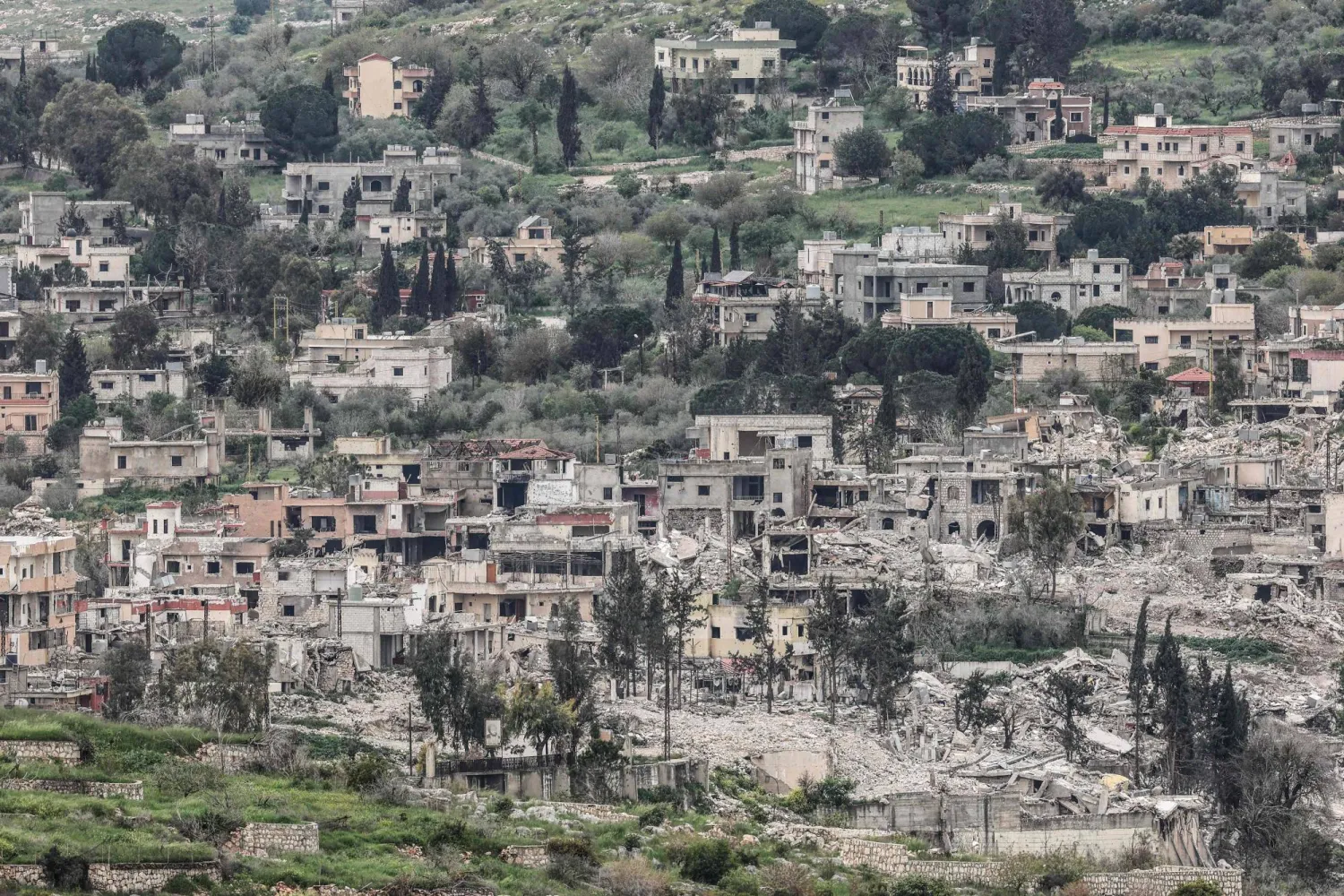
A photograph taken from the Israeli side of the border with Lebanon shows destroyed buildings in southern Lebanon on April 15, 2026.(Photo by Jack GUEZ / AFP)
TT

Hezbollah Escalates Politically and Militarily Over Lebanon-Israel Talks

A photograph taken from the Israeli side of the border with Lebanon shows destroyed buildings in southern Lebanon on April 15, 2026.(Photo by Jack GUEZ / AFP)

Hezbollah is responding to direct negotiations between Lebanon and Israel, under US sponsorship, on two tracks: political and military. Politically, it is disavowing the talks and calling on the state to “reconsider its decision to negotiate with Israel,” describing the move as one that “will deepen divisions among Lebanese.” At the same time, it has intensified rocket fire toward Israel to signal that any response will play out on the battlefield.

On the political front, Hezbollah MP Hussein Fadlallah, a member of the party’s “Loyalty to the Resistance” parliamentary bloc, said “the authority in Beirut is unfit, with personal interests, and at times sectarian ones, prevailing over the national interest.” At a press conference in parliament, he said it was “continuing to make concessions to the enemy and has entered a misguided path that will widen the rift among Lebanese.”

He added: “The Lebanese authorities must reconsider their calculations and return to their people,” noting that “it was the authorities that withdrew the army from the south, leaving it exposed to occupation and granting it free opportunities.”

Fadlallah said that “despite the enemy destroying the Bint Jbeil stadium, it failed to capture any images inside it,” arguing that “the enemy tried to compensate for its battlefield defeat in the Washington negotiations.”

He called on the Lebanese government to “reconsider its decision to negotiate with Israel, as this step will increase divisions among Lebanese.”

His remarks came a day after Hezbollah political council member Wafiq Safa said the group was not concerned with the ongoing negotiations, telling The Associated Press the group would not abide by any agreements reached in the talks.

Field escalation

Hezbollah sought to reinforce that stance by launching around 40 rockets toward Israel within a single hour, particularly targeting northern settlements. It also released footage showing the launch of a cruise missile toward a military site in the Upper Galilee, saying it targeted a gathering of Israeli soldiers at the Misgav Am site. The group also announced additional operations, including the launch of drone swarms and rocket barrages at various positions.

A negotiation formula outside the state

Commenting on the implications of the escalation, retired brigadier general Saeed Qazah told Asharq Al-Awsat that “the party is trying at this stage to establish a clear equation for Israel: it is not concerned with any negotiations conducted through the Lebanese state, but is instead seeking to entrench itself as the sole party that can be addressed to reach a ceasefire, as happened in previous phases.”

He added that “the party effectively does not recognize the authority of the Lebanese state in this matter, nor its ability to negotiate with Israel, particularly on the security dimension along the southern border.”

Qazah said this approach aims, first, to consolidate its role as a party capable of imposing negotiation terms, and second, to keep this card in Iran’s hands for use within its broader negotiations with the United States.

He also linked the escalation to timing, noting that “military operations in the south are ongoing, and the party remains engaged in field clashes with the Israeli military.”

He said that “the launch of around 40 rockets this morning, coinciding with the reopening of schools in Israeli settlements, carries implications beyond the immediate military dimension. It falls within the framework of asserting presence and sending a message that the war has not stopped, and that any negotiating track in Washington does not automatically mean de-escalation on the Lebanese front.”

He added that “the party is seeking to reproduce the pattern of indirect negotiations that prevailed in earlier phases, such as in 1993, 1996, and 2000, up to the 2006 war, when communication channels were conducted through international mediators, without the Lebanese state being the effective party managing the process.” He said this approach also extended to more recent episodes, including the maritime border demarcation file, where understandings were effectively reached under a formula imposed by the party, while the Lebanese state was in the position of recipient, or the party completing the formal framework of the agreement.

Political messages under military cover

Retired brigadier general Naji Malaeb offered a different reading of the military dimension, saying the escalation “does not carry decisive military value so much as it serves to assert political and military presence.” He explained that “Iran’s missile doctrine relies on launching multiple waves of missiles or drones to exhaust air defenses in order to ensure that the main ballistic missile reaches its target, but what is happening now does not reach that level of effectiveness.”

Malaeb added that “the military effort Hezbollah is exerting today does not alter the balance of power and inflicts only limited losses on Israel, given Israel’s comprehensive readiness, both in terms of defenses and infrastructure, including shelters that protect civilians,” noting that “Israel’s technological superiority, particularly in the field of drones, makes it difficult to confront this type of operation on the ground.”

He linked the escalation to the negotiation context, saying “what is happening is more of a political message than a military action, aimed at showing that the decision of war and peace remains in the party’s hands, not the Lebanese state.”

Malaeb added that “the continuation of operations is part of reinforcing an equation: if Israel continues fighting, we will also continue, but without meaningful military impact.”

Kosovo Lawmakers Approve Proposed Gaza Troop Deployment

Kosovo Security Forces parade during celebrations to mark the 18th anniversary of independence, in Pristina, Kosovo, Feb. 17, 2026. (AP)
TT

Kosovo Lawmakers Approve Proposed Gaza Troop Deployment

Kosovo Security Forces parade during celebrations to mark the 18th anniversary of independence, in Pristina, Kosovo, Feb. 17, 2026. (AP)

Kosovo's parliament on Friday passed a law authorizing the potential deployment of a small number of troops to Gaza as part of a peacekeeping force proposed by US President Donald Trump.

According to local media, the government intends to send 22 members of the Kosovo Security Force if the plan goes ahead, although the number has not been officially confirmed.

"The Republic of Kosovo proves that it is a reliable partner and ready to act alongside allies in support of peace, security, protection of civilians and implementation of international mandates," Defense Minister Ejup Maqedonci said before the parliament unanimously approved the law.

Announced as part of a ceasefire agreement that halted two years of devastating war, the planned International Stabilization Force was proposed by the "Board of Peace", which is led by Trump.

Kosovo joined several other countries in Washington for the Board's first meeting earlier this year to discuss funding for rebuilding Gaza and the potential deployment of thousands of foreign troops.

Under US command, the hypothetical force could include up to 20,000 soldiers, with Indonesia so far pledging 8,000 troops.

In March, Kosovo's prime minister Albin Kurti said his country was willing to take part due to the role international forces, particularly NATO peacekeepers, have played in his country after its 1998-1999 war of independence with Serbia.

So far, the future of Trump's plan remains unclear, with Israel and Hamas maintaining contradictory demands in ongoing negotiations amid accusations of ceasefire breaches on both sides.

The ceasefire followed more than two years of war triggered by Hamas's October 7, 2023, cross-border attack on Israel.

At least 766 Palestinians have been killed since the October 10 ceasefire was announced, according to the Gaza Health Ministry, which is under Hamas authority and whose figures are considered reliable by the UN.


UN: Average of 47 Women and Girls Killed Daily During Gaza War

Mourners react during the funeral of Palestinians who were killed in an Israeli strike that took place on Tuesday, according to medics, at Al-Shati camp in Gaza City, April 15, 2026. REUTERS/Dawoud Abu Alkas
TT

UN: Average of 47 Women and Girls Killed Daily During Gaza War

Mourners react during the funeral of Palestinians who were killed in an Israeli strike that took place on Tuesday, according to medics, at Al-Shati camp in Gaza City, April 15, 2026. REUTERS/Dawoud Abu Alkas

An average of at least 47 women and girls were killed each day during the war in Gaza, according to figures published by UN Women on Friday, and the agency warned that deaths have continued six months into a fragile ceasefire.

More than 38,000 women and girls were killed in Gaza between October 2023 and December 2025, according to the report by UN Women, an agency that focuses on gender equality.

"Women and girls accounted for a proportion of deaths far higher than those observed in previous ⁠conflicts in Gaza," ⁠Sofia Calltorp, the agency's humanitarian action head, told reporters in Geneva.

"They were individuals with lives and with dreams," she added, according to AFP.

The agency expressed concern that the killing of women and girls has continued since an October ceasefire, though it does not know exactly how many have died due to ⁠a lack of gender-aggregated data.

October's ceasefire halted two years of full-scale war but left Israeli troops in control of a depopulated zone that makes up well over half of Gaza, with Hamas in power in the remaining, narrow, coastal strip.

More than 750 Palestinians have been killed since then, according to local medics, while militants have killed four Israeli soldiers. Israel and Hamas have traded blame for ceasefire violations.

Israel says it aims to thwart attacks by Hamas and ⁠other militant factions.

UN ⁠children's agency UNICEF said on Friday that children continued to be killed and injured at an alarming rate in Gaza, with at least 214 reported dead in the last six months.

Around one million women and girls are displaced in Gaza, UN Women said.

"Extensive damage to infrastructure has made it almost impossible for women and girls in Gaza to access their basic needs like healthcare," said Calltorp.

World Health Organization figures show more than 500,000 women lack access to essential services including antenatal and postnatal care and management of sexually transmitted infections.


Lebanon Says Israeli Strike in South Kills One Despite Truce

 An Israeli helicopter fires a projectile, as it flies over Lebanon, after a 10-day ceasefire between Lebanon and Israel went into effect, as seen from Israel, April 17, 2026. (Reuters)
An Israeli helicopter fires a projectile, as it flies over Lebanon, after a 10-day ceasefire between Lebanon and Israel went into effect, as seen from Israel, April 17, 2026. (Reuters)
TT

Lebanon Says Israeli Strike in South Kills One Despite Truce

 An Israeli helicopter fires a projectile, as it flies over Lebanon, after a 10-day ceasefire between Lebanon and Israel went into effect, as seen from Israel, April 17, 2026. (Reuters)
An Israeli helicopter fires a projectile, as it flies over Lebanon, after a 10-day ceasefire between Lebanon and Israel went into effect, as seen from Israel, April 17, 2026. (Reuters)

Lebanese state media said an Israeli strike on a motorcycle in the south killed one person on Friday, despite the start of a 10-day ceasefire in the Israel-Hezbollah war.

The truce, announced by US President Donald Trump, went into force at midnight (Thursday 2100 GMT), seeking to end more than six weeks of war that has killed nearly 2,300 people in Lebanon and displaced more than a million.

"A motorcyclist was killed in the town of Kunin, in the Bint Jbeil district, after being targeted by an enemy drone," Lebanon's state-run National News Agency reported.

Under the terms of the truce, Israel reserves the right to continue targeting Iran-backed group Hezbollah to prevent "planned, imminent or ongoing attacks".

Israel also said it will maintain a 10-kilometer (six-mile) security zone along the border in southern Lebanon.

The ceasefire agreement makes no mention of an Israeli withdrawal from Lebanon.

Israeli Defense Minister Israel Katz said the area between this security zone and the Litani River, located around 30 kilometers (20 miles) north of Israel, had not yet been "cleared of terrorists and weapons", and that if diplomatic pressure did not achieve that goal, then military action could resume.

However, Trump said on his Truth Social network that "Israel will not be bombing Lebanon any longer. They are PROHIBITED from doing so by the USA. Enough is enough!!!"

After a November 2024 ceasefire that sought to end the previous war between Hezbollah and Israel, the latter continued to bomb Lebanon, usually saying it was targeting Hezbollah.
