


Palestinian PM to Asharq Al-Awsat: Gaza Rebuilding Delays Aid Displacement Plans

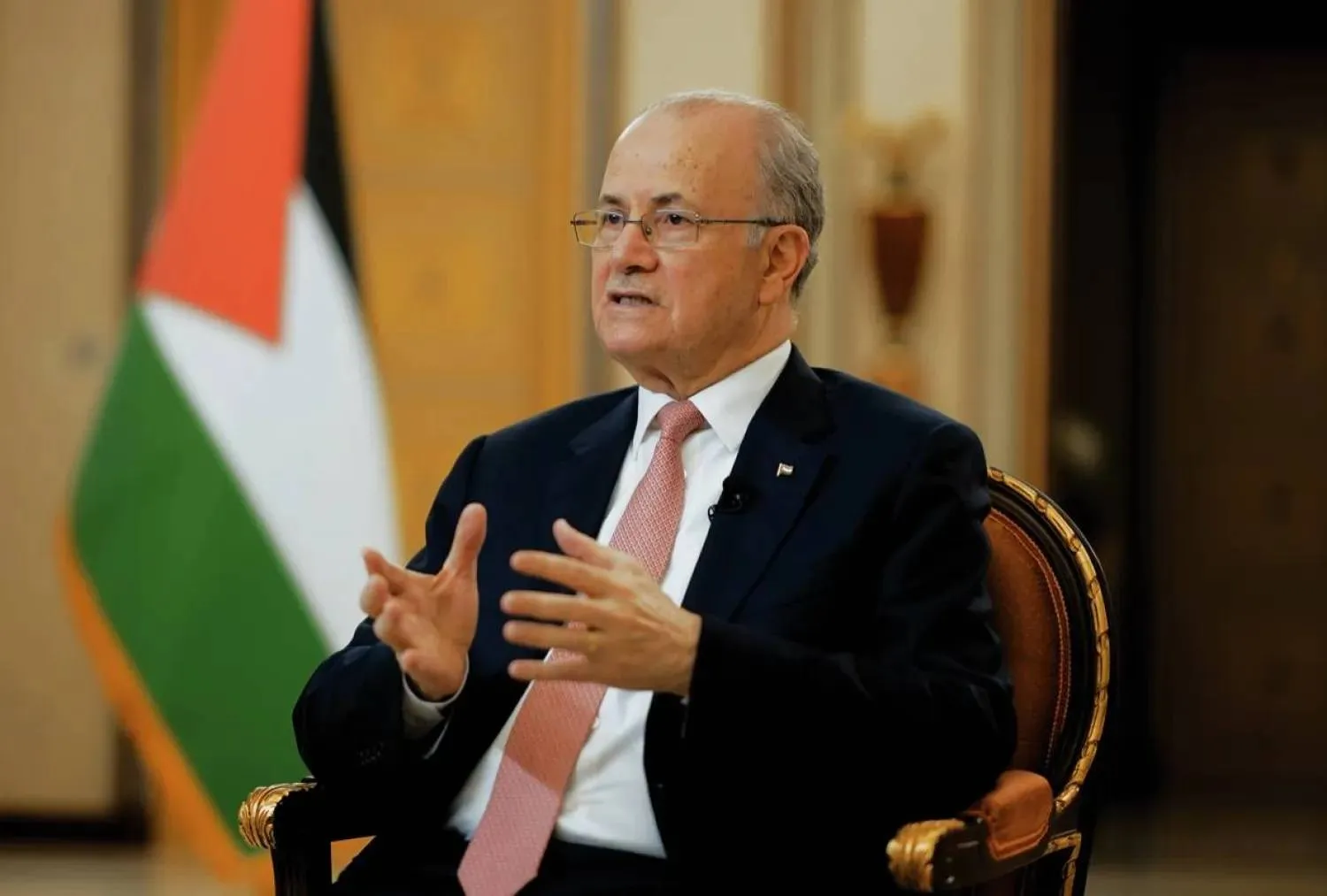
Palestinian Prime Minister Mohammad Mustafa (Asharq Al-Awsat)
TT

Palestinian PM to Asharq Al-Awsat: Gaza Rebuilding Delays Aid Displacement Plans

Palestinian Prime Minister Mohammad Mustafa (Asharq Al-Awsat)

With a fragile ceasefire holding in the Gaza Strip amid continued Israeli violations and overlapping political and security pressures, Palestinian Prime Minister Mohammad Mustafa has set out a roadmap for the next phase, beginning with urgent humanitarian needs and extending to reconstruction, institution-building, and the reunification of Gaza and the West Bank.


Speaking to Asharq Al-Awsat on the sidelines of the World Economic Forum in Davos, Mustafa tied the provision of “decent housing, even if temporary,” to the launch of reconstruction efforts, the opening of border crossings, the restoration of security, and the prevention of displacement.


Any delay in these steps, he warned, would undermine recovery prospects and advance what he described as Israel’s aim of pushing Gaza’s population to leave.


Delaying these steps, he warned, threatens recovery prospects and serves what he described as Israel’s objective of pushing Gaza’s population to leave.


Decent living basics are a top priority


Mustafa said the progress achieved so far on the Gaza ceasefire “deserves thanks to all international and Arab parties” that helped secure it and set the process toward subsequent steps.


But he stressed that the next phase still requires extensive work and that “everything must start with the basics.”


“People are still dying and suffering under these conditions,” he said. “There is indeed no famine today, but decent housing is not available, even temporarily, at least.” He said Israel “continues to impose restrictions” on this front, calling housing “an absolute priority.”


“We do not want to talk about big things. Let us simplify matters,” Mustafa added. “After food and water, the most basic need is for people to live in a dignified place. We are not asking for apartment buildings or villas, just temporary housing, a ready place, a room of 70 or 100 square meters for a family to live with dignity.”


Two conditions for economic recovery


The Palestinian prime minister said the second step after providing temporary housing was “seriously thinking about launching economic recovery and reconstruction, even in their initial stages.”


While acknowledging that arrangements are complex, he said they hinge on two essential conditions: opening the crossings and restoring security.


“Without opening the crossings, construction materials will not enter, and without security, there will be no reconstruction, no economy, nothing at all,” he said.


He added that the next step must be to allow crossings to open for the entry of construction materials and to begin repairing infrastructure to restore basic services, stressing that this “necessarily requires improving the security situation.”


Security and institution-building


Mustafa said improving security must be based on recognizing that the current situation is temporary and that, “ultimately, after around two years, full authority must return to the Palestinian Authority.”


“We want to build all institutions, including the security institution, and we are taking this into account,” he said.


In this context, he said efforts were underway to accelerate work with partners, particularly Egypt, Europeans, and Jordan, to reestablish or strengthen the Palestinian security force, especially the Palestinian police, so that it can maintain security in Gaza.


He added that an international military peace force, if deployed, could provide additional support and help preserve calm with Israel.


Unifying institutions between Gaza and the West Bank


Mustafa said the government is working to develop the performance of institutions in Gaza so they can carry out their duties in delivering services to citizens, but within unified institutional and legal frameworks linking Gaza and the West Bank.


He said the ultimate goal is the unity of Gaza and the West Bank as a step toward establishing a Palestinian state, as agreed at the New York conference led by Saudi Arabia and France, and as outlined in President Donald Trump’s plan and UN Security Council Resolution 2803.


That resolution, he said, stipulates that the process begins with a ceasefire and ends with self-determination and the establishment of a Palestinian state.


Asked whether displacement plans still pose a real threat, Mustafa said: “We hope displacement will not be real and will not succeed. But to ensure its failure, we must achieve what we talked about: reconstruction, relief, housing, and security.”


“How can people live?” he asked, warning that the absence of these fundamentals would push people to look for any opportunity to leave, which he said is what Israel wants.



UN: At Least 15 Children Killed in Sudan Drone Strike

The war in Sudan, ongoing since mid-April 2023, has caused extensive destruction across the country (AFP)
TT

UN: At Least 15 Children Killed in Sudan Drone Strike

The war in Sudan, ongoing since mid-April 2023, has caused extensive destruction across the country (AFP)

A drone strike on a displacement camp in Sudan killed at least 15 children earlier this week, the United Nations reported late on Wednesday.

"On Monday 16 February, at least 15 children were reportedly killed and 10 wounded after a drone strike on a displacement camp in Al Sunut, West Kordofan," the UN children's agency said in a statement.

Across the Kordofan region, currently the Sudan war's fiercest battlefield, "we are seeing the same disturbing patterns from Darfur -- children killed, injured, displaced and cut off from the services they need to survive," UNICEF's Executive Director Catherine Russell said.


MSF Will Keep Operating in Gaza 'as Long as We Can'

(FILES) A Palestinian man walks on his crutches to the Doctors Without Borders or Medecins Sans Frontieres (MSF) clinic, in the al-Rimal neighborhood of Gaza City on new year's Eve, December 31, 2025. (Photo by Omar AL-QATTAA / AFP)
TT

MSF Will Keep Operating in Gaza 'as Long as We Can'

(FILES) A Palestinian man walks on his crutches to the Doctors Without Borders or Medecins Sans Frontieres (MSF) clinic, in the al-Rimal neighborhood of Gaza City on new year's Eve, December 31, 2025. (Photo by Omar AL-QATTAA / AFP)

The head of Doctors Without Borders in the Palestinian territories told AFP the charity would continue working in Gaza for as long as possible, following an Israeli decision to end its activities there.

In early February, Israel announced it was terminating all the activities in Gaza by the medical charity, known by its French acronym MSF, after it failed to provide a list of its Palestinian staff.

MSF has slammed the move, which takes effect on March 1, as a "pretext" to obstruct aid.

"For the time being, we are still working in Gaza, and we plan to keep running our operations as long as we can," Filipe Ribeiro told AFP in Amman, but said operations were already facing challenges.

"Since the beginning of January, we are not anymore in the capacity to get international staff inside Gaza. The Israeli authorities actually denied any entry to Gaza, but also to the West Bank," he said.

Ribeiro added that MSF's ability to bring medical supplies into Gaza had also been impacted.

"They're not allowed for now, but we have some stocks in our pharmacies that will allow us to keep running operations for the time being," he said.

"We do have teams in Gaza that are still working, both national and international, and we have stocks."

In December, Israel announced it would prevent 37 aid organizations, including MSF, from working in Gaza from March 1 for failing to submit detailed information about their Palestinian employees, drawing widespread condemnation from NGOs and the United Nations.

It had alleged that two MSF employees had links with Palestinian militant groups Hamas and Islamic Jihad, which the medical charity has repeatedly and vehemently denied.

MSF says it did not provide the names of its Palestinian staff because Israeli authorities offered no assurances regarding their safety.

Ribeiro warned of the massive impact the termination of MSF's operations would have for healthcare in war-shattered Gaza.

"MSF is one of the biggest actors when it comes to the health provision in Gaza and the West Bank, and if we are obliged to leave, then we will create a huge void in Gaza," he said.

The charity says it currently provides at least 20 percent of hospital beds in the territory and operates around 20 health centers.

In 2025 alone, it carried out more than 800,000 medical consultations, treated more than 100,000 trauma cases and assisted more than 10,000 infant deliveries.


Egyptian-Turkish Military Talks Focus on Strengthening Partnership

The Commander of the Egyptian Air Force during his meeting with the Turkish Air Force chief in Cairo on Wednesday (Egyptian military spokesperson)
TT

Egyptian-Turkish Military Talks Focus on Strengthening Partnership

The Commander of the Egyptian Air Force during his meeting with the Turkish Air Force chief in Cairo on Wednesday (Egyptian military spokesperson)

Senior Egyptian and Turkish air force commanders met in Cairo on Wednesday for talks focused on strengthening military partnership and expanding bilateral cooperation, in the latest sign of warming defense ties between the two countries.

The meeting brought together the Commander of the Egyptian Air Force, Lt. Gen. Amr Saqr, and his Turkish counterpart, Gen. Ziya Cemal Kadioglu, to review a range of issues of mutual interest amid growing cooperation between the two air forces.

Egypt’s military spokesperson said the talks reflect the Armed Forces’ commitment to deepening military collaboration with friendly and partner nations.

Earlier this month, Egypt and Türkiye signed a military cooperation agreement during talks in Cairo between Egyptian President Abdel Fattah el-Sisi and his Turkish counterpart, President Recep Tayyip Erdogan.

Sisi highlighted similar viewpoints on regional and international issues, while Erdogan noted that enhanced cooperation and forthcoming joint steps would help support regional peace.

Cairo and Ankara also signed an agreement last August on the joint production of vertical take-off and landing (VTOL) drones. Production of unmanned ground vehicles has also begun under a partnership between the Turkish firm HAVELSAN and Egypt’s Kader Factory.

During the talks, Saqr underscored the importance of coordinating efforts to advance shared interests and expressed hope for closer ties that would benefit both air forces.

Kadioglu, for his part, stressed the depth of bilateral partnership and the strong foundations of cooperation between the two countries’ air forces.

According to the military spokesperson, Kadioglu also toured several Egyptian Air Force units to review the latest training and armament systems introduced in recent years.

Military cooperation between Egypt and Türkiye has gained momentum since 2023, following the restoration of full diplomatic relations and reciprocal presidential visits that reflected positively on the defense sector.

In September last year, the joint naval exercise “Sea of Friendship 2025” was held in Turkish territorial waters, aimed at enhancing joint capabilities and exchanging expertise against a range of threats.