South Korea to Investigate Ship Debris from Hormuz Attack

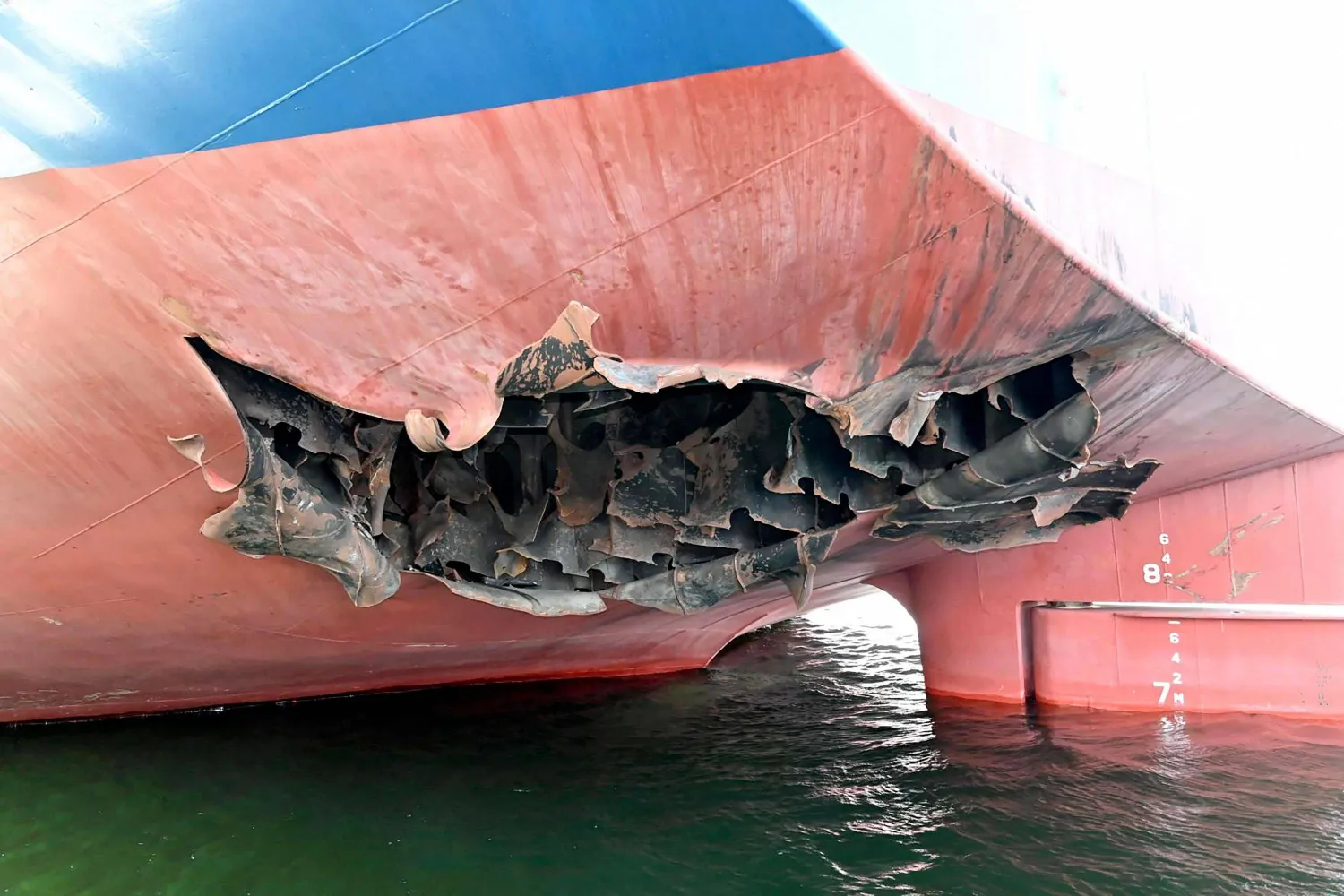
 This undated handout photograph released by South Korea's Foreign Ministry on May 10, 2026, shows a damaged part of the South Korean cargo ship HMM Namu docked at a port in Dubai. (Handout / South Korean Foreign Ministry / AFP)
This undated handout photograph released by South Korea's Foreign Ministry on May 10, 2026, shows a damaged part of the South Korean cargo ship HMM Namu docked at a port in Dubai. (Handout / South Korean Foreign Ministry / AFP)
TT

South Korea to Investigate Ship Debris from Hormuz Attack

 This undated handout photograph released by South Korea's Foreign Ministry on May 10, 2026, shows a damaged part of the South Korean cargo ship HMM Namu docked at a port in Dubai. (Handout / South Korean Foreign Ministry / AFP)
This undated handout photograph released by South Korea's Foreign Ministry on May 10, 2026, shows a damaged part of the South Korean cargo ship HMM Namu docked at a port in Dubai. (Handout / South Korean Foreign Ministry / AFP)

Debris from a fire-damaged cargo ship said to have been attacked by unidentified aircraft in the Strait of Hormuz arrived in South Korea on Friday for investigation, the foreign ministry said.

Iran has largely blocked shipping through the vital strait since conflict broke out with the United States and Israel on February 28 and Washington blockaded Tehran's ports.

HMM Namu was struck by "two unidentified aircraft" on May 4, hitting the outer plate of the vessel's port-side ballast tank near the stern and causing a fire in the engine room, Seoul, a US ally, said at a press briefing on Sunday.

The Panama-flagged cargo vessel, operated by South Korean shipping firm HMM Co., had arrived in Dubai last week for investigation.

Its debris "arrived in South Korea by air following consultations with the UAE government" on Friday, Seoul's foreign ministry said in a statement.

The vessel debris is "scheduled to undergo detailed analysis by a specialized institution", it added without providing further detail.

Seoul said the aircraft involved in the attack "were captured on CCTV footage, but there are limitations in identifying the exact type, launch origin and physical size of the objects".

A senior government official told local media this week that the "likelihood that the (attacking) entity was someone other than Iran is low."

Tehran has denied responsibility, with its embassy in Seoul posting a statement on its website in the days following the attack, saying it "firmly rejects and categorically denies any allegations regarding the involvement" of its forces.

Seoul strongly condemned the attack and said it hopes to identify those behind it through a thorough investigation.

South Korea, Asia's fourth-largest economy, relies heavily on Middle Eastern fuel imports, most of which transited through the Strait of Hormuz during peacetime.

As a major petrochemicals producer and refiner, the closure has forced South Korea to impose a fuel price cap for the first time in nearly 30 years.


Netanyahu on Syria Visit Says ‘Very Close’ to Toppling Iran Regime

09 September 2026, Israel, Northern Command: Israeli Prime Minister Benjamin Netanyahu observes operational activity from an Israeli military observation post on Mount Hermon near the Israeli Syrian border. (dpa)
TT

Netanyahu on Syria Visit Says ‘Very Close’ to Toppling Iran Regime

09 September 2026, Israel, Northern Command: Israeli Prime Minister Benjamin Netanyahu observes operational activity from an Israeli military observation post on Mount Hermon near the Israeli Syrian border. (dpa)

Israeli Prime Minister Benjamin Netanyahu said during a visit to Israeli troops in southern Syria on Wednesday that Iran's regime was on the verge of collapse, as fighting in the six-month Middle East war intensifies.

"There is still work to be done -- the main task is to bring down the terror regime in Iran. We are very close to that. We know that the entire axis will ultimately collapse," he said on the Syrian side of Mount Hermon on the Israel-Syria border during a visit with Defense Minister Israel Katz.

In southern Syria, Israeli forces have been stationed in a "security zone" since the fall of longtime ruler Bashar al-Assad in December 2024.

They occupy what was previously a buffer zone patrolled by the United Nations that had separated Israeli and Syrian forces in the Israeli-occupied Golan since 1974.

"We will not allow any terrorist army to establish itself on our border," Netanyahu reiterated on Wednesday.

Katz visited Israeli troops stationed in southern Syria two weeks ago, prompting condemnation from Damascus, which denounced a "flagrant violation of the country's sovereignty and territorial integrity".

Israel has carried out hundreds of strikes in Syria since the fall of Assad and made repeated incursions into Syrian territory.

Officials have also repeatedly vowed to keep troops in the security zone, where Israel is seeking a broader demilitarized area.

Netanyahu's threats against Iran come as Tehran and Washington are locked in a stalemate over the strategic Strait of Hormuz, with both sides trading attacks in the past week, six months into the war that the US and Israel launched against Iran at the end of February.


EU Gives Spain 115 Mn Euros Aid Over Ceuta Crisis

Improvised shelters at a makeshift camp in Trampolin Beach, following recent mass crossings of migrants from Morocco to Ceuta, in Ceuta, Spain, September 7, 2026. (Reuters)
TT

EU Gives Spain 115 Mn Euros Aid Over Ceuta Crisis

Improvised shelters at a makeshift camp in Trampolin Beach, following recent mass crossings of migrants from Morocco to Ceuta, in Ceuta, Spain, September 7, 2026. (Reuters)

The EU on Wednesday said it was granting Spain 115 million euros ($130 million) in emergency aid to help bolster border security and assist returns after the massive migrant rush into the north African exclave.

More than 70,000 migrants crossed into Spanish territory from Morocco on July 30 and 31 in an unprecedented rush that left scores dead, most by drowning as they tried to swim around a breakwater.

"The situation in Ceuta has put pressure on our external borders," said European Commission vice president Henna Virkkunen.

"Our message remains clear: we are committed to combat illegal migration and ensure the swift return of those who remain illegally in Ceuta."

Spain requested assistance from Brussels in late August.

The EU said that the funds would go towards "measures to enhance border surveillance, border protection and security-related infrastructure", such as thermal cameras and floating buoy systems and underwater drones.

"It will also serve to set up facilities for the screening of migrants, as well as to support returns of those who remain illegally in Ceuta," Brussels said.

Most of the migrants who entered Ceuta have returned to Morocco, but thousands have remained in often dire living conditions, increasing tensions in the small city and causing a political storm for the government.

The Ceuta crisis sparked rifts between EU nations, with Spain's left-wing government clashing with Italy's hard-right authorities after Rome ramped up border controls.

Spain's top criminal court on Monday opened an investigation into the deadly rush.


Suspected Measles Cases Kill Nearly 1,000 as Bangladesh Struggles to Contain Outbreak

A child receives treatment for measles, at Bangladesh Shishu Hospital & Institute in Dhaka on September 3, 2026. (Photo by Salahuddin Ahmed / AFP)
TT

Suspected Measles Cases Kill Nearly 1,000 as Bangladesh Struggles to Contain Outbreak

A child receives treatment for measles, at Bangladesh Shishu Hospital & Institute in Dhaka on September 3, 2026. (Photo by Salahuddin Ahmed / AFP)

Eight-month-old Rojatun Jannat Ramisa is struggling to breathe in a hospital in Bangladesh’s capital as her parents sit helplessly beside her. She's one of thousands of children sickened by a measles outbreak that's sweeping across the country and has killed hundreds of children following setbacks to the country's vaccine program.

Ramisa’s mother Ranu Akhter traveled hundreds of kilometers (miles) after doctors in eastern Bangladesh referred her to a specialized child hospital in Dhaka to seek treatment for the life-threatening condition, The Associated Press said.

“Fourteen days ago, when we were at the district hospital, there were other children being treated alongside my daughter. I saw that those children also had red rashes on their bodies, sores in their mouths and fevers,” Akhter told The Associated Press at Dhaka Shishu Hospital.

“It made me realize how widespread the measles outbreak is,” she said.

Every day, the death toll is rising.

Bangladesh races to vaccinate children Bangladesh has been racing to halt the outbreak's spread since March, when more than 100 children died in less than a month. By Tuesday, the death toll from suspected measles cases reached 999 since the start of the year, according to the government’s Directorate General of Health Services.

Since March, the country has recorded more than 166,000 suspected measles cases, including 19,835 laboratory-confirmed infections, according to the Ministry of Health.

The government launched an emergency vaccination drive in March together with the World Health Organization, the UN children’s agency and the Gavi vaccine alliance. It began with a focus on children from 6 months to 5 years old and later expanded nationwide in phases.

Measles is a highly contagious airborne disease that causes fever, respiratory symptoms and a characteristic rash. It can sometimes have severe or fatal complications, especially in young children, according to the WHO.

Two doses of a vaccine provide strong protection against measles, but the WHO says 95% of the population has to be vaccinated in order to stop the disease from spreading — which protects children like Ramisa who are too young to be vaccinated as well as immunocompromised people.

The pandemic and political upheaval set back vaccinations

A few years ago, Bangladesh had measles largely under control, with a vaccination program that was credited for decades for protecting children and mothers from the deadly diseases of tuberculosis, diphtheria, whooping cough, tetanus, poliomyelitis and measles. Between 2021 and 2025, the country recorded just 100 to 300 cases per year, down from 2,410 cases in 2020.

But in the last few years, disruptions to the vaccine program have left a growing number of children unvaccinated.

First the pandemic interrupted routine vaccinations, and then in 2024 the government largely missed a vaccination campaign previously carried out every four years.

Atiqul Islam, a neonatal and child specialist at Bangladesh Shishu Hospital and Institute, said during the pandemic period in 2021 and 2022, many did not take their children to get vaccinated.

“So, if you look at children who are now four or five years old, many of them missed their vaccinations. That created a gap. During the previous interim government, vaccines were also unavailable at many vaccination centers,” he said.

Rival politicians trade blame for vaccine shortfall Bangladesh's current government, headed by Prime Minister Tarique Rahman, said the failures in planning under ousted Prime Minister Sheikh Hasina and interim leader Muhammad Yunus left the country with shortages of vaccines and far behind on coverage.

The 2024 measles vaccination campaign was disrupted during the political upheaval that led to Hasina’s ouster. She left the country in the face of a mass uprising in August 2024, and was followed by Yunus, who led an interim administration that transferred power to an elected government after an election in February.

From exile in India, Hasina blamed the Yunus-led government for the disaster.

Doctor says things are getting better, but not fast enough At Bangladesh Shishu Hospital, Islam said the situation has improved, but not enough.

The doctor said his colleagues are struggling to treat infected children who often arrive at the hospital with serious complications like pneumonia, diarrhea and encephalitis, or brain swelling.

“For the past six months, we have been treating measles patients continuously, and we are exhausted,” he said.