

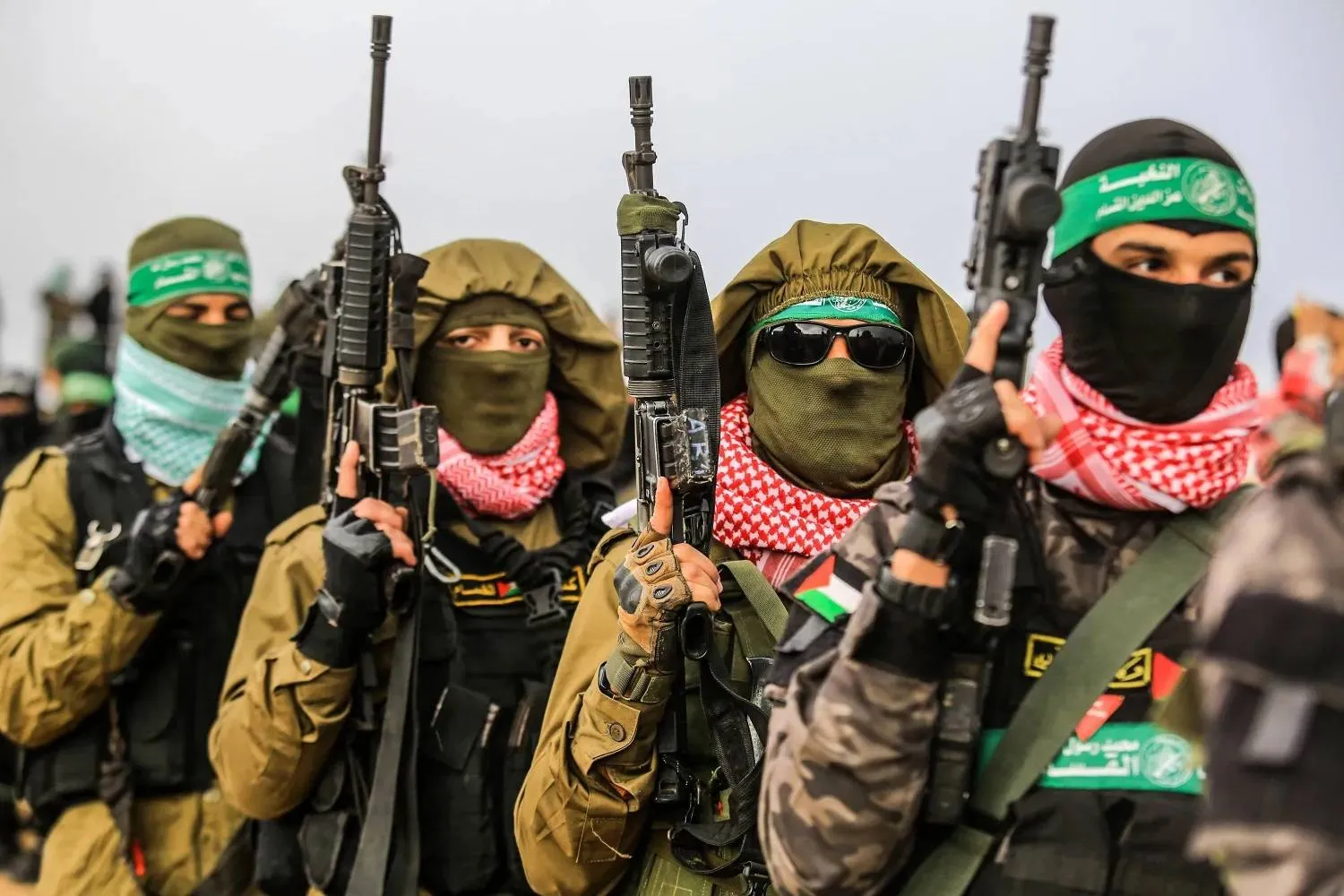

Armed Gaza Gangs Shift Tactics, Straining Hamas Security

Fighters from Hamas’s armed wing, Al-Qassam Brigades, in Khan Younis, Feb. 20, 2025. (dpa)
TT

Armed Gaza Gangs Shift Tactics, Straining Hamas Security

Fighters from Hamas’s armed wing, Al-Qassam Brigades, in Khan Younis, Feb. 20, 2025. (dpa)

For months, a proliferation of armed gangs in Gaza was widely seen as a looming threat to Hamas, which has ruled the enclave since 2007 after seizing it by force following a bitter split with Fatah in the wake of Hamas’s victory in the 2006 legislative elections.

As time passed, however, those expectations faded, as the gangs proved disorganized, fragmented, and incapable of mounting a sustained challenge.

Abu Shabab gang

The most prominent armed gang was led by Yasser Abu Shabab, a Palestinian whom the Hamas-run authorities had previously detained on criminal charges.

After his release from prison at the start of the war in October 2023, he became free to operate. He gradually gained notoriety for seizing and looting humanitarian aid, working with relatives and friends. He later formed an armed group that spread in areas under Israeli control east of Rafah in southern Gaza.

Israel, over time, placed hopes on Abu Shabab’s gang as the first group to emerge and expand, eventually attracting dozens and then a limited number of hundreds of fighters, in what was seen as a potential challenge to Hamas.

Efforts were made not only through the looting of aid arriving via the Kerem Shalom crossing, but also through skirmishes carried out by the gang against gunmen from families opposed to Hamas. These included gunfire and attacks on public and other facilities aimed at asserting the group’s presence.

Hamas confronted these practices on each occasion, with fatalities reported on both sides. The biggest losers, however, were members of families that aligned themselves with the gang and were targeted by Hamas fire as a deterrent.

This approach succeeded in several cases before the most recent ceasefire. It intensified afterward, when Hamas attacked other clans and families, killing, wounding, and arresting dozens, in what it described as a deterrent message to anyone attempting to cooperate with Israel.

For short periods, Abu Shabab’s gang was accused of taking part in the abduction of Palestinians by Israel, including Hamas activists, but this was not proven.

In some cases, it later emerged that Israeli special forces had carried out those operations. The gang was also accused of responsibility for killing Palestinians heading to US-run aid distribution centers, though accounts of those incidents were contradictory.

Other gangs

During the same period, other armed gangs emerged in different areas, including the group led by Hossam Al-Asatal south of Khan Younis, Rami Helles’s gang east of Gaza City, Ashraf Al-Mansi’s group in the north of the strip, and, most recently, the gang led by Shawqi Abu Nseira northeast of Khan Younis.

These groups adopted various names such as “Counterterrorism” and “Popular Forces.”

Abu Shabab was later killed unexpectedly while attempting to mediate a family dispute east of Rafah. Leadership of his group subsequently passed to his deputy, Ghassan Al-Dahini, described as the “mastermind, organizer, and de facto leader” of the Abu Shabab gang.

Following Abu Shabab’s killing, his group lost much of its already limited influence and carried out no significant new activities or skirmishes, particularly after the ceasefire. Some of its members fell into Hamas ambushes and were killed or arrested.

Hamas also struck the gangs led by Helles and Al-Mansi and attempted to target Al-Asatal’s group, while no action was taken against the most recently formed gang led by Abu Nseira.

The Helles and Al-Mansi gangs, operating east of Gaza City and in the north, respectively, tried to assert themselves through minimal clashes.

More recently, however, the Helles gang adopted a new tactic, killing several Gazans who approached the so-called yellow line in the Shujaiya and Tuffah neighborhoods, and forcing residents of a residential block in Tuffah to evacuate at Israel’s request. This marked a new development in the group’s methods.

These moves appear to have prompted Hamas, late Sunday into Monday, to set an ambush for members of that gang on the outskirts of Gaza City.

Details remain unclear, but the “Radea (Deterrence)” force of Gaza’s armed factions’ security apparatus said it had thwarted a “hostile security operation” and inflicted casualties.

Rami Helles, the gang’s leader, confirmed in a Facebook post that one of his fighters, Raad Al-Jamal, had been killed, without providing details. Some sources said Al-Jamal was among the earliest gunmen to join the group.

The gang appears to have attempted to prove itself by assassinating a Hamas activist, as other gangs had done, but its members were caught in the ambush.

All of the gangs, since their formation, have operated on the ground in the service of Israel by entering booby-trapped houses and tunnels to detect explosives.

This has led to the killing and wounding of some of their members, a practice later confirmed by Israeli media, which reported that the Israeli army relied on them because of the frequency of ambushes faced by its forces.

More dangerous tactics

Within the span of a month, the armed gangs shifted to what Palestinians described as “dangerous” tactics after carrying out two assassinations targeting officers in the Hamas-run security services and prominent activists in the movement’s armed wing, the Qassam Brigades, near their homes.

An investigation by Asharq Al-Awsat found that the first assassination, on Dec. 14, 2025, targeted Ahmed Zamzam, an officer in the Internal Security Service, in the Maghazi refugee camp in central Gaza.

It was carried out by gunmen belonging to Shawqi Abu Nseira’s gang. The second, on Jan. 12, targeted Mahmoud Al-Asatal, the head of investigations in the Hamas-run administration in Khan Younis.

That attack was carried out by gunmen linked to Hossam Al-Asatal’s gang. Al-Asatal was a relative of the victim, though his clan had disowned him since he formed his gang in September. Field sources said both operations followed prolonged surveillance of the targets.

The change in tactics raised questions about its rationale. Field sources told Asharq Al-Awsat that, unlike older gangs, Abu Nseira and Hossam Al-Asatal displayed greater loyalty to Israel, operated more boldly, spoke fluent Hebrew with Israeli media, and presented themselves as potential alternatives to Hamas’s rule in Gaza.

According to the sources, the gunmen who carried out the two assassinations were equipped with small body-mounted cameras to document the operations, and some of the weapons used were pistols fitted with silencers.

This pointed clearly to Israeli support, which other gangs did not receive due to their failure to demonstrate real impact.

Multiple field sources also said members of these gangs had obtained new Israeli weapons, including anti-armor munitions, for the first time since Israel began providing them with support, food, and some light arms.

Shifting factors

The ability of these gangs to carry out two assassinations within a month prompted further scrutiny. Asharq Al-Awsat verified through several sources that both Abu Nseira and Al-Asatal had been senior officers in the Palestinian Authority’s security services and possessed significant experience.

The sources said Al-Asatal had received specialized training for years with Israel’s Mossad after being recruited by the Shin Bet, and had been assigned to work outside Palestine. He later took part in the assassination of Qassam Brigades leader Fadi Al-Batsh, an engineer who was not widely known within the group and had been receiving specialized training in Malaysia to develop drones and rockets.

Al-Batsh was killed in April 2018 in an operation in which Al-Asatal participated alongside local agents working for the Mossad. Hamas later succeeded in luring Al-Asatal through one of his brothers, an officer in the Internal Security Service, arresting him and issuing a death sentence against him.

Sources said Al-Asatal and Abu Nseira possessed broader military thinking than others. Al-Asatal had held the rank of major in the Preventive Security Service, while Abu Nseira served as a major general in the Palestinian police.

By contrast, Rami Helles held the rank of junior officer in the Presidential Guard, as did Ashraf Al-Mansi, who served as a conscript in the same force. Abu Shabab had not belonged to any Palestinian security service, while his deputy, Ghassan Al-Dahini, had served in the National Security Forces.

The experience of Al-Asatal and Abu Nseira, including the former’s recruitment and extensive training by Israeli intelligence and the latter’s past imprisonment by Israel, enabled them to target active Hamas members, particularly newly recruited Qassam Brigades fighters, and recruit them to their side.

Al-Asatal recently announced that a member of the Qassam Brigades’ elite unit in Jabalia had joined his forces, prompting the man’s family to deny he had been part of the elite unit.

Hamas sources told Asharq Al-Awsat that he had been recently recruited and worked as a courier between some leaders, transporting funds, and collecting donations from abroad for charitable projects for displaced people. He was the grandson of one of Hamas’s founders in Jabalia.

The activities of these two gangs have increasingly troubled Hamas from a security standpoint, as Israel continues to intensify its intelligence efforts to carry out assassinations whenever conditions allow.

This has prompted Hamas to raise its alert level and strengthen personal security for its officers and leaders to guard against further assassination attempts, Asharq Al-Awsat has learned.

Hamas and its security services have issued internal security directives urging leaders and members to remain vigilant, vary their routes, carry appropriate weapons to repel any attack, and abandon mobile phones to reduce tracking amid Israeli assistance to the gangs.

They were also instructed to monitor any suspicious movements by individuals believed to be surveilling them and to take countermeasures accordingly.



Syria Starts Evacuating ISIS-linked Al-Hol Camp

TOPSHOT - Members of Syrian security forces march through the entrance of the Al-Hol camp in the desert region of Hasakeh province on January 21, 2026. (Photo by OMAR HAJ KADOUR / AFP)
TT

Syria Starts Evacuating ISIS-linked Al-Hol Camp

TOPSHOT - Members of Syrian security forces march through the entrance of the Al-Hol camp in the desert region of Hasakeh province on January 21, 2026. (Photo by OMAR HAJ KADOUR / AFP)

Syrian authorities began evacuating remaining residents of the ISIS group-linked Al-Hol camp in the country's northeast on Tuesday, as they empty the formerly Kurdish-controlled facility, two officials told AFP.

Fadi al-Qassem, the official appointed by the government with managing Al-Hol's affairs, told AFP that the camp "will be fully evacuated within a week, and nobody will remain", adding that "the evacuation started today".

A government source told AFP on condition of anonymity that "the emergencies and disaster management ministry is working now to evacuate Al-Hol camp" and take residents to a camp in Akhtarin, in the north of Aleppo province.


Protesters Block Beirut Roads after Cabinet Approves New Taxes that Raise Fuel Prices

Taxi drivers, foreground, block a main highway with their cars during a protest against the increased taxes and gasoline prices issued by the Lebanese Cabinet on Monday, in Beirut, Lebanon, Tuesday, Feb. 17, 2026. (AP Photo/Hussein Malla)
TT

Protesters Block Beirut Roads after Cabinet Approves New Taxes that Raise Fuel Prices

Taxi drivers, foreground, block a main highway with their cars during a protest against the increased taxes and gasoline prices issued by the Lebanese Cabinet on Monday, in Beirut, Lebanon, Tuesday, Feb. 17, 2026. (AP Photo/Hussein Malla)

Protesters blocked main roads in and around Beirut on Tuesday after Lebanon’s Cabinet approved new taxes that raise fuel prices and other products to fund public pay hikes.

The Cabinet approved a tax of 300,000 Lebanese pounds (about $3.30) on every 20 liters (5.3 gallons) of gasoline on Monday. Diesel fuel was exempted from the new tax, as most in Lebanon depend on it to run private generators to make up for severe shortages in state electricity.

The government also agreed to increase the value-added tax on all products already subject to the levy from 11 to 12%, which the parliament still has to approve, The Associated Press said.

The tax increases are to support raises and pension boosts of public employees, after wages lost value in the 2019 currency collapse, giving them the equivalent of an additional six months’ salary. Information Minister Paul Morcos said the pay increases were estimated to cost about $800 million.

Though the Mediterranean country sits on one of the largest gold reserves in the Middle East, it suffers ongoing inflation and widespread corruption. The cash-strapped country also suffered about $11 billion in damages in the 2024 war between Israel and the Hezbollah militant group.

Anger over fuel hike Ghayath Saadeh, one of a group of taxi drivers who blocked a main road leading into downtown Beirut, said the country’s leaders “consider us taxi drivers to be garbage.”

“Everything is getting more expensive, food and drinks, and Ramadan is coming,” he said. “We will block all the roads, God willing, if they don’t respond to us.”

When the Lebanese government proposed new taxes in 2019, including a $6 monthly fee for using internet calls through services such as WhatsApp, mass protests broke out that paralyzed the country for months. Demonstrators called for the country’s leaders to step down over widespread corruption, government paralysis and failing infrastructure, and for an end to the country’s sectarian power-sharing system.

Lebanon has been under international pressure to make financial reforms for years, but has so far made little progress.

Weapons plan discussed

Also Monday, the cabinet received a report from the Lebanese army on its progress on a plan to disarm non-state militant groups in the country, including Hezbollah.

Last month, the army announced it had completed the first phase of the plan, covering the area south of the Litani River, near the border with Israel. The second phase of the plan will cover segments of southern Lebanon between the Litani and the Awali rivers, which includes the port city of Sidon.

Morcos, the information minister, said following the cabinet session that the second stage is expected to take four months but could be extended “depending on the available resources, the continuation of Israeli attacks and the obstacles on the ground.”

The disarmament plan comes after a US-brokered ceasefire nominally ended a war between Hezbollah and Israel in November 2024. Since then, Israel has accused Hezbollah of rebuilding and has continued to launch near-daily strikes in Lebanon and to occupy several hilltop points on the Lebanese side of the border.

Hezbollah has insisted that the ceasefire deal only requires it to disarm south of the Litani and that it will not discuss disarming in the rest of the country until Israel stops its strikes and withdraws from all Lebanese territory.


Under Israeli Cover, Gaza Gangs Kill and Abduct Palestinians in Hamas-Controlled Areas 

A group of women wait for news as Palestinian civil defense teams work to recover the remains of 67 members of the Abu Nasr family from beneath the rubble of their home after it was destroyed in an Israeli airstrike in Beit Lahiya, north of Gaza City, 15 February 2026. (EPA)
TT

Under Israeli Cover, Gaza Gangs Kill and Abduct Palestinians in Hamas-Controlled Areas 

A group of women wait for news as Palestinian civil defense teams work to recover the remains of 67 members of the Abu Nasr family from beneath the rubble of their home after it was destroyed in an Israeli airstrike in Beit Lahiya, north of Gaza City, 15 February 2026. (EPA)

Amid heavy Israeli airstrikes across Gaza, armed gangs carried out kidnappings and executions of Palestinians on Monday in areas controlled by Hamas, west of the so-called “yellow line” separating Israeli forces from the Palestinian movement.

According to local sources, Sunday’s strikes against Hamas and other armed factions deployed along the separating line resulted in security breaches that allowed armed gangs operating in Israeli-controlled zones to infiltrate areas west of the yellow line.

In response, Palestinian factions expanded their deployment, under what they termed “Operation Ribat”, to prevent the infiltration of collaborators with Israel into their areas. However, the Israeli strikes hit those fighters, killing several.

Before dawn on Monday, gunmen affiliated with the Rami Helles gang, which is active in eastern Gaza City, raided homes on the western outskirts of the Shujaiya neighborhood, just meters from Salah al-Din Road and more than 150 meters from the yellow line.

Field sources and affected families told Asharq Al-Awsat that the gunmen abducted several residents from their homes and interrogated them on the spot amid intense Israeli drone activity. Quad-copter drones were reportedly providing “security cover” for the attackers and opening fire in the surrounding area.

The sources said the gunmen shot and killed Hussam al-Jaabari, 31, after he refused to answer their questions. His body was left at the scene before the attackers withdrew, releasing others who had been detained. Al-Jaabari was later pronounced dead at Al-Maamadani (Al-Ahli Arab) Hospital.

In a separate incident, gunmen linked to the Ashraf al-Mansi gang, which is active in Jabalia and Beit Lahiya in northern Gaza, stormed Abu Tammam School in Beit Lahiya that shelters dozens of displaced families, also under Israeli drone surveillance.

Several young men were abducted and taken to a gang-controlled location, and they haven’t been heard of since. Three families of women and children were briefly detained and later released.

Sources in the Palestinian armed factions denied that any of the abducted individuals or the victim of the killing were members of their groups.

Meanwhile, Hamas’ Ezzedine al-Qassam Brigades froze deployments near the yellow line after Israeli airstrikes killed 10 of its members in two raids in Khan Younis and Jabalia on Sunday.

A Hamas source said the move was temporary and could be reversed once Israeli strikes subside.

Israel said it targeted Qassam fighters after gunmen emerged from a tunnel in Beit Hanoun, a claim it has used to justify strikes on faction targets and the assassination of senior operatives.

On Monday, the army announced it had killed a group of gunmen in Rafah, raising fears of further escalation.

Separately, dozens of families of missing Palestinians held a protest in Khan Younis, demanding information about relatives who disappeared during the war. UN estimates put the number of missing in Gaza at between 8,000 and 11,000, with their fate still unknown.