


Political, Military Activity in Lebanon to Address Weapons, Ceasefire Mechanism Crisis

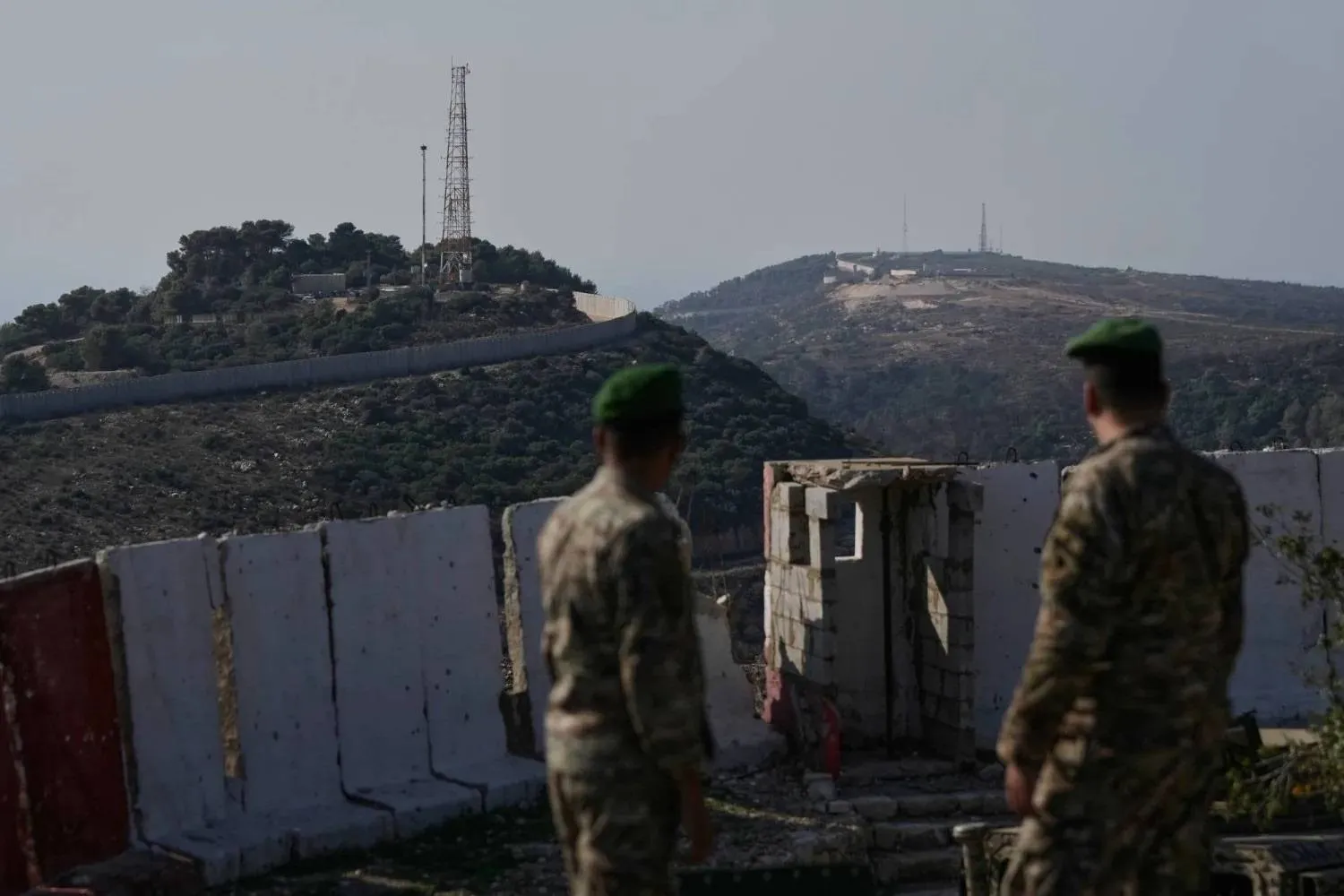
Lebanese army soldiers look toward the Israeli military position of Hanita (left) and the Labbouneh position, part of the five hills occupied by Israeli forces since last year (right), from a Lebanese military post in the village of Alma al-Shaab in southern Lebanon, Nov. 28, 2025. (AP) 
TT

Political, Military Activity in Lebanon to Address Weapons, Ceasefire Mechanism Crisis

Lebanese army soldiers look toward the Israeli military position of Hanita (left) and the Labbouneh position, part of the five hills occupied by Israeli forces since last year (right), from a Lebanese military post in the village of Alma al-Shaab in southern Lebanon, Nov. 28, 2025. (AP) 

Lebanon is preparing political and military conditions to ensure the success of an upcoming visit by Army Commander Gen. Rodolphe Haykal to the United States, consolidate stability at home, and pave the way for a Paris conference in March to support the Lebanese Armed Forces.

The effort involves coordinated steps, beginning with setting a date for the army to present its vision to the government for implementing the second phase of the “exclusive state control of weapons” plan, alongside intensified international contacts to reactivate the work of the ceasefire monitoring mechanism.

Lebanese sources told Asharq Al-Awsat that the success of the Paris conference depends on US backing, while Washington is awaiting the army’s proposed approach for launching the second phase of the weapons plan.

Political and military initiatives aim to unlock multiple obstacles simultaneously, strengthen stability, and enable the army to carry out its government-mandated tasks.

Army Plan Presented to Cabinet

The Cabinet is scheduled to meet Friday afternoon at Baabda Palace under President Joseph Aoun. A key agenda item is the army’s plan for deployment and operations north of the Litani River, which Haykal is expected to present in detail.

The Central News Agency (Al-Markaziah) reported that the briefing will cover the operational framework, implementation stages, assigned missions, and logistical and security requirements, considering recent developments in the south and Lebanon’s state commitments.

Official sources said the plan will define geographic scope, types of weapons, implementation tools, and timelines, and will be reviewed pending approval by relevant parties, an implicit reference to US and Israeli consent.

They noted that exclusive state control of weapons is a government commitment, and that Hezbollah, as part of the government, is expected to adhere to the plan.

During the first phase south of the Litani, the army worked to prevent the transfer of weapons between governorates. Proposals to “contain weapons” north of the Litani — an initiative put forward by Egypt and previously approved by the United States — are also under discussion.

The “Mechanism” Impasse

The resumption of meetings of the ceasefire “mechanism” is seen as the most significant obstacle.

On the military level, a Lebanese army delegation traveled to the United States on Wednesday ahead of Haykal’s planned visit on Feb. 5. Senior officers are expected to meet Gen. Joseph Clairfield, head of the mechanism committee, with sources confirming that no changes have been made to the committee overseeing the ceasefire.

Politically, the Lebanese presidency announced that Aoun’s security and military adviser, retired Brig. Gen. Antoine Mansour, met US Col. David Leon Klingensmith, deputy head of the mechanism committee, in the presence of Defense Attaché Col. Jason Belknap at the US Embassy in Beirut. Discussions focused on the committee’s work, cooperation with the Lebanese side, and preparations for the next meeting.

The meeting also explored whether Israel had responded to Lebanese demands regarding the ceasefire, withdrawal, and prisoner releases. Ministerial sources stressed that the mechanism remains the sole framework for security, military, and political negotiations to implement the agreement.

Next Meeting and Growing Tensions

The next mechanism meeting is scheduled for Feb. 25. While the agenda has not been finalized, official estimates suggest it will focus on security issues rather than political ones, amid continued Israeli violations despite Lebanon’s fulfillment of its commitments.

Lebanese authorities maintain that Lebanon has extended state authority south of the Litani, removed weapons, refrained from firing toward Israel, and advanced phased implementation of exclusive state control of arms — steps taken unilaterally, while Israel has not halted attacks, withdrawn from occupied positions, or released detainees.

Sources stressed the need for international pressure on Israel to honor its obligations and demonstrate good faith in the ceasefire process.


UN: At Least 15 Children Killed in Sudan Drone Strike

The war in Sudan, ongoing since mid-April 2023, has caused extensive destruction across the country (AFP)
TT

UN: At Least 15 Children Killed in Sudan Drone Strike

The war in Sudan, ongoing since mid-April 2023, has caused extensive destruction across the country (AFP)

A drone strike on a displacement camp in Sudan killed at least 15 children earlier this week, the United Nations reported late on Wednesday.

"On Monday 16 February, at least 15 children were reportedly killed and 10 wounded after a drone strike on a displacement camp in Al Sunut, West Kordofan," the UN children's agency said in a statement.

Across the Kordofan region, currently the Sudan war's fiercest battlefield, "we are seeing the same disturbing patterns from Darfur -- children killed, injured, displaced and cut off from the services they need to survive," UNICEF's Executive Director Catherine Russell said.


MSF Will Keep Operating in Gaza 'as Long as We Can'

(FILES) A Palestinian man walks on his crutches to the Doctors Without Borders or Medecins Sans Frontieres (MSF) clinic, in the al-Rimal neighborhood of Gaza City on new year's Eve, December 31, 2025. (Photo by Omar AL-QATTAA / AFP)
TT

MSF Will Keep Operating in Gaza 'as Long as We Can'

(FILES) A Palestinian man walks on his crutches to the Doctors Without Borders or Medecins Sans Frontieres (MSF) clinic, in the al-Rimal neighborhood of Gaza City on new year's Eve, December 31, 2025. (Photo by Omar AL-QATTAA / AFP)

The head of Doctors Without Borders in the Palestinian territories told AFP the charity would continue working in Gaza for as long as possible, following an Israeli decision to end its activities there.

In early February, Israel announced it was terminating all the activities in Gaza by the medical charity, known by its French acronym MSF, after it failed to provide a list of its Palestinian staff.

MSF has slammed the move, which takes effect on March 1, as a "pretext" to obstruct aid.

"For the time being, we are still working in Gaza, and we plan to keep running our operations as long as we can," Filipe Ribeiro told AFP in Amman, but said operations were already facing challenges.

"Since the beginning of January, we are not anymore in the capacity to get international staff inside Gaza. The Israeli authorities actually denied any entry to Gaza, but also to the West Bank," he said.

Ribeiro added that MSF's ability to bring medical supplies into Gaza had also been impacted.

"They're not allowed for now, but we have some stocks in our pharmacies that will allow us to keep running operations for the time being," he said.

"We do have teams in Gaza that are still working, both national and international, and we have stocks."

In December, Israel announced it would prevent 37 aid organizations, including MSF, from working in Gaza from March 1 for failing to submit detailed information about their Palestinian employees, drawing widespread condemnation from NGOs and the United Nations.

It had alleged that two MSF employees had links with Palestinian militant groups Hamas and Islamic Jihad, which the medical charity has repeatedly and vehemently denied.

MSF says it did not provide the names of its Palestinian staff because Israeli authorities offered no assurances regarding their safety.

Ribeiro warned of the massive impact the termination of MSF's operations would have for healthcare in war-shattered Gaza.

"MSF is one of the biggest actors when it comes to the health provision in Gaza and the West Bank, and if we are obliged to leave, then we will create a huge void in Gaza," he said.

The charity says it currently provides at least 20 percent of hospital beds in the territory and operates around 20 health centers.

In 2025 alone, it carried out more than 800,000 medical consultations, treated more than 100,000 trauma cases and assisted more than 10,000 infant deliveries.


Egyptian-Turkish Military Talks Focus on Strengthening Partnership

The Commander of the Egyptian Air Force during his meeting with the Turkish Air Force chief in Cairo on Wednesday (Egyptian military spokesperson)
TT

Egyptian-Turkish Military Talks Focus on Strengthening Partnership

The Commander of the Egyptian Air Force during his meeting with the Turkish Air Force chief in Cairo on Wednesday (Egyptian military spokesperson)

Senior Egyptian and Turkish air force commanders met in Cairo on Wednesday for talks focused on strengthening military partnership and expanding bilateral cooperation, in the latest sign of warming defense ties between the two countries.

The meeting brought together the Commander of the Egyptian Air Force, Lt. Gen. Amr Saqr, and his Turkish counterpart, Gen. Ziya Cemal Kadioglu, to review a range of issues of mutual interest amid growing cooperation between the two air forces.

Egypt’s military spokesperson said the talks reflect the Armed Forces’ commitment to deepening military collaboration with friendly and partner nations.

Earlier this month, Egypt and Türkiye signed a military cooperation agreement during talks in Cairo between Egyptian President Abdel Fattah el-Sisi and his Turkish counterpart, President Recep Tayyip Erdogan.

Sisi highlighted similar viewpoints on regional and international issues, while Erdogan noted that enhanced cooperation and forthcoming joint steps would help support regional peace.

Cairo and Ankara also signed an agreement last August on the joint production of vertical take-off and landing (VTOL) drones. Production of unmanned ground vehicles has also begun under a partnership between the Turkish firm HAVELSAN and Egypt’s Kader Factory.

During the talks, Saqr underscored the importance of coordinating efforts to advance shared interests and expressed hope for closer ties that would benefit both air forces.

Kadioglu, for his part, stressed the depth of bilateral partnership and the strong foundations of cooperation between the two countries’ air forces.

According to the military spokesperson, Kadioglu also toured several Egyptian Air Force units to review the latest training and armament systems introduced in recent years.

Military cooperation between Egypt and Türkiye has gained momentum since 2023, following the restoration of full diplomatic relations and reciprocal presidential visits that reflected positively on the defense sector.

In September last year, the joint naval exercise “Sea of Friendship 2025” was held in Turkish territorial waters, aimed at enhancing joint capabilities and exchanging expertise against a range of threats.
