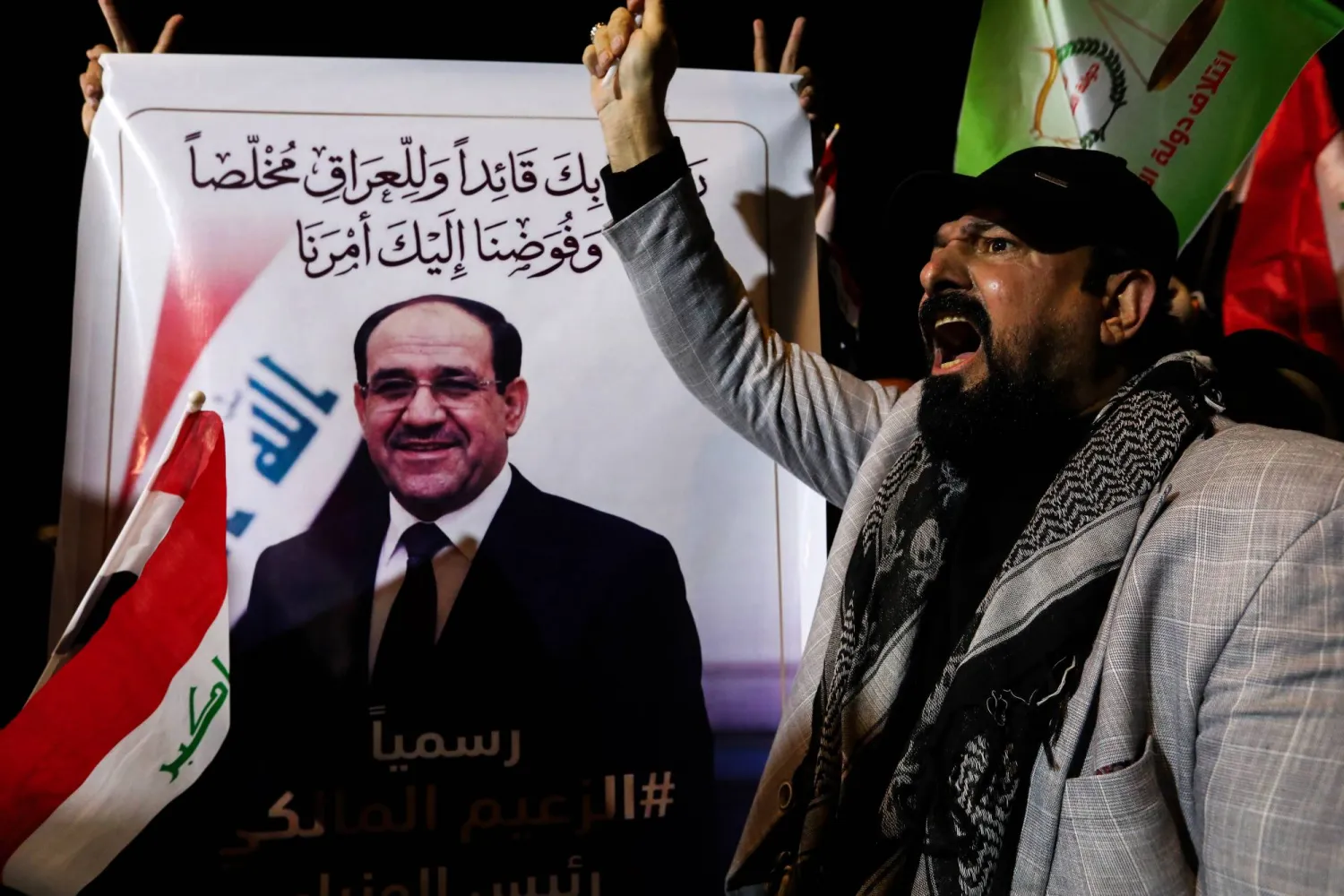
29 January 2026, Iraq, Baghdad: A supporter of former Iraqi prime minister Nouri al-Maliki chants in front of al-Maliki portrait during a protest against US President Donald Trump near the US embassy in Baghdad. Photo: Ameer Al-Mohammedawi/dpa
Iraq's parliament has again postponed the election of the country's new president, state media reported on Sunday, amid intense political horse-trading and US pressure over the new prime minister.
It was the second time parliament has delayed the presidential vote, which had first been due last week.
An AFP correspondent in the parliament said the required quorum was not reached on Sunday.
The vote was therefore delayed, according to the official INA press agency, which did not say whether a new date had been agreed.
The parliament's media office said the speaker will now meet the heads of party blocs to set a final date.
By convention, a Shiite Muslim holds the powerful post of prime minister, the parliament speaker is a Sunni and the largely ceremonial presidency goes to a Kurd.
The two main Kurdish parties have yet to settle on a presidential candidate, and the largest Shiite alliance -- despite backing Nouri al-Maliki for next premier -- faces US threats to end all support for Iraq if he takes up the post.
In Iraq, a country with chronically volatile politics driven by internal disputes and foreign pressure mostly from the United States and Iran, key decisions are often delayed beyond constitutional deadlines.
On Saturday, the Coordination Framework, an alliance of Shiite groups with varying degrees of links to Iran that has emerged as the main ruling coalition, said it "reiterates its support for its nominee", Maliki.
On Tuesday, US President Donald Trump declared Maliki a "very bad choice", and said that if Maliki was elected Washington "will no longer help Iraq".
Iraq's only two-term prime minister fell out with the United States during his premiership between 2006 and 2014 over growing ties with Iran.
Sources close to the Coordination Framework said that Shiite leaders are divided, with some wanting Maliki to stand aside, fearing US sanctions if he returns to office.
On the presidential front, Kurdish parties have yet to agree on a candidate, who must be endorsed by other blocs and win a two-thirds majority in parliament.
The presidency is usually held by the Patriotic Union of Kurdistan (PUK). This year, the rival Kurdistan Democratic Party (KDP) named its own candidate, Foreign Minister Fuad Hussein.
Iraq Awaits Zaidi’s First Move on Disarmament of Factionshttps://english.aawsat.com/arab-world/5278595-iraq-awaits-zaidi%E2%80%99s-first-move-disarmament-factions
Iraq Awaits Zaidi’s First Move on Disarmament of Factions
Zaidi speaks before presenting his government to parliament in Baghdad on May 14, 2026. (AFP)
Iraqi sources said on Friday that the prime minister’s office is preparing intensive consultations after Eid al-Adha as part of a plan to “reorganize the file of armed factions” and confine weapons to the state, as early moves emerge to dismantle the factions and merge them into official institutions.
Sources said Prime Minister Ali al-Zaidi has been in contact and exchanged direct messages in recent days with political forces with armed factions, in an effort to establish gradual mechanisms for the handover of weapons.
Five armed factions have so far declared an initial readiness to hand over their weapons, but have given no clear details or timetable.
The move is being viewed as the first political and security test of efforts to dismantle armed groups outside the state in a country where about 20 of them still operate beyond full official control, according to political estimates.
Weapons handover
The sources said the government plans to hold separate meetings with political leaders and blocs with armed factions, particularly within the ruling pro-Iran Coordination Framework, to agree on handover mechanisms and the reintegration of fighters into the regular forces or civilian state institutions.
In a significant move, influential Shiite cleric Moqtada al-Sadr announced that he was breaking with his armed faction, Saraya al-Salam, and handing its weapons and headquarters to the state.
Observers saw the step as backing the prime minister’s efforts and raising political pressure on other factions to follow suit.
A motorbike drives past a banner depicting influential cleric Moqtada al-Sadr, erected along a street the Iraqi capital Baghdad on May 27, 2026. (AFP)
The sources said the restructuring of Saraya al-Salam involved three main brigades, which include about 9,000 members, and placing them under the command of the commander-in-chief of the armed forces. That could make it easier to integrate them later into state institutions.
Sadr’s return
Other factions remain divided. Some political forces with armed groups have said they do not plan to join the current government, while others voiced conditional support for reform steps, demanding guarantees over the legal status of their members.
The Nujaba faction renewed its refusal to hand over weapons outside what it calls an “ideological path.” Other factions have adopted a more flexible tone, but have not publicly committed to any timetable.
A source within the Coordination Framework said the dismantling of Saraya al-Salam could open the way for a wider political repositioning by the Sadrist movement and give the government more room to maneuver on the armed factions file.
Political researcher Ghalib al-Daami told Asharq Al-Awsat that Sadr’s move “will strengthen the government’s ability to control weapons outside state authority and weaken the justifications of factions that refuse to hand them over.”
Al-Daami said some members of Saraya al-Salam are already part of the pro-Iran Popular Mobilization Forces and receive salaries from it.
He said the faction’s civilian wing is expected to be reintegrated into civilian groups working in the humanitarian field.
Syria: Sharaa Visits Deir Ezzor after Flooding Caused by Rising Euphrates Levelshttps://english.aawsat.com/arab-world/5278583-syria-sharaa-visits-deir-ezzor-after-flooding-caused-rising-euphrates-levels
Syrian President Ahmed al-Sharaa waves as he arrives to visit a flooded area after the Euphrates River overflowed its banks in recent days, in Deir Ezzor, Syria, Friday, May 29, 2026. (AP Photo/Omar Albam)
Syria: Sharaa Visits Deir Ezzor after Flooding Caused by Rising Euphrates Levels
Syrian President Ahmed al-Sharaa waves as he arrives to visit a flooded area after the Euphrates River overflowed its banks in recent days, in Deir Ezzor, Syria, Friday, May 29, 2026. (AP Photo/Omar Albam)
Syrian President Ahmed al-Sharaa visited the province of Deir Ezzor on Friday, accompanied by a ministerial delegation, to assess the situation and humanitarian conditions there amid flooding due to rising water levels in the Euphrates River, state news agency SANA said.
Syrian naval forces deployed several boats and watercraft to Deir Ezzor Friday to assist with evacuation and transportation operations across both banks of the Euphrates following the sharp rise in the river's water level.
The Syrian Ministry of Defense announced the mobilization of its military units and relevant departments, in coordination with the Ministry of Emergency and Disaster Management, to help address the consequences.
On Thursday, Syria's energy ministry warned of rising water levels on the Euphrates River after flooding in the north and east following increased flows from neighboring Türkiye and recent rains.
The ministry said it was monitoring the situation on the Euphrates "in light of the significant and unprecedented increase in water flows from the Turkish side".
It said the increase was due to "the abundance of the current rainy season and the opening of floodgates at dams located along the river in Turkish territory".
A statement said government water authorities in Deir Ezzor, Raqa and Aleppo provinces had announced a "state of emergency" and were taking precautionary measures.
SANA reported flooding in urban and rural areas of Deir Ezzor province on Thursday, where an earthen bridge was submerged.
It had said several bridges in the province were out of service on Wednesday because of flooding which also affected farmland and homes, and had also reported flooding in neighboring Raqa province.
Turkish local media, quoting the regional water authority, reported "controlled water releases" from the Ataturk Dam after a rise in water levels due to heavy rainfall in recent months, with the spillway gates opened for the first time in seven years.
The Ataturk facility is one of Türkiye’s three major dams and was built to generate electricity and irrigate the region along the border with Syria.
The energy ministry in Damascus said that according to authorities managing the country's Euphrates Dam, Syria's dam storage capacities were almost full, "necessitating the continued release of large quantities of water".
Late Wednesday, the ministry posted an image showing the opening of the Euphrates Dam floodgates, saying they had not been used for around 40 years, and warned people to exercise caution.
Separately, Sharaa had previously apologized to the people of Deir Ezzor after remarks by his father, Hussein al-Sharaa, sparked backlash on social media. Critics said the comments, made during a podcast discussion about social divisions between urban and rural communities in Syria, were offensive to Deir Ezzor residents.
Hussein al-Sharaa later said his remarks were taken out of context and were intended to address the impact of past exclusionary policies, not to insult the province's residents.
Asharq Al-Awsat Publishes Hamas Letter to Mediators as Cairo Meeting Loomshttps://english.aawsat.com/arab-world/5278481-asharq-al-awsat-publishes-hamas-letter-mediators-cairo-meeting-looms
Asharq Al-Awsat Publishes Hamas Letter to Mediators as Cairo Meeting Looms
A Palestinian inspects the site of an Israeli strike in Khan Younis, southern Gaza Strip, Friday, May 29, 2026. (AP)
Asharq Al-Awsat has obtained a document recently sent by Hamas to mediators regarding the ceasefire agreement in the Gaza Strip, where escalating Israeli violations have killed more than 930 Palestinians since the deal took effect on October 10.
Israel’s Channel 13 reported on Thursday evening, citing a regional diplomat who recently met Hamas leaders, that the Palestinian group would not accept disarmament and believed the United States would prevent Israel from carrying out any major military action in Gaza.
The report said Hamas had grown stronger, gained confidence, and was tightening its control over the enclave, especially after the withdrawal of Israeli forces.
A senior Hamas source told Asharq Al-Awsat that the reports were completely baseless.
The source said the movement had recently sent mediators a document on Israeli violations and its position on the political deadlock, in light of the negative stance of Prime Minister Benjamin Netanyahu’s government toward recent proposals by the mediators, as well as the roadmap put forward by the Board of Peace through its High Representative for Gaza, Nickolay Mladenov.
They also said Hamas had not recently held meetings with diplomatic officials in the region, apart from meetings held as part of negotiation rounds, with the participation of Mladenov and figures representing the US administration and the Board of Peace.
The source said the negotiation round, expected to take place before Eid al-Adha, had been postponed until after the holiday that started on Wednesday.
They said no specific date had been set for the round, but a delegation from the movement’s leadership was preparing to visit Cairo at Egypt’s invitation in the coming days, once the necessary arrangements were completed.
The source said messages of protest had been sent in the past period over Israel's continued escalation in killings and the targeting of people, adding that there had been no new positions.
Hamas sent the document to mediators in Egypt and sent copies to Qatar and Türkiye. Through those countries, it was relayed to other parties, including the Board of Peace and the US administration.
The Hamas document obtained by Asharq Al-Awsat.
The message
At the beginning of the document, dated May 20, Hamas referred to efforts made by mediators to bridge differences during the latest negotiation rounds in Cairo and Istanbul, which it said had succeeded in narrowing gaps.
The document said Israel’s measures, the expansion of its aggression, assassinations, and the targeting of Palestinians, the negotiating delegation, their families, and those connected to the negotiations had created a negative environment and strongly affected the course of talks, undermining mediators’ efforts to keep negotiations on their normal track.
The document criticized Mladenov’s recent briefing to the UN Security Council, saying it contained inaccurate points and held Hamas responsible for obstructing the negotiation process.
It said everyone knew the movement was fully committed to all provisions of the Sharm el-Sheikh agreement and that Israel was the party obstructing the deal and deliberately sabotaging mediators’ efforts.
The document affirmed Hamas and the Palestinian factions' commitment to the negotiation track and its importance. It said they were working seriously to develop ideas to help overcome the deadlock and saw the need to intensify cooperation with mediators to reach reasonable approaches.
Hamas urged mediators to pressure Israel to stop its daily violations of the agreement, which were obstructing the completion of the required tasks.
The document said that while consultations were underway to reach a suitable formula to present to mediators, Israel assassinated Ezzedine al-Haddad, the commander of the Qassam Brigades, Hamas’ armed wing. It said the killing disrupted communication and consultation.
Hamas hoped that once consultations were completed, it would communicate with mediators in the coming days to find a suitable formula to resume the negotiation process.
More than a month ago, Asharq Al-Awsat revealed the full details of the proposal, which was classified as a roadmap and aimed to complete what remained of the first phase while negotiating the provisions of the second phase.
Conditions set by Hamas and Israel obstructed the implementation of the roadmap. The two sides exchanged responses through mediators amid attempts to bridge their differences, and progress was later made.
But Netanyahu’s government’s demand to obtain a signed document on disarming Gaza before moving ahead with any steps stalled progress on the agreement again, especially as Israel also refrained from allowing the Gaza administration committee to enter the enclave and assume its duties.
لم تشترك بعد
انشئ حساباً خاصاً بك لتحصل على أخبار مخصصة لك ولتتمتع بخاصية حفظ المقالات وتتلقى نشراتنا البريدية المتنوعة