
Germany, France Condemn Far-Right Israeli Minister’s ‘Inhumane’ Gaza Remarks

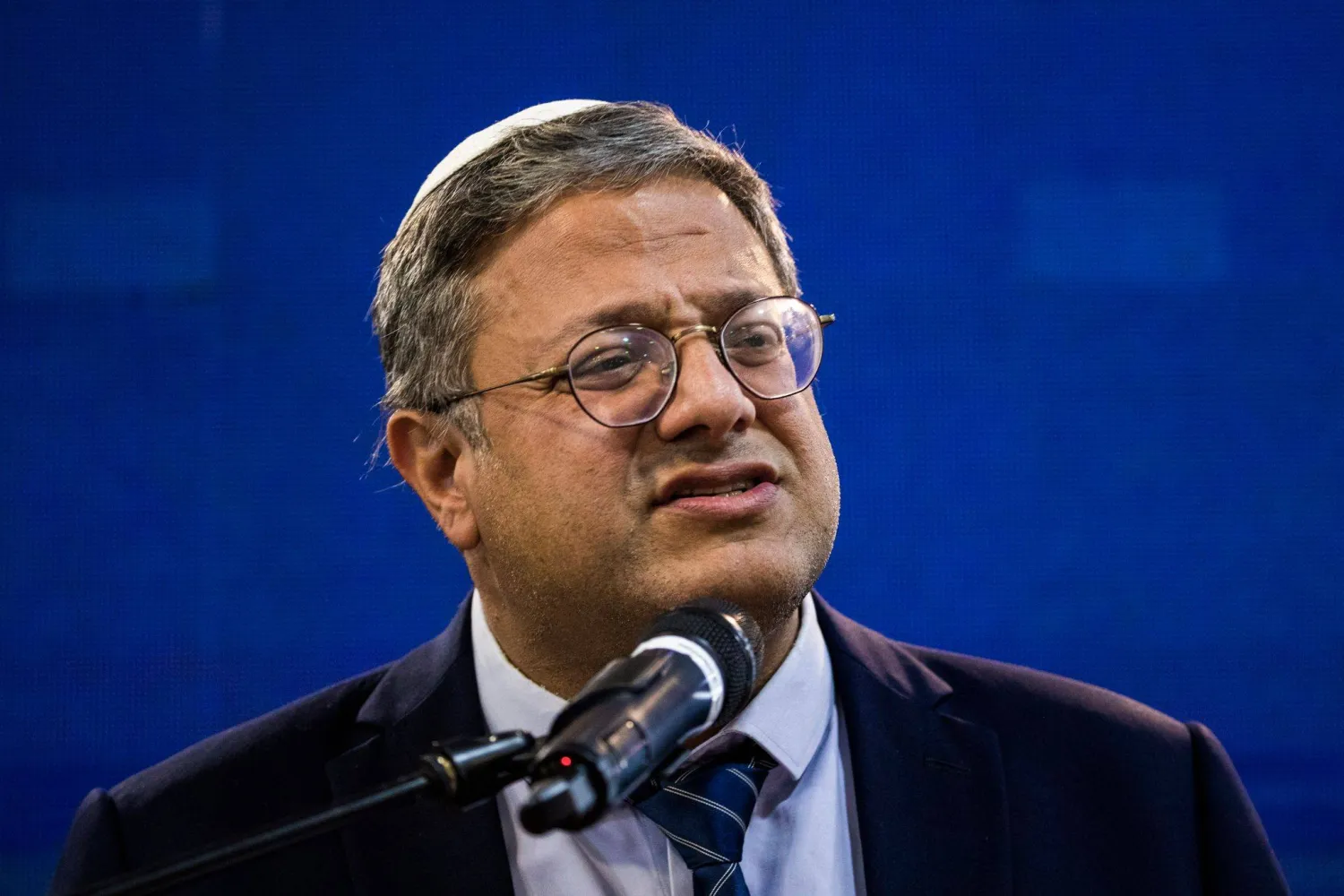
10 November 2022, Israel, Jerusalem: Israeli Minister of National Security Itamar Ben-Gvir speaks during a memorial ceremony for late Rabbi Meir Kahane. (dpa)
TT

Germany, France Condemn Far-Right Israeli Minister’s ‘Inhumane’ Gaza Remarks

10 November 2022, Israel, Jerusalem: Israeli Minister of National Security Itamar Ben-Gvir speaks during a memorial ceremony for late Rabbi Meir Kahane. (dpa)

Germany and France on Wednesday condemned remarks by Israel's far-right national security minister, who declared that Israel should kill "30 or 40" people every night in the Palestinian territory of Gaza.

German Chancellor Friedrich Merz "strongly condemns the inhumane appeals made by Minister (Itamar) Ben-Gvir, which violate international law," German government spokesman Sebastian Hille said. "They are unacceptable."

French Foreign Minister Jean-Noel Barrot also slammed the remarks, calling them "intolerable and inhumane" in an interview with the La Montagne regional newspaper.

Israel launched a military campaign on Hamas-ruled Gaza after the October 7, 2023 attack by the Palestinian group Hamas against Israel.

Ben-Gvir, who is already facing calls from several European countries for bloc-wide sanctions, made the call for mass killings during a podcast with a former Gaza hostage who had been held by Hamas.

"I think targeted eliminations should be carried out in Gaza every night. Take out 30 or 40," he said.

"Not only those who endanger you right now. These are people who shouldn't be alive," Ben-Gvir said. "I'm paying them a compliment by calling them humans."

Lars Klingbeil, German vice chancellor and finance minister, said in a TV interview Tuesday that Ben-Gvir's comments "must have consequences", adding that sanctions were being discussed at the European level.

Several European countries have called for EU-wide sanctions against the far-right minister, but the proposal has failed to win the required unanimity.

Calls to blacklist Ben-Gvir grew after he published a video in May of himself mocking bound activists seized by Israeli soldiers on a Gaza-bound aid flotilla.

France in response banned Ben-Gvir from entering the country and called for the EU to impose bloc-wide sanctions.

But EU sanctions have to be signed off by all 27 member states and staunch supporters of Israel refused to go along with the push.

- 'No further steps' -

Germany also condemned Israeli plans for settlement expansion in the so-called E1 area of the occupied West Bank, saying it jeopardizes the prospect for a two-state solution.

"Our message is clear: there must be no further steps toward annexation in the West Bank," said Hille.

"No formal ones, but also no political, structural, or other measures whose impact is increasingly and obviously leading toward annexation. They run counter to a two-state solution."

France's Barrot did not rule out further sanctions on Israeli settlers in the West Bank, who have increasingly been harassing and assaulting Palestinian residents in recent months, often with the aim to take their property.

"We imposed European sanctions against these settlers for the third time on May 28," he said.

"Further sanctions could be imposed and all options are on the table," Barrot added.

Israel has occupied the West Bank since 1967 and since then settlement expansion has been a policy under successive Israeli governments.

But it has accelerated significantly under the current coalition government of Prime Minister Benjamin Netanyahu.

Excluding east Jerusalem, more than 500,000 Israelis now live in the West Bank in settlements that are illegal under international law, among some three million Palestinians.


Mansouri Destruction Tests Limits of Southern Lebanon’s ‘Yellow Line’

Smoke rises from the site of an Israeli strike on the southern Lebanese village of Mansouri on Sept. 9, 2026 (AFP)
TT

Mansouri Destruction Tests Limits of Southern Lebanon’s ‘Yellow Line’

Smoke rises from the site of an Israeli strike on the southern Lebanese village of Mansouri on Sept. 9, 2026 (AFP)

Israel has stepped up demolitions, explosions and bulldozing in the coastal town of Mansouri, south of Tyre, making it one of the hardest-hit areas in southern Lebanon in recent days.

The intensity of the destruction has raised questions over why Israel is focusing on the town — and whether it is targeting specific military installations or pursuing a broader aim:

reshaping the terrain to control Mansouri by fire without fully occupying it.

A documented tally of Israeli attacks over the past seven days shows a sharp surge in explosions inside the town. More than 75 were recorded between Sept. 3 and midday Thursday, alongside airstrikes and repeated artillery shelling.

The campaign peaked on Wednesday, with dozens of explosions in a single day. Another 12 were recorded on Thursday morning. The figures are a minimum estimate, with further explosions reported but not precisely counted.

According to available information, Israeli forces have recently adopted a method of demolishing homes and residential neighborhoods remotely. Drones drop barrels packed with powerful explosives onto rooftops before detonating them.

A similar tactic was recorded in Bani Hayyan, where a drone dropped explosives onto homes before they were blown up.

Mansouri is strategically important because it lies along the coastal route and close to several positions occupied by Israeli forces. The mounting destruction suggests Israel’s actions go beyond daily military operations, raising questions about the military reality it is seeking to impose in the town and its surroundings.

Reshaping the terrain

Retired Brig. Gen. Hassan Jouni links Israel’s focus on Mansouri to the area’s geography. But he says the presence of Hezbollah infrastructure alone does not explain the scale of the destruction.

“This is linked to Mansouri’s geography and its geographical extent,” Jouni told Asharq Al-Awsat. “The area forms a corridor that Hezbollah historically used extensively in its operations.

My assessment is that infrastructure exists there.”

“The terrain, dense woodland and a long corridor stretching from north of Tyre to the border made the area particularly useful to Hezbollah,” he said.

“It is likely to contain extensive and varied infrastructure, especially given its proximity to the border. During the fighting, reports spoke of drones and rockets being launched from this area.”

But Jouni stressed that this “does not mean every explosion carried out by Israel is targeting such infrastructure.”

“Israel is reshaping the geography and altering the terrain to create a military landscape better suited to its army,” he said.

“The natural geography is being changed to make surveillance, observation and monitoring easier for the Israeli army. What we are seeing is more an effort to reshape the geography than simply to target infrastructure in Mansouri.”

Jouni said the same logic applied to the destruction of buildings.

“Some homes stand at commanding, elevated locations that overlook the surrounding area,” he said.

“They are being destroyed because of the importance of their position — not necessarily because they contain infrastructure or ammunition, or because they belong to Hezbollah or its members. Some are destroyed solely because of where they stand.”

Jouni described Mansouri as a “pivotal target” for Israel because it “lies between Israeli army positions in the western sector and the city of Tyre.”

A shifting operational zone

Jouni said the “yellow line” should not be understood as a fixed boundary on the ground.

“The yellow line being discussed cannot be drawn as a line on the ground,” he said. “It is a series of operational zones extending in the west from the vicinity of Mansouri and Majdal Zoun, moving north toward Haddatha and then east to the vicinity of Ali al-Taher.”

“There is no yellow line like the one in Gaza, marked by signs or concrete blocks,” he added.

“Here, we are talking about a fluid, dynamic operational zone. It has been called the yellow line, but in practice, it is not fixed.”

Jouni said the limits of the Israeli army’s presence in southern Lebanon were defined not by a fixed line, but by shifting operations.

In Israeli calculations, he said, Mansouri is “a vital central target separating the city of Tyre from Israeli army positions along the southern border or in the buffer zones.”

“Israel views Mansouri strategically,” he said. “It is treating the town as a barrier village — and seeking to remove that barrier.”

Control by fire

Retired Brig. Gen. Saeed Qazah said Israel appeared to be trying to strip Mansouri of cover and control it from surrounding positions, rather than occupy it and station troops inside.

“Mansouri appears to contain many Hezbollah installations and infrastructure sites,” Qazah told Asharq Al-Awsat. “I do not know whether Hezbollah members are still able to infiltrate or move through them, but that may be one reason the Israelis are targeting the town so heavily.”

“They appear to be trying to destroy Mansouri — its infrastructure and its buildings — to leave it exposed without having to occupy it physically,” he said.

“They can control it by fire from Majdal Zoun, Bayyada and Shamaa. Once the buildings are destroyed and the area is exposed, they can detect any movement inside and respond.”

Qazah said the scale of destruction did not necessarily mean Israel was preparing to occupy the town.

“Mansouri lies on the edge of what has been declared the yellow line,” he said. “It is close to Majdal Zoun, Bayyada and Shamaa, while Majdal Zoun stands on higher ground overlooking it.”

“The Israelis enter, plant explosives and destroy infrastructure and homes to turn the area into exposed, scorched ground.”

Qazah said Israel appeared to want Mansouri cleared and exposed, allowing it to monitor the town from surrounding hills and positions.

“They would then be able to use firepower against any armed movement inside without having to station forces in the heart of the town, as long as they can control it by fire,” he said.

Qazah said Majdal Zoun lies southeast of Mansouri, while Bayyada and Shamaa lie to the south, alongside the Buyout al-Sayyad area. Their terrain and elevation, he said, allow Israel to monitor the town and its surroundings.

“Mansouri is tied to this coastal route,” Qazah said.

“It appears to contain many installations that are being entered and destroyed, while homes are also being demolished to leave the area devastated and completely exposed, allowing any potential movement inside it to be detected.

“This is particularly important because any movement from Mansouri could head toward Majdal Zoun or areas where Israeli forces are deployed.”


Algeria Severs Diplomatic Ties with the UAE

Algerian President Abdelmadjid Tebboune (Photo: The Presidency)
TT

Algeria Severs Diplomatic Ties with the UAE

Algerian President Abdelmadjid Tebboune (Photo: The Presidency)

Algeria announced Thursday that it's severing diplomatic ties with the United Arab Emirates, in a Foreign Ministry statement reported by state media.

“Having exhausted all the ways for preserving the bilateral relations, the Algerian government has decided, today, to sever diplomatic relations with the United Arab Emirates,” the statement said, according to the official APS news agency.

The ministry statement was also read out on public television.


Yemeni Army Makes Battlefield Gains in Al-Jawf, Marib

Yemeni army forces advance in Al-Jawf governorate (government media)
TT

Yemeni Army Makes Battlefield Gains in Al-Jawf, Marib

Yemeni army forces advance in Al-Jawf governorate (government media)

Yemeni government forces expanded military operations against the Houthis on several fronts Wednesday, making battlefield gains east of Al-Hazm in Al-Jawf province and cutting Houthi supply lines toward the eastern fronts.

The advances coincided with the launch of a major operation south of Marib, intensified fighting in southern Taiz and along the western coast, and the thwarting of a Houthi boat attack in the Red Sea.

A military source told the Yemeni Armed Forces Media Center that government forces continued advancing east of Al-Hazm to the outskirts of Bir al-Maraziq and cut Houthi supply lines on the city’s eastern fronts.

Operations were continuing amid what the source described as heavy Houthi personnel and material losses. Several Houthi fighters were detained or neutralized and others wounded in the clashes, the source added.

The advance followed several days of government military moves in Al-Jawf, as forces sought to consolidate gains and pressure Houthi supply lines rather than merely retake frontline positions.

Marib and Taiz Developments

In Marib, the Yemeni army’s Third Military Region launched a major operation on the province’s southern fronts targeting Houthi positions and concentrations. Government forces said the operation aimed to secure Marib’s southern belt and push the group away from its defensive lines.

According to a statement from the Third Military Region, the operation, which began early Wednesday and was still underway, killed, wounded and captured a number of Houthis and destroyed vehicles and combat equipment. Army and Popular Resistance forces also seized several positions and brought Houthi supply lines under fire.

The operation coincided with military activity in Marib in recent days and fighting across the province’s northern, western and southern axes, as government forces sought to capitalize on battlefield pressure to prevent the Houthis from regrouping or sending reinforcements to other fronts.

In Taiz, clashes continued on southeastern fronts, alongside artillery fire and airstrikes targeting Houthi positions and concentrations in Al-Mamshat, Al-Ahkum, Ayrim, Al-Qubaytah, Al-Rahidah and Karsh.

A military source said the Houthis had sent reinforcements to several positions, including Al-Akboush School, Al-Zubayrah market, the Al-Ahkum junction, Hawd Hill, Al-Khazjah, Al-Aabous and Al-Manzarah Hill.

On the western coast, the National Resistance’s military media said its forces shot down a Houthi suicide drone over Al-Barh and reported the killing and capture of several commanders linked to a Houthi plan to attack toward Bab al-Mandab.

Among those reportedly captured by the Giants Brigades was Murtada al-Nuami, known as “Abdul Samad,” identified as head of the medical division of the Houthi reserve and rapid intervention forces.

Naval forces separately said they thwarted a Houthi boat attack in the Red Sea after detecting the vessels and engaging them, forcing them to retreat north toward Hodeidah port.

In Al-Dhale, Yemeni Defense Minister Lt. Gen. Taher al-Aqili inspected front lines to assess operations, readiness and deployments, urging troops to remain vigilant and prepared to counter any Houthi attempt to target government positions.