
Israel Fears SDF-Like Agreement in South Syria

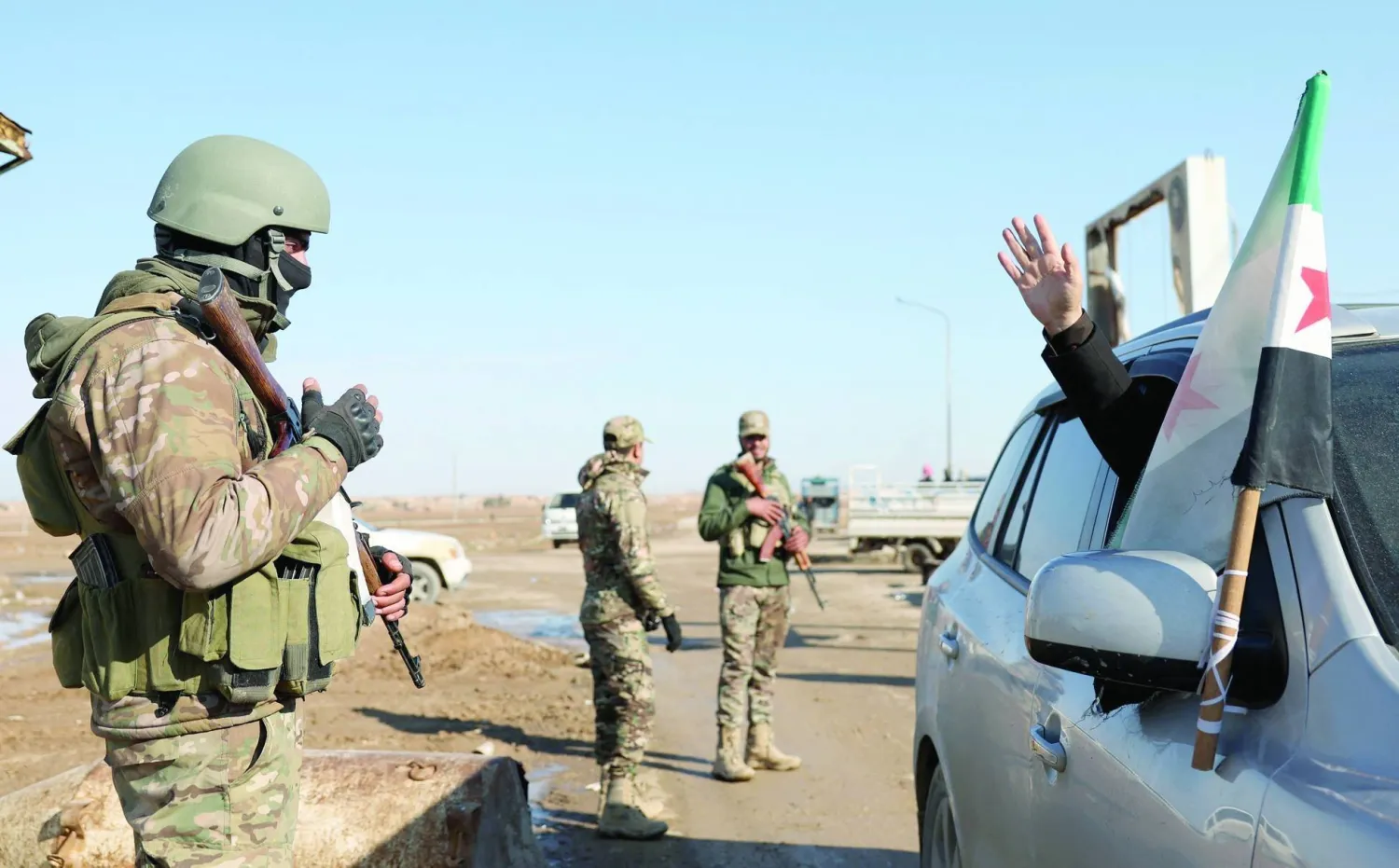
A resident greets Syrian government forces south of Hasakah, in northeastern Syria, on Jan. 20, 2026. (Credit: Omar Haj Kadour/AFP) 
TT

Israel Fears SDF-Like Agreement in South Syria

A resident greets Syrian government forces south of Hasakah, in northeastern Syria, on Jan. 20, 2026. (Credit: Omar Haj Kadour/AFP) 

As the United States seeks to activate the joint Syrian-Israeli Mechanism Committee and invite it to meet again within the next two weeks, political sources in Tel Aviv revealed that the government of Benjamin Netanyahu is further disputing with Washington over Damascus.

The government considers the US policy in Syria as “silly and not compatible with the nature of the broiling Middle East,” the sources said.

According to far-right newspaper Makor Rishon, “Israel expressed frustration with the US administration's policy in Syria, including Washington’s support and confidence in the rule of Syrian President Ahmad al-Sharaa, who has not yet proven he cleared his past associated to the Hay’at Tahrir al-Sham.”

Misgav Institute Fellow, Dr. Elie Klutstein, wrote that Washington is looking out for its own interests in Syria while placing Israel's security interests on the sidelines.

Klutstein said the Israeli government should confront Washington to insist on its interests at any cost.

Israel fears the new regime in Syria succeeds at consolidating itself. Tel Aviv bets on an ethnically and sectarian fragmented country and could not support the idea of a “united Syria.”

Israel is particularly angered by an agreement between the Syrian Democratic Forces (SDF) and the Syrian government in the north, that would guarantee the unity of the Syrian territory.

Today, Israel also fears al-Sharaa government will reach a similar agreement with the Druze in the province of Sweida, south of the country.

The majority of Druze leaders in the south are concerned with the unity of Syria, and are ready to ink an agreement with the government in return of guarantees that attacks by its forces will not be repeated.

The leaders also argue that only a small Druze community opposes al-Sharaa regime and therefore, will eventually succumb to an agreement if the government is serious in granting them minority rights.

Last week, Hebrew media outlets said the comprehensive agreement between Kurdish-led Syrian SDF factions and the Syrian government to integrate with the Syrian army is not an arrangement between two equal parties.

“This is a Kurdish submission to Ahmed al-Sharaa that happened after government supporters dismantled the SDF from the inside, and brought several factions closer to the regime,” the Hebrew media wrote.

Earlier, US sources said Türkiye informed the US administration it supports a centralized Syrian state and rejects any Kurdish canton in the northeast.

In return, Israel’s government conveyed to Washington its opposition to a centralized Syria, preferring a federal model.

Sources said Netanyahu is angered by the outcome in northeastern Syria and considers US Special Envoy to Syria tom Barrack biased toward Ankara.

The Israeli circles see Türkiye as the 'biggest winner' from the collapse of the SDF.

Therefore, the Israeli government reiterated that it will not accept Turkish troop presence in Syria and insists on protecting Druze communities in southern Syria.

Tel Aviv’s response to the agreement between SDF forces and al-Sharaa’s government was translated on Friday, when Israeli forces entered two locations in southern Syria: the Saida al-Hanout village in the southern Quneitra countryside and the village of Samdaniya al-Sharqiya in the northern Quneitra countryside.

An Israeli patrol, consisting of seven military vehicles, erected a barrier west the village of Saida in Hanout, before withdrawing from the area.

This development came while the US plans to invite the joint Syrian-Israeli Mechanism Committee to again meet in Amman within the next two weeks and resume direct official talks between the two countries.

The joint fusion mechanism -- a dedicated communication cell -- aims to facilitate immediate and ongoing coordination on the two countries’ intelligence sharing, military de-escalation and diplomatic engagement under the supervision of the United States.


Hezbollah Says Fighters Clash with Israeli Troops on Lebanon-Syria Border

Israeli tanks gather on the Israeli border with Lebanon, northern Israel, 06 March 2026. EPA/ATEF SAFADI
TT

Hezbollah Says Fighters Clash with Israeli Troops on Lebanon-Syria Border

Israeli tanks gather on the Israeli border with Lebanon, northern Israel, 06 March 2026. EPA/ATEF SAFADI

Lebanese official media reported on Saturday that clashes had erupted as Israeli forces attempted a landing operation along the Lebanon-Syria border, with militant group Hezbollah saying its fighters were involved.

The state-run National News Agency (NNA), citing the Lebanese health ministry, said Israeli strikes on Nabi Sheet killed at least three people and wounded 16 others.

There was no immediate comment from the Israeli military, which has launched numerous strikes and sent ground troops into Lebanon since Tehran-backed group Hezbollah fired missiles at Israel on Monday to avenge the killing of Iranian supreme leader Ali Khamenei, reported AFP.

If confirmed, the latest reported raid would be the deepest Israeli forces have reached inside Lebanon since special unit troops apprehended Hezbollah operative Imad Amhaz from the northern city of Batroun in November 2024.

The NNA said that "clashes are taking place on the eastern mountain range along the Lebanese-Syrian border... to repel Israeli landing attempts."

It gave the location as Nabi Sheet, in the eastern Baalbek district where Hezbollah holds sway.

Hezbollah said in a statement that its fighters had "observed the infiltration of four Israeli enemy army helicopters from the Syrian direction".

After landing, advancing troops "were engaged by a group" of Hezbollah fighters as they reached the Nabi Sheet cemetery, Hezbollah said, noting the use of light and medium weapons.

"The clash escalated after the enemy force was exposed," it added, saying the Israeli troops launched intense strikes and began to evacuate.

A separate statement said Hezbollah fighters had fired rockets as the Israeli forces withdrew.

Footage shared on social media showed waves of gunfire in the air.

Nabi Sheet was the target of at least 13 Israeli air strikes on Friday, according to the NNA, with the Lebanese health ministry reporting at least nine people killed.


Iraq, Kurds Say Country Not a Launchpad Against Neighbors

Smoke rises after an explosion near Erbil International Airport in Erbil on March 6, 2026. (AFP)
TT

Iraq, Kurds Say Country Not a Launchpad Against Neighbors

Smoke rises after an explosion near Erbil International Airport in Erbil on March 6, 2026. (AFP)

The Iraqi government and the autonomous Kurdistan region said Friday that Iraq must not be a launchpad for attacks against neighboring countries, following reports that militants might attempt to cross into Iran.

Prime Minister Mohammed Shia al-Sudani and Kurdistan's regional president Nechirvan Barzani agreed in a phone call "that Iraqi territory must not be used as a launching point for attacks against neighboring countries", the premier's media office said.

Tehran threatened Friday to target "all the facilities" of Iraq's autonomous region if exiled Kurdish Iranian militants were allowed to enter Iran.


Kurdish Iranian Dissidents in Iraq Deny Attack Plans but Say They Would Join a US Invasion of Iran

Members of the Kurdistan Freedom Party PAK stand guard in Erbil, Iraq, Thursday, March 5, 2026. (AP)
TT

Kurdish Iranian Dissidents in Iraq Deny Attack Plans but Say They Would Join a US Invasion of Iran

Members of the Kurdistan Freedom Party PAK stand guard in Erbil, Iraq, Thursday, March 5, 2026. (AP)

Officials with one of the armed Kurdish Iranian dissident groups based in northern Iraq told The Associated Press that they are not planning an imminent cross-border attack on Iran but would join a ground invasion if the US were to launch one.

The comments appeared to be aimed at reassuring Iraqi Kurdish officials, who have said they do not want attacks to be launched against Iran from their territory, fearing that they will be further dragged into the war in the Middle East sparked by the US and Israel’s strikes on Iran.

In the event of a US ground operation, “then we would enter alongside the coalition forces,” said Khalil Nadiri, an official with the Kurdistan Freedom Party PAK, in an interview with the AP Thursday. But he said, “The Kurds must not place themselves as the spearhead of the attack.”

He added that his group also has armed members already present inside of Iran and that they would not necessarily require cross-border support if they were to stage an uprising.

Nadiri said the Kurdish groups have been in contact with the US and Israel but denied having received any material aid from them.

The comments came after Kurdish officials said earlier this week that the Kurdish Iranian dissident groups based in northern Iraq are preparing for a potential cross-border military operation in Iran, and the US had asked Iraqi Kurds to support them

Rebaz Sharifi, a military commander with the PAK, said it would be “a very positive development” if the US and its allies were to arm the Kurdish groups, but also denied that they have received any such support so far.

Sharifi said he expects that at some point, US President Donald Trump “might want the peshmerga forces of Eastern Kurdistan to participate in the conflict during a ground invasion” and “if it reaches that point, we, for our part, would be pleased with it.”

However, the two officials sought to dispel the fears of Iraqi Kurdish officials that Iraq’s semiautonomous Kurdish region would be used as a launching pad.

Peshawa Hawramani, spokesperson for the Kurdistan Regional Government, said in a statement earlier this week that “allegations claiming that we are part of a plan to arm and send Kurdish opposition parties into Iranian territory are completely unfounded” and that the Iraqi Kurdish parties do not want to “expand the war and tensions in the region.”

Already Iran and allied Iraqi militias have launched dozens of missiles and drone attacks into northern Iraq, targeting the US bases and consulate in Irbil as well as bases of the Iranian Kurdish dissident groups.

Sharifi said PAK's bases have been attacked twice with ballistic missiles and four times with drones since the start of the war, killing one of their fighters and wounding three others.

Nadiri said that “since the (Iraqi) Kurdistan region has adopted a policy of not becoming a part of this conflict and because we do not want to disrupt the stability and security here and we respect the laws of this region, consequently, the environment has not yet been established for us to move our forces back into Eastern Kurdistan.”

He was using the term used by Kurdish groups to refer to the Kurdish region of Iran.

The potential military involvement of the Kurds has raised tensions with other Iranian opposition groups - notably the faction led by the former shah’s son, Reza Pahlavi, who has accused the Kurds of being separatists aiming to carve up Iran.

Sharifi said that his group's “ultimate goal is the statehood of the Kurds in all four regions and the reunification of Kurdistan,” referring to the Kurdish areas that are currently split among Iran, Iraq, Türkiyeand Syria.

Nadiri said that a confederal system could be a “viable solution” that would allow the Kurdish area to remain part of Iran while maintaining its “own sovereignty, identity, and unique characteristics.”