


Hezbollah’s Selective Turn to State Exposes Paralysis

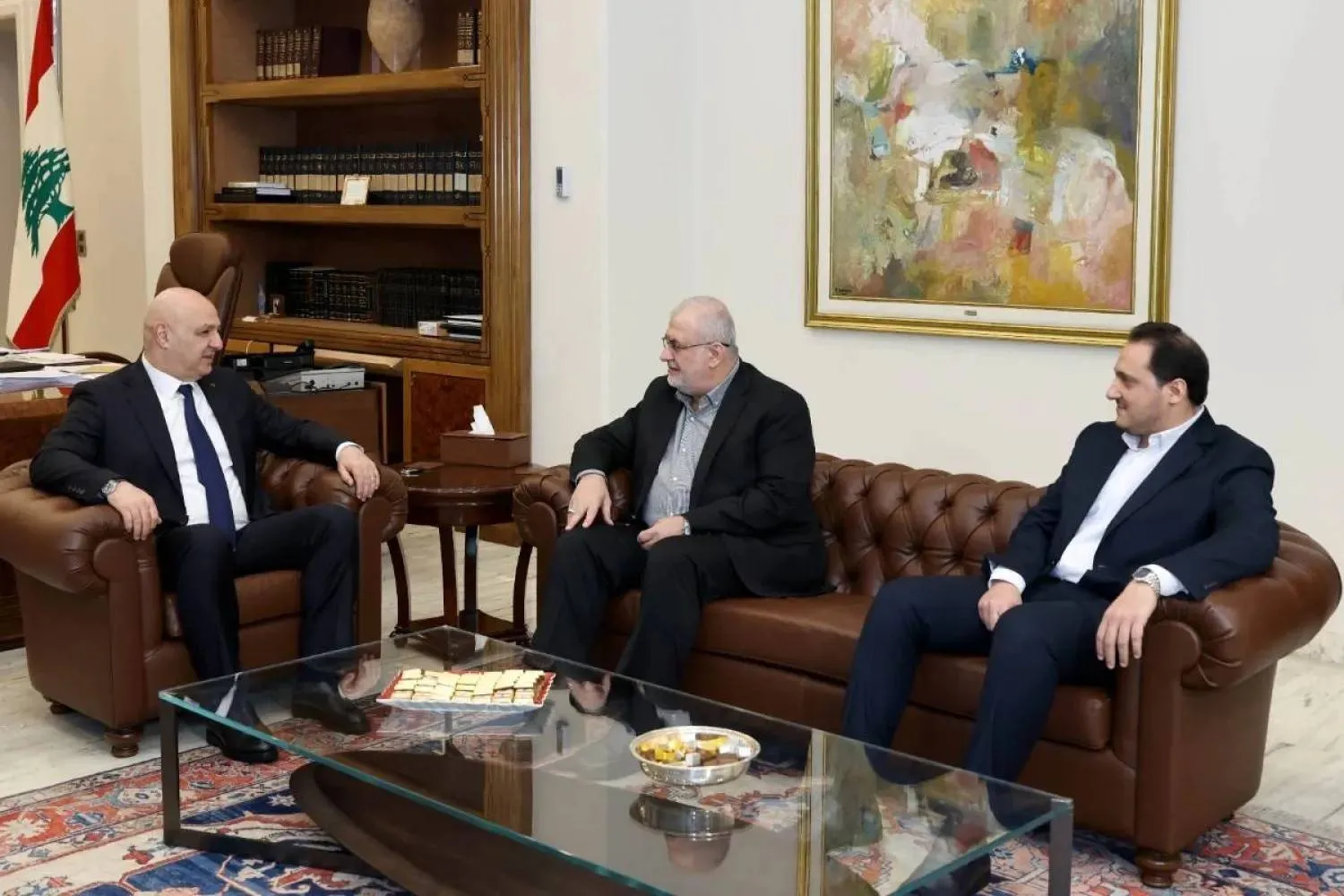
Hezbollah parliamentary bloc head Mohammed Raad meets Lebanese President Joseph Aoun (Lebanese Presidency)
TT

Hezbollah’s Selective Turn to State Exposes Paralysis

Hezbollah parliamentary bloc head Mohammed Raad meets Lebanese President Joseph Aoun (Lebanese Presidency)

Since the ceasefire reached with Israel in November 2024, Hezbollah has shown a striking shift in its political conduct, particularly in how it deals with Lebanese state institutions.

A group long used to operating outside official channels is now, despite its escalatory rhetoric, shifting responsibility to the state on issues ranging from Lebanese prisoners held by Israel and postwar reconstruction to indirect negotiations with Tel Aviv.

Since the ceasefire, Hezbollah has also refrained from responding militarily to Israel, with no direct action recorded, in clear contrast to its traditional discourse built around retaliation and deterrence.

At the same time, the group continues to reject any discussion of handing over its weapons. It has launched a campaign against officials who have spoken about restricting arms to the state north of the Litani River.

This was evident in remarks by Mohammed Raad, head of Hezbollah’s parliamentary bloc, following his meeting with Lebanese President Joseph Aoun on Wednesday, after tensions had surfaced between the two sides over recent statements by the president urging the group to act with restraint.

While Raad did not address the issue of weapons during his remarks at the presidential palace, he reiterated Hezbollah’s stance of placing responsibility on the state regarding liberation, prisoners, and reconstruction.

He said the group was committed to understanding and cooperation to achieve the goals of all Lebanese, starting with ending the occupation, securing the release of prisoners, strengthening stability, enabling residents to return to their homes and villages, launching reconstruction efforts, and having the state assume responsibility for protecting sovereignty, with Hezbollah supporting it when necessary, while rejecting all forms of intervention and tutelage.

This approach is also reflected in Hezbollah’s meetings with Aoun and Prime Minister Nawaf Salam to hand over lists of Lebanese prisoners and explicitly call on the state to take full responsibility for the issue. This practice was not typical of the group in previous phases.

Contradiction and confusion

Sources close to the presidency declined to comment on Raad’s remarks or assess the meeting with Aoun, telling Asharq Al-Awsat that there was an apparent contradiction and confusion in Hezbollah’s behavior and positions. At the same time, everyone awaited the outcome of US-Iranian negotiations.

They said what was happening amounted to buying time, and that the state was not a menu from which responsibilities could be selectively chosen.

They said Hezbollah wanted the state to shoulder responsibility for all outstanding issues, which was indeed the state’s duty, even though the group had launched its support front without consulting it and continued to reject the implementation of state decisions. They described Hezbollah officials as lacking clarity in defining their objectives.

Clear incapacity

Opposition political analyst Ali al-Amin described Hezbollah’s behavior, combining escalatory rhetoric with rejection of disarmament while demanding the state resolve outstanding issues, as a clear expression of its inability to respond to repeated Israeli strikes, including killings and destruction.

Amin told Asharq Al-Awsat that Hezbollah was also attempting to transfer the consequences of the war to the state, channeling the complaints of displaced and affected citizens toward state institutions, as if to say the matter was the state’s responsibility, while ignoring what was required of it in terms of handing over its weapons.

He said that when the discussion turns to the role of the state, weapons are framed in terms of dignity and honor, but when it comes to bearing burdens, citizens are told the state is responsible.

Despite this, Amin said Hezbollah had succeeded to some extent in shifting these burdens, noting that it had not paid housing compensation, issued checks that were not honored, and that citizens were now being told the state would pay instead.

At the same time, the group had not carried out any response against Israel, raising a question it avoided answering: whether it no longer wanted to fight Israel.

Confusion and mutual benefit

Amin said Hezbollah was seeking to reduce the cost of confrontation and transfer the burden to the state without abandoning its tools or strategic options.

He said the group wanted to preserve the current situation, with ongoing Israeli attacks used to justify retaining weapons. At the same time, Israel benefits from their continued presence to strengthen its leverage and impose conditions on Lebanon later.

He added that Lebanon was facing a state of confusion: no fighting, no resistance, no liberation, only a continued insistence on retaining arms whose remaining function was unclear, except as an Israeli pretext for further attacks and for weakening the Lebanese state.


US Embassy in Beirut Warns of Possible Iran Threat to Universities in Lebanon

People walk past the main gate to the campus of the American University of Beirut (AUB) in the center of Beirut on January 13, 2022. (AFP)
TT

US Embassy in Beirut Warns of Possible Iran Threat to Universities in Lebanon

People walk past the main gate to the campus of the American University of Beirut (AUB) in the center of Beirut on January 13, 2022. (AFP)

The US embassy in Beirut said on ‌Friday ‌that Iran ‌and ⁠its aligned armed ⁠groups "may intend to target ⁠universities ‌in Lebanon".

In ‌a security ‌alert, ‌the embassy also ‌urged US citizens to depart ⁠Lebanon "while ⁠commercial flight options remain available".

Lebanon was dragged into the conflict in the Middle East when Iran-backed Hezbollah shot rockets at Israel in retaliation to the killing of Iranian supreme leader Ali Khamenei at the beginning of the war.

Over the past 24 hours, Israeli strikes killed 23 people and wounded 98, the Lebanese health ministry said Friday.

The ministry said that the overall death toll includes 125 children and 91 women, since Israel launched intense airstrikes across Lebanon after the Hezbollah fired rockets toward northern Israel in solidarity with Iran on March 2. The strikes have also wounded 4,138 others.

Among those killed are 53 health workers, while Israeli strikes have targeted 83 emergency medical service facilities, the health ministry said.


UN Force Says 3 Peacekeepers Wounded in Blast Inside South Lebanon Position

 UNIFIL vehicles drive on a main road in Qlayaa, amid escalating hostilities between Israel and Hezbollah, as the US-Israel conflict with Iran continues, in Qlayaa, southern Lebanon, March 27, 2026. (Reuters)
UNIFIL vehicles drive on a main road in Qlayaa, amid escalating hostilities between Israel and Hezbollah, as the US-Israel conflict with Iran continues, in Qlayaa, southern Lebanon, March 27, 2026. (Reuters)
TT

UN Force Says 3 Peacekeepers Wounded in Blast Inside South Lebanon Position

 UNIFIL vehicles drive on a main road in Qlayaa, amid escalating hostilities between Israel and Hezbollah, as the US-Israel conflict with Iran continues, in Qlayaa, southern Lebanon, March 27, 2026. (Reuters)
UNIFIL vehicles drive on a main road in Qlayaa, amid escalating hostilities between Israel and Hezbollah, as the US-Israel conflict with Iran continues, in Qlayaa, southern Lebanon, March 27, 2026. (Reuters)

The United Nations Interim Force in Lebanon said a blast hit one of its positions and wounded three peacekeepers on Friday, the third such incident in a week.

"This afternoon, an explosion inside a UN position... injured three peacekeepers, two seriously. They are all currently being evacuated to hospital. We do not yet know the origin of the explosion," UNIFIL spokesperson Kandice Ardiel said in a statement.

"UNIFIL reminds all actors of their obligations to ensure the safety and security of peacekeepers, including by avoiding combat activities nearby that could put them in danger," she added.

The UN force is deployed in south Lebanon near the Israeli border, where Israel and Hezbollah have been at war for a month and where Israeli troops are pressing a ground invasion.

Lebanon was drawn into the Middle East war on March 2 when the Tehran-backed Hezbollah launched rockets at Israel to avenge the US-Israeli attack that killed Iran's supreme leader Ali Khamenei.

Israel has responded with massive strikes across Lebanon, as well as the ground operation.

UNIFIL had said that a peacekeeper was killed on Sunday evening when a projectile of unknown origin "exploded in a UNIFIL position near Adchit al-Qusayr".

The following day, UNIFIL said an "explosion of unknown origin" destroyed a peacekeeping vehicle, killing two more Indonesian troops.

It said investigations had been launched into both incidents.

A UN security source told AFP this week that Israeli fire was the source of Sunday's attack, while a mine may have caused the following day's deadly blast.

Israel's military denied responsibility for Monday's incident.

"A comprehensive operational examination indicates that no explosive device was placed in the area by army troops, and that no troops were present in the area at all," the statement said.

According to the UN, 97 force members have been killed in violence since UNIFIL was first established to monitor the withdrawal of Israeli forces after they invaded Lebanon in 1978.

The mandate of the force, which for decades has acted as a buffer between Israel and Lebanon, finishes at the end of this year.


RSF in Sudan Kill at Least 10 People in Hospital Drone Attack, Medical Group Says

Fighters of the paramilitary Rapid Support Forces (RSF) drive an armored vehicle in Khartoum in 2023. (AFP)
TT

RSF in Sudan Kill at Least 10 People in Hospital Drone Attack, Medical Group Says

Fighters of the paramilitary Rapid Support Forces (RSF) drive an armored vehicle in Khartoum in 2023. (AFP)

Sudan ’s paramilitary forces killed at least 10 people on Thursday in a drone attack that hit a hospital in the south-central part of the country, said a medical group.

Doctors Without Borders, also known as MSF, said the Sudanese paramilitary Rapid Support Forces, RSF, launched two drone strikes on al-Jabalain Hospital in the White Nile province, hitting an operating theater and a maternity ward.

The strikes, the latest in an intensifying drone warfare between the army and the RSF, killed 10 people, including seven medical staffers, and injured at least 19 people. Those injured were transferred to a hospital in Kosti, which is around 50 miles (80 kilometers) away, said MSF.

Salah Moussa, a senior staffer in the nursing department at al-Jabalain Hospital, was injured in his leg in one of the two strikes. He told The Associated Press by phone on Friday that those killed include the hospital’s general manager, the administrative manager, several policemen and a citizen.

Moussa said he was in his house near the hospital when he heard the sound of explosions at around 11 a.m. on Thursday.

“I rushed to the hospital when I heard the explosion and while we were helping evacuate three injured staff members, another drone strike was launched and I got hit and lost consciousness,” he said. “The hospital lost all its medical and administrative leadership in this attack.”

The strikes are the latest in a series of attacks on the health care system in Sudan that continues to be hit hard during the ongoing war between the army and the RSF that broke out in April 2023. The World Health Organization said in March that over 200 attacks have targeted health care since the war began. Most recently, 70 people were killed, including at least 13 children, in a strike on a hospital in Sudan’s western Darfur region last month.

The nearly three-year conflict in Sudan killed more than 40,000 people, according to UN figures, but aid groups say the true number could be much higher.

“The attack is even more appalling as it occurred during a children’s immunization campaign,” the MSF said of the strike on the al-Jabalain hospital.

Meanwhile, Emergency Lawyers, a local rights group, said Thursday that the attacks also targeted a medical supply depot in Rabak, the capital city of the White Nile province.

The Emergency Lawyers said the “recurring pattern” of drone attacks by the warring parties since March in the provinces of South Kordofan, Blue Nile, East, Central and South Darfur displaced more people.

On Friday, Khalid Aleisir, the minister of culture, information, antiquities and Tourism condemned the attack and called for designating the RSF a terrorist organization and prosecuting its members.

“We also hold regional backers directly responsible for perpetuating this violent campaign through military and logistical support, including advanced weaponry and unmanned aerial systems, which have escalated violence and targeted civilians,” he wrote on X.

Sudan Doctors Network, a local group that monitors war violence, called the attack a “deliberate assault on health facilities and unarmed civilians” that further worsens an already deteriorating health sector in the country.

“MSF is outraged by these repeated attacks on health care, which have escalated dangerously in recent weeks,” said Esperanza Santos, MSF head of emergencies for Sudan in the group’s statement on Thursday. “Health facilities, medical staff, and patients must always be protected. We call on RSF and SAF to immediately stop this spiral of violence against medical facilities.”

A surge in drone strikes in the Sudanese region of Kordofan has taken a growing toll on civilians and hampered aid operations, analysts and humanitarian workers previously said.