
Egypt Pushes Diplomacy to Clear Hurdles in US-Iran Talks

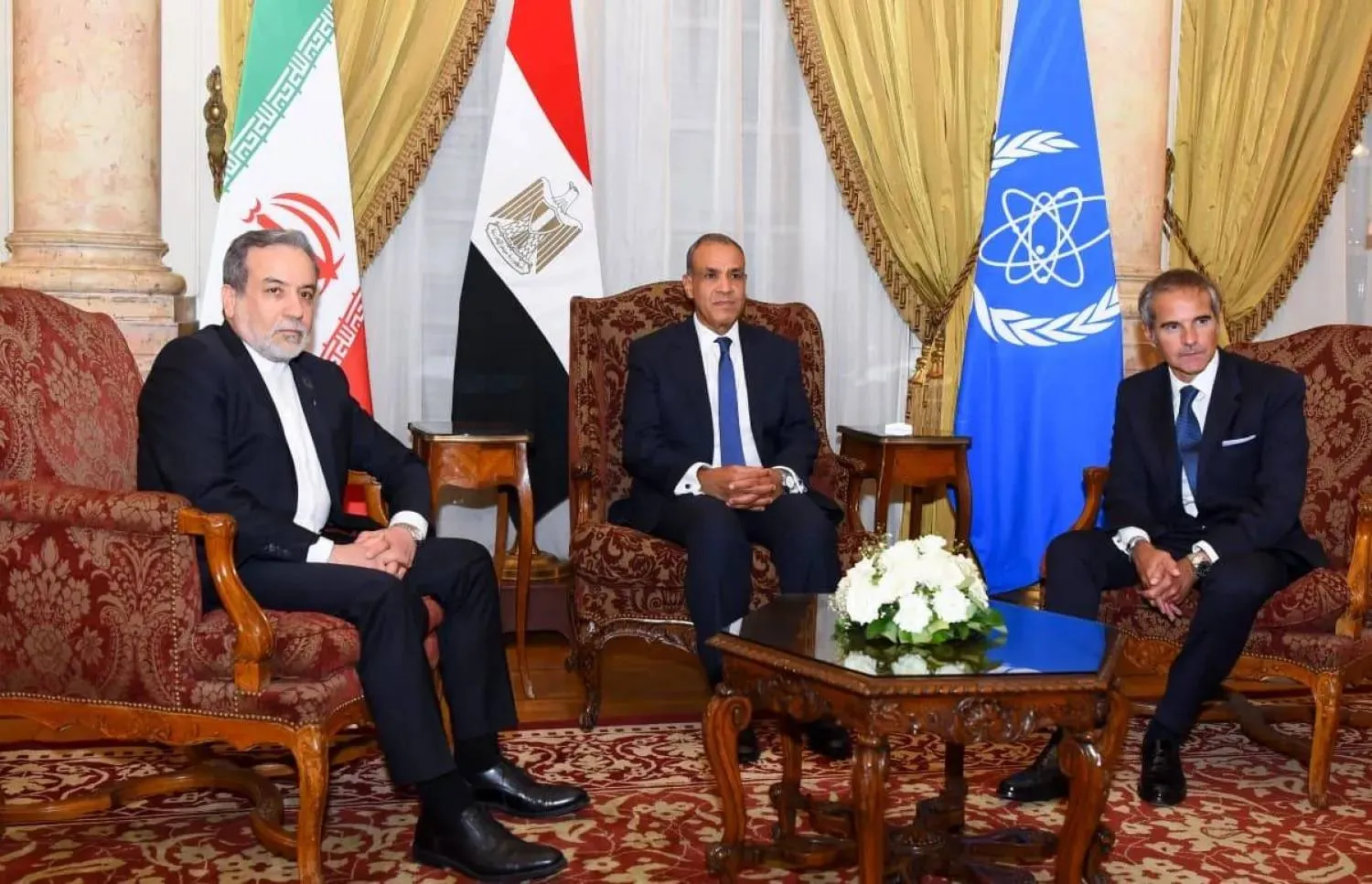
Meeting between Badr Abdelatty, Abbas Araghchi, and Rafael Grossi in Cairo in September (Egyptian Foreign Ministry)
TT

Egypt Pushes Diplomacy to Clear Hurdles in US-Iran Talks

Meeting between Badr Abdelatty, Abbas Araghchi, and Rafael Grossi in Cairo in September (Egyptian Foreign Ministry)

Egypt has stepped up regional and international efforts to break the deadlock in negotiations between the United States and Iran, as Cairo welcomed a preliminary agreement to hold a joint meeting between the two sides.

Egyptian Foreign Minister Badr Abdelatty said on Thursday it was of paramount importance for Washington and Tehran to reach a “peaceful, consensual settlement” that addresses the concerns of all parties on the basis of mutual respect and shared interests, and helps spare the region the specter of war.

The Egyptian position was conveyed over the past two days through Abdelatty's talks with Qatar’s Prime Minister and Foreign Minister Sheikh Mohammed bin Abdulrahman Al Thani, Omani Foreign Minister Badr bin Hamad Al Busaidi, Iranian Foreign Minister Abbas Araghchi, and US Special Envoy for the Middle East Steve Witkoff.

According to a statement by Egypt’s Foreign Ministry on Thursday, the discussions focused on efforts to de-escalate tensions and contain rising regional strain, as well as developments related to a planned meeting between the United States and Iran in Oman.

Abdelatty welcomed the preliminary agreement to hold the meeting, describing it as a development Egypt has long sought, achieved by creating conducive conditions through sustained diplomatic engagement and a series of intensive talks over recent weeks, in line with directives from President Abdel Fattah el-Sisi.

He stressed the importance of overcoming any differences at this critical stage in a way that preserves regional security and serves the aspirations of the region’s peoples for stability and development.

Risks of escalation

Ali El-Hefny, former assistant foreign minister and secretary general of the Egyptian Council for Foreign Affairs, said Egypt continues its efforts between Iran and the United States because it fully recognizes the risks that could result from escalation between Washington, alongside Israel, and Tehran, noting that such a scenario would have serious repercussions for the region.

He told Asharq Al-Awsat that Egypt has, for decades, played a role in resolving regional and international disputes through peaceful means and away from military escalation, succeeding at times and falling short at others due to the involvement of multiple overlapping parties.

According to Hefny, the Egyptian efforts reflect Cairo’s determination to prevent escalation and promote regional stability.

He added that Egypt, along with other countries, is encouraging Washington and Tehran to resume negotiations, set aside procedural disputes, and engage with substantive differences to bridge gaps and prevent a war that could escalate into a wider regional conflict beyond what anyone might imagine.

Israeli affairs expert Ahmed Fouad Anwar said Egypt has long experience and communication channels with all parties, forming the basis for the Foreign Ministry’s role, as well as several direct contacts made by Sisi on the issue.

He said this provided solid ground for sustained Egyptian efforts to advance dialogue.

Anwar said the core dispute lies in Washington’s desire to conduct negotiations under military pressure rather than focusing solely on the nuclear file, warning that such an approach threatens regional stability given the capabilities and armaments of Iran’s allies.

Diplomatic solutions

US President Donald Trump warned Tehran late last month that it would face the harshest measures if it did not return to the negotiating table over its nuclear program.

On Thursday, Abdelatty expressed hope that the US-Iran meeting would help reduce tensions and escalation in the region and advance diplomatic and political solutions, in line with President Sisi’s view that there are no military solutions to the region’s crises and challenges, and that security and stability can only be achieved through political and diplomatic tracks and by avoiding a slide into insecurity.

He said Egypt would continue its intensive talks and sincere efforts with regional partners and both the American and Iranian sides to push for diplomatic and political solutions.

Cairo agreement

Last year, Egypt brokered mediation between Iran and the International Atomic Energy Agency, culminating in an agreement signed in Cairo on September 9 by Iran’s foreign minister and IAEA Director General Rafael Grossi.

The deal provided for the resumption of cooperation, including renewed inspections of Iranian nuclear facilities, before Tehran announced a freeze of the agreement in November.

Hefny said there is a preliminary understanding on a meeting between US and Iranian delegations, with references to possible involvement by other parties to help ease the current crisis.

He stressed the importance of maintaining dialogue, avoiding threats of force, and giving diplomacy a chance, without procrastination or using time pressure to weaken the other side’s resolve.

Anwar said both sides are engaging in trial balloons, alternating between threats and conciliatory signals.

He noted that Trump has said Washington does not want nuclear weapons in Iran. At the same time, Tehran insists it does not seek such weapons or pose a threat to others, adding that dialogue is essential given the airspace closures and losses suffered by countries during previous confrontations.

At the end of last month, Abdelatty held talks with his Iranian, Omani, Qatari, and Turkish counterparts, as well as with Witkoff, stressing the need to pursue peaceful solutions through diplomacy and dialogue.

A different Middle East

Former assistant foreign minister Hussein Haridy said that only Washington and Tehran can ultimately resolve their dispute, noting that analyses often focus on immediate developments while US-Iran relations are long-standing.

He told Asharq Al-Awsat that the region is entering a Middle East different from that of the past four decades in terms of power balances, and that both the United States and Iran are aware of this reality. He said current developments reflect discussions over Iran’s role in the future Middle East as understood between Washington and Tehran.


Israel Launches ‘Large-scale Wave of Strikes against Iran Infrastructure,’ Hits Lebanon

Smoke rises following an Israeli airstrike in Dahiyeh, Beirut's southern suburbs, Lebanon, Thursday, March 5, 2026. (AP Photo/Hassan Ammar)
TT

Israel Launches ‘Large-scale Wave of Strikes against Iran Infrastructure,’ Hits Lebanon

Smoke rises following an Israeli airstrike in Dahiyeh, Beirut's southern suburbs, Lebanon, Thursday, March 5, 2026. (AP Photo/Hassan Ammar)

The Israeli military said it launched a wave of strikes on the Iranian capital Tehran on Thursday.

The army “has just begun a large-scale wave of strikes against infrastructure of the Iranian terror regime across Tehran," a military statement said.

Meanwhile, the Israeli military said it began new strikes against Hezbollah in Lebanon.

An overnight Israeli drone strike targeted a vehicle on a coastal highway in southern Lebanon, killing three people, Lebanon’s state news agency said.

The highway connects the city of Tyre to Naqoura, a border town near Israel.

On Wednesday, the Israeli military warned residents to move north of the Litani River, which serves as a key buffer line with villages south of it lying closest to the Israeli border.

The number of people killed in Israeli strikes in Lebanon in the four days since the conflict between Israel and Hezbollah reignited has risen to more than 70, with over 430 people wounded, Lebanon’s Health Ministry said Wednesday.

It is not clear how many of those killed in Lebanon were civilians, but the Health Ministry said Tuesday that they included seven children.


Lebanese State Media Says Israeli Strike Kills Hamas Official

Smoke rises from the city of Khiam after an Israeli bombing targeted one of its neighborhoods, coinciding with the incursion of tanks (AFP)
TT

Lebanese State Media Says Israeli Strike Kills Hamas Official

Smoke rises from the city of Khiam after an Israeli bombing targeted one of its neighborhoods, coinciding with the incursion of tanks (AFP)

Lebanese state media said an Israeli strike killed a Hamas official on Thursday, the first reported targeted killing of a member of the Palestinian militant group since US-Israeli strikes on Iran triggered regional war.

Wassim Atallah al-Ali and his wife were killed when an "enemy drone targeted their home" in Beddawi, a Palestinian refugee camp near Tripoli, in a pre-dawn strike, the National News Agency (NNA) reported, describing the man as a senior Hamas official.

The strike hit the area without prior warning and marked the northernmost strike so far in Lebanon.

Located about 85 kilometers (53 miles) north of Beirut and more than 180 kilometers (112 miles) from the Lebanese-Israeli border, Beddawi was targeted during the 2024 war between Israel and Hezbollah.
Despite a ceasefire reached in November 2024, the Israeli military said in July it struck a Hamas figure in the camp.


Lebanon’s Displaced Face Housing Crunch, Surging Rents, Municipal Curbs

A woman sits on the ground beside her belongings on Beirut’s seaside corniche (EPA)
TT

Lebanon’s Displaced Face Housing Crunch, Surging Rents, Municipal Curbs

A woman sits on the ground beside her belongings on Beirut’s seaside corniche (EPA)

As war erupted in Lebanon, scenes of displacement quickly returned to the streets. Roads filled with cars packed with families fleeing bombardment, while some displaced people spread out along the seaside corniche in Sidon and Beirut, waiting for shelter.

But the search for a roof has become an ordeal. Rental prices have surged to unprecedented levels, and available apartments are scarce, deepening a housing crisis that has forced many families to remain in their cars or on roadsides while they search for somewhere to stay.

In some areas, residents have refused to receive displaced families amid fears they could be targeted and anger at Hezbollah for engaging in the war again.

“As time passes, the chances of moving to safe housing are shrinking. There are not many options,” said Hassan Daoud.

“What is available does not suit us, or it is beyond our financial means,” he added, noting that some homes are too small for his family while others are far too expensive.

Daoud, a man in his thirties who fled on Monday from a village in the Bint Jbeil district, is still staying with his family of nine along the seaside corniche, living in their cars until they can secure suitable housing.

He said a woman asked for $2,000 to rent a semi-furnished apartment in the Barouk area of Mount Lebanon.

“Who knows how long we will stay there,” he said. “What we fear is that the war will drag on and we will be unable to pay rent for more than one month.”

Displaced families must now pay for many essentials they were unable to take with them when they fled. At the same time, their jobs and businesses have stopped, and their sources of income have dried up.

“We cannot afford such amounts,” Daoud said.

Multiple pressures

Like Daoud, thousands of displaced people have yet to find housing. For many, the immediate goal is simple: a roof to shelter their families.

But displacement carries heavy consequences, particularly as many people have yet to recover from the previous war.

Another form of hardship is faced by Haj Mustafa, who fled his village in Kafra in the Bint Jbeil district.

“It seems there is a municipal decision banning people from renting us homes simply because we are from the Shiite sect,” he told Asharq Al-Awsat, referring to measures taken by municipalities amid fears Hezbollah members could blend in among displaced families.

Mustafa described a long and exhausting journey.

“It lasted more than 25 hours. I felt dizzy many times and was extremely exhausted. I am 80 years old and can no longer endure such displacement. It is extremely bad.”

Speaking in a low voice, he added: “Perhaps what happened to us could have been avoided, I do not know. But we are not well. That is all I know.”

Several Lebanese municipalities have issued circulars requiring residents, property owners, investors and tenants to notify local authorities in writing before signing any rental contract or occupying residential apartments.

Officials say the measures aim to ensure administrative order and proper application of the law.

Rising rents

Crisis profiteers are also exploiting the growing demand for shelter, either by sharply raising rents or imposing strict conditions such as annual contracts or six months’ payment in advance.

Mona, displaced from the city of Tyre, said: “I thought $800 would provide suitable housing for my family of four. But we were surprised that this amount is not enough for a small two-room apartment without furniture.”

“Why are they doing this to us?” she told Asharq Al-Awsat.

“Being forced into the war has already exhausted us.”

“We are losing, and we expect many more losses in lives and livelihoods. On top of that, we face rejection from fellow Lebanese of other sects. Of course we cannot generalize, but we are treated harshly and judged simply for belonging to a Shiite environment. They want to punish us for what the party did.”

Some landlords demand full payment for a year or six months upfront, such as $7,800 in advance for six months instead of $1,300 monthly. The conditions effectively limit available homes to wealthier displaced families.

At the same time, many Lebanese who experienced previous displacement and have the financial means kept their rented homes as a precaution and moved into them as soon as the war began.

Shelter centers

Meanwhile, many families are still waiting for rooms in official shelter centers. Some facilities have yet to open, leaving large numbers sleeping on the ground outside schools while they wait.

Dozens of people forced open the doors of some schools on Tuesday evening and entered them.

Lebanese authorities have published a list of shelter centers for displaced people, but the delay in opening some facilities has drawn criticism.

Sources at the Ministry of Education told Asharq Al-Awsat that shelter centers are opened gradually based on need, adding that the ministry responds immediately to requests from the Ministry of Social Affairs to open new centers.

According to official figures from the Disaster Risk Management Unit, the total number of shelter centers reached 171 on Monday. The number of displaced people stood at 29,347, while 52 people had been killed and 154 injured.

Mohammad Shamseddine, a researcher at the International Information organization, said the Bekaa region has seen fewer displaced people this time.

“The numbers are lower than during the same period in the previous war, when they reached 420,000,” he said. “Residents of frontline villages have still not returned since then because they lost their homes and livelihoods and the conditions for return and life there have not been restored.”

The United Nations said Tuesday that at least 31,000 people have been displaced in Lebanon due to Israeli bombardment and air strikes across several areas, particularly in the south and Beirut’s southern suburbs.

UNHCR spokesperson Babar Baloch told a news conference in Geneva that large-scale displacement has been reported after Israel issued evacuation warnings to residents of more than 53 Lebanese villages and carried out intensive air strikes there.