

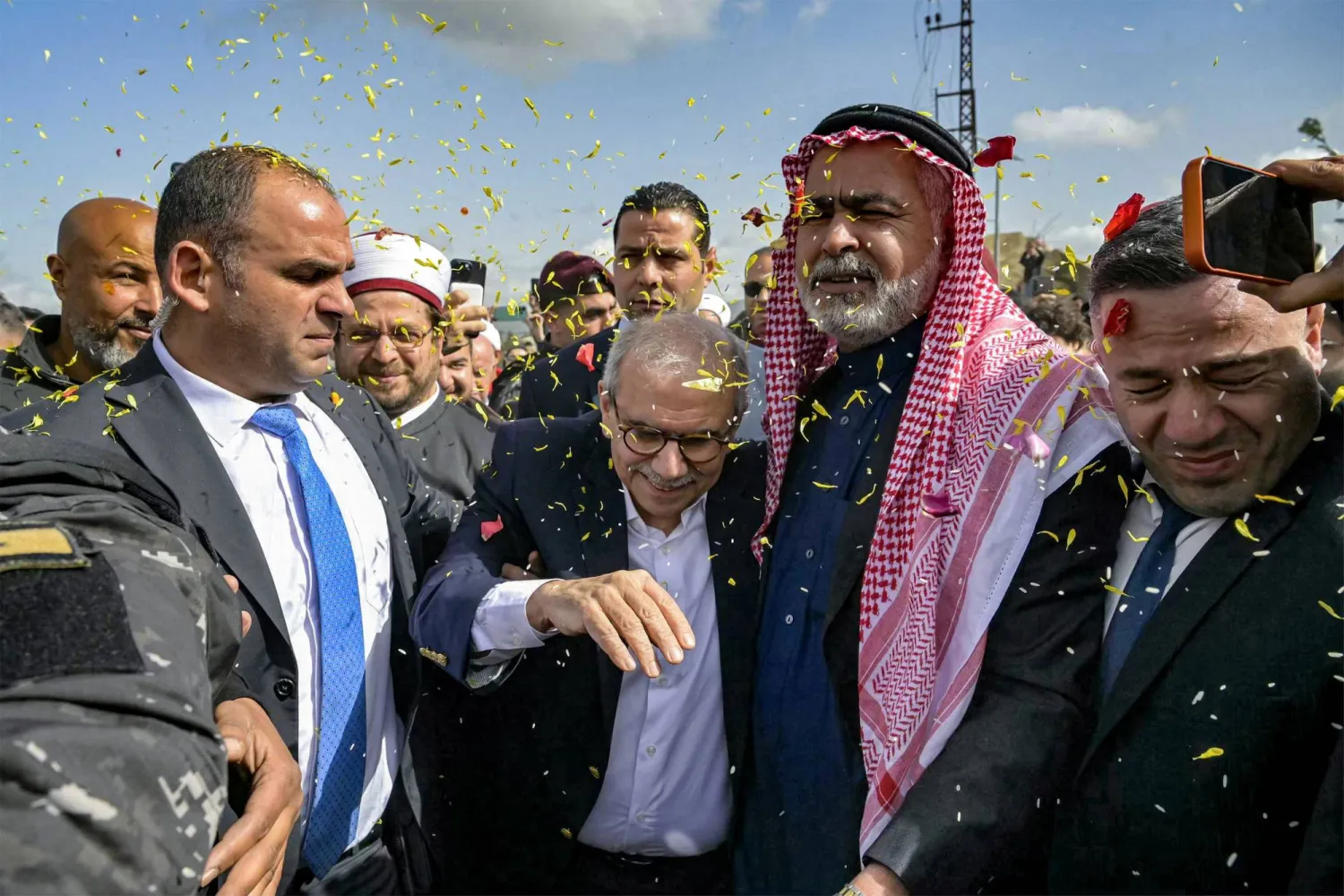

Lebanon PM Pledges Reconstruction on Visit to Ruined Border Towns

This handout picture released by the Lebanese Government Press Office shows Lebanon's Prime Minister Nawaf Salam being showered with confetti as he is received by locals during a tour in the heavily-damaged southern village of Dhayra near the border with Israel on February 7, 2026. (Lebanese Government Press Office / AFP)
TT

Lebanon PM Pledges Reconstruction on Visit to Ruined Border Towns

This handout picture released by the Lebanese Government Press Office shows Lebanon's Prime Minister Nawaf Salam being showered with confetti as he is received by locals during a tour in the heavily-damaged southern village of Dhayra near the border with Israel on February 7, 2026. (Lebanese Government Press Office / AFP)

Lebanese Prime Minister Nawaf Salam visited heavily damaged towns near the Israeli border on Saturday, pledging reconstruction.

It was his first trip to the southern border area since the army said it finished disarming Hezbollah there, in January.

Swathes of south Lebanon's border areas remain in ruins and largely deserted more than a year after a US-brokered November 2024 ceasefire sought to end hostilities between Israel and the Iran-backed group.

Lebanon's government has committed to disarming Hezbollah, and the army last month said it had completed the first phase of its plan to do so, covering the area between the Litani River and the Israeli border about 30 kilometers (20 miles) further south.

Visiting Tayr Harfa, around three kilometers from the border, and nearby Yarine, Salam said frontier towns and villages had suffered "a true catastrophe".

He vowed authorities would begin key projects including restoring roads, communications networks and water in the two towns.

Locals gathered on the rubble of buildings to greet Salam and the delegation of accompanying officials in nearby Dhayra, some waving Lebanese flags.

In a meeting in Bint Jbeil, further east, with officials including lawmakers from Hezbollah and its ally the Amal movement, Salam said authorities would "rehabilitate 32 kilometers of roads, reconnect the severed communications network, repair water infrastructure" and power lines in the district.

Last year, the World Bank announced it had approved $250 million to support Lebanon's post-war reconstruction, after estimating that it would cost around $11 billion in total.

Salam said funds including from the World Bank would be used for the reconstruction and rehabilitation projects.

The second phase of the government's disarmament plan for Hezbollah concerns the area between the Litani and the Awali rivers, around 40 kilometers south of Beirut.

Israel, which accuses Hezbollah of rearming, has criticized the army's progress as insufficient, while Hezbollah has rejected calls to surrender its weapons.

Despite the truce, Israel has kept up regular strikes on what it usually says are Hezbollah targets and maintains troops in five south Lebanon areas.

Lebanese officials have accused Israel of seeking to prevent reconstruction in the heavily damaged south with repeated strikes on bulldozers, excavators and prefabricated houses.

Visiting French Foreign Minister Jean-Noel Barrot on Friday said the reform of Lebanon's banking system needed to precede international funding for reconstruction efforts.

The French diplomat met Lebanon's army chief Rodolphe Haykal on Saturday, the military said.


UN: Over 200 Civilians Reported Killed in Sudan Drone Strikes Since March 4

Residents receive aid from World Food Programme (WFP) at Al-Omada neighbourhood of Omdurman, the twin city of Khartoum on March 11, 2026. (Photo by Ebrahim Hamid / AFP)
TT

UN: Over 200 Civilians Reported Killed in Sudan Drone Strikes Since March 4

Residents receive aid from World Food Programme (WFP) at Al-Omada neighbourhood of Omdurman, the twin city of Khartoum on March 11, 2026. (Photo by Ebrahim Hamid / AFP)

UN rights chief Volker Turk said Thursday he was "appalled" at reports that more than 200 civilians had been killed by drone attacks in Sudan since March 4.

"It is deeply troubling that despite multiple reminders, warnings and appeals, parties to the conflict in Sudan continue to use increasingly powerful drones to deploy explosive weapons with wide-area impacts in populated areas," Turk said in a statement.

Dozens of civilians have been killed in drone strikes across southern Sudan over the past two days, medical sources told AFP on Wednesday, as some of the heaviest fighting of the nearly three-year war grips the region.

Sudan has been riven by conflict since April 2023, when a power struggle between the regular army and the Rapid Support Forces (RSF) plunged the country into a war that has killed tens of thousands and displaced millions.

Since the war broke out, both sides have been accused of war crimes, including targeting civilians and indiscriminately shelling residential areas.


Arab League, Arab Parliament Condemn Closure of Al-Aqsa Mosque

A view of the Aqsa Mosque is pictured in Old City of Jerusalem on March 6, 2026.  (Photo by AHMAD GHARABLI / AFP)
A view of the Aqsa Mosque is pictured in Old City of Jerusalem on March 6, 2026. (Photo by AHMAD GHARABLI / AFP)
TT

Arab League, Arab Parliament Condemn Closure of Al-Aqsa Mosque

A view of the Aqsa Mosque is pictured in Old City of Jerusalem on March 6, 2026.  (Photo by AHMAD GHARABLI / AFP)
A view of the Aqsa Mosque is pictured in Old City of Jerusalem on March 6, 2026. (Photo by AHMAD GHARABLI / AFP)

The General Secretariat of the Arab League expressed deep concern over the continued measures by the Israeli occupation authorities to close Al-Aqsa Mosque to Muslim worshippers, particularly during the holy month of Ramadan, considering this a violation of freedom of worship and an infringement of the historical and legal status quo of the holy sites in the city of Jerusalem.

In a statement issued Thursday, the General Secretariat stressed that Al-Aqsa Mosque holds a special religious and historical status for Muslims around the world, and that any measures restricting access to it or hindering the performance of religious rituals there could lead to an escalation of tensions and undermine efforts to achieve calm and stability, SPA reported.

The Arab League called on the international community and concerned organizations to assume their responsibilities to protect the holy sites and preserve the historical and legal status quo in Jerusalem, stressing that respect for holy sites and freedom of worship are fundamental to maintaining stability and enhancing prospects for peace in the region.

Also, the speaker of the Arab Parliament Mohammed bin Ahmed Al-Yamahi condemned the Israeli occupation's ongoing measures that close the Al-Aqsa Mosque and the Haram Al-Sharif to Muslim worshippers, particularly during Ramadan. He described these actions as violations of the freedom of worship and an infringement on the historical status quo in occupied Jerusalem.

Al-Yamahi stated that restricting access to Al-Aqsa Mosque is a troubling escalation that provokes Muslims globally and reflects efforts to alter the city's Arab and Islamic identity. He emphasized that the Al-Aqsa Mosque, covering 144 dunams, is exclusively for Muslim worship.

He warned that such restrictions would heighten tensions in the region and expressed concern over violations at the Ibrahimi Mosque in Hebron. He called on the international community, including the United Nations, to protect the holy sites in Jerusalem and ensure respect for the historical status of Islamic and Christian sacred sites.


51 Crew Rescued, 1 Dead after Attack on Tankers Off Iraq

An oil tanker burns after being hit by an Iranian strike in the ship-to-ship transfer zone at Khor al-Zubair port near Basra, Iraq, late Wednesday, March 11, 2026. (AP Photo)
TT

51 Crew Rescued, 1 Dead after Attack on Tankers Off Iraq

An oil tanker burns after being hit by an Iranian strike in the ship-to-ship transfer zone at Khor al-Zubair port near Basra, Iraq, late Wednesday, March 11, 2026. (AP Photo)

More than 50 crew members were rescued after an attack on two oil tankers in Iraq's territorial waters, Farhan al-Fartousi of the port authorities told AFP.

Fartousi, from Iraq's General Company for Ports, said "all crew members of the two tankers were rescued," adding that the 51 workers were in good condition.

The attack killed at least one crew member, an Indian national.

Iran's Revolutionary Guards said Thursday they had struck a Marshall Islands-flagged ship, which they claimed was US-owned, in the north of the Gulf.

The vessel, Safesea Vishnu, came under attack March 11 while operating near Basra, India’s embassy said.

The remaining 15 Indian crew members were evacuated and are safe, the embassy added.
