


Hezbollah Overhaul Gives Qassem Tighter Administrative Control

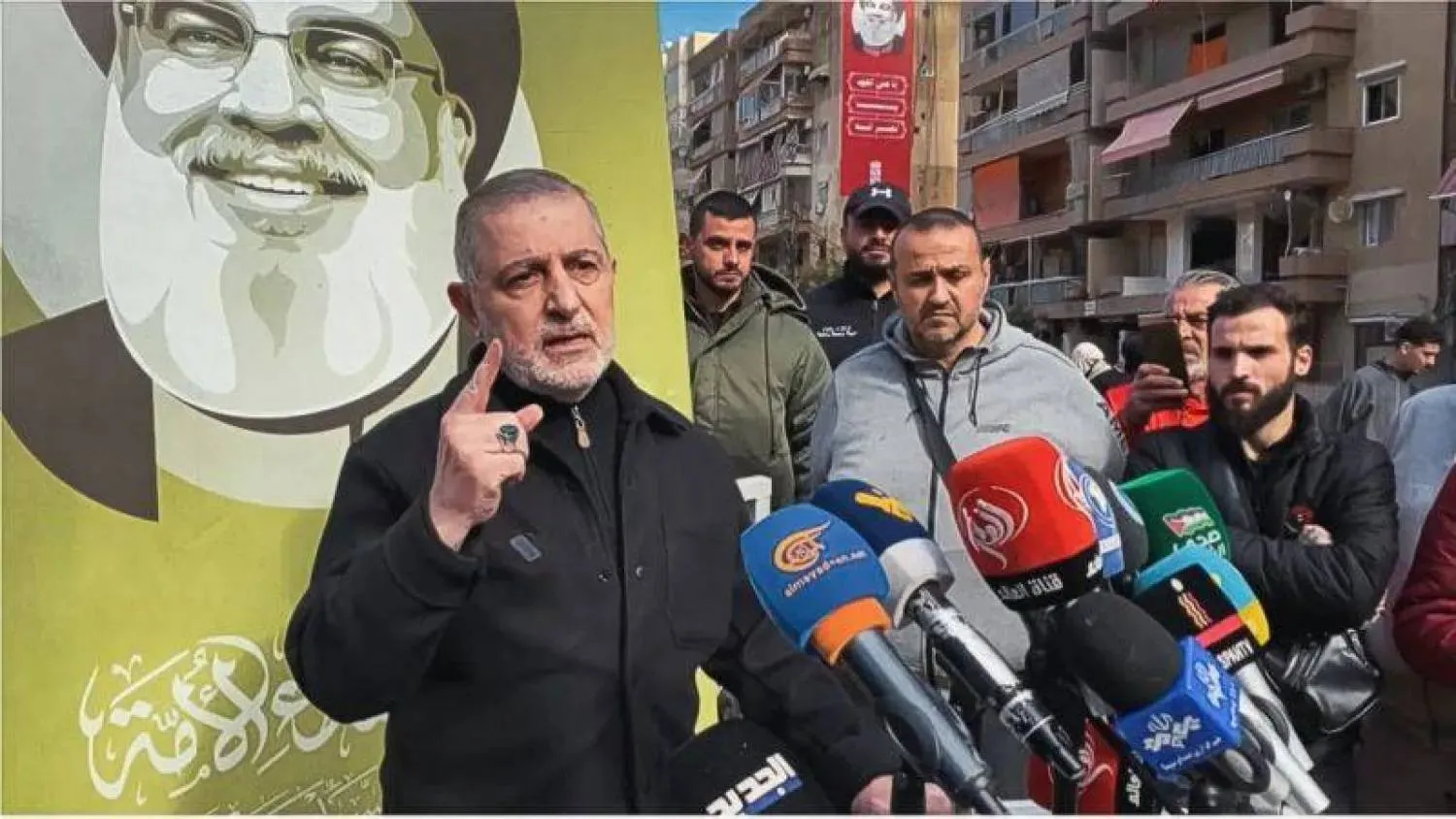
Wafiq Safa, head of Hezbollah’s Liaison and Coordination Unit, speaks to the media at the site of the killing of Hassan Nasrallah, Hezbollah’s secretary-general, in Beirut’s southern suburbs last year (Social media)
TT

Hezbollah Overhaul Gives Qassem Tighter Administrative Control

Wafiq Safa, head of Hezbollah’s Liaison and Coordination Unit, speaks to the media at the site of the killing of Hassan Nasrallah, Hezbollah’s secretary-general, in Beirut’s southern suburbs last year (Social media)

The resignation of Wafiq Safa, head of Hezbollah’s Liaison and Coordination Unit, a move that bore the hallmarks of a dismissal, has lifted the lid on a far-reaching internal shake-up of the group’s organizational structure after the heaviest blows it has suffered in its history.

The restructuring follows Hezbollah’s latest war with Israel, which decimated the group’s senior leadership, killing its long-time secretary-general Hassan Nasrallah, his designated successor Hashem Safieddine, a third potential successor Nabil Qaouq, along with much of its military command.

Well-informed Lebanese sources told Asharq Al-Awsat that Safa’s exit marks only the visible edge of bigger changes underway as the group moves to overhaul its leadership, security, and political apparatus in response to the unprecedented damage inflicted by the war.

Previously, that post led the organization without delving into the executive council's responsibilities, which function as a government-like body within the party.

Another key shift is the growing role of political figures in decision-making at the expense of clerics who had dominated the leadership in the previous phase.

New figures have also entered the decision-making circle, including individuals who worked with Qassem in the Islamic Daawa Party and Islamic committees before joining Hezbollah after its founding.

Raad seen as deputy secretary-general

The picture becomes clearer with the entry of Mohammad Raad, head of Hezbollah’s parliamentary bloc Loyalty to the Resistance, into the party’s decision-making core. There is a clear trend toward appointing him deputy secretary-general.

However, the decision is unlikely to be announced before parliamentary elections. MP Hassan Fadlallah is expected to assume leadership of the bloc after the latest elections.

Fneish to lead the party’s executive council

Sources told Asharq Al-Awsat that former minister and MP Mohammad Fneish has taken over responsibility for Hezbollah’s executive council, where he is tasked with reorganizing the party’s administrative and institutional structure. Sheikh Ali Daamoush is handling operational and organizational duties within the council.

Internal organizational measures

Opposition sources familiar with Hezbollah’s internal affairs said Safa was among the first officials affected by internal organizational decisions that curtailed media activity. A directive from the secretary-general’s office barred him from making statements without prior approval from the party’s media relations department.

The same sources said the measures went beyond media restrictions and were accompanied by a noticeable reduction in Safa’s political role, including contacts with political forces and involvement in elections and nominations. According to this account, he has had no public presence in recent months as a political envoy, neither to allies nor rivals.

Redistribution of roles

Sources explained that the unit, previously known in practice as the Security Committee, had handled internal security disputes and field tensions within Hezbollah’s environment or with other parties, intervening directly before coordinating with relevant actors and later with Lebanese state institutions, including security and judicial bodies. It also followed detainee cases and brokered reconciliations.

They added that the unit’s head benefited from growing influence within the party, particularly after being pushed to the forefront in sensitive files such as indirect negotiations and prisoner exchanges, enabling him to build political and international networks, including external channels.

Limiting political authority

Sources tracking the organizational file said the expansion of this role eventually led the unit to exceed its strictly security mandate by performing political functions, including receiving delegations and relaying messages.

They said that after the current leadership took charge, clear instructions were issued to restrict the Liaison and Coordination Unit’s role to security and technical coordination only, barring it from any political, negotiating, or media activity.

According to sources, all political decisions and contacts are now confined to the party’s political leadership, specifically to Secretary-General Naim Qassem, parliamentary bloc head Mohammad Raad, or the secretary-general’s political aide, Hussein Khalil. The security unit’s role is limited to technical coordination with Lebanese security agencies.

Broader structural shifts

Observers link these changes to broader transformations within Hezbollah since Qassem assumed leadership. They note that the previous phase saw prominent roles for clerical figures in the second and third ranks, such as Hashem Safieddine and Nabil Qaouq, who Israel killed in the recent war.

The current scene, by contrast, is marked by the rise of non-clerical political figures, including Mohammad Raad, Mahmoud Qmati, and Ibrahim Mousawi, signaling a gradual shift toward reinforcing the party’s political character.

The sources said media affairs have been centralized under a single administration overseen by MP Ibrahim Mousawi, with direct coordination with the leadership, as part of a policy aimed at unifying messaging and restricting public statements to authorized figures.

War fallout behind Safa’s removal

Political analyst Ali al-Amin told Asharq Al-Awsat that Safa’s sidelining comes amid the fallout from the war and its direct repercussions on Hezbollah, as well as the impact of Iran’s retrenchment and ongoing US-Iran negotiations. He said the party has come to realize that what was possible in the past is no longer sustainable.

Al-Amin said the decision affects a body with both personal and institutional dimensions, noting that Safa is subject to US sanctions, making the move a clear signal that Hezbollah no longer enjoys the same level of control over security bodies amid US pressure and Lebanese state demands to dismantle the apparatus.

He said Hezbollah is trying to adapt to new realities, adding that acceptance of this path will depend on how the party handles implementation of the principle of exclusive state control over weapons.

He noted that recent statements by Mohammad Raad had a tone that could appear positive about weapons exclusivity but fell short of complete clarity. He described the current step as an initial practical measure whose impact will be assessed later, both at the Lebanese official level and by US officials closely following the Lebanese file.

Al-Amin said Hezbollah will continue, whenever possible, to present itself as a political party, even if only superficially, in an effort to project a peaceful, civilian image and show alignment with state institutions.

He added that any progress or disruption in US-Iran negotiations would be reflected in greater flexibility in the party’s domestic behavior, unless a decisive international decision is taken to end Hezbollah’s current status.

In this context, reports have circulated that Hussein Abdallah has been tasked with heading the Liaison and Coordination Unit. Abdallah previously served as Hezbollah’s security chief in southern Lebanon and is considered close to Naim Qassem. Responsibility for contacts with the state and abroad has reportedly been assigned to his deputy, Ahmed Mahna.

Party-aligned account

A source close to Hezbollah offered a different account, telling Asharq Al-Awsat that the measures affecting Safa are part of an organizational restructuring the party has pursued since the end of the war as part of a comprehensive internal review affecting multiple positions and officials.

The source stressed that Safa remains within Hezbollah’s organizational structure.

By contrast, Al-Jadeed television reported that Safa submitted his resignation as head of the Liaison and Coordination Unit with internal approval, citing deep disagreements with Secretary-General Naim Qassem, Shura Council member and parliamentary bloc head Mohammad Raad, and the curtailment of his powers.



Egypt’s Prime Minister and FM Head to Washington for Trump Peace Council Meeting

Egyptian Foreign Minister Badr Abdelatty speaks during a joint press conference with Kenyan Prime Cabinet Secretary/Cabinet Secretary for Foreign Diaspora Affairs Musalia Mudavadi in Nairobi, Kenya, Monday, Feb. 16, 2026. (AP)
TT

Egypt’s Prime Minister and FM Head to Washington for Trump Peace Council Meeting

Egyptian Foreign Minister Badr Abdelatty speaks during a joint press conference with Kenyan Prime Cabinet Secretary/Cabinet Secretary for Foreign Diaspora Affairs Musalia Mudavadi in Nairobi, Kenya, Monday, Feb. 16, 2026. (AP)

Egypt's Prime Minister Mostafa Madbouly headed to Washington on Tuesday ‌to ‌participate in ‌the inaugural ⁠meeting of a "Board of Peace" established by US President Donald ⁠Trump, the ‌cabinet ‌said.

Madbouly is ‌attending ‌on behalf of President Abdel ‌Fattah al-Sisi and is accompanied by ⁠Foreign ⁠Minister Badr Abdelatty.

Foreign Minister Gideon Saar will represent Israel at the inaugural meeting, his office said on Tuesday.

Hamas, meanwhile, called on the newly-formed board to pressure Israel to halt what it described as ongoing violations of the ceasefire in Gaza.

The Board of Peace, of which Trump is the chairman, was initially designed to oversee the Gaza truce and the territory's reconstruction after the war between Hamas and Israel.

But its purpose has since morphed into resolving all sorts of international conflicts, triggering fears the US president wants to create a rival to the United Nations.

Saar will first attend a ministerial level UN Security Council meeting in New York on Wednesday, and on Thursday he "will represent Israel at the inaugural session of the board, chaired by Trump in Washington DC, where he will present Israel's position", his office said in a statement.

It was initially reported that Prime Minister Benjamin Netanyahu might attend the gathering, but his office said last week that he would not.

Ahead of the meeting, Hamas spokesman Hazem Qassem told AFP that the Palestinian movement urged the board's members "to take serious action to compel the Israeli occupation to stop its violations in Gaza".

"The war of genocide against the Strip is still ongoing -- through killing, displacement, siege, and starvation -- which have not stopped until this very moment," he added.

He also called for the board to work to support the newly formed Palestinian technocratic committee meant to oversee the day-to-day governance of post-war Gaza "so that relief and reconstruction efforts in Gaza can commence".

Announcing the creation of the board in January, Trump also unveiled plans to establish a "Gaza Executive Board" operating under the body.

The executive board would include Turkish Foreign Minister Hakan Fidan and Qatari diplomat Ali Al-Thawadi.

Netanyahu has strongly objected to their inclusion.

Since Trump launched his "Board of Peace" at the World Economic Forum in Davos in January, at least 19 countries have signed its founding charter.


Palestinian Child Dies After Stepping on Mine in West Bank

Israeli troops conduct a military raid in the village of Al-Yamoun, west of Jenin, West Bank, 17 February 2026. (EPA)
TT

Palestinian Child Dies After Stepping on Mine in West Bank

Israeli troops conduct a military raid in the village of Al-Yamoun, west of Jenin, West Bank, 17 February 2026. (EPA)

A Palestinian child died after stepping on a mine near an Israeli military camp in the occupied West Bank on Tuesday, the Palestinian Red Crescent said, with an Israeli defense ministry source confirming the death.

"Our crews received the body of a 13-year-old child who was killed after a mine exploded in one of the old camps in Jiftlik in the northern Jordan Valley," the Red Crescent said in a statement.

A source at COGAT, the Israeli defense ministry's agency in charge of civilian matters in the Palestinian territories, confirmed the death to AFP and identified the boy as Mohammed Abu Dalah, from the village of Jiftlik.

Israel's military had previously said in a statement that three Palestinians were injured "as a result of playing with unexploded ordnance", without specifying their ages.

It added that the area of the incident, Tirzah, is "a military camp in the area of the Jordan Valley", near Jiftlik and close to the Jordanian border.

"This area is a live-fire zone and entry into it is prohibited," the military said.

Jiftlik village council head Ahmad Ghawanmeh told AFP that three children, the oldest of whom was 16, were collecting herbs near the military base when they detonated a mine.

Jiftlik as well as the nearby Tirzah base are located in the Palestinian territory's Area C, which falls under direct Israeli control.

Israel has occupied the West Bank since 1967.

Much of the area near the border with Jordan -- which Israel signed a peace deal with in 1994 -- remains mined.

In January, Israel's defense ministry said it had begun demining the border area as part of construction works for a new barrier it says aims to stem weapons smuggling.


Hezbollah Rejects Disarmament Plan and Government’s Four-Month Timeline

29 July 2024, Iran, Tehran: Then Hezbollah deputy leader Sheikh Naim Qassem is pictured during a meeting in Tehran. (Iranian Presidency/dpa)
TT

Hezbollah Rejects Disarmament Plan and Government’s Four-Month Timeline

29 July 2024, Iran, Tehran: Then Hezbollah deputy leader Sheikh Naim Qassem is pictured during a meeting in Tehran. (Iranian Presidency/dpa)

Hezbollah rejected on Tuesday the Lebanese government's decision to grant the army at least four months to advance the second phase of a nationwide disarmament plan, saying it would not accept what it sees as a move serving Israel.

Lebanon's cabinet tasked the army in August 2025 with drawing up and beginning to implement a plan to bring all armed groups' weapons under state control, a bid aimed primarily at disarming Hezbollah after its devastating ‌war with ‌Israel in 2024.

In September 2025 the cabinet formally ‌welcomed ⁠the army's plan to ⁠disarm the Iran-backed Shiite party, although it did not set a clear timeframe and cautioned that the military's limited capabilities and ongoing Israeli strikes could hinder progress.

Hezbollah Secretary-General Sheikh Naim Qassem said in a speech on Monday that "what the Lebanese government is doing by focusing on disarmament is a major mistake because this issue serves the goals of Israeli ⁠aggression".

Lebanon's Information Minister Paul Morcos said during a press ‌conference late on Monday after ‌a cabinet meeting that the government had taken note of the army's monthly ‌report on its arms control plan that includes restricting weapons in ‌areas north of the Litani River up to the Awali River in Sidon, and granted it four months.

"The required time frame is four months, renewable depending on available capabilities, Israeli attacks and field obstacles,” he said.

Hezbollah lawmaker Hassan ‌Fadlallah said, "we cannot be lenient," signaling the group's rejection of the timeline and the broader approach to ⁠the issue of ⁠its weapons.

Hezbollah has rejected the disarmament effort as a misstep while Israel continues to target Lebanon, and Shiite ministers walked out of the cabinet session in protest.

Israel has said Hezbollah's disarmament is a security priority, arguing that the group's weapons outside Lebanese state control pose a direct threat to its security.

Israeli officials say any disarmament plan must be fully and effectively implemented, especially in areas close to the border, and that continued Hezbollah military activity constitutes a violation of relevant international resolutions.

Israel has also said it will continue what it describes as action to prevent the entrenchment or arming of hostile actors in Lebanon until cross-border threats are eliminated.