
Residents of North Lebanon City Lose Neighbors, Livelihoods in Building Collapse

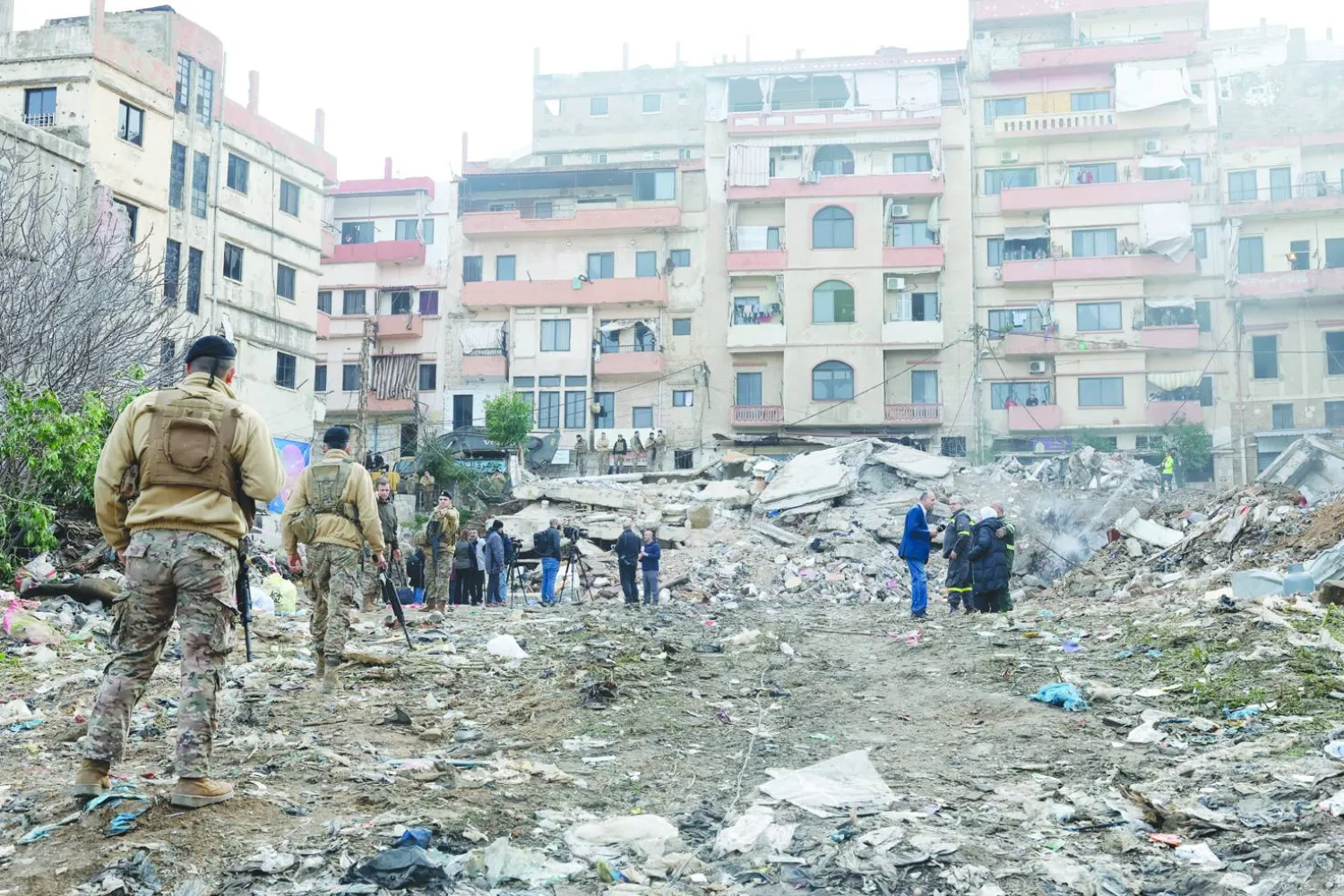
People stand at the site of the collapsed residential building in Tripoli, Lebanon, 09 February 2026. EPA/WAEL HAMZEH
TT

Residents of North Lebanon City Lose Neighbors, Livelihoods in Building Collapse

People stand at the site of the collapsed residential building in Tripoli, Lebanon, 09 February 2026. EPA/WAEL HAMZEH

Rubble is all that remains of the building once home to Adnan Mardash's grocery shop in north Lebanon's Tripoli after it collapsed, killing 14 people and shining a spotlight on the impoverished city's neglect.

Mardash, 54, said he shut the small ground-floor store where he worked for more than three decades and went to his nearby home shortly before the disaster on Sunday afternoon.

"Our neighbors and loved ones died... people lost their livelihoods," said the father of four, who has no other income.

"We felt the building's situation wasn't good and we contacted the municipality but got no response," he told AFP.

Only eight people were pulled out alive after the building, home to 12 apartments, collapsed in the Bab al-Tabbaneh neighborhood.

People were angry and grieving on Monday, some peering over balconies to watch emergency workers remove debris after the disaster, which came just over two weeks after another building in the city collapsed, killing two people.

"Officials come, put on a show then leave, they're all liars... nobody cares about the poor people. If an official had lived in this building, it would have been fixed in seconds," Mardash said.

Naser Fadel, 60, who has lived all his life in the neighborhood, stood at his small store weeping.

"We live here in extreme poverty. We've gone through wars... There are no words to express what we have been through," he said.

Those who died were "the best people, they were poor and humble," he said.

- 'Rich people' -

Even before a years-long economic crisis began in Lebanon in 2019, more than half of the city's residents lived at or below the poverty line, according to the United Nations.

The building that collapsed is on a crowded street that divides the predominantly Sunni Bab al-Tabbaneh neighborhood from the mainly Alawite Jabal Mohsen.

Buildings still bear the scars of recurring clashes between the two neighborhoods from 2007 to 2014.

The fighting, and a 2023 earthquake that hit Türkiye and neighboring Syria, not far from Tripoli, worsened the situation.

The Tripoli municipality on Sunday declared the city "disaster-stricken" and urged the Lebanese state to bear its responsibilities.

After an emergency cabinet meeting on Monday, Prime Minister Nawaf Salam said authorities had decided to evacuate 114 buildings at risk of collapse and provide a year of housing allowances for the affected families.

Tripoli Mayor Abdel Hamid Karimeh told AFP that at least 600 other buildings needed "direct intervention to reinforce them" but he warned that the real number could be much higher.

He said the municipality has recently evacuated 12 buildings and relocated residents to a hospitality institute.

In the Qubbeh neighborhood near to Bab al-Tebbaneh, Yousef Ahmed, 80, had moved in with his daughter after losing his home in last month's deadly building collapse.

"Nobody has given us any help... there are lawmakers and rich people" in the city but "nobody asks about our situation", he lamented.

- 'Without oversight' -

Lebanon is dotted with derelict buildings, and many inhabited structures are in an advanced state of disrepair.

Several buildings have collapsed before in Tripoli and other parts of the country over the years, with the authorities failing to take appropriate measures to ensure structural safety.

Many buildings were built illegally, especially during the 1975-1990 civil war, while some owners have added new floors to existing residential blocks without permits.

Abir Saksouk, co-founder of research and design firm Public Works Studio, said authorities had allowed buildings to fall into disrepair and noted a lack of oversight and legislative gaps.

She said a public safety decree dating to the early 2000s fails to provide a mechanism for restoring buildings constructed before it was issued.

Many buildings were also built "without oversight", she told AFP, while decrying neglect of the issue and "unjust housing policies".

Many residents have little choice but to stay in their dilapidated homes.

Mohammed al-Sayed, 56, has remained in his building despite pieces falling from a second-floor balcony.

He said the municipality had repeatedly warned about cracks after four additional floors were built on the original two.

But he said he was unable to leave the building where he has spent almost his whole life.

"I have no shelter or alternative place to live," he said.


Libya: 17 Migrants Perish at Sea, 9 Missing Feared Dead

Migrants rescued after their boat, which departed from Libya's coast towards Europe, sank (AP)
TT

Libya: 17 Migrants Perish at Sea, 9 Missing Feared Dead

Migrants rescued after their boat, which departed from Libya's coast towards Europe, sank (AP)

At least 17 migrants died and nine are missing after their boat broke down and drifted for eight days in the Mediterranean Sea, Libya's Red Crescent and Libyan security sources said on Wednesday.

The Red Crescent said in a statement that the volunteers in cooperation with naval forces and coast guards of the Libyan National Army rescued seven survivors during recovery operations off Tobruk city in eastern Libya, ⁠near the border ⁠with Egypt.

Libya is a transit route for migrants, many of them from sub-Saharan Africa, who risk their lives to flee to Europe across desert and sea in the hope of escaping conflict and poverty. The ⁠security sources said they expected the bodies of the nine missing migrants to wash ashore in the next few days.

Pictures posted on the internet by the Red Crescent showed the volunteers placing the bodies in black plastic bags and loading them into the back of pick-up vehicles, Reuters reported.

On Tuesday, the country's attorney general said Tripoli Criminal Court sentenced four ⁠members ⁠of a "criminal gang" in Zuwara, western Libya, to up to 22 years in jail for human trafficking, abductions for ransom and torture.

In a separate case, the Public Prosecutor's Office ordered on Monday the arrest of another gang that allegedly sent migrants from Tobruk on a dilapidated boat that capsized, resulting in the death of 38 Sudanese, Egyptian, and Ethiopian nationals, according to the attorney general.


US Auditors Find No Evidence Linking Iraq PM-Designate to Iran’s Revolutionary Guards

Iraq’s prime minister-designate Ali al-Zaidi attends a Coordination Framework meeting in Baghdad on April 27 (AP)
TT

US Auditors Find No Evidence Linking Iraq PM-Designate to Iran’s Revolutionary Guards

Iraq’s prime minister-designate Ali al-Zaidi attends a Coordination Framework meeting in Baghdad on April 27 (AP)

A US law firm said an independent investigation it recently conducted found no evidence linking Iraq’s prime minister-designate, Ali al-Zaidi, to financial activities tied to Iran’s Revolutionary Guards, adding that restrictions imposed on him in 2024 were due to reputational risks, not proven involvement in money laundering.

The clarification comes as al-Zaidi’s surprise designation to form a government in Baghdad, succeeding Mohammed Shia al-Sudani, faces political scrutiny over his background, after a bank he owns was included in restrictions by the Central Bank of Iraq on access to US dollars, as part of what was described at the time as a campaign to combat illicit financial flows.

Representatives of K2 Integrity, who asked not to be named because they are not authorized to speak publicly, said an independent probe by the firm found no credible evidence linking al-Zaidi or Al-Janoob Islamic Bank to the Quds Force and did not identify direct financial transfers from the bank to regional entities classified as high risk.

One representative told Asharq Al-Awsat that the restriction recommended by the US Treasury and the New York Federal Reserve on Al-Janoob Islamic Bank was limited to US dollar transactions and was driven by reputational concerns and the bank’s ownership, rather than confirmed violations related to money laundering or financing Iran-linked entities.

Al-Zaidi, a businessman who owns companies with his brother and partners, including Al-Oweis, Al-Janoob, and Dijlah TV, is seen as an opaque figure in Iraq’s political landscape.

His designation came amid public US opposition that led to Nouri al-Maliki’s exclusion from the race, while unannounced objections were also reported to have sidelined al-Sudani.

Restrictions linked to Iran

In February 2024, Iraq imposed restrictions on eight local banks, including Al-Janoob Islamic Bank, preventing them from accessing US dollars through the central bank window. The move was part of Washington’s efforts to curb money transfers to Iran.

A US Treasury spokesperson said at the time the measures aimed to protect Iraq’s financial system from abuse, citing concerns that US currency could be used in illegal activities.

The case highlights the ongoing challenge facing Baghdad in balancing its ties with both the United States and Iran, given its heavy reliance on the US dollar. Iraq receives about $10 billion in cash annually from the Federal Reserve, according to official estimates.

The US Embassy in Baghdad welcomed al-Zaidi’s designation, expressing support for efforts to form a government that reflects the aspirations of the Iraqi people. This follows months of political deadlock and comes amid pressure from the administration of Donald Trump, which had threatened to cut support to Iraq if al-Maliki returned to power.

Al-Zaidi faces a 30-day deadline to form a government, amid sharp divisions within the Coordination Framework and as regional tensions escalate following military strikes on Iran in February 2026 and subsequent attacks by armed groups on US interests in Iraq.


Syria Justice Chief Says Pursuing Assad Regime Requires Patience

Brig. Gen. Abdul Basit Abdul Latif, head of Syria’s National Transitional Justice Commission (file photo)
TT

Syria Justice Chief Says Pursuing Assad Regime Requires Patience

Brig. Gen. Abdul Basit Abdul Latif, head of Syria’s National Transitional Justice Commission (file photo)

Syria’s judiciary has begun investigating four senior figures from the former regime accused of war crimes against Syrians, even as the National Transitional Justice Commission has yet to complete the formation of its council, raising questions over whether the move falls within a transitional justice framework, particularly in the absence of a dedicated law.

Commission head Brig. Gen. Abdul Basit Abdul Latif said the referrals are part of that process.

“Referring the four former regime figures to the courts falls within the path of transitional justice,” he told Asharq Al-Awsat, adding that the move was coordinated with the Ministry of Justice.

His remarks come amid doubts about the state’s willingness to hold former regime figures accountable.

Public Prosecutor Judge Hassan al-Turba said on July 30 that prosecutions had been launched against several defendants accused of crimes and violations against Syrians, as part of efforts to implement transitional justice, ensure accountability, and protect victims’ rights.

Those targeted include former officials under Bashar al-Assad: Atef Najib, Ahmad Badr al-Din Hassoun, Mohammad al-Shaar, and Ibrahim al-Huweija.

Justice process launched

On May 17, Syria’s president issued a decree establishing a transitional justice commission to uncover violations by the former regime, hold those responsible accountable, and provide redress to victims.

The decree describes transitional justice as a cornerstone for building a state governed by the rule of law, guaranteeing victims’ rights, and achieving national reconciliation.

The decree appointed Abdul Latif to lead the body and tasked him with forming a team and drafting internal regulations within 30 days. It grants the commission legal personality and financial and administrative independence, with authority to operate across Syria.

Abdul Latif, born in Deir al-Zor in 1963, studied law at the University of Aleppo and holds advanced degrees in police and legal sciences.

He headed the Qamishli district before defecting in 2012 and later served as secretary-general of the Syrian opposition National Coalition until the regime’s fall.

The commission will examine complaints related to the Assad government’s crackdown on protests that began in March 2011.

Alleged violations include chemical attacks, widespread aerial bombardment with barrel bombs, arbitrary detention, enforced disappearance, and systematic torture in detention centers, which rights groups say killed or disappeared hundreds of thousands of civilians.

Draft law in the works

Abdul Latif said a draft law on transitional justice and serious violations is being prepared and is expected after the upcoming parliamentary elections.

Trials will cover “all types of crimes defined in the decree,” including genocide, war crimes, torture, enforced disappearance, and the use of toxic and chemical gases, as defined under the Geneva Conventions.

On the prospect of prosecuting Bashar al-Assad and his brother Maher, who have fled abroad, Abdul Latif said Syrians are waiting for justice but warned that building legally sound cases will take time.

“Nothing is achieved easily,” he said.

Broad accountability

The commission is preparing to establish committees, compile case files, and refer them to the judiciary for the issuance of arrest warrants.Abdul Latif said it would work with international bodies to ensure justice and support for victims. Accountability will span both Hafez al-Assad and his son, covering 54 years of rule.

Abdul Latif said it would be “unethical” to ignore crimes under Hafez al-Assad, including the 1982 Hama massacre, as well as killings in Jisr al-Shughour, Aleppo’s Masharqa neighborhood, and abuses in Tadmor prison.

He said residents of Hama have asked whether the commission will address the largely overlooked massacres of the 1980s. “The commission will listen to all,” he said.

Focus on past crimes

The process will cover the period before Dec. 8, as stipulated in the decree. “Transitional justice addresses past crimes,” Abdul Latif said, noting that current violations fall under the transitional government’s ministries of defense, interior, and justice.

While the commission is not directly responsible for those cases, he did not rule out a role where relevant.

On crimes committed by non-Syrian armed groups before the regime’s fall, Abdul Latif said the decree targets violations by the former regime. However, any Syrian harmed by any group can file a complaint with the commission, which will review it.

Building the commission

Since mid-May, the commission has received about 120 applications. Fifteen will be selected to join the council alongside the chairman, bringing the total to 16 members.

Other applicants will be assigned to specialized teams supporting committee work, with victims at the center of the commission’s mandate.

Abdul Latif said he has met representatives from more than 20 countries and around 30 local and international civil society organizations in recent weeks. Discussions have focused on creating a compensation fund under Syrian sovereignty with international support, given the scale of destruction and the state’s limited capacity.

He said reconstruction could form part of compensation, at least through partial repairs to damaged homes.

Syrian organizations, he added, bring significant expertise in human rights, transitional justice, and the issue of missing persons. They will form a second pillar of the commission’s work, alongside a third made up of legal academics and historians tasked with documenting violations and preserving national memory.

Complaints mechanism

The commission is preparing to launch an online platform and dedicated phone lines to receive complaints, alongside a witness protection program.

Cases will be reviewed by specialized committees, including a truth-seeking body tasked with gathering evidence and building case files.

Drawing on global experience, Abdul Latif said some countries prioritized reconciliation while others focused on accountability.

Syria, he said, will pursue both tracks in parallel to ensure justice and pave the way for national reconciliation.

Globally, such processes have taken five to eight years. Syria’s decree sets a five-year mandate, with the possibility of extension.

“We hope to complete the work within five years,” Abdul Latif said.