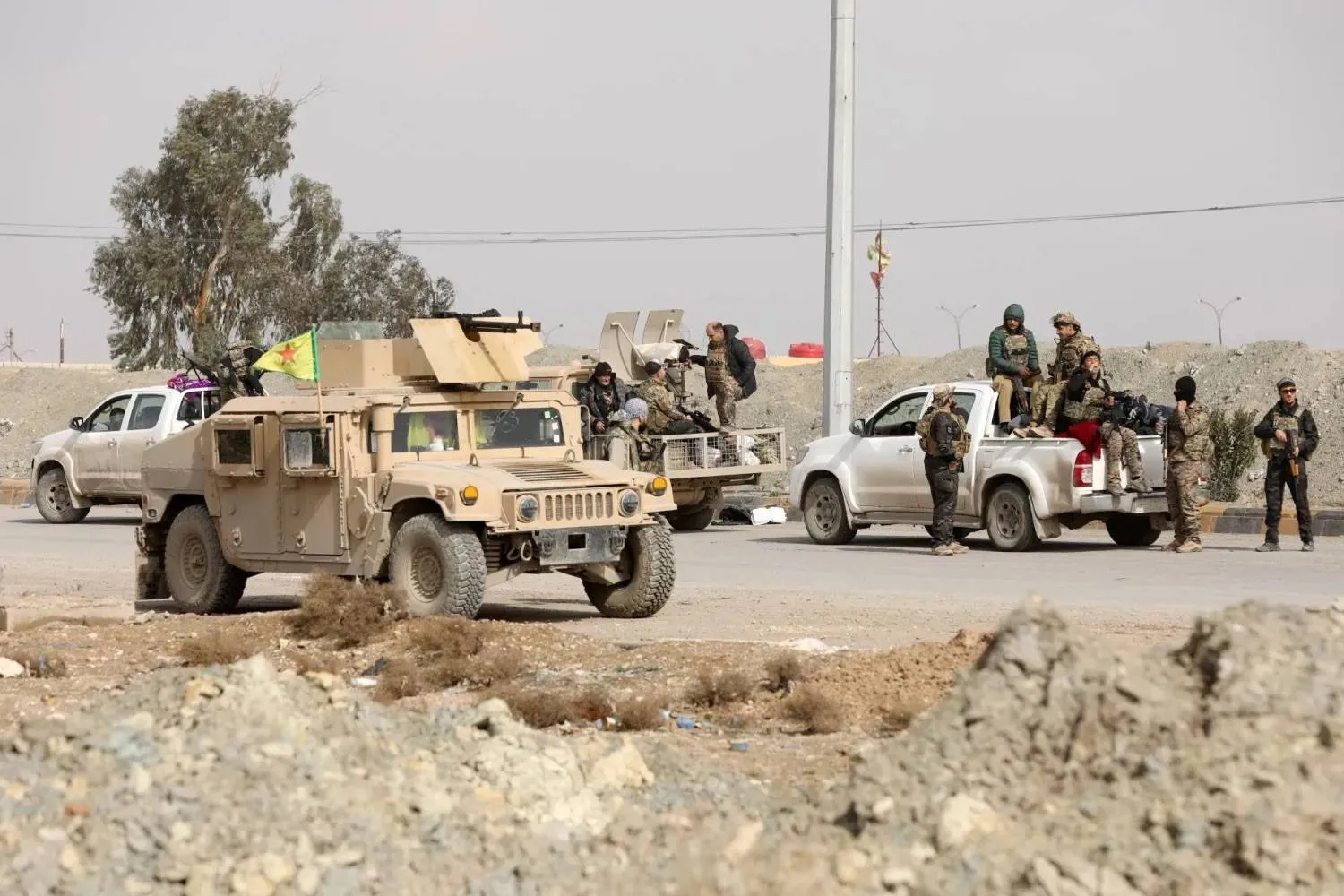

The Syrian Democratic Forces (SDF) have begun withdrawing their troops from frontline positions in the city of Hasakah under an agreement reached with the Syrian government, according to news reports and photographs published by Reuters.
Earlier on Tuesday, SDF units started preparations to pull back from southern rural areas of Hasakah. Images circulated by local media showed SDF fighters withdrawing from the Panorama Roundabout checkpoint south of the city, ahead of handing it over to General Security forces.
The move followed a security meeting between the Internal Security Forces (Asayish) and Syrian security services to coordinate the deployment of internal security forces in the city, according to North Press.
Syrian security sources told Asharq Al-Awsat that implementation of the agreement is proceeding smoothly, including steps toward integration.
The SDF has nominated units to be incorporated as brigades within the Ministry of Defense, while some Asayish personnel are expected to join the General Security forces in predominantly Kurdish areas.
On Tuesday, the SDF also began withdrawing its military units and heavy equipment from contact lines inside Hasakah, particularly in southern neighborhoods around the Panorama Roundabout. This step is part of a permanent ceasefire and the launch of a gradual integration process stipulated in the January agreement.
Syrian affairs researcher from the Jusoor Center for Studies Mohammad Suleiman said the withdrawal involves redeploying SDF military forces from inside Hasakah to agreed barracks outside the city, including Dirbasiyah, Amuda, and the outskirts of Qamishli. At the same time, government internal security forces will deploy in the city centers of Hasakah and Qamishli to oversee security integration.
Suleiman noted differing interpretations of the agreement. The SDF considers the withdrawal limited to its military forces, with the Asayish remaining responsible for internal security, while the government views it as a timetable for a full SDF withdrawal from city neighborhoods.
He added that Syrian army units will also pull back to areas around Hasakah, including Shaddadi, while maintaining a ban on military forces entering cities, particularly those with a Kurdish majority.
The current phase marks the second stage of the agreement and includes the transfer of oil wells and Qamishli Airport to state control. A third phase will place border crossings under state control, notably the Nusaybin crossing with Türkiye and the Semalka crossing with the Iraqi Kurdistan Region.
The agreement also calls for the integration of Kurdish autonomous administration institutions into state bodies, stabilization of civilian employees, settlement of Kurdish civil and educational rights, and guarantees for the return of displaced residents to their homes.