


Hezbollah's Installment Payments for Shelter Reveal Depth of Financial Crisis

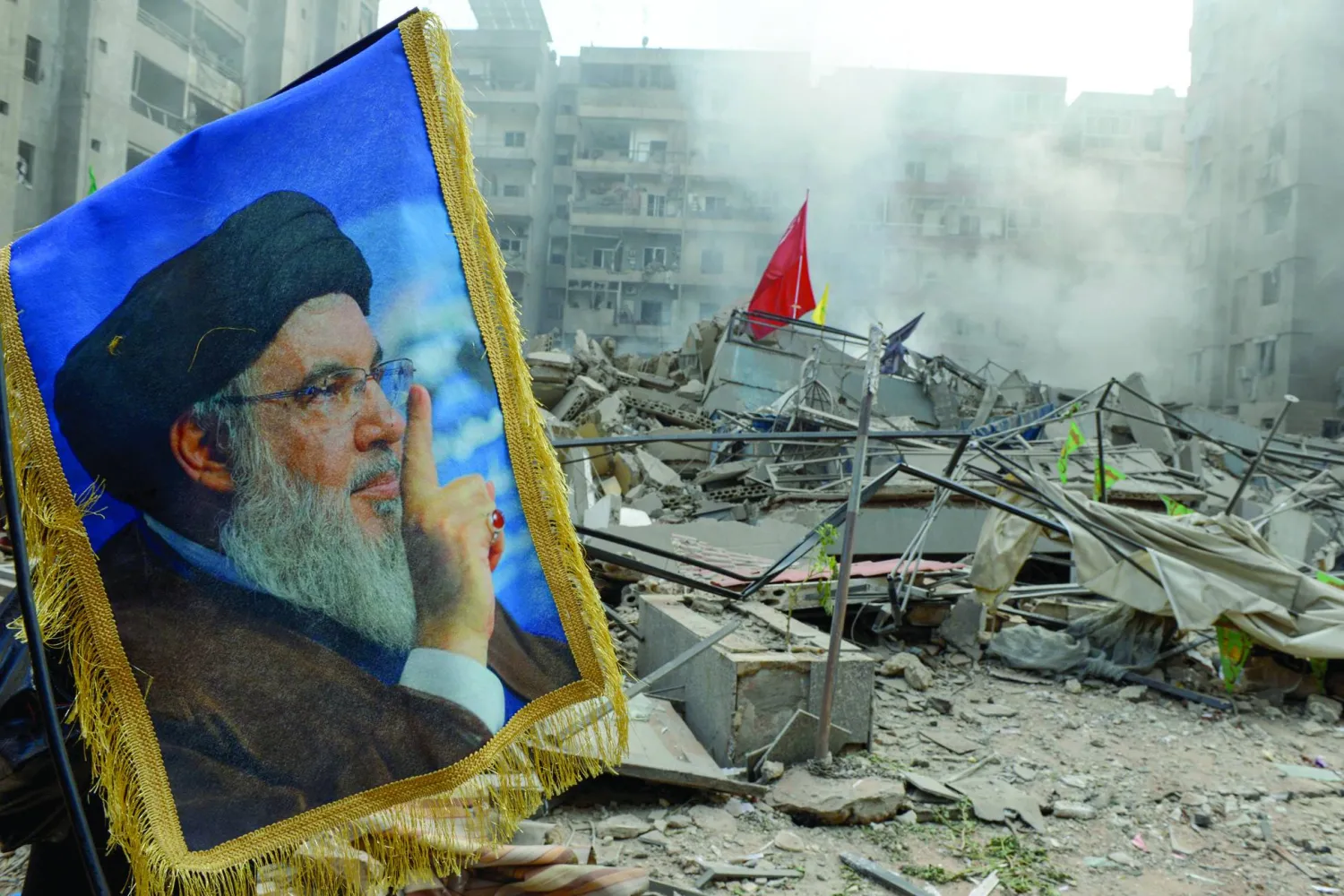
01 November 2024, Lebanon, Beirut: A picture of assassinated Hezbollah leader Hassan Nasrallah is displayed in front of rubble of flattened building caused by Israeli air raids on Beirut southern suburb. Photo: Marwan Naamani/ZUMA Press Wire/dpa
TT

Hezbollah's Installment Payments for Shelter Reveal Depth of Financial Crisis

01 November 2024, Lebanon, Beirut: A picture of assassinated Hezbollah leader Hassan Nasrallah is displayed in front of rubble of flattened building caused by Israeli air raids on Beirut southern suburb. Photo: Marwan Naamani/ZUMA Press Wire/dpa

A decision by Hezbollah Secretary-General Naim Qassem to limit housing support to a three-month window has thrown a spotlight on the group’s tightening finances, after it moved from yearlong lump-sum payments to staggered installments paid once every quarter.

Qassem said Hezbollah would disburse housing allowances for February, March, and April 2026 to “everyone whose home was destroyed or rendered uninhabitable.” The payment had originally been due in early December for three months.

Instead, the party paid allowances for the previous two months and has now approved another three-month tranche, despite a 10-day delay since the disbursement was announced.

Uneven payments, lingering questions

Housing allowances are seen not only as a political signal but also as a practical test of the group’s ability to cover rent, school transfers for children, transportation costs, and the reality of prolonged internal displacement turning into a forced way of life.

Rana, who fled a southern town to Beirut, said families’ priority was no longer politics but securing a place to live.

“People are asking about rent support, about the duration, about continuity. Three months go by quickly, and after that, no one knows what will happen,” she said.

Hassan, another affected resident living in Beirut’s southern suburbs, said the announcement “eased part of the anxiety,” but added that “the issue is not just the announcement, it is the regularity of payment and whether everyone is included.”

Disparities in payouts

Behind the anxiety lies what residents describe as selective disbursement. In the previous phase, not all beneficiaries received full housing allowances, residents of the southern suburbs said, noting disparities in case outcomes.

One resident said he had received only $2,000 for four months, adding that other payments from the previous year had not reached him in full and that he did not know their fate.

Another said he received $3,000 for six months, but that talk of additional allowances had continued without clarity on how they would be completed or whether they would be paid at all.

A woman from the Haret Hreik area said: “We don’t know whether what is being paid is a full housing allowance, partial installments, or a settlement. People are talking, but there is no clear official answer.”

‘Committed’ to housing support

Hezbollah says it has “decided to secure housing,” and sources familiar with the details said the step is aimed at easing the burden on those affected in the postwar phase, especially amid rising living costs and soaring rents.

But the pledge comes amid intensifying external pressure and sanctions aimed at curbing the flow of funds to the group.

The US Department of the Treasury recently announced it had taken “action to disrupt two key mechanisms Hezbollah uses to sustain its economic stability,” namely “revenue generation in coordination with the Iranian regime and the exploitation of Lebanon’s informal financial sector.”

Opponents of Hezbollah say the issue is no longer merely political but directly linked to the group’s ability to secure liquidity to meet social obligations, foremost among them housing allowances. The real test, they argue, will be in regular payments and clarity of mechanism, not in the announcement itself.

Temporary relief

Jad Al-Akhawi, head of the Lebanese Democratic Coalition, told Asharq Al-Awsat that talk of injecting funds resembled “a morphine shot.”

“In previous periods, it was said that large sums of money entered the country, but they were not disbursed. Today, there may be limited spending, but it remains within the framework of temporary calming, nothing more,” he said.

He added that the state had pledged around $300 million, arguing that Hezbollah’s move was “an attempt to give people a dose of calm, something like morphine, until actual funding becomes available.”

He ruled out a return to previous financing patterns, particularly through institutions such as Al-Qard Al-Hasan, saying that continuation of that approach would pose “serious risks to the economy.”



Israel Military Says Soldier Killed in Gaza 

A drone view shows the destruction in a residential neighborhood, after the withdrawal of the Israeli forces from the area, amid a ceasefire between Israel and Hamas in Gaza, in Gaza City, October 21, 2025. (Reuters)
TT

Israel Military Says Soldier Killed in Gaza 

A drone view shows the destruction in a residential neighborhood, after the withdrawal of the Israeli forces from the area, amid a ceasefire between Israel and Hamas in Gaza, in Gaza City, October 21, 2025. (Reuters)

The Israeli military announced that one of its soldiers had been killed in combat in southern Gaza on Wednesday, but a security source said the death appeared to have been caused by "friendly fire".

"Staff Sergeant Ofri Yafe, aged 21, from HaYogev, a soldier in the Paratroopers Reconnaissance Unit, fell during combat in the southern Gaza Strip," the military said in a statement.

A security source, however, told AFP that the soldier appeared to have been "killed by friendly fire", without providing further details.

"The incident is still under investigation," the source added.

The death brings to five the number of Israeli soldiers killed in Gaza since a ceasefire took effect on October 10.


Syria: SDF’s Mazloum Abdi Says Implementation of Integration Deal May Take Time

People sit outdoors surrounded by nature, with the Tigris river flowing in the background, following a long atmospheric depression, near the Syrian-Turkish border in Derik, Syria, February 16, 2026 REUTERS/Orhan Qereman
TT

Syria: SDF’s Mazloum Abdi Says Implementation of Integration Deal May Take Time

People sit outdoors surrounded by nature, with the Tigris river flowing in the background, following a long atmospheric depression, near the Syrian-Turkish border in Derik, Syria, February 16, 2026 REUTERS/Orhan Qereman

Mazloum Abdi, commander of the Syrian Democratic Forces, said the process of merging the SDF with Syrian government forces “may take some time,” despite expressing confidence in the eventual success of the agreement.

His remarks came after earlier comments in which he acknowledged differences with Damascus over the concept of “decentralization.”

Speaking at a tribal conference in the northeastern city of Hasakah on Tuesday, Abdi said the issue of integration would not be resolved quickly, but stressed that the agreement remains on track.

He said the deal reached last month stipulates that three Syrian army brigades will be created out of the SDF.

Abdi added that all SDF military units have withdrawn to their barracks in an effort to preserve stability and continue implementing the announced integration agreement with the Syrian state.

He also emphasized the need for armed forces to withdraw from the vicinity of the city of Ayn al-Arab (Kobani), to be replaced by security forces tasked with maintaining order.


Israeli Far-Right Minister to Push for ‘Migration’ of West Bank, Gaza Palestinians 

A Palestinian man checks leather belts as people prepare for Ramadan, in the old city of Hebron in the Israeli-occupied West Bank, February 17,2026. (Reuters)
TT

Israeli Far-Right Minister to Push for ‘Migration’ of West Bank, Gaza Palestinians 

A Palestinian man checks leather belts as people prepare for Ramadan, in the old city of Hebron in the Israeli-occupied West Bank, February 17,2026. (Reuters)

Israel's far-right Finance Minister Bezalel Smotrich said he would pursue a policy of "encouraging the migration" of Palestinians from the occupied West Bank and Gaza Strip, Israeli media reported Wednesday.

"We will eliminate the idea of an Arab terror state," said Smotrich, speaking at an event organized by his Religious Zionism Party late on Tuesday.

"We will finally, formally, and in practical terms nullify the cursed Oslo Accords and embark on a path toward sovereignty, while encouraging emigration from both Gaza and Judea and Samaria.

"There is no other long-term solution," added Smotrich, who himself lives in a settlement in the West Bank.

Since last week, Israel has approved a series of measures backed by far-right ministers to tighten control over the West Bank, including in areas administered by the Palestinian Authority under the Oslo Accords, in place since the 1990s.

The measures include a process to register land in the West Bank as "state property" and facilitate direct purchases of land by Jewish Israelis.

The measures have triggered widespread international outrage.

On Tuesday, the UN missions of 85 countries condemned the measures, which critics say amount to de facto annexation of the Palestinian territory.

"We strongly condemn unilateral Israeli decisions and measures aimed at expanding Israel's unlawful presence in the West Bank," they said in a statement.

"Such decisions are contrary to Israel's obligations under international law and must be immediately reversed.

"We underline in this regard our strong opposition to any form of annexation."

UN Secretary-General Antonio Guterres on Monday called on Israel to reverse its land registration policy, calling it "destabilizing" and "unlawful".

The West Bank would form the largest part of any future Palestinian state. Many on Israel's religious right view it as Israeli land.

Israeli NGOs have also raised the alarm over a settlement plan signed by the government which they say would mark the first expansion of Jerusalem's borders into the occupied West Bank since 1967.

The planned development, announced by Israel's Ministry of Construction and Housing, is formally a westward expansion of the Geva Binyamin, or Adam, settlement situated northeast of Jerusalem in the West Bank.

The current Israeli government has fast-tracked settlement expansion, approving a record 52 settlements in 2025.

Excluding Israeli-annexed east Jerusalem, more than 500,000 Israelis live in West Bank settlements and outposts, which are illegal under international law.