


UN: Syria's President and 2 Top Ministers Were Targets of 5 Foiled Assassination Attempts

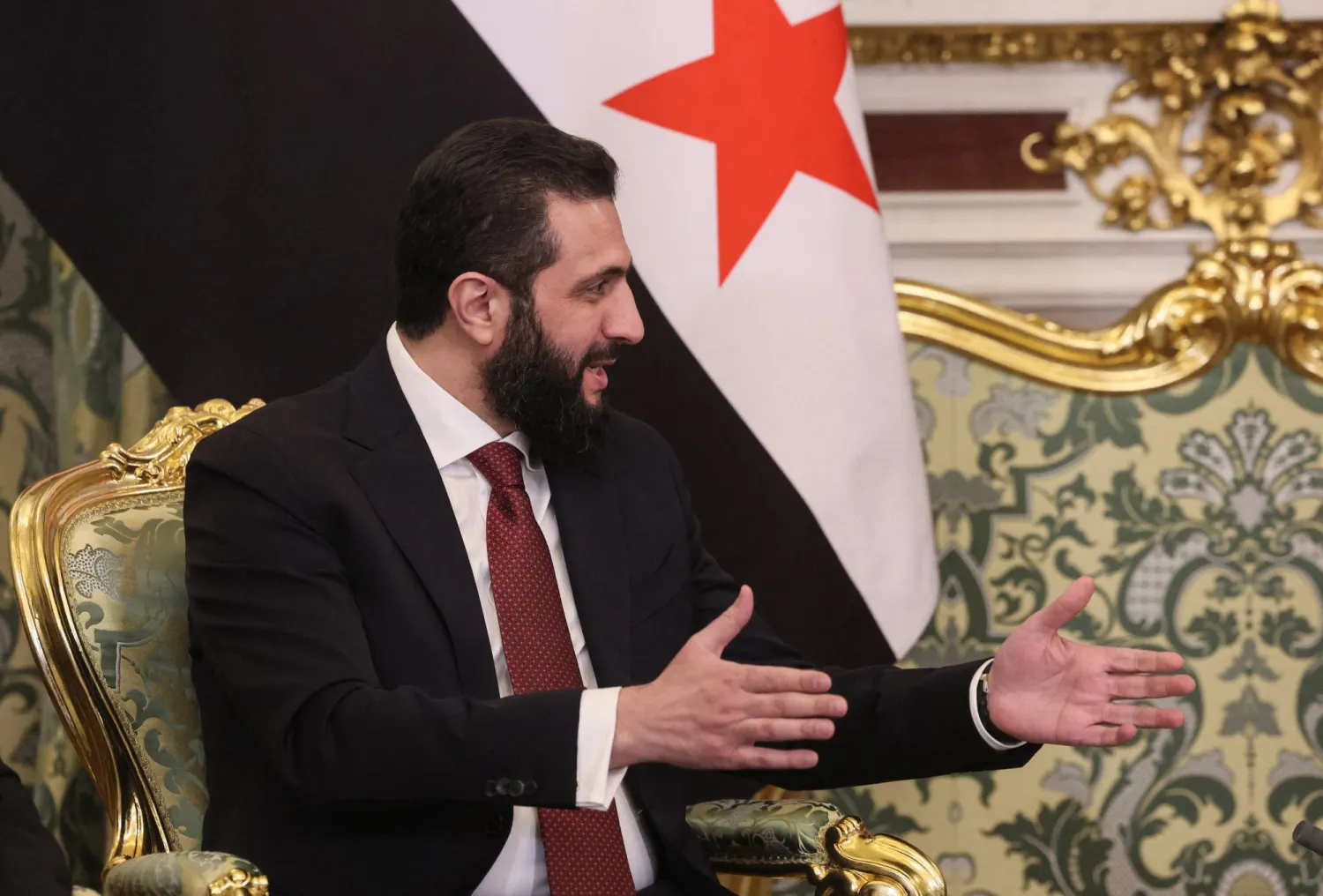
Syrian President Ahmed al-Sharaa gestures speaking with Russian President Vladimir Putin during their meeting at the Kremlin in Moscow, Russia, 28 January 2026. MAXIM SHIPENKOV/Pool via REUTERS
TT

UN: Syria's President and 2 Top Ministers Were Targets of 5 Foiled Assassination Attempts

Syrian President Ahmed al-Sharaa gestures speaking with Russian President Vladimir Putin during their meeting at the Kremlin in Moscow, Russia, 28 January 2026. MAXIM SHIPENKOV/Pool via REUTERS

Syria’s president, interior minister and foreign minister were the targets of five foiled assassination attempts last year, the UN chief said in a report on threats posed by ISIS militants released Wednesday.

The report said President Ahmad al-Sharaa was targeted in northern Aleppo, the country’s most populous province, and southern Daraa by a group assessed to be a front for the ISIS group.

The report, issued by Secretary-General António Guterres and prepared by the UN Office of Counter-Terrorism, gave no dates or details of the attempts against al-Sharaa or Syrian Interior Minister Anas Hasan Khattab and Foreign Minister Asaad al-Shibani.

The assassination attempts are more evidence that the militant group remains intent on undermining the new Syrian government and “actively exploiting security vacuums and uncertainty” in Syria, the report said.

It said al-Sharaa was “assessed to be a primary target” of the ISIS. And it said the front group provided ISIS with plausible deniability and "improved operational capacity.”

Al-Sharaa has led Syria since his opposition forces ousted longtime Syrian President Bashar Assad in December 2024, ending a 14-year civil war.

In November, his government joined the international coalition formed to counter the ISIS group, which once controlled a large part of Syria.

The UN counter-terrorism experts said the militant group still operates across the country, primarily attacking security forces, particularly in the north and northeast.

In one ambush attack on Dec. 13 on US and Syrian forces near Palmyra, two US servicemen and an American civilian were killed and three Americans and three members of Syria's security forces were wounded. President Donald Trump retaliated, launching military operations to eliminate ISIS fighters.

According to the UN counter-terrorism experts, the ISIS group maintains an estimated 3,000 fighters across Iraq and Syria, the majority of them based in Syria.

The US military in late January began transferring ISIS detainees who were held in northeastern Syria to Iraq to ensure they remain in secure facilities. Iraq has said it will prosecute the militants.

Syrian government forces had taken control of a sprawling camp housing thousands of ISIS detainees following the withdrawal of the US-backed Syrian Democratic Forces as part of a ceasefire with the Kurdish fighters.

The report released Wednesday to the UN Security Council said as of December, before the ceasefire deal, more than 25,740 people remained in the al-Hol and Roj camps in the northeast, more than 60% of them children, with thousands more in other detention centers.



Arab League, Arab Parliament Condemn Closure of Al-Aqsa Mosque

A view of the Aqsa Mosque is pictured in Old City of Jerusalem on March 6, 2026.  (Photo by AHMAD GHARABLI / AFP)
A view of the Aqsa Mosque is pictured in Old City of Jerusalem on March 6, 2026. (Photo by AHMAD GHARABLI / AFP)
TT

Arab League, Arab Parliament Condemn Closure of Al-Aqsa Mosque

A view of the Aqsa Mosque is pictured in Old City of Jerusalem on March 6, 2026.  (Photo by AHMAD GHARABLI / AFP)
A view of the Aqsa Mosque is pictured in Old City of Jerusalem on March 6, 2026. (Photo by AHMAD GHARABLI / AFP)

The General Secretariat of the Arab League expressed deep concern over the continued measures by the Israeli occupation authorities to close Al-Aqsa Mosque to Muslim worshippers, particularly during the holy month of Ramadan, considering this a violation of freedom of worship and an infringement of the historical and legal status quo of the holy sites in the city of Jerusalem.

In a statement issued Thursday, the General Secretariat stressed that Al-Aqsa Mosque holds a special religious and historical status for Muslims around the world, and that any measures restricting access to it or hindering the performance of religious rituals there could lead to an escalation of tensions and undermine efforts to achieve calm and stability, SPA reported.

The Arab League called on the international community and concerned organizations to assume their responsibilities to protect the holy sites and preserve the historical and legal status quo in Jerusalem, stressing that respect for holy sites and freedom of worship are fundamental to maintaining stability and enhancing prospects for peace in the region.

Also, the speaker of the Arab Parliament Mohammed bin Ahmed Al-Yamahi condemned the Israeli occupation's ongoing measures that close the Al-Aqsa Mosque and the Haram Al-Sharif to Muslim worshippers, particularly during Ramadan. He described these actions as violations of the freedom of worship and an infringement on the historical status quo in occupied Jerusalem.

Al-Yamahi stated that restricting access to Al-Aqsa Mosque is a troubling escalation that provokes Muslims globally and reflects efforts to alter the city's Arab and Islamic identity. He emphasized that the Al-Aqsa Mosque, covering 144 dunams, is exclusively for Muslim worship.

He warned that such restrictions would heighten tensions in the region and expressed concern over violations at the Ibrahimi Mosque in Hebron. He called on the international community, including the United Nations, to protect the holy sites in Jerusalem and ensure respect for the historical status of Islamic and Christian sacred sites.


Iraq to Keep Crude Output at 1.4 million bpd amid Hormuz Tensions, Oil Minister Says

Technicians working at the Majnoon oil field in Basra, Iraq. (Reuters)
TT

Iraq to Keep Crude Output at 1.4 million bpd amid Hormuz Tensions, Oil Minister Says

Technicians working at the Majnoon oil field in Basra, Iraq. (Reuters)

Iraq will keep crude oil production at around 1.4 million barrels per day, Oil Minister Hayan Abdel-Ghani ​was quoted as saying on Thursday, less than a third of the level before the US-Israeli conflict with Iran.

According to the state news agency, the minister said that 200,000 bpd is being transported by truck through Türkiye, Syria, and Jordan ‌and that ‌Iraq has put in ​place ‌a ⁠plan ​to manage ⁠the current disruptions.

Oil production from Iraq's main southern oilfields, where most of its oil is produced and exported, has plunged 70% to just 1.3 million bpd, sources told Reuters on March 8, as the country ⁠is unable to export via the ‌Gulf due to ‌the war.

The drop in ​production and exports ‌is set to strain Iraq's already fragile finances ‌as the state relies on crude sales for nearly all public spending and more than 90% of its income.

Under pressure to mitigate ‌the losses, the oil ministry has asked the Kurdistan Regional Government (KRG) if ⁠it ⁠would pump at least 100,000 bpd from its state-managed Kirkuk oilfields to Türkiye's Ceyhan port, sources told Reuters on Wednesday. The ministry said the KRG has not yet responded to the request.

Abdel-Ghani was quoted as saying on Thursday that Iraq will sign an agreement on exporting oil through the Ceyhan pipeline, but he did not ​give further details. 


51 Crew Rescued, 1 Dead after Attack on Tankers Off Iraq

An oil tanker burns after being hit by an Iranian strike in the ship-to-ship transfer zone at Khor al-Zubair port near Basra, Iraq, late Wednesday, March 11, 2026. (AP Photo)
TT

51 Crew Rescued, 1 Dead after Attack on Tankers Off Iraq

An oil tanker burns after being hit by an Iranian strike in the ship-to-ship transfer zone at Khor al-Zubair port near Basra, Iraq, late Wednesday, March 11, 2026. (AP Photo)

More than 50 crew members were rescued after an attack on two oil tankers in Iraq's territorial waters, Farhan al-Fartousi of the port authorities told AFP.

Fartousi, from Iraq's General Company for Ports, said "all crew members of the two tankers were rescued," adding that the 51 workers were in good condition.

The attack killed at least one crew member, an Indian national.

Iran's Revolutionary Guards said Thursday they had struck a Marshall Islands-flagged ship, which they claimed was US-owned, in the north of the Gulf.

The vessel, Safesea Vishnu, came under attack March 11 while operating near Basra, India’s embassy said.

The remaining 15 Indian crew members were evacuated and are safe, the embassy added.