


Grundberg Warns Against Reversal of Gains in Yemen, Broader Conflict 

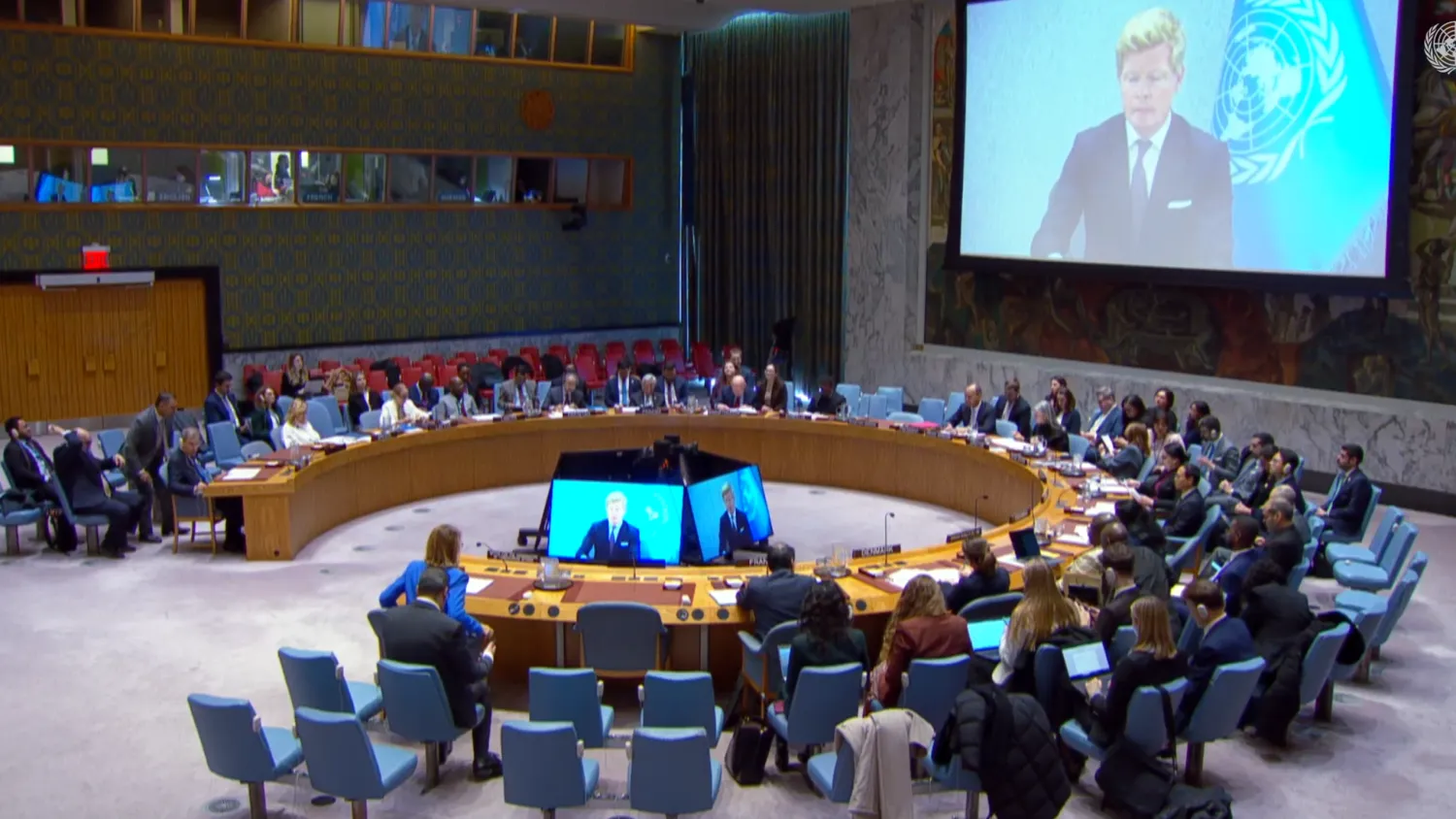
UN Special Envoy for Yemen Hans Grundberg addresses the Security Council. (Office of the Special Envoy of the Secretary-General for Yemen/ Abdel Rahman Alzorgan)
TT

Grundberg Warns Against Reversal of Gains in Yemen, Broader Conflict 

UN Special Envoy for Yemen Hans Grundberg addresses the Security Council. (Office of the Special Envoy of the Secretary-General for Yemen/ Abdel Rahman Alzorgan)

UN Special Envoy for Yemen Hans Grundberg noted on Thursday a relative improvement in conditions in areas held by the legitimate government, warning, however, that “without a wider negotiated political settlement to the conflict, gains will continue to remain vulnerable to reversal.”

In a briefing before the UN Security Council, he said 73 UN colleagues are being held in Houthi jails. “Many have been held incommunicado, with serious concerns about their conditions and wellbeing,” he added.

He called on the Houthis “to unconditionally and immediately release detained staff and rescind all court referrals,” urging regional and international actors to use their influence to push for the same outcomes.

Elsewhere, he said that “there are early positive signs in government areas, including improvements in the provision of electricity and payment of public sector salaries. However, continued tensions, recent security incidents and demonstrations, where in some cases violence and loss of life have been reported, underscore the fragility of the situation.”

“Improvements in service delivery can be reversed if security deteriorates, if economic reforms stall, or if institutions are pulled in competing directions,” he warned.

“The new cabinet under Prime Minister Shaya al-Zindani’s leadership can protect recent gains by anchoring them in strengthened institutions and economic reforms. That will require an enabling environment that shields the cabinet and the Central Bank from politicization and rebuilds confidence,” continued Grundberg.

Political process

He revealed that in recent weeks, he has been engaging with the Yemeni parties, regional actors and members of the international community to explore pathways to restart an inclusive political process. His office has also been consulting with diverse Yemenis on this question, including with governors to gain more nuanced insights into local concerns and how to address them at the national level.

Grunberg said: “Across these discussions, three reflections on the way forward are clear: First, we must be honest about what more than a decade of war has done to Yemen. The conflict has become more complex. Lines of contestation have multiplied and local dynamics have grown alongside national ones.”

“While regional tensions have increasingly fueled the conflict and been fueled by it, our common objective has remained steady and firm: Yemen needs an inclusive political process under UN auspices to reach a negotiated political settlement that can sustainably end the conflict,” he urged.

“But getting there requires that the parties adopt a forward-looking approach. We need to build on what still works, revise what are outdated assumptions, and be pragmatic in designing a political process for today’s reality.”

“Second, Yemen’s conflict is a set of interlocking files. Treating political, economic and security issues in isolation can only produce partial results that will not hold,” said the envoy. “Restarting a political process will therefore require that the parties engage across these tracks in tandem, without making engagement in one track contingent on progress in another.”

“And third, a credible process must deliver for Yemenis on two time horizons. It should enable near-term agreements that reduce suffering and demonstrate progress, including economic de-escalation measures. At the same time, it must create space for Yemenis to negotiate the longer-term issues essential to ending the conflict, including the future shape of the state, security arrangements and principles of governance,” Grundberg added.

On the issue of detainees, the envoy said the file “is a clear example of what can be achieved when the parties choose to engage in dialogue.”

“Right now, the parties are in Amman, negotiating face-to-face under UN auspices, to work through the complex task of finalizing names of detainees so a release operation can materialize, building on the agreed outcome of their meeting in Muscat in December,” he told the council.

He encouraged the parties to sustain this engagement, finalize the remaining elements “without delay, and move swiftly to implementation”. He thanked Jordan for hosting these negotiations, and the International Committee of the Red Cross for its “indispensable” role.

Broader conflict

Grundberg also noted regional tension and hoped for de-escalation.

“Whatever the regional trajectory, Yemen must not be pulled back into broader confrontation. The question of peace and war is, fundamentally, a national one. It cannot be outsourced, nor can it be appropriated by a single actor,” he said.

“No single Yemeni actor has the right to unilaterally drag the country into a regional conflict. The responsibility borne by all Yemeni actors and decision makers is first and foremost to the Yemeni people – to their security, to their livelihoods and to their future,” he added.

“Upholding Yemen’s national interest and the aspirations of all its people must remain the guiding principles at all times including in moments of heightened tension. Restraint, in this context, is an obligation,” he urged.



Hamas Hopes Pressure Will Amend Gaza Disarmament Plan

Gunmen from Hamas’ Izz al-Din al-Qassam Brigades in Nuseirat refugee camp, central Gaza, February 2025 (EPA)
TT

Hamas Hopes Pressure Will Amend Gaza Disarmament Plan

Gunmen from Hamas’ Izz al-Din al-Qassam Brigades in Nuseirat refugee camp, central Gaza, February 2025 (EPA)

Hamas is pressing mediators to secure changes to a plan presented more than a week ago by Nikolay Mladenov, the High Representative of the “Board of Peace,” which calls for the full disarmament of Gaza without exception.

A Hamas delegation in Cairo is holding intensive talks with Palestinian factions and Egyptian officials, alongside meetings with representatives of the Board of Peace, including Mladenov, who has already met the group again, Asharq Al-Awsat has learned.

A senior Hamas official in Cairo said the movement has delivered a clear message to mediators: the proposal in its current form is unacceptable to Palestinians.

The official said amendments must bind Israel to complete the remaining terms of the first phase of the ceasefire agreement and commit to the second phase, particularly a full and immediate withdrawal, in line with the 20-point plan presented by US President Donald Trump during negotiations last September.

Hamas, they said, is still consulting internally and with other factions, with no final position yet on disarmament. Any response will depend on changes to the plan, especially guarantees of Israeli withdrawal and an end to what the official described as repeated ceasefire violations.

The official also accused Israel of restricting aid and goods, engineering shortages, tightening movement through the Rafah crossing, and using armed groups to search and humiliate travelers.

They said talks with mediators are focused on forcing revisions to the proposal.

A second Palestinian faction source said the plan is unjust and requires major changes, not only on weapons but also on withdrawal mechanisms, reconstruction, and governance, which he said must remain purely Palestinian without foreign oversight.

Linking disarmament to second-phase measures, including reconstruction limited to disarmed areas, amounts to blackmail, he said, adding that all Palestinian factions reject such conditions.

Reuters cited three sources, two Egyptian and one Palestinian, as saying Hamas has told mediators it will not discuss disarmament without guarantees of a full Israeli withdrawal from Gaza, as outlined in the Board of Peace proposal.

Hamas has also demanded an end to Israeli violations, full implementation of all provisions, and clarification over Israel’s expanding control in the enclave.

Two Hamas officials declined to comment, while the Israeli government and Board of Peace representatives did not respond to requests for comment, Reuters reported.

Israel insists on full disarmament of Gaza, including light and heavy weapons. The Board of Peace plan calls for dismantling tunnel networks and surrendering weapons in stages over eight months, with a full Israeli withdrawal only after Gaza is verified to be free of weapons.

Trump’s top Board of Peace envoy in the Middle East, Mladenov, said on X that all mediators had endorsed the plan and helped shape it before presenting it to Hamas.

"(The) international community has supported it, now is the time to agree to the framework for its implementation. For the sake of both Palestinians and Israelis, there is not time to lose," he said in the post.


Baghdad Says Faction Attacks are ‘Individual Attempts’

Members of the Popular Mobilization Forces stand guard during a pro-Iran rally in Tahrir Square on April 2, 2026 (AFP)
TT

Baghdad Says Faction Attacks are ‘Individual Attempts’

Members of the Popular Mobilization Forces stand guard during a pro-Iran rally in Tahrir Square on April 2, 2026 (AFP)

The Iraqi government moved on Friday to contain the fallout from an escalating regional war, after the US issued sharp warnings of possible attacks on its interests inside Iraq.

Prime Minister Mohammed Shia al-Sudani vowed to pursue those behind attacks and the kidnapping of foreigners, saying the law would be enforced “without red lines.”

The move comes as the confrontation between the US and Israel on one side, and Iran on the other, spills further into Iraq, through rocket and drone attacks and mounting humanitarian and economic strains, including an extended closure of Iraqi airspace.

Iraq’s foreign ministry, responding to a US Embassy statement urging American citizens to leave immediately, said Iraq “is not a party to the conflict and does not wish to be part of it,” reaffirming a policy of distancing itself from the crisis.

The embassy warned that “Iran-aligned militias” could carry out attacks in the near term, underscoring fears that the conflict could spread into Iraq.

The foreign ministry said such incidents were “individual attempts” that do not reflect state policy, adding that some actors may take unilateral steps “contrary to the state’s direction.”

It described the actions as “illegal” and said holding the state responsible amounted to “unjustified generalization,” as Iraq faces growing pressure given its geography and ties with both Washington and Tehran.

Security push

Sudani chaired a security meeting at the Interior Ministry’s intelligence headquarters with senior officials to address threats to diplomatic missions, vital facilities, and the kidnapping of foreigners.

He called for “maximum measures” to pursue those responsible and stressed that enforcing the law would face “no red lines,” regardless of the party involved. He also ordered stronger intelligence efforts and higher readiness as regional tensions intensified.

This comes as uncertainty persists over the fate of American journalist Shelly Kittleson kidnapped in Baghdad, with no group claiming responsibility, highlighting ongoing challenges in securing foreign interests.

Observers say Baghdad’s description of the attacks as “individual” aims to avoid direct responsibility and preserve a delicate balance in relations with Washington and Tehran.

Unclear strike

A security source said an airstrike hit a gravel plant in al-Rutba district in western Anbar province. “Unknown” warplanes carried out the strike early Friday, with no casualties or significant damage reported. Authorities have opened an investigation.

Local data showed the Kurdistan region has been hit by 614 rockets and drones since Feb. 28 through midday Friday.

The attacks killed 14 people and wounded 93, with Erbil accounting for 484 projectiles, Sulaymaniyah 103, Duhok 25, and Halabja two.

The figures underscore mounting pressure on the region as it remains within the wider theater of confrontation.

Displacement rises

A report by the International Organization for Migration said regional tensions have begun to drive internal displacement.

It recorded 90 families displaced in Sulaymaniyah province by March 24 due to fears of drone strikes.

Baghdad and Erbil also saw limited displacement, with residents leaving affected areas to stay with relatives or in rented homes in rural areas.

Iraq’s civil aviation authority extended the suspension of air traffic for seven more days, from 12 p.m. Friday to the same time on April 10, describing the move as a temporary precaution based on ongoing security assessments.

The extension reflects fears of a wider escalation or the use of Iraqi airspace in further military action, leaving Baghdad to navigate a difficult balance: preventing the country from becoming an open conflict arena while maintaining ties with regional and international powers.


Israeli Army: Hezbollah Disarmament Needs Full Occupation of Lebanon

An Israeli military truck transports a tank in the Upper Galilee in northern Israel near the Lebanese border (AFP)
TT

Israeli Army: Hezbollah Disarmament Needs Full Occupation of Lebanon

An Israeli military truck transports a tank in the Upper Galilee in northern Israel near the Lebanese border (AFP)

A senior Israeli military commander said on Friday that disarming Hezbollah was not part of the current war objectives, and that the army’s plan instead focused on razing entire villages in southern Lebanon and forcibly displacing residents to create a buffer zone imposing a new border reality.

Defense Minister Israel Katz said the war aimed to achieve what he called the “top objective” of disarming Hezbollah and that the government remained committed to it.

The spokesperson for the Israeli army later walked back the commander’s remarks, saying the military remained committed to the long-term goal of disarming Hezbollah through a broad, gradual effort.

The current operation weakens Hezbollah and will contribute to its disarmament over time, the spokesperson noted.

A military source said Israel would act if the Lebanese government failed to disarm the group, adding that Hezbollah Secretary-General Naim Qassem was within the scope of Israeli assassination plans.

Former general Yom-Tov Samia said dismantling Hezbollah would require targeting the Lebanese state itself, including its infrastructure, to pressure the public against the group.

Despite the clarification, the initial remarks continued to reverberate. Military analysts and reserve generals said they reflected a blunt reality: the current war cannot destroy Hezbollah.

They said such a goal would require full occupation of Lebanon and sweeping searches across all towns and villages, which would exceed the scope of the current operation.

Amid the visible rift, Prime Minister Benjamin Netanyahu postponed a cabinet meeting scheduled for Friday, replacing it with limited consultations before rescheduling it for Saturday evening.

A military source said the army would present a plan to the cabinet to completely destroy Lebanese border villages and establish a depopulated security zone, barring residents from returning to areas along what Israel calls the “contact line,” with 20 Christian villages exempted.

The army says Hezbollah has tried over the past year to rebuild its infrastructure along the border. It proposes turning a 3-4 km strip into a forward defensive zone.

The plan calls for the total destruction of dozens of villages near Israeli towns, from Kfarkela opposite Metula to Naqoura opposite Shlomi, including the demolition of all infrastructure and a permanent ban on residents returning.

The military says the plan has received legal approvals, arguing that villages used by Hezbollah constitute “incriminated” infrastructure and that their existence would enable the group to rebuild in the future.

It added that after a November 2024 ceasefire, Hezbollah fighters returned to border villages and attempted to rebuild underground infrastructure and deploy weapons not previously detected.

The army said it would be impossible after the current operation to revert to the existing border, as Hezbollah would return, requiring a new line.

The proposed model mirrors what the army calls the “yellow line” in the Gaza Strip, a 2-4 km strip cleared of locals and controlled by Israeli forces with forward positions.

A senior Israeli officer said the plan differs from Israel’s past security zone in southern Lebanon, stressing that civilians would not be allowed to return.

The officer acknowledged that setting Hezbollah’s disarmament as a war goal had been “overly ambitious,” saying current constraints, including a prolonged war and the need to focus on Iran, prevent making it an immediate objective.