


‘Jerusalem After the West Bank’: Israel Effectively Erases the Land of a Palestinian State

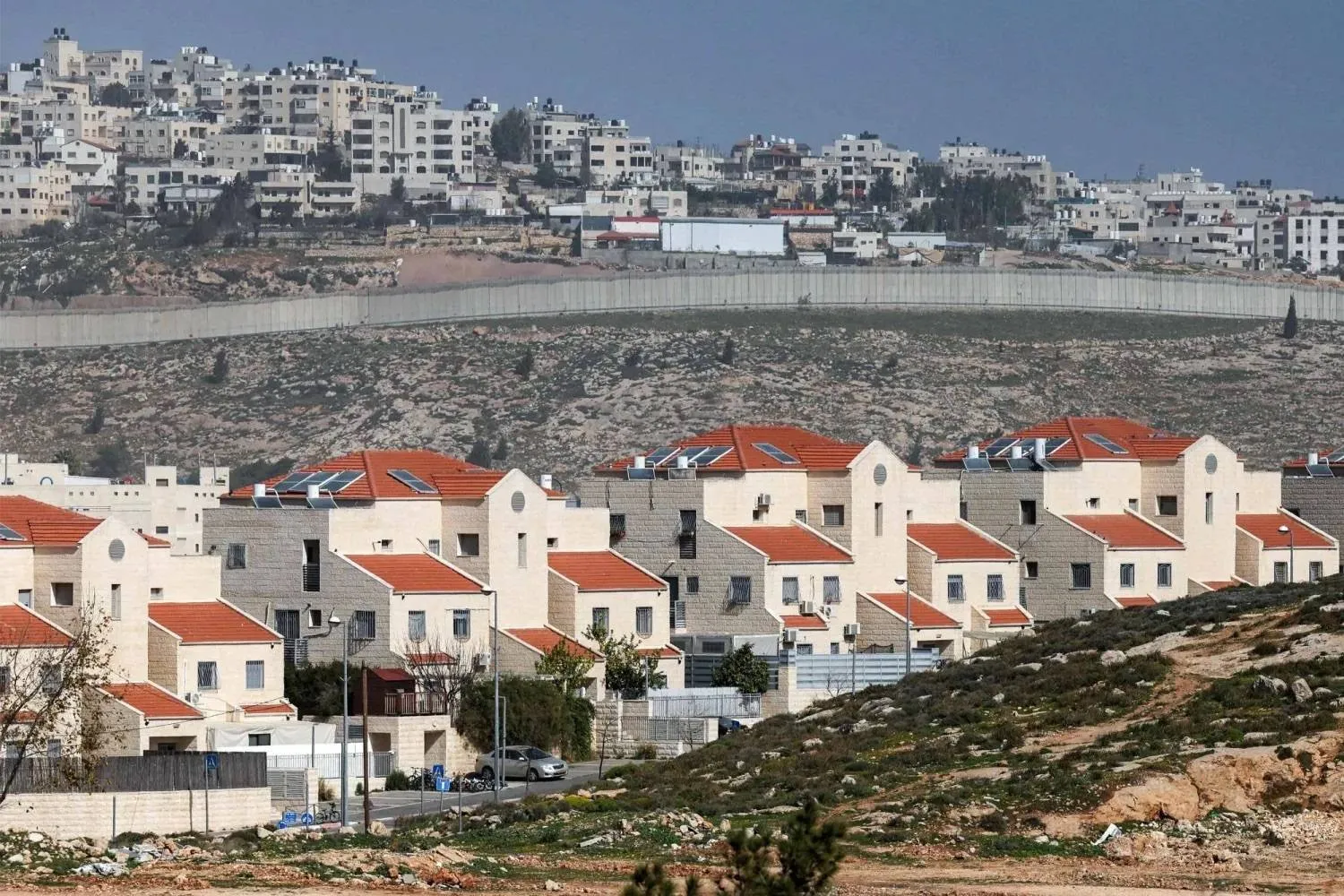
The Neve Yaakov settlement north of East Jerusalem, with the Israeli wall visible separating the Palestinian neighborhood of al-Ram in the West Bank (AFP). 
TT

‘Jerusalem After the West Bank’: Israel Effectively Erases the Land of a Palestinian State

The Neve Yaakov settlement north of East Jerusalem, with the Israeli wall visible separating the Palestinian neighborhood of al-Ram in the West Bank (AFP). 

A day after an unprecedented Israeli decision allowing the seizure of land in the occupied West Bank, Hebrew-language reports revealed a settlement plan that would, in effect, extend Jerusalem’s boundaries beyond the pre–1967 lines.

According to a report published by Yedioth Ahronoth, a housing plan being promoted in the settlement of Adam (also known as Geva Binyamin), in the Binyamin region, is formally presented as an expansion of the settlement bloc.

In practice, however, it would push Jerusalem’s municipal boundaries beyond the lines that existed before the June 1967 war. Such a move would amount to the imposition of de facto sovereignty over the city and a further expansion of Israel’s occupation of Jerusalem.

The Palestinian Authority (PA), backed by international resolutions, demands East Jerusalem as the capital of the hoped-for Palestinian state on the basis of the pre-1967 borders, within the framework of a two-state solution.

Limited Options for the Palestinian Authority

Israeli efforts to seize Palestinian land are effectively undermining the prospects of statehood, while the PA appears to have few tools at its disposal to confront the occupation.

The Palestinian presidency rejected the Israeli decisions, saying it does not recognize them and that they “do not change reality in any way.” It described the moves as a threat to security and stability and as an annulment of signed agreements.

A well-informed Palestinian source told Asharq Al-Awsat that the PA’s options are limited to “the steadfastness of Palestinians on their land and confronting this Israeli encroachment by relying on and adhering to international law and international legitimacy resolutions, turning to the UN Security Council, relevant institutions, international courts, and diplomatic channels.”

The source acknowledged that the PA’s tools are confined to resisting on the ground and rejecting Israeli decisions on the basis that they neither create nor negate rights and do not alter the status of the West Bank as occupied territory.

The PA is also betting on a global rejection of these measures and on pressure by influential states on Israel and the United States to halt them.

He added that the PA has instructed its apparatuses and ministries not to deal with any situation imposed by Israel in the West Bank and is relying on public awareness among Palestinians to avoid engaging with Israeli attempts to create new facts on the ground.

In parallel, the international community, the Security Council, and all legal and international bodies have been urged to confront these unilateral steps and take urgent action.

The PA is also awaiting the outcome of US President Donald Trump’s plan for Gaza, hoping it will lead to a political process toward statehood.

It remains committed to the plan’s provisions and pins hopes on potential changes in Israel’s upcoming elections that could unseat the current right-wing government in favor of a less extreme coalition.

Trump’s “Peace Council” is scheduled to hold its first meeting in Washington on Thursday, as the US president speaks of achieving what he calls “global peace.”

The Jerusalem Plan

The plan for Jerusalem calls for the construction of hundreds of housing units on land located some distance from the Adam settlement, currently without direct access from it, despite earlier discussions about building a bridge to link the two areas.

Construction in the designated zone would create geographic contiguity within Jerusalem and effectively expand the Neve Yaakov neighborhood. According to the plan, the housing units are intended for the Haredi (ultra-Orthodox) community.

Advancing the plan through the West Bank planning system has become significantly easier following sweeping changes introduced by Finance Minister Bezalel Smotrich within the Civil Administration, including the creation of a new settlement authority.

Approval is expected to proceed rapidly, and under procedures adopted in recent years, the project could be implemented within a few years. Smotrich has reshaped the government’s approach to settlement construction by replacing lengthy bureaucratic processes with fast-track approval channels.

A “Misleading Cover”

The Jerusalem Governorate said Israel’s Ministry of Construction and Housing plans to build around 2,780 settlement units to expand the Adam settlement, describing this as a misleading cover aimed at extending Jerusalem’s municipal boundaries beyond the Green Line—the demarcation between territories occupied in 1948 and those occupied in 1967—as part of a calculated policy to impose new sovereign realities without an official declaration.

In a statement issued Monday, the governorate said promoting what is called the “expansion of Adam” is an attempt to obscure the truth.

The plan shows that the new settlement neighborhood would, in practice, be administered as part of Jerusalem’s municipality, despite being formally presented as part of the settlement, an open attempt to conceal annexation behind deceptive planning labels.

Israeli Opposition

Knesset member Gilad Kariv, from the opposition Democrats party warned that the planned step would exacerbate friction between Israelis and Palestinians and inflame unnecessary tensions.

He added that the plans contradict Israel’s international commitments, including those toward Trump, and reflect Prime Minister Benjamin Netanyahu’s complete submission to his extremist partners.

The Israeli peace group Peace Now sharply criticized the move, saying that for the first time since 1967, the government is clandestinely annexing land under the pretext of establishing a new settlement.

In a message to Trump, the group warned: “Netanyahu is deceiving you. You said you would not allow annexation, yet he is carrying it out before your eyes.”

The Jerusalem plan comes amid a series of controversial decisions by the Israeli government regarding the West Bank. On Sunday, the government approved the reopening of land registration in the West Bank for the first time since 1967, endorsing a proposal to register vast areas in the name of the state—effectively granting legal cover to the seizure of Palestinian land.


UN: At Least 15 Children Killed in Sudan Drone Strike

The war in Sudan, ongoing since mid-April 2023, has caused extensive destruction across the country (AFP)
TT

UN: At Least 15 Children Killed in Sudan Drone Strike

The war in Sudan, ongoing since mid-April 2023, has caused extensive destruction across the country (AFP)

A drone strike on a displacement camp in Sudan killed at least 15 children earlier this week, the United Nations reported late on Wednesday.

"On Monday 16 February, at least 15 children were reportedly killed and 10 wounded after a drone strike on a displacement camp in Al Sunut, West Kordofan," the UN children's agency said in a statement.

Across the Kordofan region, currently the Sudan war's fiercest battlefield, "we are seeing the same disturbing patterns from Darfur -- children killed, injured, displaced and cut off from the services they need to survive," UNICEF's Executive Director Catherine Russell said.


MSF Will Keep Operating in Gaza 'as Long as We Can'

(FILES) A Palestinian man walks on his crutches to the Doctors Without Borders or Medecins Sans Frontieres (MSF) clinic, in the al-Rimal neighborhood of Gaza City on new year's Eve, December 31, 2025. (Photo by Omar AL-QATTAA / AFP)
TT

MSF Will Keep Operating in Gaza 'as Long as We Can'

(FILES) A Palestinian man walks on his crutches to the Doctors Without Borders or Medecins Sans Frontieres (MSF) clinic, in the al-Rimal neighborhood of Gaza City on new year's Eve, December 31, 2025. (Photo by Omar AL-QATTAA / AFP)

The head of Doctors Without Borders in the Palestinian territories told AFP the charity would continue working in Gaza for as long as possible, following an Israeli decision to end its activities there.

In early February, Israel announced it was terminating all the activities in Gaza by the medical charity, known by its French acronym MSF, after it failed to provide a list of its Palestinian staff.

MSF has slammed the move, which takes effect on March 1, as a "pretext" to obstruct aid.

"For the time being, we are still working in Gaza, and we plan to keep running our operations as long as we can," Filipe Ribeiro told AFP in Amman, but said operations were already facing challenges.

"Since the beginning of January, we are not anymore in the capacity to get international staff inside Gaza. The Israeli authorities actually denied any entry to Gaza, but also to the West Bank," he said.

Ribeiro added that MSF's ability to bring medical supplies into Gaza had also been impacted.

"They're not allowed for now, but we have some stocks in our pharmacies that will allow us to keep running operations for the time being," he said.

"We do have teams in Gaza that are still working, both national and international, and we have stocks."

In December, Israel announced it would prevent 37 aid organizations, including MSF, from working in Gaza from March 1 for failing to submit detailed information about their Palestinian employees, drawing widespread condemnation from NGOs and the United Nations.

It had alleged that two MSF employees had links with Palestinian militant groups Hamas and Islamic Jihad, which the medical charity has repeatedly and vehemently denied.

MSF says it did not provide the names of its Palestinian staff because Israeli authorities offered no assurances regarding their safety.

Ribeiro warned of the massive impact the termination of MSF's operations would have for healthcare in war-shattered Gaza.

"MSF is one of the biggest actors when it comes to the health provision in Gaza and the West Bank, and if we are obliged to leave, then we will create a huge void in Gaza," he said.

The charity says it currently provides at least 20 percent of hospital beds in the territory and operates around 20 health centers.

In 2025 alone, it carried out more than 800,000 medical consultations, treated more than 100,000 trauma cases and assisted more than 10,000 infant deliveries.


Egyptian-Turkish Military Talks Focus on Strengthening Partnership

The Commander of the Egyptian Air Force during his meeting with the Turkish Air Force chief in Cairo on Wednesday (Egyptian military spokesperson)
TT

Egyptian-Turkish Military Talks Focus on Strengthening Partnership

The Commander of the Egyptian Air Force during his meeting with the Turkish Air Force chief in Cairo on Wednesday (Egyptian military spokesperson)

Senior Egyptian and Turkish air force commanders met in Cairo on Wednesday for talks focused on strengthening military partnership and expanding bilateral cooperation, in the latest sign of warming defense ties between the two countries.

The meeting brought together the Commander of the Egyptian Air Force, Lt. Gen. Amr Saqr, and his Turkish counterpart, Gen. Ziya Cemal Kadioglu, to review a range of issues of mutual interest amid growing cooperation between the two air forces.

Egypt’s military spokesperson said the talks reflect the Armed Forces’ commitment to deepening military collaboration with friendly and partner nations.

Earlier this month, Egypt and Türkiye signed a military cooperation agreement during talks in Cairo between Egyptian President Abdel Fattah el-Sisi and his Turkish counterpart, President Recep Tayyip Erdogan.

Sisi highlighted similar viewpoints on regional and international issues, while Erdogan noted that enhanced cooperation and forthcoming joint steps would help support regional peace.

Cairo and Ankara also signed an agreement last August on the joint production of vertical take-off and landing (VTOL) drones. Production of unmanned ground vehicles has also begun under a partnership between the Turkish firm HAVELSAN and Egypt’s Kader Factory.

During the talks, Saqr underscored the importance of coordinating efforts to advance shared interests and expressed hope for closer ties that would benefit both air forces.

Kadioglu, for his part, stressed the depth of bilateral partnership and the strong foundations of cooperation between the two countries’ air forces.

According to the military spokesperson, Kadioglu also toured several Egyptian Air Force units to review the latest training and armament systems introduced in recent years.

Military cooperation between Egypt and Türkiye has gained momentum since 2023, following the restoration of full diplomatic relations and reciprocal presidential visits that reflected positively on the defense sector.

In September last year, the joint naval exercise “Sea of Friendship 2025” was held in Turkish territorial waters, aimed at enhancing joint capabilities and exchanging expertise against a range of threats.
