

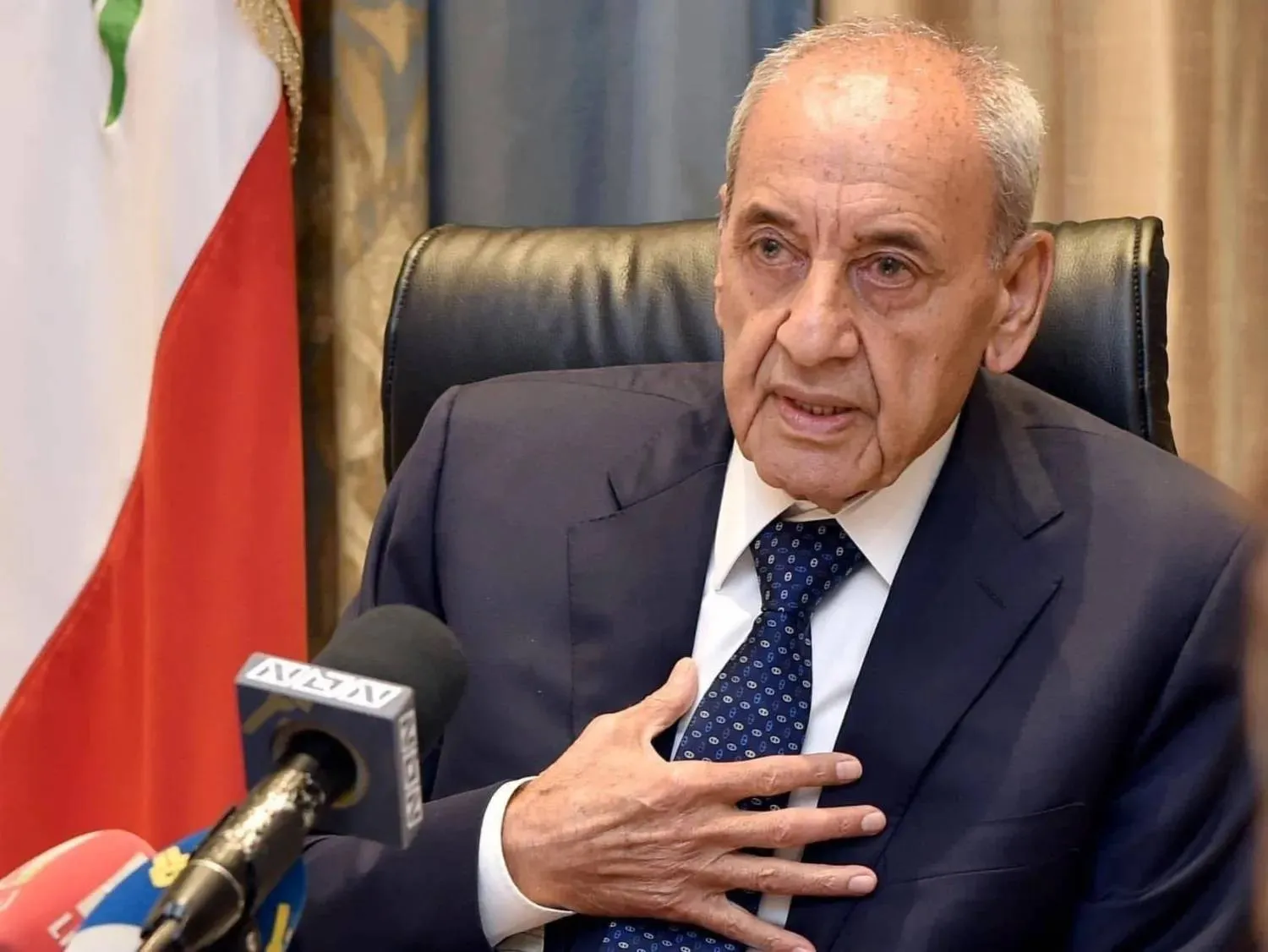

Berri to Asharq Al-Awsat: Parliamentary Elections Will Be Held on Time 

Parliament Speaker Nabih Berri. (Lebanese parliament)
TT

Berri to Asharq Al-Awsat: Parliamentary Elections Will Be Held on Time 

Parliament Speaker Nabih Berri. (Lebanese parliament)

Lebanon continues to come under pressure to postpone the parliamentary elections in May with international powers believing that priority in the country lies in disarming Hezbollah and granting Prime Minister Nawaf Salam’s government more time to approve financial, economic and administrative reforms.

Israel also continues to apply pressure on Lebanon as it maintains its attacks against Hezbollah, targeting its members and fighters across the country and delivering a message that it has no choice but to disarm.

Despite the pressure, parliament Speaker Nabih Berri stressed that the elections will be held on time.

In remarks to Asharq Al-Awsat, he said he had conveyed this position to the ambassadors of the quintet committee countries, who want to delay the polls.

“I do not support the postponement or the extension of parliament’s term,” he added.

“I was the first to announce my nomination,” he noted, explaining that he did so to block claims that he wanted to delay the elections and extend the term of parliament.

“This is a message to whom it may concern inside Lebanon and beyond: I am committed to seeing the elections through to the end,” Berri declared, saying he had advised several members of his Amal movement to submit their candidacies.

Moreover, the speaker said the postponement “was not justified.”

The elections will be held on time and according to the current electoral law, he vowed. “Those who want to postpone them should assume responsibility for their position and not blame it on others.”

Commenting on the latest Israeli strikes on Lebanon that targeted the central and northern Bekaa in the east, he described them as a “new war aimed at pressuring the country to surrender to Tel Aviv’s conditions.”

A prominent military source told Asharq Al-Awsat that the raids sought to deliver a message to Hezbollah members and fighters that they no longer had a safe place to hide.

Israel can pursue them and assassinate them anywhere, it added.

The success of these attacks means that the Iran-backed party has been breached, something that has been acknowledged by several of its MPs, who have vowed to investigate the issue, it said.



Israel Expands Warnings to Hezbollah-linked Money Changers

Lebanese security personnel at the site of an Israeli strike targeting senior military commander Youssef Hashem in the Jnah area on the outskirts of Beirut (Reuters). 
TT

Israel Expands Warnings to Hezbollah-linked Money Changers

Lebanese security personnel at the site of an Israeli strike targeting senior military commander Youssef Hashem in the Jnah area on the outskirts of Beirut (Reuters). 

The Israeli army said it has killed a senior Hezbollah commander, Youssef Ismail Hashem, in a naval strike, as it widened its warnings in Lebanon to include individuals it accuses of handling the group’s finances.

The military described Hashem as Hezbollah’s “southern front commander”, adding he had more than 40 years of experience and was one of Hezbollah’s “major pillars”.

A security source told AFP that Hashem, also known as Sayyed al-Sadeq, was responsible for Hezbollah’s military and security file in Iraq and was killed in a strike on the Jnah area of Beirut. Lebanon’s health ministry said the attack killed seven people.

The source noted that Hashem “was in a meeting with other party members inside a tent near several vehicles” at the time of the attack.

A source close to Hezbollah confirmed the killing, describing him as “the most senior official targeted since the start of the war”. Hezbollah also announced the death of one of its members, Mohammad Baqer al-Nabulsi, who was killed in the same strike.

US sanctions

Hashem has been under US sanctions since 2018 for working for or on behalf of Hezbollah, according to the US Treasury.

The Treasury noted that he oversaw Hezbollah’s operational activities in Iraq and was responsible for protecting the group’s interests there.

It added that he managed relations with armed groups in Iraq, including coordinating the deployment of fighters to Syria.

Senior figure

Hashem is the most senior military figure killed since the start of the war, succeeding Ali Karaki, who was assassinated in an Israeli strike that targeted former Hezbollah secretary-general Hassan Nasrallah in Beirut’s southern suburbs on Sept. 27, 2024.

Israel had previously targeted lower-ranking commanders, including Hassan Salameh, head of Hezbollah’s “Nasr Unit”, who was killed on March 10.

According to Israeli media, Hezbollah’s southern front is divided into three sectors — the Nasr, Aziz and Badr units — which operate independently, with Hashem overseeing all three.

Warnings broadened

Israel has expanded its warnings in Lebanon to include “money changers working in the service of Hezbollah”.

Israeli army spokesman Avichay Adraee said in a post on X that the military had targeted Hezbollah funding sources during the war, including the Al-Qard al-Hassan association and fuel networks.

“Another source that has been targeted is the network of money changers, which constitutes the main and most important financial source for this terrorist organization,” he added.

He named Mohammad Noureddine and Hussein Ibrahim as key money changers working for Hezbollah.

Addressing them directly, he said: “Due to your involvement in financing Hezbollah, the IDF warns you that continuing to fund Hezbollah puts you at risk.”

He also urged Lebanese citizens to avoid “any contact with Hezbollah money changers” and to “stay away from them” for their own safety.

Security zone plans

The intensified strikes come as Israeli Defense Minister Israel Katz said that “at the end of the operation, the Israeli army will establish a security zone inside Lebanon along a defensive line against anti-tank missiles”.

He added that Israel would maintain security control over the area up to the Litani River, about 30 kilometers from the border.

Lebanese Defense Minister Michel Menassa condemned the remarks, saying they “no longer constitute mere threats, but reflect a clear intention to impose a new occupation of Lebanese territory”.


US Embassy in Baghdad Warns of Attacks in City over Next 24-48 Hours

A view of the US Embassy in Baghdad (archival - Reuters)
TT

US Embassy in Baghdad Warns of Attacks in City over Next 24-48 Hours

A view of the US Embassy in Baghdad (archival - Reuters)

The US embassy in Baghdad warned Thursday that pro-Iran armed groups in Iraq may attack the city in the coming one or two days.

"Iraqi terrorist militia groups aligned with Iran may intend to conduct attacks in central Baghdad in the next 24-48 hours," the embassy said in a statement on X, again urging Americans in the country to leave immediately.


Strike in Darfur Kills Senior Figure in RSF-backed Government

Osama Hassan, a leader in the “Taasis” coalition, who was killed in a strike on his home in the city of Nyala (Taasis coalition). 
TT

Strike in Darfur Kills Senior Figure in RSF-backed Government

Osama Hassan, a leader in the “Taasis” coalition, who was killed in a strike on his home in the city of Nyala (Taasis coalition). 

A senior figure in a Sudanese coalition that formed a government backed by the Rapid Support Forces (RSF) was killed in a strike by the Sudanese army on his home in Nyala, South Darfur, late Tuesday, while Health Minister Alaaeldin Naqd and others survived.

Mohamed Hassan al-Taishi, prime minister of the “Taasis” government, said in a statement that an army drone targeted Osama Hassan, a member of the coalition’s leadership body, killing him instantly and seriously wounding four of his aides, two of them critically.

Al-Taishi strongly condemned the killing, describing it as “the beginning of a dangerous pattern of political assassinations targeting civilian and democratic leaders”.

He said targeting the home of a civilian political leader in a populated area constituted “a flagrant violation of international and humanitarian law and moral norms” and undermined any real chance for a ceasefire or a peaceful settlement.

He called on the international community, rights groups and the United Nations to open “an independent, transparent and urgent international investigation” to establish the circumstances of the attack and hold those responsible accountable.

Major blow

The killing of Hassan in Nyala, a stronghold of the Taasis administration, is seen as one of the most significant blows dealt to the RSF, raising expectations the conflict could enter a new phase marked by the targeting of leaders on both sides.

Hassan headed the Democratic Alliance for Social Justice party and was considered a leading candidate for the youth and sports portfolio in the Taasis administration.

Pro-army media outlets reported his death shortly before it was officially confirmed by Taasis authorities.

RSF reaction

The presidential council of the Taasis government, headed by RSF commander Mohamed Hamdan Daglo, known as Hemedti, also mourned Hassan.

In a statement posted on Facebook, it said he was targeted by a Turkish-made Akinci drone that struck his home.

The council described Hassan as “a prominent national figure who contributed effectively to the struggle and was a staunch defender of the causes of freedom and justice, and an example of steadfastness in principle”.

The Sudanese army rarely claims direct responsibility for strikes it carries out on cities in Darfur controlled by the RSF, while the group maintains strict silence regarding its losses.

Since the outbreak of war in April 2023, the Sudanese army and the RSF have exchanged near-daily drone attacks.