

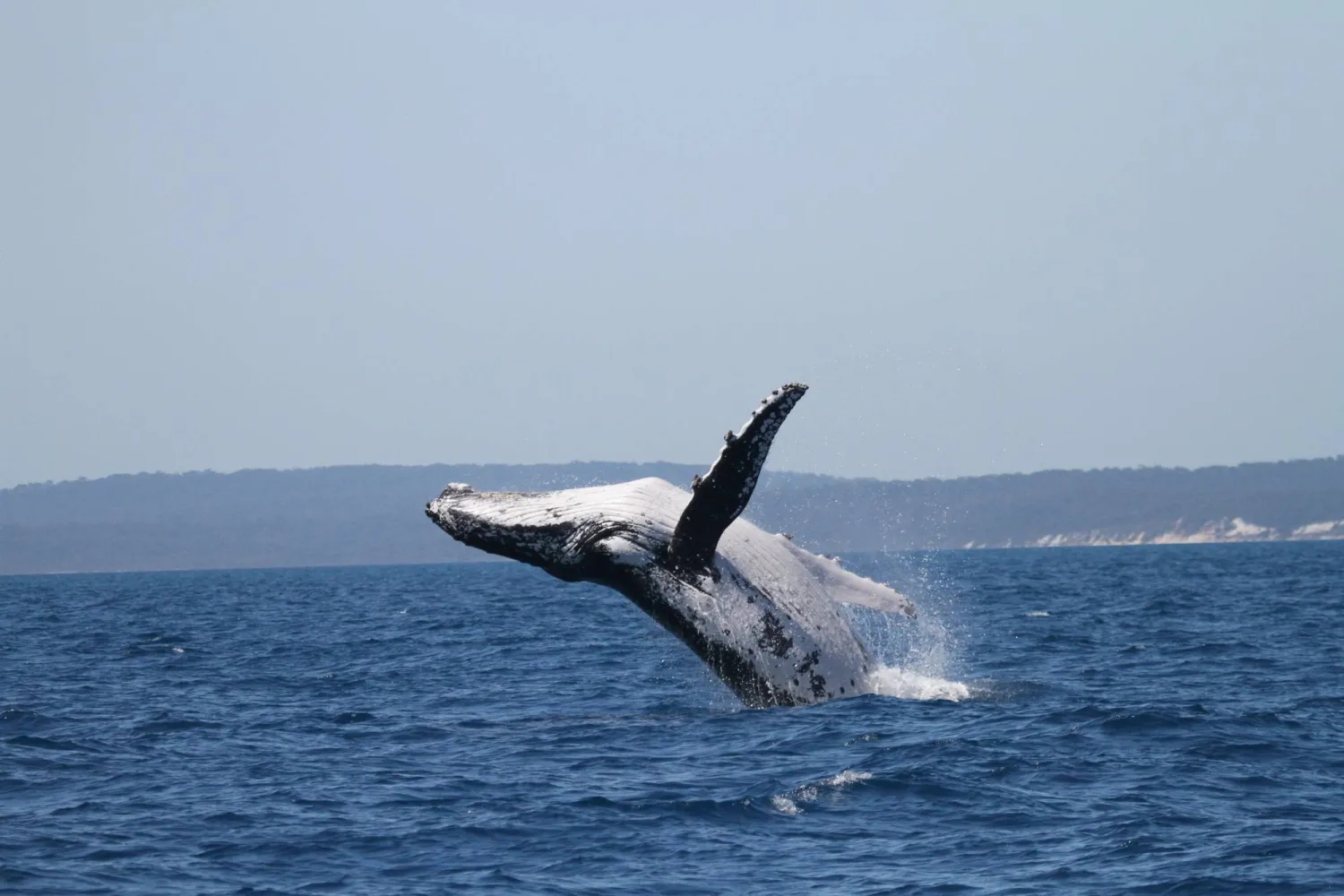

2 Humpback Whales Set Records Swimming between Australia and Brazil

This photo provided by the Pacific Whale Foundation in May 2026, shows a humpback whale breaching off the coast of Australia. (Pacific Whale Foundation via AP)
TT

2 Humpback Whales Set Records Swimming between Australia and Brazil

This photo provided by the Pacific Whale Foundation in May 2026, shows a humpback whale breaching off the coast of Australia. (Pacific Whale Foundation via AP)

Scientists have spotted two humpback whales that made separate, record-breaking crossings between Australia and Brazil.

The whales were identified by their distinctive tail markings at the two locations about 9,000 miles (14,500 kilometers) apart. They traveled in opposite directions and journeyed farther than any humpback known so far.

“It’s a very rare event, but it is a really wonderful demonstration of just how wide-ranging these animals are,” said Phillip Clapham, former head of a NOAA whale research program who was not involved with the new findings.

Humpback whales are known for roaming long distances across major oceans in predictable patterns, typically following migration routes learned from their mothers. They feed on krill and small fish in the warmer months and breed in tropical waters over winter.

It's difficult to track the movements of creatures that spend most of their lives underwater. In the new study, scientists analyzed over 19,000 whale images taken in the past four decades by research groups and citizen scientists, The Associated Press reported.

Recognition software helped to identify the whales based on their tails' color patterns and jagged edges. Researchers pinpointed two different whales at breeding sites in eastern Australia and Brazil over the years, suggesting they had crossed from one place to the other.

One whale traveled just over 9,300 miles (15,000 kilometers), outranking previous recordholders including a humpback that swam from Colombia to Zanzibar.

The findings were published Tuesday in the journal Royal Society Open Science.

Since the photos only depict the whales at the beginning and end of their journeys, researchers don't know the exact route they took.

Whales don't typically travel between mating sites so it's not yet clear why these two separately embarked on their journeys. They may have met other whales on shared feeding grounds and split off instead of returning to where they came from, study co-author Stephanie Stack with the Pacific Whale Foundation said in an email.

“Finding not one but two individuals that have crossed between Australia and Brazil challenges what we thought we knew about how separate these populations really are,” Stack said.

Such odysseys are more difficult for whales in the Northern Hemisphere, where massive continents make traveling across oceans tougher.

Scientists said the record journey shows just how far humpback whales can go. These methods can also help keep track of them as climate change warms oceans, possibly changing where krill live and where humpbacks might go to feed and breed.



Record 274 Climbers Scale Mount Everest in a Single Day from Nepali Side

Climbers walk in a long queue as they head to summit Mount Everest in the Solukhumbu district, also known as the Everest region, Nepal, May 18, 2026. REUTERS/Purnima Shrestha/File Photo
TT

Record 274 Climbers Scale Mount Everest in a Single Day from Nepali Side

Climbers walk in a long queue as they head to summit Mount Everest in the Solukhumbu district, also known as the Everest region, Nepal, May 18, 2026. REUTERS/Purnima Shrestha/File Photo

A record number of 274 climbers scaled Mount Everest on Wednesday, a hiking official said, the highest number ever to reach the world's tallest peak on the same day from the Nepali side.

The 8,849-meter (29,032 feet) Everest straddles the border between Nepal and the Tibet region of China and can be climbed from both sides.

Expedition ‌operators say ‌there were no climbers on the Tibetan side ‌this ⁠year as Chinese ⁠authorities had not issued any permits.

Rishi Bhandari, secretary general of the Expedition Operators Association of Nepal, said on Thursday the record compared with the previous highest of 223 ascents from the Nepali side on May 22, 2019.

“This is the highest number of climbers in a single day so far,” Bhandari told Reuters, ⁠adding the number could rise as some climbers ‌who had reached the summit ‌might not have informed the base camp about their feat yet.

There ‌are no figures available from China on how many climbers ‌reach the peak, but Bhandari said in the normal climbing season of April and May, about 100 people head to Everest from the Tibetan side.

Department of Tourism official Himal Gautam said he had received ‌preliminary information that more than 250 people climbed the peak on Wednesday.

“We wait for climbers ⁠to return, ⁠give us photographs and other evidence to prove their ascents and provide them with climbing certificates,” Gautam told Reuters. “Only then we will be able to confirm the numbers.”

Nepal has issued 494 permits to climb Everest this year, each costing $15,000.

Mountaineering experts often criticize Nepal for allowing large numbers of climbers on the mountain which sometimes leads to risky traffic jams or long queues in the so-called "death zone" area below the summit, where the level of natural oxygen is dangerously below what is required for human survival.

Nepal has acknowledged risks from congestion and inexperienced climbers by introducing tighter controls and higher fees.


'Their Story is Our Story': Pigeons and Humans, 3,500 Years Together

Children chase pigeons as they play on the seaside promenade in the southern Lebanese coastal city of Tyre on April 21, 2026. (Photo by Mahmoud ZAYYAT / AFP)
TT

'Their Story is Our Story': Pigeons and Humans, 3,500 Years Together

Children chase pigeons as they play on the seaside promenade in the southern Lebanese coastal city of Tyre on April 21, 2026. (Photo by Mahmoud ZAYYAT / AFP)

They have been our meat and our messengers, a source of fertilizer and a religious symbol: while pigeons are now mostly reviled as dirty city pests, they long played an important role in human society.

Now, research published on Thursday has revealed that the humble birds were first domesticated 3,500 years ago, meaning they have been enmeshed in our lives for nearly a millennium longer than previously thought.

"Humans forgetting about pigeons happened relatively recently in human history," Anderson Carter, a bioarchaeologist at the University of Groningen in the Netherlands, told AFP.

Pigeons were still a useful part of society as recently as the 19th and 20th centuries, explained the lead author of a new study in the journal Antiquity.

"They were still being used to carry messages and even had an important role in wars in particular," she added.

"But then a lot of technological advancements happened, the telegraph was invented and then the telephone, and pigeons were out of a job".

However, because we had spent thousands of years conditioning them to live alongside us, the birds stayed nearby.

It was only when huge cities emerged after the industrial revolution that "there was a rising view that they were pests, dirty and spreading diseases," Carter said.

Now, "anti-pigeon architecture such as spikes on top of buildings" are a common sight, she added.

The common pigeon -- or rock dove -- originally came from the Mediterranean region. Genomic analysis has shown that today's city-dwellers are closely related to wild doves from the Middle East.

For the new research, a Dutch-led team of scientists went to the Hala Sultan Tekke archaeological site on the shores of the Larnaca salt lake in southeast Cyprus.

They analyzed 159 ancient pigeon bones to find out how they lived and died -- and look for signs of human intervention, such as cuts.

Biometric and isotopic analysis revealed that the pigeons lived in the 13th and 14th centuries BC, during the Bronze Age.

By extracting collagen from the bones, the scientists were able to find out their ratios of nitrogen and carbon, which is closely linked to an animal's diet.

The results were then compared with animals and humans found in Cyprus dating to the same period.

"The Hala Sultan Tekke pigeons overlapped pretty significantly with the results from humans from other Bronze Age Cypriot sites, showing that they likely ate a very similar diet to humans," Carter said.

"This very likely means that they were domesticated or on their way to being domesticated" at around 1,400 BC, senior study author Canan Cakirlar of the Royal Netherlands Institute of Sea Research said in a statement.

That is nearly a thousand years earlier than previous research has found, including giant stone structures used as pigeon nesting houses discovered in Greece dating from around 300 BC.

One goal of the research is "to change how we interact with and think about this bird," Carter said.

"And start realizing that their story is also our story."


'Wiped Out': Ukraine's Bird Lovers Long for Peaceful Skies

Viktor Sevidov 37-year-old photographer takes pictures of birds in Kryvyi Rig on April 22, 2026, amid the Russian invasion of Ukraine. (Photo by Tetiana DZHAFAROVA / AFP)
TT

'Wiped Out': Ukraine's Bird Lovers Long for Peaceful Skies

Viktor Sevidov 37-year-old photographer takes pictures of birds in Kryvyi Rig on April 22, 2026, amid the Russian invasion of Ukraine. (Photo by Tetiana DZHAFAROVA / AFP)

When Viktor Sevidov looked up to the sky above Ukraine's war-scarred landscape, he was not watching out for incoming missiles or drones. Instead, he was looking for birds.

"There's a jay ... That's a bluethroat ... Do you see the hen harrier? We're lucky," the 37-year-old photographer told AFP.

Threatened in peacetime by deforestation, intensive agriculture, urbanization, pollution, hunting and climate change, Russia's 2022 invasion has wrought yet more suffering on Ukraine's birdlife.

The constant aerial bombardments have devastated wildlife and wrecked a delicate ecosystem across a 1,200-kilometer (750-mile) frontline -- including birds' nesting grounds and migratory routes.

Every dawn or dusk, Sevidov leaves his grey apartment block on the outskirts of Kryvyi Rig, an industrial city in central Ukraine, to see what birds he can spot.

"I see shaheds every day ... I want to see a clear sky," he said, referring to the Iranian-style attack drones that Russia fires hundreds of every day at Ukraine.

Amid a global biodiversity crisis, birds -- which play a vital role in pollination, seed dispersal and controlling insect populations -- are one of the fastest declining groups.

Before Russia invaded, Sevidov photographed wildlife in the southern Zaporizhzhia and Kherson regions.

Partly occupied by Russia and under constant bombardment, his previous spots are either "destroyed" or "unreachable".

One day in 2024, he saw a Russian missile shot down above him while he was taking photos near Odesa.

"For me, it's disgusting ... I don't want to see that. I love nature. I love life. Not things that bring death."

Contrary to what some may think, birds cannot always easily flee the dangers of war, zoologist Ewa Wegrzyn, from the Polish University of Rzeszow, said.

Many species of birds are philopatric, meaning they either stay in the area they were born or regularly return to the same place to mate.

"Unfortunately, during war, philopatry can be fatal, as it leads birds along migration routes over areas affected by fighting," Wegrzyn said.

At a refuge center in Voropaiv, near the capital Kyiv, more than 200 birds have been housed, including dozens wounded in the war.

"Birds very often get caught in anti-drone nets or become entangled in fiber-optic cables, injuring their wings, and they suffer terribly," Iryna Snopko, the shelter's 63-year-old director told AFP.

Alongside covering roads in huge nets to stop drone attacks, both Russia and Ukraine have fired thousands of tethered fiber-optic attack drones -- with the webs of discarded cables stretching for dozens of kilometers.

Since 2022, the Sadyba Nyushanik center has built a new aviary to house the influx of injured birds.

Among those taken in are a blind swan, an eagle with an amputated wing and a stork that suffered a concussion during an air attack.

They recently paid to treat an owl that had been severely burned when a drone crashed into its tree. It later succumbed to the injuries.

Walking around, Snopko spoke affectionately about the "love stories" that have formed among the storks.

She showed off a female crow, Varia, who can say her own name.

"Vooaaria!" the bird croaked, a concoction of sounds that resembled a drunken old man.

When Russia invaded in 2022, Sevidov stopped taking photographs for two years -- not wanting to pursue his "hobby" while many of his friends were going off to war.

He had wanted to join the army, but was declared unfit for service as one of his arms has been disabled since birth.

Those same friends eventually convinced him to restart, to try to show something "positive".

His vivid color photographs now frequently appear in local media outlets -- alongside pictures of fires, explosions and obituaries.

Bird enthusiast and Sevidov's best friend, Vyacheslav Kaistro, did enlist.

"There's simply no living space left where the fighting is taking place," the 58-year-old told AFP, speaking in a park in the central city of Dnipro.

"Habitats are being destroyed. The birds that live in those habitats are simply being wiped out."

He recalled seeing a lot of "traumatized" animals near the front.

"Their behavior is completely different ... as if they're under the influence of some kind of drug."

One night in 2023 while on an offensive he saw a Eurasian eagle-owl for the first time in his life.

"It was a bad omen. I had a feeling that something was going to happen," he said, falling silent and staring ahead with eyes frozen.

Hours later he stepped on a mine, losing his right leg in the blast.