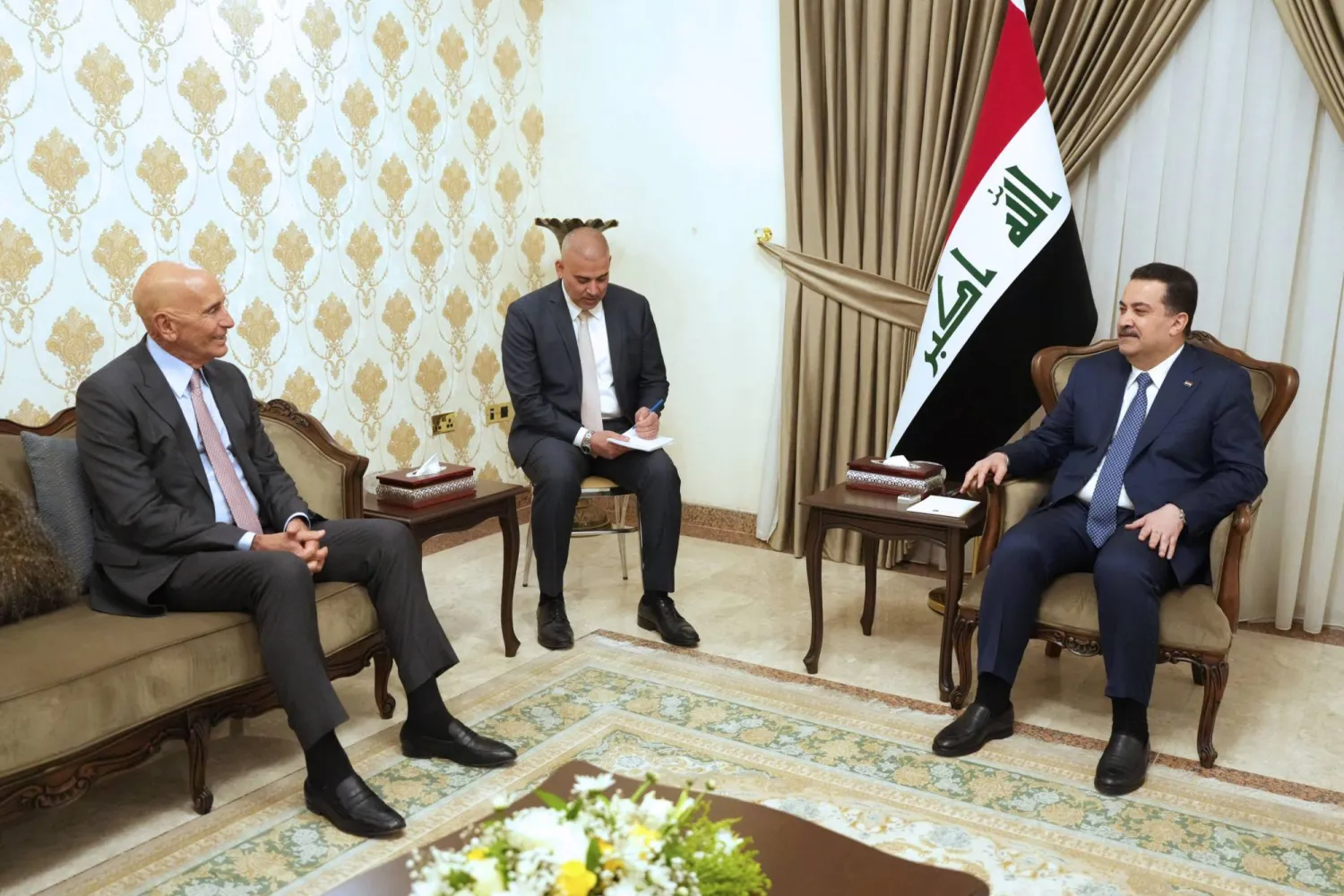
US Envoy Barrack Meets Iraq's Ex-Prime Minister Maliki

FILE: A handout picture made available by the Iraqi prime minister's office on February 22, 2026, shows US envoy to Syria Tom Barrack (L) meeting with Iraq's Prime Minister Mohammed Shia al-Sudani (R) in Baghdad's Green Zone. "AFP PHOTO / IRAQI PRIME MINISTER'S OFFICE"
TT

US Envoy Barrack Meets Iraq's Ex-Prime Minister Maliki

FILE: A handout picture made available by the Iraqi prime minister's office on February 22, 2026, shows US envoy to Syria Tom Barrack (L) meeting with Iraq's Prime Minister Mohammed Shia al-Sudani (R) in Baghdad's Green Zone. "AFP PHOTO / IRAQI PRIME MINISTER'S OFFICE"

The leading candidate to become Iraq's next prime minister, Nouri al-Maliki, met with US diplomat Tom Barrack on Friday after refusing to withdraw his nomination despite the US threatening to stop supporting the country if he returns to the post. 

Barrack, the US envoy to Syria and ambassador to Türkiye, has recently visited Iraq multiple times to meet with senior officials. 

Maliki's media office said in a short statement that the PM candidate stressed during the meeting "the need to respect Iraq's sovereignty and the will of its people". 

He also spoke of the "importance of supporting the democratic process and strengthening political stability" in Iraq. 

It wasn't clear what message Barrack conveyed to Maliki. 

Last month President Donald Trump intervened in Iraq's affairs by issuing an ultimatum that if Maliki -- a two-time former premier with close ties to Iran -- was named Iraq's next prime minister, the US would no longer help the country. 

Trump's threat left Iraqi leaders at a loss, particularly within the Coordination Framework -- a ruling alliance of Shiite groups with varying degrees of links to Iran that nominated Maliki. 

Earlier this week, Maliki told AFP he would not withdraw his nomination, while also seeking to allay Washington's concerns. 

"I have absolutely no intention of withdrawing out of respect for my country, its sovereignty, and its will," Maliki told AFP in an interview. 


Israel’s Top Court Allows Aid Groups to Keep Working in Gaza as Israeli Strikes Kill 5 There

 Palestinians react as they wait to receive food at a soup kitchen in Khan Yunis, in the southern Gaza Strip, on February 26, 2026.  (Photo by BASHAR TALEB / AFP)
Palestinians react as they wait to receive food at a soup kitchen in Khan Yunis, in the southern Gaza Strip, on February 26, 2026. (Photo by BASHAR TALEB / AFP)
TT

Israel’s Top Court Allows Aid Groups to Keep Working in Gaza as Israeli Strikes Kill 5 There

 Palestinians react as they wait to receive food at a soup kitchen in Khan Yunis, in the southern Gaza Strip, on February 26, 2026.  (Photo by BASHAR TALEB / AFP)
Palestinians react as they wait to receive food at a soup kitchen in Khan Yunis, in the southern Gaza Strip, on February 26, 2026. (Photo by BASHAR TALEB / AFP)

Israel's top court on Friday moved to allow international aid groups to keep operating in the Gaza Strip and other Palestinian territories as Israeli strikes killed at least five people across the war-torn enclave. 

The Supreme Court's order, which followed a petition from 17 aid groups, effectively halted an earlier Israeli government decision that barred aid groups for refusing to comply with Israel's new rules. 

Israel had announced it will ban 37 aid groups by March 1 for not abiding by rules introduced last year that require aid groups to register names and contact information of employees, and provide details about their funding and operations. 

The groups view the rules as invasive and arbitrary, and say the ban would hinder critical assistance. Israel says the new measures are necessary to ensure armed groups do not infiltrate humanitarian organizations. 

A US-negotiated ceasefire reached in October has halted major military operations. But the two-year war triggered by Hamas' Oct. 7, 2023 attack on Israel has left much of the territory in ruins and most of Gaza's 2 million Palestinians reliant on international aid. 

Israel has also continued to strike what it says are gunmen, often killing civilians. 

Aid groups express relief Friday's order was a temporary injunction while the court considers the case. There was no timeline for a final decision. 

“This is, however, a step in the right direction — with a long, long way still to go. We will keep fighting to be able to do our jobs, and deliver life saving assistance to Palestinians in need,” said Athena Rayburn, the executive director of AIDA, an umbrella organization representing over 100 groups operating in the Palestinian territories. 

Lawyers representing the aid groups said the decision has given Palestinians in Gaza and the West Bank some “breathing room." 

The petition said the new rules violate international law, and that Israel, as an occupying power, has the obligation to ensure food and medicine reach people. It also says Israel does not have the authority to shutter organizations in areas under the nominal control of the Palestinian Authority. 

COGAT, the Israeli military body overseeing civilian affairs in Gaza, has said that the organizations whose licenses are to be revoked contribute less than 1% of the total aid going into the territory. More than 20 organizations will continue to operate after complying with the new regulations, it said. 

Airstrikes kill at least 5  

Israeli airstrikes overnight killed at least five people, four of them members of the Hamas-run police, officials said Friday. 

Such strikes have repeatedly disrupted the truce since it took effect in October. The escalating Palestinian death toll has left many in Gaza feeling as though the war never ended. 

Three of the five were killed by a strike on a police checkpoint in southern Gaza near Khan Younis, said Dr. Ahmed al-Farra at Nasser Hospital. Another died in a strike on a checkpoint in Bureij refugee camp, according to a statement from the Hamas-run Interior Ministry, which oversees police in Gaza. 

A separate strike in western Khan Younis killed one Palestinian, al-Farra said. 

The Israeli military said it killed several fighters in Rafah, on the border with Egypt. It said the strikes were in response to a violation of the ceasefire. 

The Hamas-run police force has continued to operate in the half the territory under the group's control. The ceasefire agreement calls for Hamas to disarm and hand over power to a committee of Palestinian administrators, and for Israel to withdraw as international forces are deployed. There is no firm timeline for implementing those aspects of the agreement. 

US Embassy provides services in settlement  

Meanwhile, in the occupied West Bank, the US Embassy began offering consular services for the first time Friday in an Israeli settlement. 

The move continues a shift in policy under US President Donald Trump, whose administration has been far friendlier to Israeli settlements in the West Bank than past US leaders. Most of the international community views the settlements as illegal and an obstacle to peace with the Palestinians. 

People lined up in the settlement of Efrat, where some 4,000 US citizens live. “The United States says Efrat is part of Israel, Efrat is going to be forever here,” the city’s mayor, Dovi Sheffler, said. 

More than 500,000 Israelis live in settlements across the West Bank, which is home to around 3 million Palestinians living under military rule, with the Palestinian Authority exercising limited autonomy in population centers. 

The US Embassy has previously provided consular services in Ramallah and other Palestinian cities in the West Bank, which is home to many Palestinian Americans. 

Israel captured the West Bank, Gaza and east Jerusalem in the 1967 Mideast war, territories the Palestinians want for a future state. 


Iraq’s Kataib Hezbollah Tells Fighters to Prepare for Long Iran-US War 

A veiled Iranian woman walks past an anti-US mural next to former US embassy in Tehran on February 26, 2026. (AFP)
TT

Iraq’s Kataib Hezbollah Tells Fighters to Prepare for Long Iran-US War 

A veiled Iranian woman walks past an anti-US mural next to former US embassy in Tehran on February 26, 2026. (AFP)

The Iran-backed Iraqi Kataib Hezbollah told its fighters to prepare for the scenario of a long war in neighboring Iran should the United States launch strikes.

It warned the US on Thursday of "immense losses" were it to start a war in the region, while a commander in an armed faction told AFP his group was "highly likely" to intervene in case of strikes.

"Amid American threats and military build-up indicating a dangerous escalation in the region, it is necessary" for all fighters "to prepare for a potentially long war of attrition," Kataib Hezbollah said in a statement.

The commander told AFP that his group sees Iran as strategic to its own interests, and therefore any attack on the country "directly threatens us".

US-sanctioned Iraqi armed groups did not intervene during the 12-day war between Israel and Iran last year.

This time, the commander said they would be "less restrained", especially in the event of strikes seeking to overthrow the regime.

For months during the Israel-Hamas war in Gaza, Iran-backed groups carried out attacks against US troops in the region and mostly failed attempts against Israel.

Under mounting US and domestic pressure, these attacks came to a halt, while pressure on the groups to disarm has grown.

Iran-backed groups are part of the so-called "axis of resistance", which also includes Lebanon's Hezbollah, Hamas in Gaza and the Houthis in Yemen.

A Hezbollah official told AFP this week that the Lebanese movement would not intervene militarily in the event of "limited" US strikes on Iran, but would consider any attack against supreme leader Ali Khamenei a "red line".

US President Donald Trump has deployed warships and fighter jets near Iran to back up his threats of strikes should ongoing negotiations over Iran's nuclear program fail to secure a deal.

US and Iranian negotiators met for a third round of talks on Thursday, with Iranian Foreign Minister Abbas Araghchi telling state TV that the talks "made very good progress."


ISIS Intensifies Lone Wolf Attacks in Syria 

This picture shows a view of the empty tent at al-Hol camp, closed by the Syrian authorities in the northeastern Hasakeh governorate on February 25, 2026. (AFP)
TT

ISIS Intensifies Lone Wolf Attacks in Syria 

This picture shows a view of the empty tent at al-Hol camp, closed by the Syrian authorities in the northeastern Hasakeh governorate on February 25, 2026. (AFP)

The ISIS extremist group has intensified its lone wolf attacks against security forces and the army in Syria, especially in its eastern provinces, such as Raqqa and Deir Ezzor.

Al-Ikhbariah Syria reported that the attacks intensified after the state’s security and political achievements across the country.

Despite ISIS’ territorial defeat in Syria, it is still capable of carrying out attacks through various cells in the country.

ISIS staged an attack against security forces in Raqqa this week, killing four members and wounding others. A soldier was also killed in Mayadeen city in Deir Ezzor.

The security forces have since intensified their efforts in cracking down on ISIS cells, reported dpa.

They managed to bust the cell that staged the Raqqa attack, killing two of its members and detaining four others, as well as seizing weapons and ammunition in their possession, according to the Interior Ministry.

In Mayadeen, internal security forces detained an ISIS member during a raid. He was wanted for involvement in an attack against Defense Ministry personnel.

ISIS attacks have notably spiked in wake of the Kurdish Syrian Democratic Forces’ (SDF) sudden withdrawal last month from the sprawling al-Hol camp that was detaining members of the group.

There were scenes of "utter chaos" when thousands of women and children related to suspected ISIS fighters escaped the camp in Syria, witnesses have told AFP.

An AFP journalist who entered the huge al-Hol camp on Wednesday found it virtually deserted after the Syrian government decided to evacuate the site.

Until recently, it housed 23,500 people and was the largest camp for relatives of suspected ISIS members in northeastern Syria.

Since the territorial defeat of ISIS it had been under the control of the SDF. However, the SDF swiftly left the camp on January 20, under pressure from Syrian troops which were seizing swathes of the country's north months after their ouster of longtime ruler Bashar al-Assad.

This picture shows a view of the empty tent at al-Hol camp, closed by the Syrian authorities in the northeastern Hasakeh governorate on February 25, 2026. (AFP)

Syrian security forces say they took over control six hours later.

Thousands of family members of suspected extremists left for parts unknown.

As soon as the Kurdish forces left, "it was utter chaos," Salah Mahmud al-Hafez, who lives in the nearby al-Hol village, told AFP.

"The SDF withdrew, and the locals and tribesmen came," he said. "Cars loaded people and drove off."

- Toys, food left behind -

The camp held mostly women and children, the majority of them Syrian or Iraqi.

However, a high-security annex housed more than 6,000 foreigners of around 40 nationalities.

Access to the camp remains prohibited and checkpoints have been set up on the road leading to it, according to the AFP journalist at the scene.

The paths of the empty camp are now strewn with rubbish bags, and white tents stretch as far as the eye can see.

Children's toys and tricycles have been abandoned in the foreigners' annex.

Clothes, notebooks and even food were left behind, signs of a hasty departure.

Last week, Syrian authorities evacuated the remaining families at the camp after determining that the conditions at al-Hol -- particularly security -- were inadequate.

A member of the Syrian government forces looks towards the empty al-Hol camp, closed by the Syrian authorities in the northeastern Hasakeh governorate on February 25, 2026. (AFP)

Syria's interior ministry confirmed on Wednesday there were mass escapes from the camp, accusing the Kurdish SDF of withdrawing "suddenly, without coordination and without informing" them.

Morhaf Al-Olayan, a 43-year-old farmer who lives next to the camp, said that after the Kurdish forces departed, "cars came, loaded the families, and left".

The father of five said he saw men "wearing camouflage military uniforms" among those transporting the families.

Farhan Abbas, an 86-year-old who lives near the camp, said that "people fled... in all directions".

They rejoiced at being rid of oppression and injustice, he added.

The detained family members had not been charged with any crime.

- Women and children at risk -

The foreigners' annex held a large number of people from around the world.

While the whereabouts of those who left the camp remain unknown, teachers in Idlib in northwestern Syria told AFP that several children from Uzbekistan have enrolled in their schools since late January.

In a report earlier this week, Human Rights Watch said that most of al-Hol's residents "left in a largely unplanned and chaotic manner".

"The way these departures have unfolded has exposed women and children to serious risks, including trafficking, exploitation, and recruitment by armed groups," the report warned.

Kurdish forces still control the smaller Roj camp in Syria's northeast, where more relatives of suspected foreign extremists, including Westerners, are detained.

The Kurds had repeatedly urged countries to take back their citizens, but few did, fearing security threats and a domestic political backlash.

"For years, many governments claimed that difficulties negotiating with a non-state actor in charge of the camps was why they couldn't repatriate their citizens, but now that excuse won't hold," Adam Coogle, deputy Middle East director at Human Rights Watch, said in the report.

For the extremists themselves, the United States military has transferred more than 5,700 ISIS suspects from Syrian prisons to Iraq.