


Sudan’s Burhan Warns Islamist Group Over Call to Fight with Iran

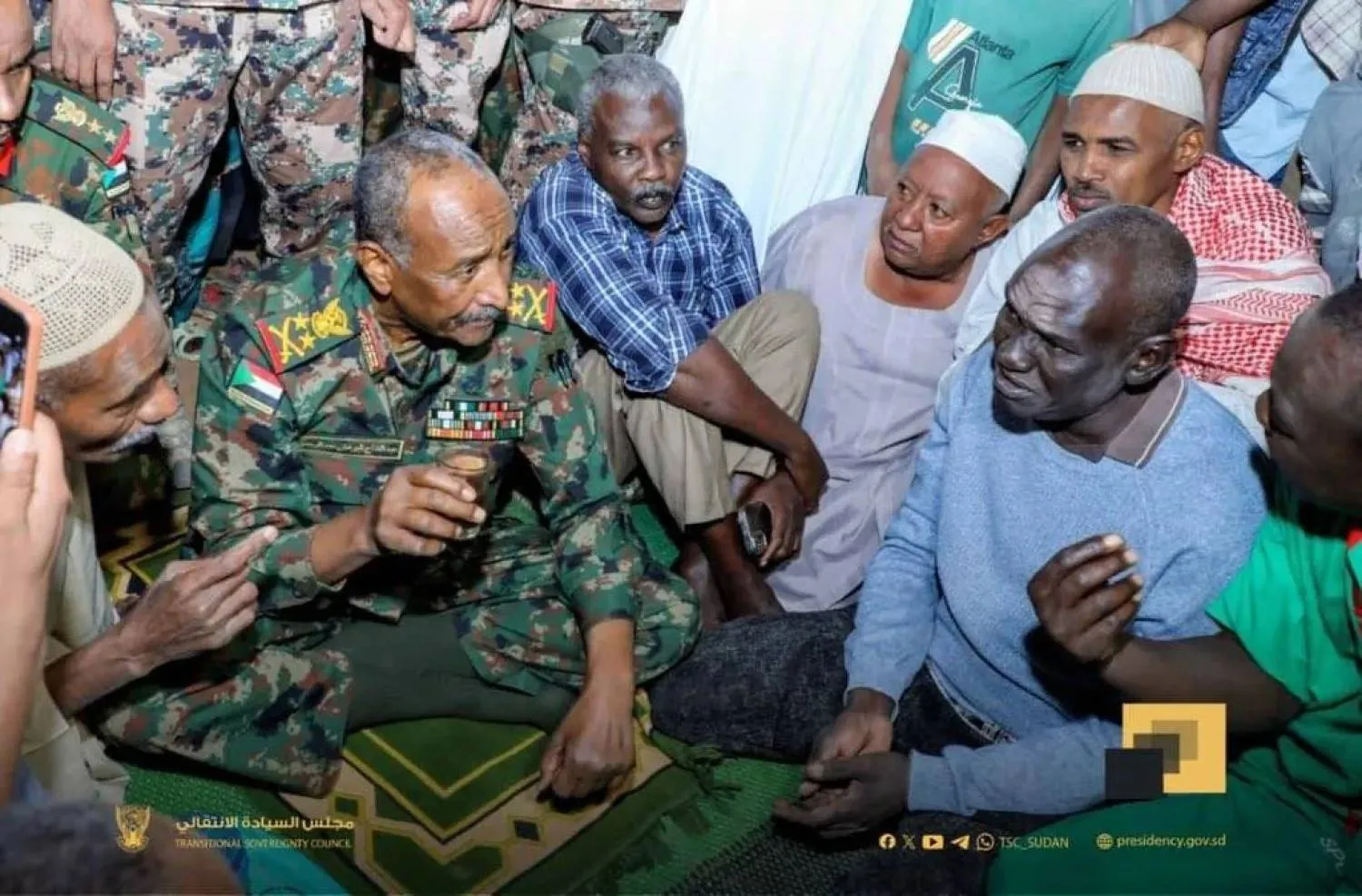
Burhan attends a Ramadan iftar with police personnel in the Haj Youssef district of Khartoum on Wednesday (Sudanese Sovereignty Council)
TT

Sudan’s Burhan Warns Islamist Group Over Call to Fight with Iran

Burhan attends a Ramadan iftar with police personnel in the Haj Youssef district of Khartoum on Wednesday (Sudanese Sovereignty Council)

Head of Sudan’s Transitional Sovereignty Council and army chief Abdel Fattah al-Burhan warned that the military would confront an Islamist group wearing army uniforms after it called on fighters it described as “mujahideen” to join Iran if it faced a ground invasion by the United States or Israel.

Burhan said the Sudanese Armed Forces would not allow any party to speak in its name or exploit its identity to pursue political or ideological goals.

He signaled that strict measures could be taken, warning to back down and return to what he called “the right path”.

His remarks echoed a statement issued Tuesday by the official spokesperson of the Sudanese army, which said the armed forces would take legal action against groups linked to the Islamist movement.

The group had declared during a communal Ramadan iftar that it was ready to defend Iran if it faced a ground invasion by the United States or Israel, sparking wide debate in political and media circles.

Burhan: We stand with Gulf states

Speaking Wednesday evening after a joint iftar with military leaders, Burhan described the war in the Middle East as “sad for us,” adding that the Sudanese people know the harshness of war after suffering from it for years.

“No Sudanese would encourage the outbreak of war or call for it,” he said, urging all those carrying weapons to lay them down and work to halt the cycle of violence.

Burhan also expressed solidarity with the Gulf Arab states, saying they had supported Sudan over the years.

“Our brothers in the Gulf have extended many helping hands to Sudan and played great roles in supporting it. We stand with them in full solidarity,” he said.

He stressed that Sudan rejects any violation of the sovereignty of the Gulf states and said Sudan does not wish to see their peoples placed in painful situations or subjected to infringements on their sovereignty, adding that Sudan’s solidarity with them is “complete and unwavering.”

Burhan warned what he called “our brothers who are making noise inside Sudan,” without naming them, saying: “We will not allow any group to speak in the name of the armed forces or the Sudanese state on matters that do not concern them.”

“Everyone should open their eyes carefully, and if they do not... we will open them for them and then close them,” he said, adding that the authorities would not accept exploiting the space of freedom against Sudan and its people.

He vowed to stand against them and against anyone who supports or encourages aggression anywhere in the world. “We are a peaceful state and seek peace. Therefore, in clear terms, we warn anyone against making statements that harm the state,” he added.

Islamist commander calls for supporting Iran

Burhan’s reaction came after Naji Abdullah, one of the leaders of Islamist jihadist fighters, said in a speech to members of the al-Baraa bin Malik Brigade, in the presence of militia leader al-Misbah Talha, that the group backed Iran.

“We support Iran, and I say this on behalf of all the mujahideen in Sudan: if a ground war begins between the Americans and the Iranians, open the way for us to participate in it,” he said.

The al-Baraa bin Malik group was one of the shadow battalions during the rule of the Islamist movement under former president Omar al-Bashir. After the outbreak of war between the Sudanese army and the Rapid Support Forces, it joined the army in the fighting.

Abdullah’s remarks align with the stance of Sudan’s Islamist movement, historically aligned with Iran, while the army’s position reflects Sudan’s current regional relations.

Divisions among Islamists

Islamists fighting alongside the army appeared divided over the issue. Some criticized the army’s position on the Middle East conflict, describing it as “weak,” while others appeared to accept it tactically, even as they condemned measures taken against Abdullah.

Separately, Ali Karti, secretary-general of the Islamic Movement in Sudan, condemned what he described as the targeting of Arab and Islamic countries and attempts to “stir discord and fragment the unity of the nation.”

In a statement, he said the challenges facing the Muslim world were not isolated incidents but part of a broader project aimed at weakening it and undermining its unity.

Karti condemned attacks on Arab and Islamic countries and violations of their sovereignty, describing the war as aggression by Israel and those backing it against “resistance forces” in the region, with the aim of “breaking the will of the nation and weakening its ability to defend itself.”

He said the movement’s current focus is on defending Sudan and its people against what he called “forces of evil,” adding that its leadership and members remain committed to that approach and that any statements contradicting it do not represent the movement.



At Least 21 Iraqis Killed, 19 Wounded in Bus Crash and Fire Near Nassiriya

 Vehicles enter and exit an underpass road during rainfall in Baghdad on March 15, 2026. (AFP)
Vehicles enter and exit an underpass road during rainfall in Baghdad on March 15, 2026. (AFP)
TT

At Least 21 Iraqis Killed, 19 Wounded in Bus Crash and Fire Near Nassiriya

 Vehicles enter and exit an underpass road during rainfall in Baghdad on March 15, 2026. (AFP)
Vehicles enter and exit an underpass road during rainfall in Baghdad on March 15, 2026. (AFP)

At ‌least 21 Iraqis were killed and 19 others injured when a passenger bus crashed and caught fire near the southern city of Nassiriya on Sunday, police and health officials said.

The accident occurred after the driver lost control of ‌the bus on ‌a highway near ‌Nassiriya, ⁠causing the vehicle ⁠to overturn and burst into flames, the officials said.

Iraqi Prime Minister Ali al-Zaidi ordered an investigation into the causes of the crash and ⁠directed authorities to submit a ‌report ‌on the circumstances surrounding the accident, ‌his office said.

Police and medical ‌officials said 21 people were confirmed dead at the scene and in hospital, while 19 others ‌were wounded.

Most of the injured were in critical ⁠condition ⁠and suffering from severe burns, health officials said.

The cause of the crash was under investigation, police said.

Road accidents are common in Iraq, where speeding, poor road conditions and inadequate enforcement of traffic regulations contribute to a high number of fatalities each year.


Israel Military Opens Probe into West Bank Baby’s Killing

Fahd Abou Haikal, a Palestinian man comforts his elder son Kinan Abou Haikal after burying his seven-month-old baby Sam Fahd Abou Haikal, in Hebron, in the occupied West Bank on June 6, 2026. (AFP)
TT

Israel Military Opens Probe into West Bank Baby’s Killing

Fahd Abou Haikal, a Palestinian man comforts his elder son Kinan Abou Haikal after burying his seven-month-old baby Sam Fahd Abou Haikal, in Hebron, in the occupied West Bank on June 6, 2026. (AFP)

The Israeli military has opened an investigation into the killing of a seven-month-old infant by Israeli gunfire in the occupied West Bank, it said Sunday.

Sam Fahd Abou Haikal died and his parents sustained light injuries when Israeli forces opened fire on the family's car in the city of Hebron, according to Palestinian sources.

Shortly after Friday's incident, the military said its forces had fired after "soldiers perceived a vehicle accelerating toward them".

However, an initial inquiry found the three Palestinians were "uninvolved civilians".

On Sunday, the military said it was opening an investigation into the incident.

"Based on the findings of the preliminary examination, it was decided to open an investigation by the Military Police Criminal Investigation Division," the military said in a statement.

"Upon its conclusion, the findings will be transferred to the Military Advocate General's Office."

Since the war in Gaza broke out in October 2023 with Hamas's attack on Israel, near-daily violence has also rocked the West Bank, which Israel has occupied since 1967.

Israeli soldiers or settlers have killed at least 1,080 Palestinians since then, including both fighters and civilians, according to an AFP tally based on Palestinian health ministry data.

Official Israeli figures show that at least 46 Israelis, both civilians and soldiers, have been killed in Palestinian attacks or during Israeli military operations in the same period.


Israel Kills Nine in Gaza as Egypt Hosts New Ceasefire Talks

Palestinians look at the wreckage of a car hit by an Israeli airstrike in Gaza City on June 7, 2026. (AFP)
TT

Israel Kills Nine in Gaza as Egypt Hosts New Ceasefire Talks

Palestinians look at the wreckage of a car hit by an Israeli airstrike in Gaza City on June 7, 2026. (AFP)

Israeli strikes on a Hamas-run police station and a vehicle in the Gaza Strip killed at least nine people and wounded 20 others, health officials said, as mediators began new efforts to salvage a fragile US-brokered ceasefire deal.

One strike hit a police post adjacent to a large tent encampment of displaced families in Khan Younis in the south of the enclave, killing five people and wounding 16 others, medics said. They did not say how many of the casualties were police.

Israel has stepped up attacks against police headquarters and personnel in the past several months, killing dozens of them, according to Hamas security officials.

Later on ‌Sunday, another Israeli ‌airstrike killed four people and wounded four others when it hit a ‌vehicle ⁠driving through the middle ⁠of Gaza City, medics said.

The Israeli military did not immediately comment on the incidents.

Major fighting has been paused since October under a ceasefire after two years of war, but no agreement has been reached to implement a further US-backed plan for Israeli troops to withdraw, Hamas to disarm and Gaza to be rebuilt.

Israeli troops still control more than half of Gaza's territory, where they have ordered residents out and destroyed remaining buildings. Nearly the entire population of 2 million now lives in a tiny strip of land along ⁠the coast, mainly in makeshift tents or damaged buildings, under Hamas control.

Hamas' ‌nearly 10,000 police officers have emerged as a sticking point ‌in talks to advance US President Donald Trump's plan for Gaza. Hamas wants them included in a new ‌police force; Israel rejects a role for any Hamas-affiliated personnel.

Egypt began hosting a new round of ‌truce talks with leaders from Hamas and other Palestinian factions, sources from Hamas and other sources close to the negotiations said. The talks are expected to last for a few days.

Israel and Hamas have repeatedly accused each other of violating the truce. Israeli strikes in Gaza have killed more than 950 Palestinians since the start of the ‌truce, while Palestinian attacks have killed four Israeli soldiers.

Last year's deal established a Board of Peace led by Trump to oversee a phased ⁠ceasefire and was ratified ⁠by the United Nations Security Council.

However, many of the toughest areas of dispute, including the disarmament of Hamas, Israeli withdrawal and make-up of a Gaza government, were postponed to later in the process. The Board of Peace negotiators have been talking to both sides on the disarmament issue.

Hamas told envoys from the Board and mediators Egypt, Qatar and Türkiye that ending Israeli attacks in Gaza was essential for any progress, sources from the group and officials close to the talks said.

Hazem Qassem, a Hamas spokesperson in Gaza, said on Sunday the group was open to ideas that would lead to ending Israeli attacks in Gaza and reaching common ground over issues of the second phase of the Trump plan. But he said the Board of Peace should stop being "biased" towards Israel.

Nearly 73,000 people in Gaza have been killed since the war started, most of them civilians, according to Gaza health authorities.

Israel launched its assault after Hamas-led fighters broke across the border, killing 1,200 people and taking 251 Israeli and foreign hostages on October 7, 2023.