


In South Lebanon, a Few Villages Defy Israel’s Evacuation Orders

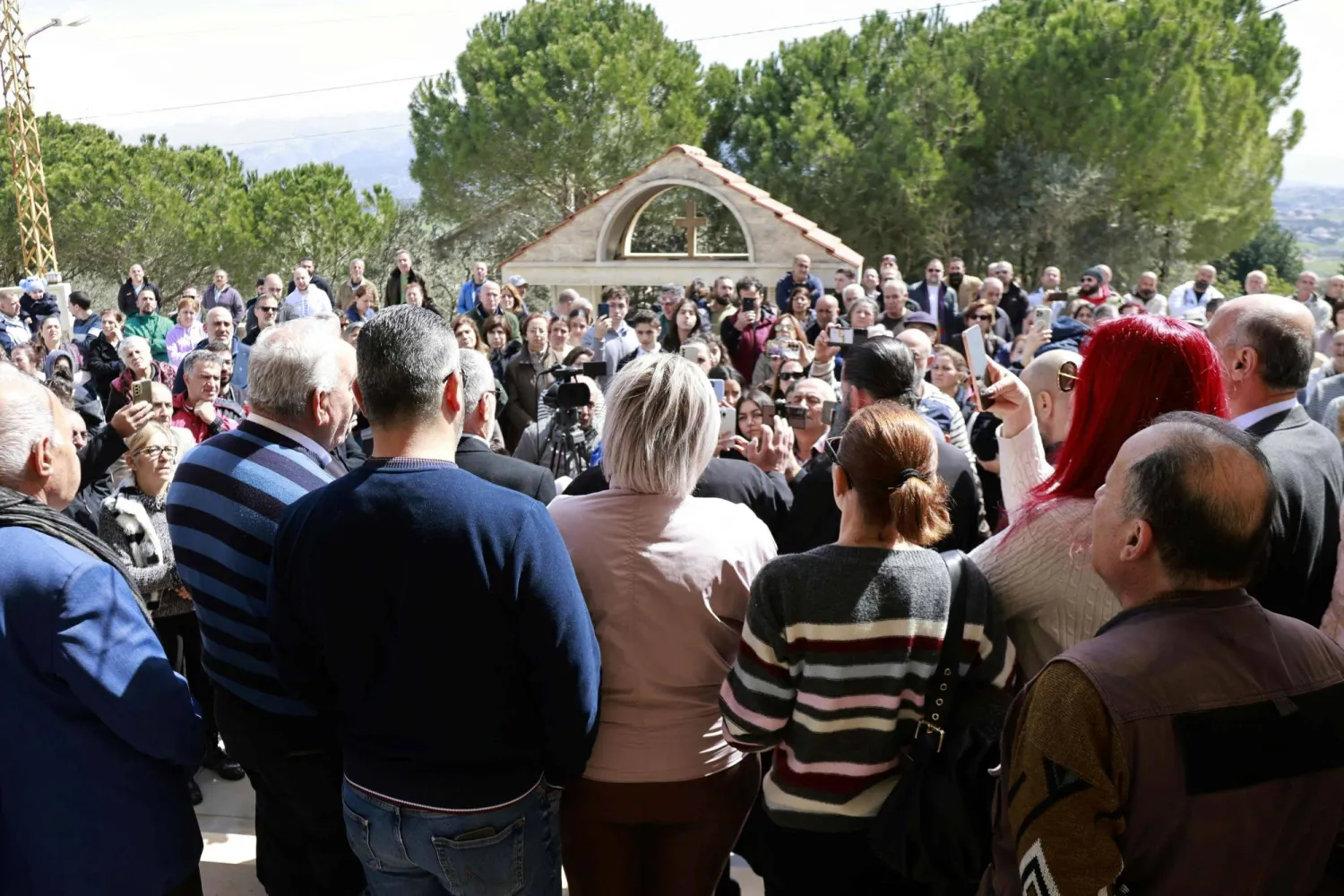
Residents of the southern Lebanese border town of Marjeyoun gather to listen to their priest in the town's churchyard to assert their intention not to leave their homes as directed by the Israeli military earlier this week on March 6, 2026. (AFP)
TT

In South Lebanon, a Few Villages Defy Israel’s Evacuation Orders

Residents of the southern Lebanese border town of Marjeyoun gather to listen to their priest in the town's churchyard to assert their intention not to leave their homes as directed by the Israeli military earlier this week on March 6, 2026. (AFP)

In the basement of a church in Alma al-Shaab, a Lebanese village near the border with Israel, dozens of residents gathered amidst the sound of Israeli bombing, defying the Israeli army's order to flee.

"It is our right to preserve and remain in our land," town mayor Shadi Sayah told AFP over the phone.

"We are pacifists... a danger to no one," he added, as the sound of strikes got closer.

Following the start of a new war between Israel and Iran-backed Hezbollah on Monday, the Israeli military warned residents in large swathes of southern Lebanon to flee, causing mass exodus.

The area, surrounded by green hills, saw many of its localities razed in the last war in 2024. It is now nearly free of residents.

Close to the border, Alma al-Shaab is one of several Christian towns and villages in the south which have tried to stay away from the conflict.

Farther east, several hundred inhabitants of the large town of Marjeyoun and the neighboring village of Qlayaa also say they are determined to stay on their land, as they did during the previous war, from October 2023 to November 2024.

Dozens of people gathered in one of Marjeyoun's churches on Friday, with the local priest saying they "will not leave".

"We have only one choice: to remain steadfast."

A Marjeyoun resident, requesting anonymity, told AFP that "we have bread, but my wife also bought flour, in case of a famine".

- 'We love our land' -

Of Alma al-Shaab's 250 residents, 96 have stayed including women, children and elderly people.

"We want to live in peace in our land... we love our land, we grew up here, and we will die here," Fadi Haddad, 43, said.

In 2024, the town's residents fled, contrary to other Christian villages.

Alma al-Shaab then became a "war zone", mayor Sayah said, as it was caught in the crossfire between Hezbollah and Israel.

Now, only the town's residents are there, and "we did not see anyone else go in or out".

The Lebanese military, which had a post in the village, withdrew on Tuesday as Israeli forces started their incursions into the country.

According to a source among the United Nations peacekeepers in southern Lebanon, the incursions are limited so far as Israeli troops are "entering and leaving".

Sayah said they are "traumatized by what we went through" in the last war

Upon returning after the November 2024 ceasefire, residents saw that more than half of the homes were destroyed.

"That is why we will remain, no matter the outcome," he added.

"Of course I am scared, I am trembling, but what will history remember? That 96 crazy people... were attached to their land."


Houthi Leader Signals Readiness to Enter the War in Support of Iran

Crowds of Houthis in Sanaa raise portraits of Iranian Supreme Leader Ali Khamenei after his killing (Reuters)
TT

Houthi Leader Signals Readiness to Enter the War in Support of Iran

Crowds of Houthis in Sanaa raise portraits of Iranian Supreme Leader Ali Khamenei after his killing (Reuters)

In a notable shift in rhetoric, Yemen’s Houthi leader Abdul Malik al-Houthi on Thursday signaled the group could join the war between Iran on one side and the US and Israel on the other, saying his fighters had their “hands on the trigger” and would move “at any moment if developments require it.”

Speaking during his daily Ramadan lectures, al-Houthi declared support for Iran and said the group was ready to escalate militarily if necessary. He claimed the confrontation underway was “a battle for the entire Muslim nation.”

Al-Houthi also praised what he described as “strong operations” carried out by Lebanon’s Hezbollah and said Iran-aligned Iraqi factions were continuing their military actions.

He urged supporters to stage mass demonstrations on Friday in Sanaa and other areas under the group’s control.

The remarks followed several days of notable restraint by the Houthis since the war erupted on Feb. 28, a pause that observers attributed to complex political and military calculations over the risks of direct involvement in a broader regional conflict.

Missile arsenal

In recent years, the Houthis have evolved from a local insurgency into a military force with relatively advanced weaponry, making it one of Iran’s most prominent regional proxies.

Military research centers estimate the group possesses a diverse arsenal of ballistic and cruise missiles; some developed locally from Iranian models with assistance from Iranian experts and Lebanon’s Hezbollah.

These include long-range missiles such as “Toufan,” with an estimated range of 1,350 to 1,950 km, as well as various versions of the “Palestine” cruise missiles, whose range can reach about 2,000 km.

Medium- and short-range systems include the “Burkan” missiles derived from the Iranian Shahab and Qiam families, with ranges of up to 1,200 km, as well as the short-range “Badr” missiles.

The Houthis have also developed anti-ship missiles such as “Asef” and “Tankil,” modified versions of Iranian missiles equipped with heavy warheads, giving the group the capability to target vessels in the Red Sea and the Gulf of Aden during its involvement in the Gaza war.

Drone warfare

Unmanned aerial vehicles form a cornerstone of the Houthis’ military strategy, largely because they are cheaper than ballistic missiles and can cause significant economic and psychological impact.

Among the most prominent systems are the “Samad” drones in several variants, particularly the Samad-3 loitering drone with an estimated range of 1,500 to 1,800 km. Some upgraded versions can travel even farther. Newer models, such as Samad-4, are capable of carrying guided munitions.

The group also operates “Waed” loitering drones, which closely resemble Iran’s Shahed-136 and are estimated to have a range of 2,000 to 2,500 km. Short-range “Qasef-2K” drones are widely used in tactical operations.

Military experts say the effectiveness of these drones lies not only in their destructive power but also in their ability to overwhelm air defenses and inflict economic damage by targeting ships or vital infrastructure at relatively low cost.

Naval capabilities

Houthi naval capabilities have expanded significantly over the past two years, with the group introducing new technologies, including unmanned boats and advanced naval mines, with support from Iranian experts.

These capabilities include explosive-laden unmanned boats such as the “Toufan” vessel, a remotely controlled high-speed craft designed to strike ships.

The group has also developed unmanned submersible vehicles capable of attacking vessels from below to evade surface detection systems.

The Houthis possess several types of naval mines planted in shipping lanes, posing a persistent threat to international trade in the Red Sea.

According to military estimates, the group relies on mobile launch platforms hidden within a wide network of tunnels and caves in northern and western Yemen.

In addition, the Houthis maintain a large stockpile of conventional weapons directed internally, with more than 300,000 recruits in their ranks, alongside armed tribal fighters loyal to the group.

Many of the resources in areas under their control have been devoted to recruitment and mobilization in recent years.

Yemen’s Presidential Leadership Council chairman Rashad al-Alimi has described the group as “armed to the teeth” with Iranian weapons banned internationally, saying it has transformed from a local insurgency into a “cross-border terrorist organization” with an advanced arsenal.

Observers say any Houthi decision to directly join the regional war could open a new front in the Red Sea, further complicating the security landscape along one of the world’s most vital maritime corridors.


Hamas Foils Armed Gang Attack in Gaza City

 Obaida Suleiman, 8, sits on the ruins of a mosque where his family is currently taking shelter, after it was destroyed during the war between Israel and Hamas, in Deir al-Balah, Gaza Strip, Friday, March 6, 2026. (AP)
Obaida Suleiman, 8, sits on the ruins of a mosque where his family is currently taking shelter, after it was destroyed during the war between Israel and Hamas, in Deir al-Balah, Gaza Strip, Friday, March 6, 2026. (AP)
TT

Hamas Foils Armed Gang Attack in Gaza City

 Obaida Suleiman, 8, sits on the ruins of a mosque where his family is currently taking shelter, after it was destroyed during the war between Israel and Hamas, in Deir al-Balah, Gaza Strip, Friday, March 6, 2026. (AP)
Obaida Suleiman, 8, sits on the ruins of a mosque where his family is currently taking shelter, after it was destroyed during the war between Israel and Hamas, in Deir al-Balah, Gaza Strip, Friday, March 6, 2026. (AP)

Security sources in Gaza said a plot by an armed gang was foiled in western Gaza City, describing the attempt as bold, given it took place in zones where the Hamas movement maintains full security control.

Sources told Asharq Al-Awsat the incident occurred Thursday evening in the Al-Nasr neighborhood

Large security forces were deployed in the area, and vehicles were searched as part of a manhunt for members of a cell belonging to an armed gang calling itself the “Popular Army.”

The group is led by Ashraf Al-Mansi, a former officer in the Palestinian Authority’s security services, and operates mainly in the northern Gaza areas of Jabalia and Beit Lahia.

Shortly before midnight on Wednesday-Thursday, gunmen opened fire near a Hamas security checkpoint in the area before fleeing. Security investigations later found they had hidden in a nearby part of the neighborhood.

On Thursday evening, the same group tried to open fire on another patrol, but was chased after security forces, already on alert, moved to intercept them. One gunman was arrested after security forces raided a house where members of the gang were staying. Two firearms and ammunition were seized, while the remaining suspects fled toward their areas of influence northwest of Beit Lahia.

Motive

Investigators are questioning the detainee to determine the intended target of the planned attack and whether it was aimed at a Hamas security officer or simply a security post.

The armed gangs had assassinated two senior security officers in the past three months in Khan Younis and Al-Maghazi.

Such groups often exploit the presence of Israeli drones overhead for cover when carrying out attacks. Sources said this was the first time they attempted such an operation, while Israel was more focused on the war with Iran.

Days earlier, four-wheel-drive vehicles mounted with new heavy machine guns known as “Dushka” were seen moving along Salah al-Din Street east of Khan Younis. It later emerged that they belonged to members of an armed gang active in those areas, while Israeli drones were flying overhead.

Hamas has been waging a campaign against these armed gangs, seeking to kill or arrest their members. The movement has also tried to dismantle the groups through local clans, urging their members to surrender in return for the opportunity to “repent.”

Hamas is holding many arrested members of these gangs in secure locations and interrogating them for information about their activities. Some were killed when a site where they were being held was struck by an Israeli attack about a month ago in Gaza.

Israeli attacks continue

On the ground, Israeli attacks across Gaza have continued, killing eight Palestinians near the yellow line designated as the initial withdrawal line under the ceasefire agreement that took effect on October 10.

A Palestinian was killed Friday afternoon in an Israeli strike on the main Salah al-Din Street at the entrance to the Shujaia neighborhood east of Gaza City, about 230 meters from the yellow line.

Four others were wounded in separate incidents in different areas.

Three Palestinians were also killed on Thursday in similar incidents as gunfire and shelling continued across the Gaza Strip.

Since early Friday, areas on both sides of the yellow line have come under heavy gunfire and artillery shelling, while Israeli forces carried out demolition operations in several parts of the enclave.

According to the Gaza Health Ministry, 638 people have been killed since the ceasefire took effect, while the overall death toll since the start of the war on Oct. 7, 2023, has risen to more than 72,120.


Death of Iraqi ‘Oil King’ Exposes ‘Jurf al-Sakhar Empire’

A photo released by the Popular Mobilization Forces showing its fighters in the town of Jurf al-Sakhar, south of Baghdad, in 2014
TT

Death of Iraqi ‘Oil King’ Exposes ‘Jurf al-Sakhar Empire’

A photo released by the Popular Mobilization Forces showing its fighters in the town of Jurf al-Sakhar, south of Baghdad, in 2014

A mysterious assassination of a faction leader in Iraq has exposed details of a lucrative oil trade run by what officials and local sources describe as the “Jurf al-Sakhar empire” south of Baghdad, according to information gathered from officials and local residents.

Sources said a “major incident” led to the killing of Abu Saif, believed to be the key figure overseeing the trade in smuggled crude oil, its refining and the sale of its derivatives.

Officials, who requested anonymity because of the sensitivity of the matter, said Abu Saif was likely targeted by a drone strike, coinciding with a broader security escalation in Iraq linked to the war on Iran.

The strike is believed to have been carried out by the United States or Israel, as military aircraft of various types were seen flying intensively over several parts of Iraq throughout the previous week.

Sources said the flights were intended to track groups and individuals already involved in the conflict.

Since Feb. 28, 2026, Iraq’s skies have turned into a crowded theater of drones, attack helicopters and missiles launched by the opposing sides in the regional confrontation: the US and Israel on one side, and Iran and its Iraqi proxies on the other.

Backbone of militia finances

Abu Saif was a shadowy operator who largely worked behind the scenes. Sources said he began as a member of the Mahdi Army, the militia once loyal to Muqtada al-Sadr, before splitting with others and joining factions whose influence has since expanded.

Over the past decade, he has become a central coordinator of specialized operations tied to oil trading, building networks of intermediaries across northern and western Iraqi provinces.

These intermediaries helped obscure his factional ties within what sources describe as Iraq’s “large shadow oil market.”

A person familiar with the parallel oil market described Abu Saif as “one of the nerves of the parallel economy of Iran-aligned groups.”

As the business expanded and the network widened, Abu Saif oversaw refining oil, selling it on the local market, and supplying Iraqi Kurdistan, eventually emerging as one of what sources called Iraq’s “oil kings.”

His network controlled several mobile refineries, known locally as “furnaces,” which produce petroleum derivatives from crude oil siphoned through illegal punctures in major pipelines.

A former oil engineer said these units are small, mobile refining systems designed for quick installation and transport.

They rely on simple distillation equipment that includes heating tanks, small distillation towers, cooling systems and storage tanks that separate gasoline, kerosene, diesel and other products.

Despite their crude design, the operations generate huge profits. But they lack safety and environmental standards, making them vulnerable to explosions and causing severe pollution. The resulting fuel is often low quality and harmful to vehicle engines, the engineer said.

The furnaces also leave behind distinct black stains that damage soil and groundwater, revealing where they have operated.

“Jurf al-Sakhar furnaces”

Security sources said such furnaces spread in areas that experienced security turmoil after 2014, where armed groups and smugglers used them to refine oil extracted from small wells or siphoned from punctured pipelines.

The account is based on remote interviews with security and local sources. Field verification remains difficult because Jurf al-Sakhar has largely been closed to journalists and researchers for years.

The town south of Baghdad became a key hub for these operations because strategic pipelines linking southern oil fields with refineries and stations in central and northern Iraq pass through it.

Jurf al-Sakhar became a major stronghold for Iraqi factions in 2014, when military operations were launched to retake the agricultural town from ISIS fighters. While Shiite factions expelled the militants, around 120,000 civilians were forced to leave.

In the years that followed, the town — once dependent on agriculture — evolved into a complex hub for military and intelligence operations run by armed factions.

According to sources, surrounding farms offered safe cover for mobile refineries, tanker fleets and specialized equipment operated by workers with oil-sector expertise.

Clients of the “oil king”

Sources described a structured network behind Abu Saif’s operations. Products refined in the furnaces were loaded onto tankers that carried no official movement permits and transported to private refineries or facilities with government operating contracts that require petroleum derivatives, such as asphalt plants.

Normally, tanker drivers must carry documents — including official permits — allowing them to pass through checkpoints between Iraqi provinces. But sources said Abu Saif had enough influence to move shipments without interference from security or government authorities.

Dozens of contractors and intermediaries formed what sources described as an army of agents working for the oil king, handling every stage of the process — from operating and relocating furnaces to distributing products to factories and refineries. Many of these intermediaries operate in northern and western Iraqi cities.

The final deal

About a month before his assassination, Abu Saif completed what sources described as his final deal.

They said the network sold about 600,000 tons of oil products, worth roughly $120 million, with nearly half going to the local market.

It remains unclear how the network collects or stores the money. But sources said the deals represent pure profit, since the crude oil is siphoned illegally from pipelines at no cost.

Iraqi authorities periodically announce the dismantling of sites used to recycle and smuggle petroleum derivatives, seizing tankers and illegal refineries across the country.

In some cases, preliminary investigations reveal small networks led by oil traders, operators and complicit security or military officers.

Since 2018, oil smuggling by Iraqi militias has drawn increasing attention from US authorities, prompting Washington to sanction individuals and networks accused of involvement in the factions’ economic activities.

Among them is businessman Salim Ahmed Said, sanctioned by the US Treasury Department in 2025 for running a network of companies that sold Iranian oil as Iraqi oil using front companies and ship-to-ship transfers to conceal the shipments’ origins.

Washington also sanctioned businessman Walid Khaled Hamid al-Samarrai, accused of running a network of tankers and shipping companies used to smuggle Iranian oil and blend it with Iraqi crude before marketing it internationally.

Sources said the oil king exported large quantities of heavy derivatives, particularly black fuel oil, to regional networks that blend them with Iranian oil to facilitate exports using altered shipping documents.

The “Jurf empire”

Sources believe Abu Saif’s assassination during the war on Iran was likely linked to his involvement in military activities targeting US interests from within Jurf al-Sakhar.

Political sources said Shiite armed groups received orders from Iran’s Revolutionary Guards after the killing of Iran’s supreme leader to carry out operations aimed at damaging the US and its allies and targeting the most significant objectives.

Although Abu Saif’s main role involved oil trading and managing the furnaces hidden in Jurf al-Sakhar’s farms, his killing came after his commercial activities intersected with military assignments, which may have included launching explosive drones from the town.

The overlapping roles illustrate how Iraqi factions have built a semi-integrated empire inside Jurf al-Sakhar, combining economic and security functions.

According to sources, the enclave includes missile and drone depots, workshops to test and manufacture improvised explosives, farms, fish lakes, mobile refineries, command and intelligence centers and fortified prisons.

The area also serves as an alternative regional headquarters for units of Hezbollah and advisers from Iran’s Revolutionary Guards, the sources said.
