


Hezbollah’s Rejection of ‘Surrender’ Stalls Macron Initiative to Halt War

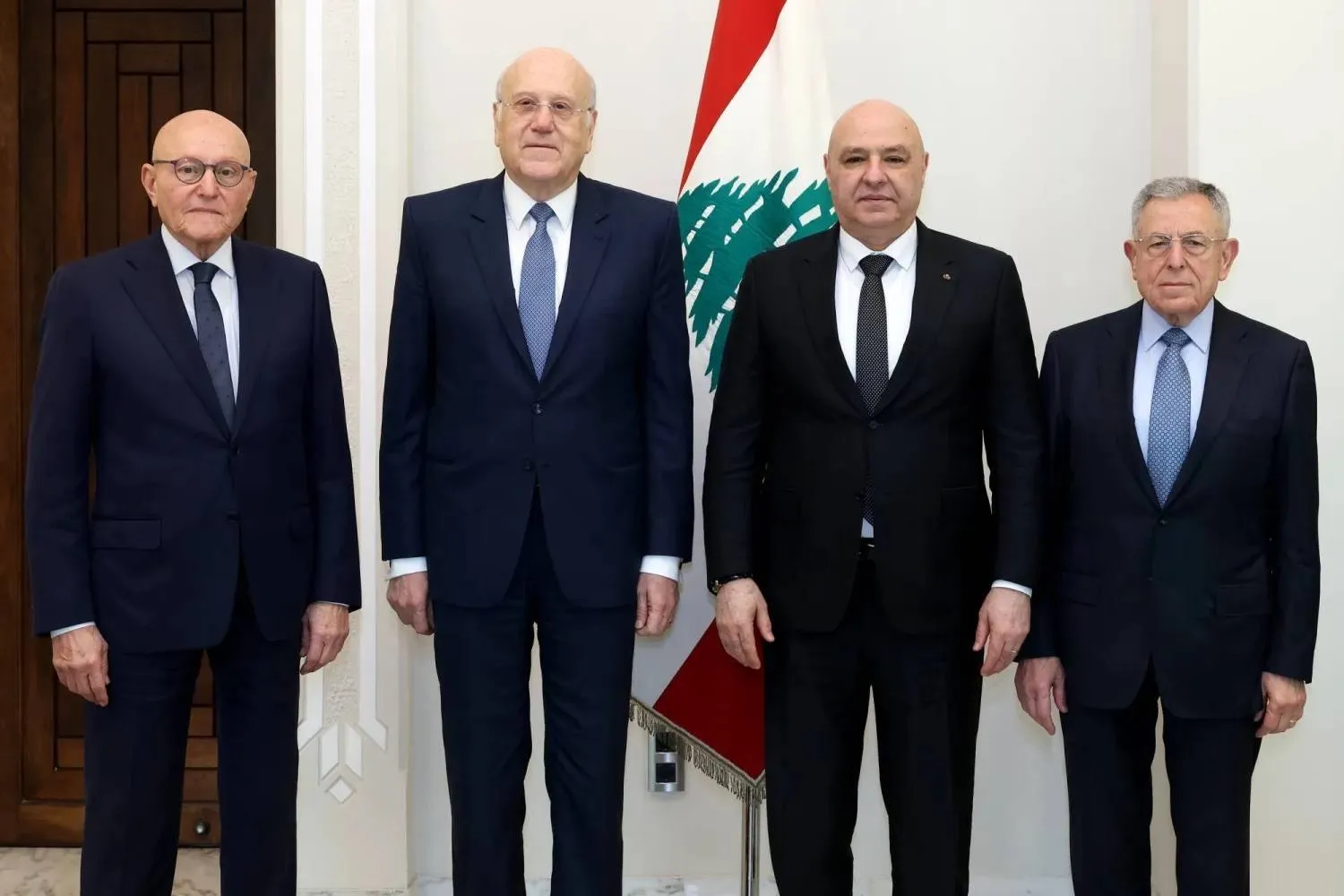
Lebanese President Joseph Aoun receiving former prime ministers Fouad Siniora, Tammam Salam, and Najib Mikati (Lebanese Presidency). 
TT

Hezbollah’s Rejection of ‘Surrender’ Stalls Macron Initiative to Halt War

Lebanese President Joseph Aoun receiving former prime ministers Fouad Siniora, Tammam Salam, and Najib Mikati (Lebanese Presidency). 

French President Emmanuel Macron’s initiative has failed to break the political stalemate surrounding the ongoing war in Lebanon, as Hezbollah rejects what it describes as “surrender” and insists on pressing ahead with the confrontation.

Lebanese and international observers view Hezbollah's fighting as support for Iran in its conflict with Israel and the United States. At the same time, Washington’s continued silence regarding the renewed hostilities in Lebanon has drawn notice.

Lebanese sources familiar with the ongoing contacts said Hezbollah has declined to engage in negotiations after Parliament Speaker Nabih Berri conveyed a call to return to the ceasefire agreement reached in November 2024, which ended the previous round of fighting.

Activists involved in the communications channel quoted senior Hezbollah officials as saying that it was “too early to speak of negotiations.”

Lebanese ministerial sources said President Joseph Aoun informed Macron that any initiative should be presented to Berri, who oversees negotiations on behalf of Hezbollah.

However, visitors to Berri told Asharq Al-Awsat that Macron had only informed him of his intention to send vehicles and equipment to the Lebanese Armed Forces.

Deputy Speaker of Parliament Elias Bou Saab, speaking after meeting the president, referred to “ongoing diplomatic efforts.”

“There are contacts with many parties,” he said. “The media has reported on them, whether French or, in particular, American. But so far we have not reached a breakthrough that we can speak about. The effort is still ongoing, and I believe the contacts made yesterday by the president, as well as the call between the Speaker of Parliament and President Macron, helped reduce attacks that had been planned against Lebanon, including areas that were ultimately not targeted.”

He added: “I can say the diplomatic effort has achieved a measure of success. We must meet these efforts internally with solidarity. Those concerned in Lebanon must also cooperate with the president, the prime minister, and the speaker of parliament so that we can emerge from the current crisis.”

Meanwhile, former prime ministers Najib Mikati, Fouad Siniora, and Tammam Salam visited the president and issued a statement condemning what they described as “the continuing Israeli aggression and crimes against Lebanon and the Lebanese people.”

They voiced support for government decisions affirming that the authority to decide on war and peace must rest exclusively with the state and for enforcing the principle that weapons should be held solely by the Lebanese state across all Lebanese territory. They also called for broad national support for these measures.

Prime Minister Nawaf Salam, for his part, told Arab and foreign ambassadors during a meeting that decisions on war and peace must remain in the hands of the state. He noted that the government is continuing to work with various international partners to halt Israeli attacks.

Salam reiterated Lebanon’s willingness to negotiate and stressed the need to spare facilities and property from damage amid the ongoing escalation. He emphasized that Lebanon “did not choose this war.”

As diplomatic activity intensified, Foreign Minister Youssef Raji held a phone call with Oman’s Foreign Minister Badr Albusaidi, asking Muscat to use its diplomatic influence with the relevant parties to prevent the conflict from being drawn onto Lebanese territory.

Raji also received calls from several European foreign ministers, including Germany’s Johann Wadephul, Ireland’s Helen McEntee, Spain’s José Manuel Albares, Belgium’s Maxime Prévot, and Montenegro’s Ervin Ibrahimović.

The ministers collectively expressed solidarity with Lebanon while welcoming the Lebanese government’s decision to ban Hezbollah’s military and security activities and require the group to surrender its weapons. They also affirmed their readiness to provide the necessary humanitarian assistance.

In turn, Raji expressed deep appreciation for the supportive positions of his counterparts and urged them to mobilize their international contacts to press for an end to the attacks and to spare civilian infrastructure from being targeted.



Katz: Israel to Continue Operations in Lebanon for Now Despite Ceasefire

(2L/R) Israel's Ambassador to the US Yechiel Leiter, State Department Chief of Staff Daniel Holler, US Ambassador to Lebanon Michel Issa and Lebanese Ambassador to the US Nada Hamadeh attend a meeting between Israeli and Lebanese delegations hosted by the United States at the State Department in Washington, DC, on June 3, 2026. (Photo by Oliver Contreras / AFP)
TT

Katz: Israel to Continue Operations in Lebanon for Now Despite Ceasefire

(2L/R) Israel's Ambassador to the US Yechiel Leiter, State Department Chief of Staff Daniel Holler, US Ambassador to Lebanon Michel Issa and Lebanese Ambassador to the US Nada Hamadeh attend a meeting between Israeli and Lebanese delegations hosted by the United States at the State Department in Washington, DC, on June 3, 2026. (Photo by Oliver Contreras / AFP)

Israel will continue its operations on the ground in southern Lebanon for the time being and Lebanese residents forced from their homes by Israel would not be able to return, Defense Minister Israel Katz said on Thursday.

His comments came a day after Lebanon and Israel said they had ⁠agreed to implement ⁠a ceasefire during talks in Washington. The deal is contingent on a cessation of fire from Hezbollah.

In a statement, Katz said troops ⁠would remain in its so-called security zone in southern Lebanon, including in the area of Beaufort Castle, a 900-year-old fortress captured by Israel on Saturday.

According to Reuters, he said Israel would continue to "dismantle terrorist infrastructure in the area" while Israel had "freedom of action, backed by the United States, ⁠to ⁠strike in Beirut in response to attacks on Israeli communities and territory."

Lebanon and Israel agreed on Wednesday to a new US-backed ceasefire in Lebanon. They had previously agreed to a cessation of hostilities in April that was then extended in May, but violence has continued.


Civil Defense: Israeli Strikes Kill at Least 8 in Gaza

A Palestinian man stands at the site of an Israeli strike on an apartment in Gaza City, June 4, 2026. REUTERS/Dawoud Abu Alkas
TT

Civil Defense: Israeli Strikes Kill at Least 8 in Gaza

A Palestinian man stands at the site of an Israeli strike on an apartment in Gaza City, June 4, 2026. REUTERS/Dawoud Abu Alkas

Israeli attacks on Gaza killed at least eight people on Thursday, a spokesman for the civil defense agency in the Palestinian territory told AFP.

"At least eight martyrs as a result of Israeli airstrikes on Gaza City at dawn," with seven killed in strikes on residential buildings and one in the Al-Shati refugee camp to the west of Gaza City, said spokesman Mahmoud Bassal.

Al-Shifa Hospital in Gaza City also reported 15 people wounded in the strikes, he added.

Despite a truce technically in effect since October, daily violence has rocked the Gaza Strip, over half of which is under Israeli military control in defiance of the ceasefire's terms.

Israel has killed at least 936 people since the ceasefire began, according to Gaza's health ministry, which operates under Hamas authority and whose figures are considered reliable by the UN.

Both Hamas and Israel accuse each other of violating the ceasefire.

The first phase of the truce involved the release of the last Israeli hostages held by Hamas in exchange for Palestinians detained by Israel.

A transition to the second phase of the ceasefire, which was supposed to involve Hamas's disarmament and a gradual withdrawal of the Israeli army, has been stalled for months.

Last week, Israeli Prime Minister Benjamin Netanyahu said he had ordered the military to take control of 70 percent of the Gaza Strip.

The latest head of Hamas's armed wing in Gaza, Mohammed Odeh, was killed in an Israeli strike last week, a month after his predecessor was also killed.


Lebanon State Media Reports Israeli Strikes after Conditional Truce Announcement

This photograph taken from the southern Lebanese area of Marjayoun shows smoke rising from the site of an Israeli strike that targeted the village of Kfar Tibnit on June 3, 2026. (Photo by AFP)
TT

Lebanon State Media Reports Israeli Strikes after Conditional Truce Announcement

This photograph taken from the southern Lebanese area of Marjayoun shows smoke rising from the site of an Israeli strike that targeted the village of Kfar Tibnit on June 3, 2026. (Photo by AFP)

Lebanese official media reported Israeli strikes on the country's south on Thursday morning, hours after an announcement that Israel and Lebanon had agreed to implement a conditional ceasefire following talks in Washington.

The state-run National News Agency (NNA) reported Israeli drone strikes along roads at several south Lebanon locations, saying at least one caused casualties.

Israel and Lebanon agreed Wednesday to implement a ceasefire but said it would require a "complete cessation" of fire by Iran-backed Hezbollah, according to a joint statement after US-led talks in Washington.