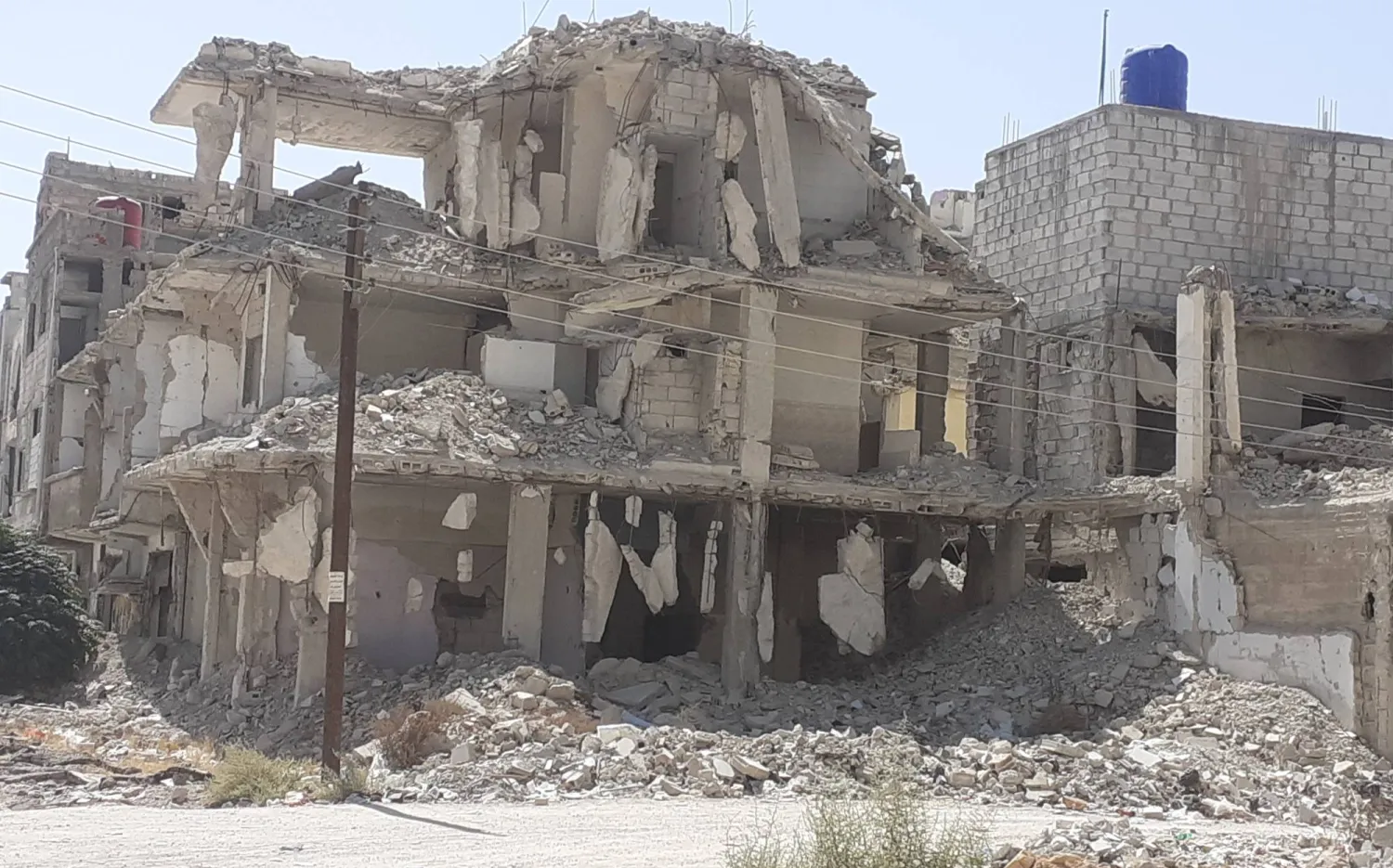

On the Southern Ring Road in the Syrian capital, Damascus, Najah Hassan waves at passing cars, hoping one will take her to the turnoff for her hometown of Daraya, where large areas remain either completely or partially destroyed by the war. Once inside a car, she begins describing the hardships of displacement and her inability to repair her home in Daraya's Shamiyat neighborhood, which was damaged by shelling.
She says she is forced to move between her two daughters' homes because she cannot afford to rent even a single room in neighborhoods around the capital.
A striking contrast is visible on either side of the road dividing the area. To the south, the destruction of Daraya stretches across the horizon. To the north, the residential buildings of the Mezzeh district and the towers of the Marota City project rise into view. Syrian authorities have resumed work on the development, which was originally launched under the previous government.
Najah, who lost both her husband and son during the war, points toward the towers with regret.
"Building homes for displaced families is more important than building luxury towers for the wealthy who never lost their homes or their livelihoods."
The contrast is evident across Damascus, where two realities appear to belong to different countries. Billboards advertise modern residential compounds and luxury apartments, promoted as symbols of a new life with promises of comfort, investment opportunities, and a more prosperous future. Yet just a few yards away, entire neighborhoods still bear the scars of war, with widespread destruction and districts that have yet to see reconstruction projects or even basic infrastructure restored.
This gap between the image promoted by real estate development projects and the reality facing much of Syria's population raises questions that go beyond architecture and urban planning. It has prompted debate over the selective nature of these projects, their economic and social priorities, who stands to benefit from them, and whether they reflect the country's actual housing needs.
Following the fall of Bashar al-Assad's government, discussion of investment and development projects gained momentum. Many Syrian families hoped the new authorities would make addressing the country's severe housing crisis a priority by launching a genuine reconstruction plan that would help end years of displacement, homelessness, and the burden of rising rents.
That optimism quickly faded as the government's strategy came to rely on attracting domestic and foreign real estate investment companies. These firms have focused on building large new residential developments where only wealthy buyers can afford to purchase apartments, while families whose homes were destroyed have largely been left to face their circumstances on their own.
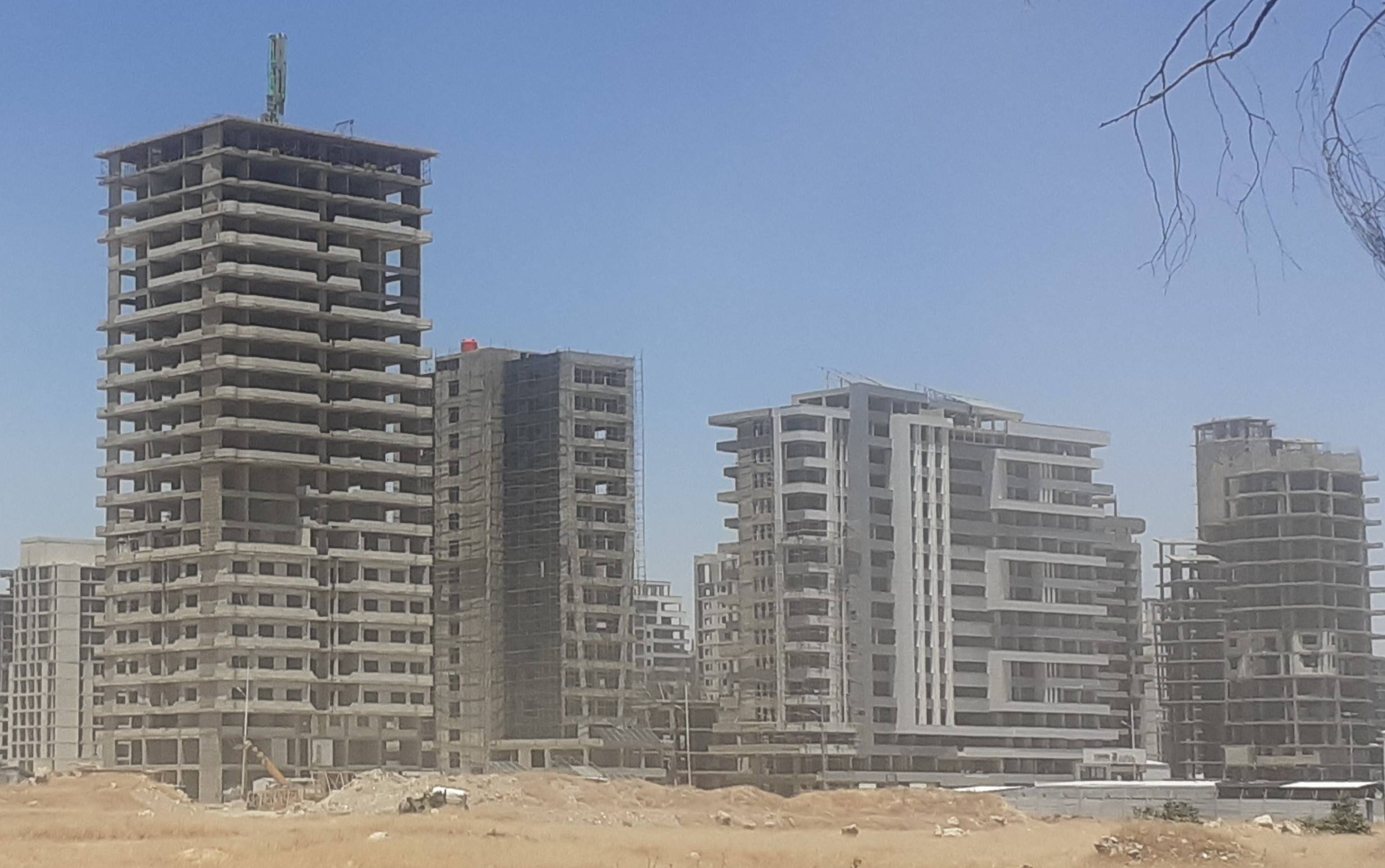
"Yaafour 963"... A $300,000 Apartment
Among the real estate developments that have been promoted in recent months is Yaafour 963, located west of Damascus along the Damascus-Beirut highway. The project was launched by Invest Group Overseas, an investment firm headquartered in Dubai.
According to the real estate platform Al Masdar Al Aqari, the development spans nearly 144,000 square meters and consists of 13 buildings, including 12 residential buildings and a social club. More than 75 percent of the total area has been allocated to green spaces, open areas, and shared amenities.
The project's total investment value has not been disclosed. However, the platform said it includes 1,280 residential units, ranging from two, three, and four-bedroom apartments to penthouses.
Apartments in the development, which offers a wide range of facilities and services, start at $300,000 for a two-bedroom unit. Such apartment sizes do not meet the needs of the average Syrian family, while their prices are far beyond what most households can afford.
In a country where the monthly salary for most public sector employees does not exceed $150, while the basic monthly living expenses for even a small family are estimated at around $500, a price tag of $300,000 is far beyond reach.
With hopes fading for a government-led reconstruction effort or investment-backed projects aimed at rebuilding devastated areas, many families have found themselves with little choice but to return to damaged homes after carrying out limited repairs at their own expense, often financed through irregular money transfers from relatives abroad.
Questionable Investment Deals in Jobar
Residents and local officials in Jobar, a historic and economically significant suburb northeast of Damascus, say they have been presented with investment offers from unidentified companies in which the government acts as an intermediary rather than a guarantor.
Eymen al-Dasuqi, a senior researcher at the Omran Center for Strategic Studies who recently conducted a field visit to war-damaged areas, said one company has begun offering settlements to property owners in Jobar regarding their real estate. Under the proposed arrangements, owners of properties officially registered in the land registry would receive only 50 percent of the value of their holdings, while agricultural landowners would be offered 35 percent of the value of their land.
Al-Dasuqi said the mechanism has raised concerns that residents could lose ownership of their properties or see their real estate rights diminished through reconstruction projects. Some view the model as a way of consolidating privately owned properties while compensating owners for only a portion of their value.
It is widely rumored that businessmen with ties to the former government are behind these companies or hold significant stakes in them. As a result, many Jobar residents say their objections to the company's proposal go beyond legal and technical concerns and extend to the individuals involved.
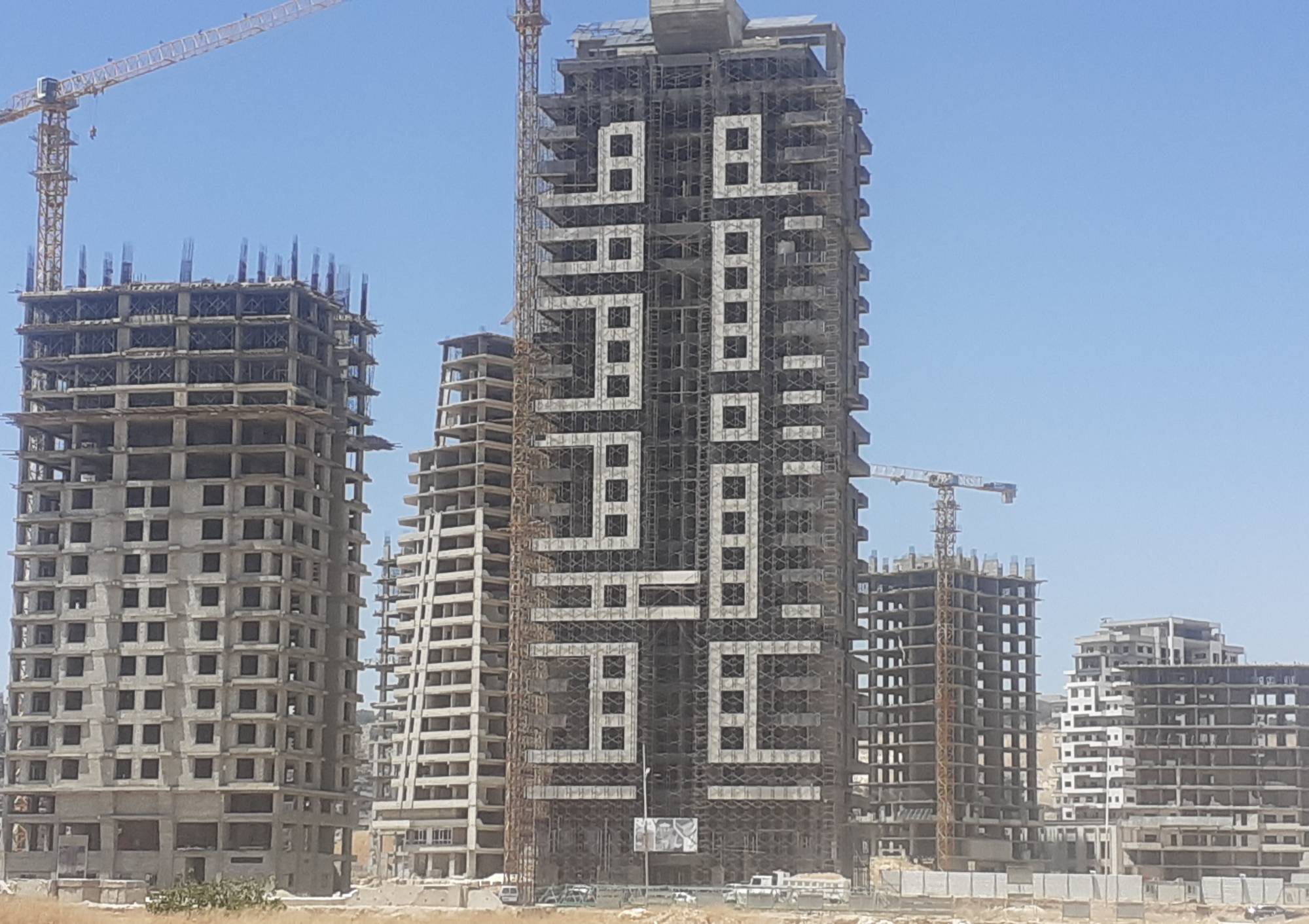
Al-Dasuqi added that, based on the company's market assessment, the proposed sale price for residential units is about $1,000 per square meter, well beyond the purchasing power of Jobar's residents, most of whom remain displaced.
He attributed the high price to the structure of real estate development projects in war-damaged areas. Under these arrangements, investment companies are expected to finance the restoration of basic services to compensate for the government's limited role. The cost is then passed on through higher housing prices and by acquiring stakes in land through partnership agreements with property owners.
Government as an Intermediary for Investors
The government is seeking to position itself as an intermediary that persuades investors to rebuild war-damaged areas while responding to pressure from communities that endured years of conflict and are seeking compensation. At the same time, it has announced a plan to close displacement camps, making investor-led construction in cleared areas its preferred approach.
However, what appears to be a pragmatic strategy has directed development projects toward higher-income buyers, while sidelining a large segment of rightful property owners with limited incomes.
Al-Dasuqi said this model is unlikely to achieve "social stability."
"The government genuinely wants to rebuild the destroyed areas and may encourage such projects, but it has no authority to compel investors to work there. Investors put forward proposals that align with their own economic interests," he said.
He added that the relevant government bodies, including the Damascus Governorate, the Ministry of Housing, and the Ministry of Local Administration, have been trying to persuade residents of war-damaged areas to accept the offers made by investment companies, arguing that they may represent the best available option.
According to al-Dasuqi, another explanation for the state's reluctance to take on reconstruction directly is the view that its role is limited to regulating the process by issuing laws and legislation and attracting investment proposals, rather than carrying out reconstruction itself or providing basic services. Under this approach, those responsibilities are left to the domestic and foreign private sector.
At the same time, luxury cities are being developed to serve what al-Dasuqi describes as a new social class in Syria, the "newly wealthy." He said this group accumulated substantial wealth during the war through large-scale real estate projects in parts of northern Syria and now represents an estimated 1 to 3 percent of the population. The target market also includes Syrians living abroad, the large Syrian diaspora in Europe that has become integrated into the European economy, and foreign investors seeking a foothold in Syria.
Al-Dasuqi said such large-scale developments meet the needs of only a limited segment of the population, which could be accommodated with the construction of around 100,000 housing units. Meanwhile, the housing crisis facing 3 million internally displaced people and 5 million refugees remains unresolved.
Marota City and Decree 66
The involvement of new companies in real estate development projects in war-damaged areas is not a new phenomenon in Syria. In 2012, the Assad government issued the controversial Decree 66, officially presented as a plan to redevelop informal settlements and unregulated housing areas.
Since the fall of the former government, debate over the decree has resurfaced, particularly in connection with the two redevelopment zones established under it. The first covers the southeastern Mezzeh and Kafr Sousa area, later renamed Marota City, including what is commonly known as the Mezzeh Orchards and parts of Kafr Sousa. The second is located south of the Southern Ring Road and was later named Basilia City.
Property owners in both areas who spoke to Asharq Al-Awsat, along with Syrian legal experts and international human rights organizations, said the former government's objective in issuing Decree 66 was to strip residents of their property, displace them, and alter the demographic composition of the two areas.
According to international reports published in 2018, "Decree 66 punishes displaced people and obstructs investigations into war crimes." The reports also said the former government "used the decree to confiscate property and displace residents."
In June 2020, the US Treasury Department imposed sanctions on former Damascus Governor Adel al-Olabi for his role in overseeing Damascus Cham Holding and the Marota City and Basilia City real estate developments. It described the project as "the largest real estate investment in Syria, worth millions of dollars," and said it was intended to reshape the area's demographics into "a wealthy population that is politically loyal to the regime."
Property Owners Seek Changes to Decree 66
Following the fall of the former government in 2024, original landowners in the Marota City and Basilia City development areas have expressed hope that the Syrian authorities will repeal or amend Decree 66 to restore the rights of the original owners after what they describe as years of injustice under the ousted government. Instead, Damascus Governorate has continued implementing the decree, prompting growing frustration among residents, who have staged protests demanding fair treatment.
Bashir Baalbaki, one of the original landowners in the Mezzeh Orchards area, told Asharq Al-Awsat that "under the former government, the governorate returned only 17 percent of our land to the original owners. That is the height of injustice."
Baalbaki added, "The replacement housing was supposed to be provided free of charge and within the same area. However, the governorate failed to honor that commitment, both in terms of location and compensation. Instead, property owners received a modest annual rental allowance that did not come close to compensating them for their property rights."
Following the change in government, the governorate increased the rental allowance by a factor of 35. However, Baalbaki said it "still does not reflect current rental and real estate market prices, especially given the enormous inflation. The governorate also promised to provide replacement housing in a neighboring area, but the units would be delivered unfinished and at a price that remains unknown to this day."
Targeting "Revolution Strongholds" Through the Law
Moatasim al-Sioufi, director of the Syria-based organization The Day After, which has conducted research on property rights and real estate development projects, said the core problem with Decree 66 and Law No. 10 of 2018 is that they "were issued under extraordinary circumstances during the years of the uprising , and were used by the former government against areas that had risen up against it. Those areas were strongholds of the uprising , and the laws were used to alter their identity and demographic character."
Al-Sioufi told Asharq Al-Awsat that property owners were subjected to "significant abuse," noting that many original owners were unable to prove ownership because of the circumstances at the time. He also said there were numerous cases of forced property sales. According to al-Sioufi, several prominent figures from the former government, including Asma al-Assad and businessmen Samer Foz and Hossam al-Qaterji, held major stakes in the Marota City towers, and those holdings have since been placed under the management of the Sovereign Fund.
Explaining what he describes as the mechanism behind the process, al-Sioufi said: "If you own a piece of agricultural land in Damascus today worth $1,000, its value can rise to $10,000 or even $100,000 once it is rezoned for construction. But under Decree 66, the land was assigned a fixed value, and owners were given shares in the new development in return. Meanwhile, property prices within the redevelopment zone rose so dramatically that the shares allocated to owners were no longer enough to buy even a single room, or even a bathroom, in one of the new towers, while individual apartments sell for around $1.5 million. In my view, this amounts to a form of fraud against property owners, or an indirect seizure of their property, and it continues to this day."
Al-Sioufi said that during the former government's rule, the Damascus Governorate took control of a large share of the residential and commercial plots within the project before offering them for investment through Damascus Cham Holding, claiming the proceeds would finance infrastructure projects. He said the arrangement raises many questions.
In his view, "the logical solution" would be to halt the implementation of Decree 66 at its current stage and then amend it in a way that guarantees fair compensation for the original property owners from the governorate's share.
Yarmouk Camp: A Double Catastrophe
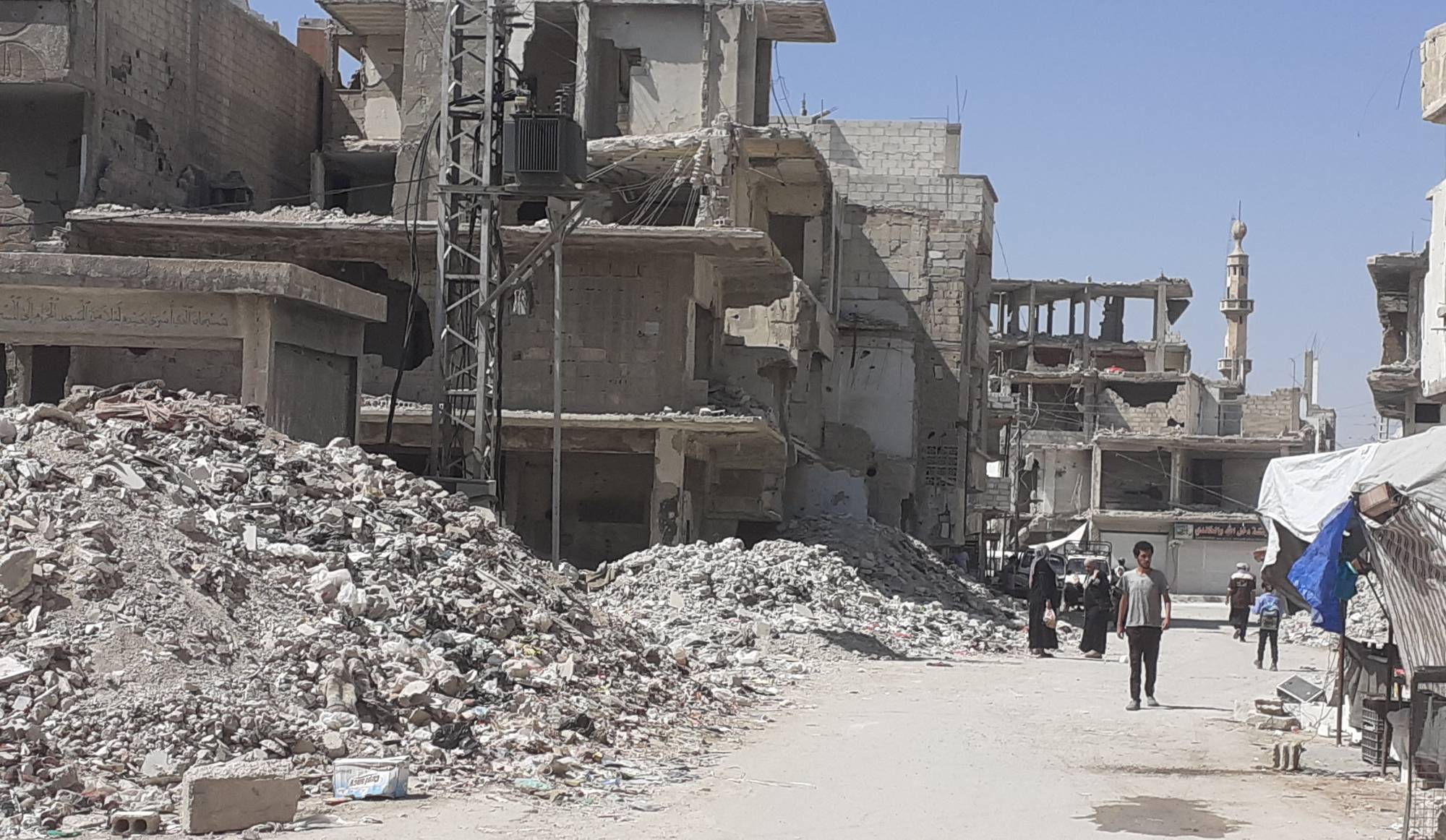
In Yarmouk camp, south of Damascus, once known as the "capital of the Palestinian diaspora" before becoming one of the most prominent symbols of Syria's wartime destruction, signs of returning displaced families are becoming increasingly visible. Local markets have seen some activity resume, despite the continued devastation and the poor state of basic services, including electricity, water, sanitation, and telecommunications.
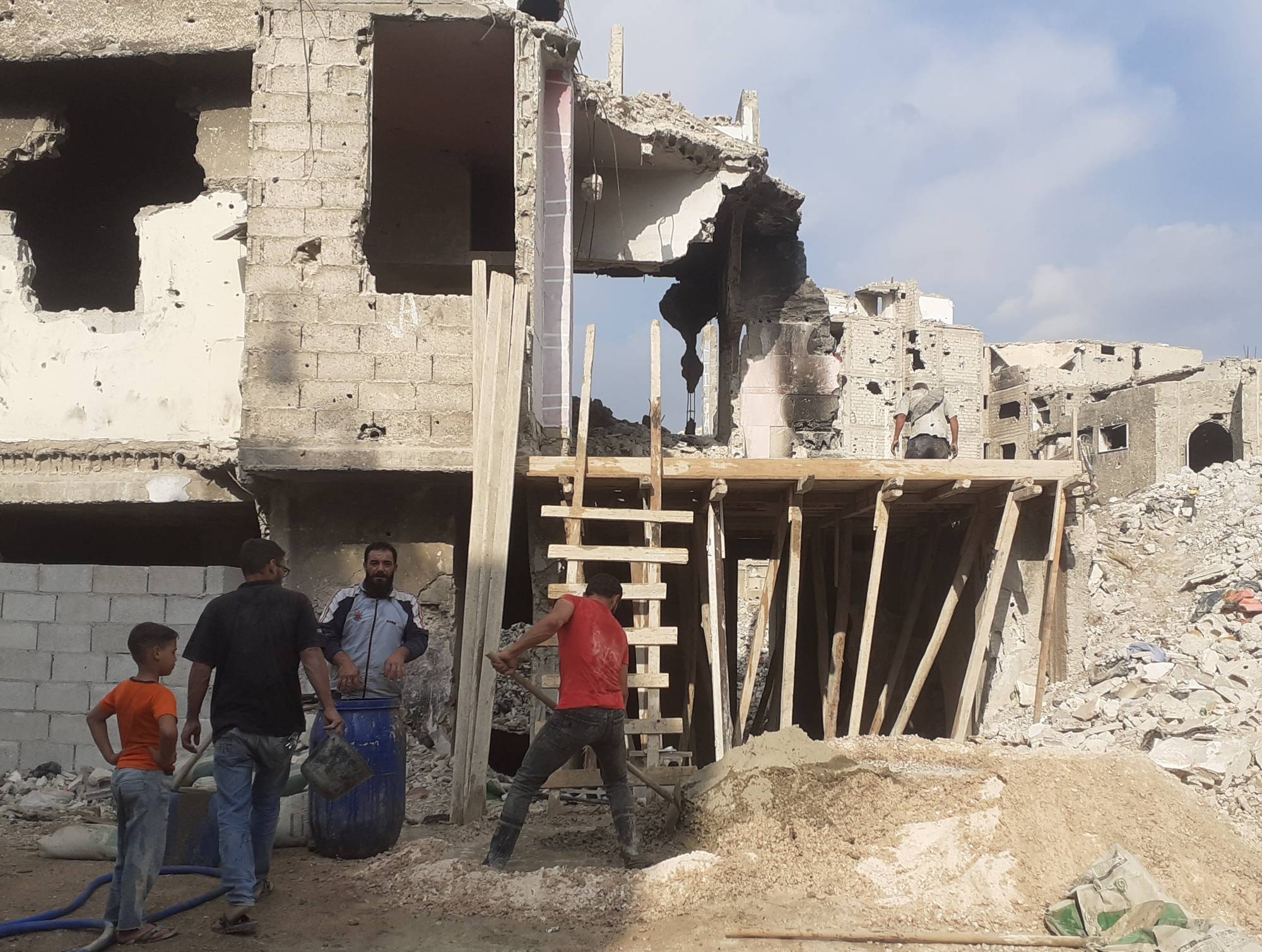
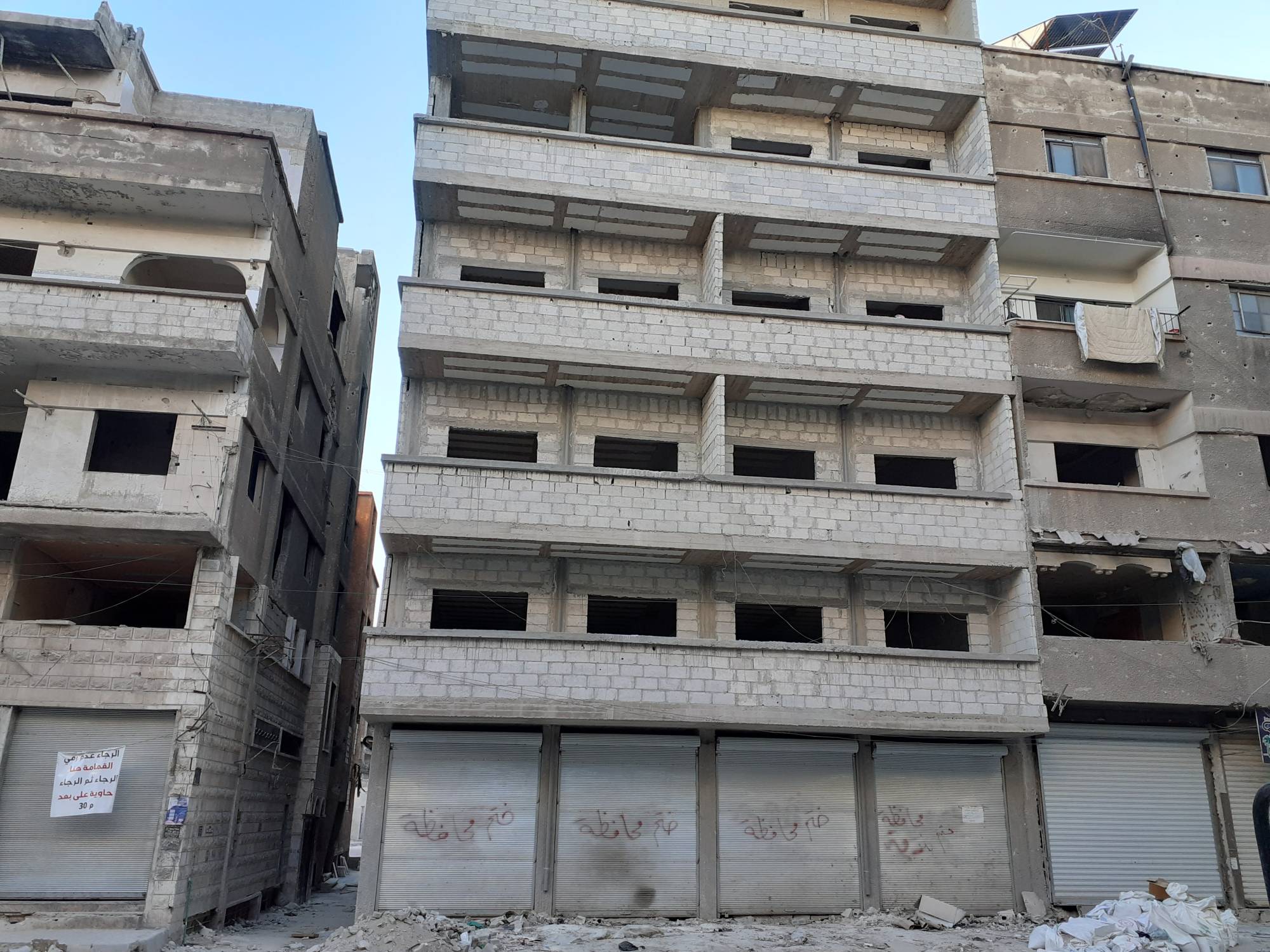
Along the main street and in several side alleys, buildings that have been rebuilt only to the structural frame stand out. Families are living in a single finished room with a minimally equipped kitchen and bathroom, while others have repaired their apartments despite the risk of collapse in severely damaged buildings.
Yassar al-Omar returned to his home in the camp about a year and a half ago. Speaking to Asharq Al-Awsat while sitting on a chair along the sidewalk, the man in his sixties blamed both the government and the UNRWA.
"Unfortunately, we haven't seen anyone."
He said soaring apartment rents, which have climbed to more than $400 a month in areas surrounding the camp, have forced displaced families to return to their homes after carrying out only limited repairs.
"The important thing is to escape the greed of landlords. We installed a front door for the apartment and used curtains and blankets to cover the interior doorways and windows. Some people are living on bread and onions just to save enough money for repairs."
Commenting on the new residential developments, he said, "These apartments and services are not for us. Even in informal neighborhoods, owning a small apartment has become an impossible dream for the overwhelming majority of people given current prices."
Government Largely Absent From Reconstruction
Al-Dasuqi pointed to local community initiatives to repair homes in the city of Deir ez-Zor, as well as projects by aid organizations to rehabilitate some markets. "But what is missing in all the war-damaged areas I visited, whether in Jobar in Damascus or the eastern countryside of Aleppo and Idlib, is the government's presence in the reconstruction process," he said.
According to al-Dasuqi, the government's absence stems from the enormous cost of reconstruction, which is typically financed by the state, the private sector, or external loans. As for the Syrian government, he said, "it is effectively outside this process because it faces major challenges and has not yet recovered financially in terms of public revenues and the state treasury. Taking on reconstruction could overwhelm the state's already strained finances.
That raises the question of why the government has not turned to foreign loans, especially since reconstruction efforts in many countries have relied on external financing.
Al-Dasuqi believes the government's reluctance to seek loans is driven by religious rulings on borrowing and interest, as well as concerns over sovereignty. Instead, it has sought to attract private capital by opening the door to investment in rebuilding war-damaged cities through agreements with local residents.
However, al-Dasuqi argued that the state is failing to fulfill its role as the guarantor of property rights. Instead, it functions more as an intermediary. When it presents residents with an offer from a real estate company to redevelop their area, it simply asks whether they accept it. In his view, the government should instead clearly determine whether the proposal adequately protects property rights and ownership interests.
Possible Solutions Based on the Turkish Model
Al-Dasuqi believes one possible alternative would be for the government to strike land-for-development agreements with real estate companies by granting them state-owned land for investment in exchange for rebuilding a war-damaged neighborhood. He said the government needs to deliver tangible progress that helps narrow the gap between itself and residents of these areas before it widens further. This, he said, could be achieved by offering incentives and exemptions to encourage investors to undertake projects in devastated neighborhoods.
Al-Dasuqi noted that the government has the advantage of being able to draw on the experiences of other countries, particularly Turkish public-private housing models. He pointed to the Turkish state housing developer TOKİ, which builds homes and sells them at cost through affordable installment plans.
He added, "It is not unlikely that we will see a restructuring of Syria's Sovereign Fund through the creation of a real estate holding arm modeled on TOKİ. It could then begin providing housing at cost to citizens through installment plans, once settlement agreements with businessmen linked to the former government have been completed."
He said such a model would depend on two key factors: establishing effective governance for the Sovereign Fund to ensure a stable operating framework, and securing sufficient capital to finance the initiative. However, he does not expect such a project to be in place for at least another one to two years.
The Sovereign Fund was established by presidential decree in June 2025. It has since participated in several investment forums, and indications have emerged that it manages assets acquired through settlements reached by the Committee for Combating Illicit Gains with businessmen linked to the former government and some of its leading economic figures.