
Lebanese Army Faces Criticism over Delay in Enforcing Monopoly on Arms

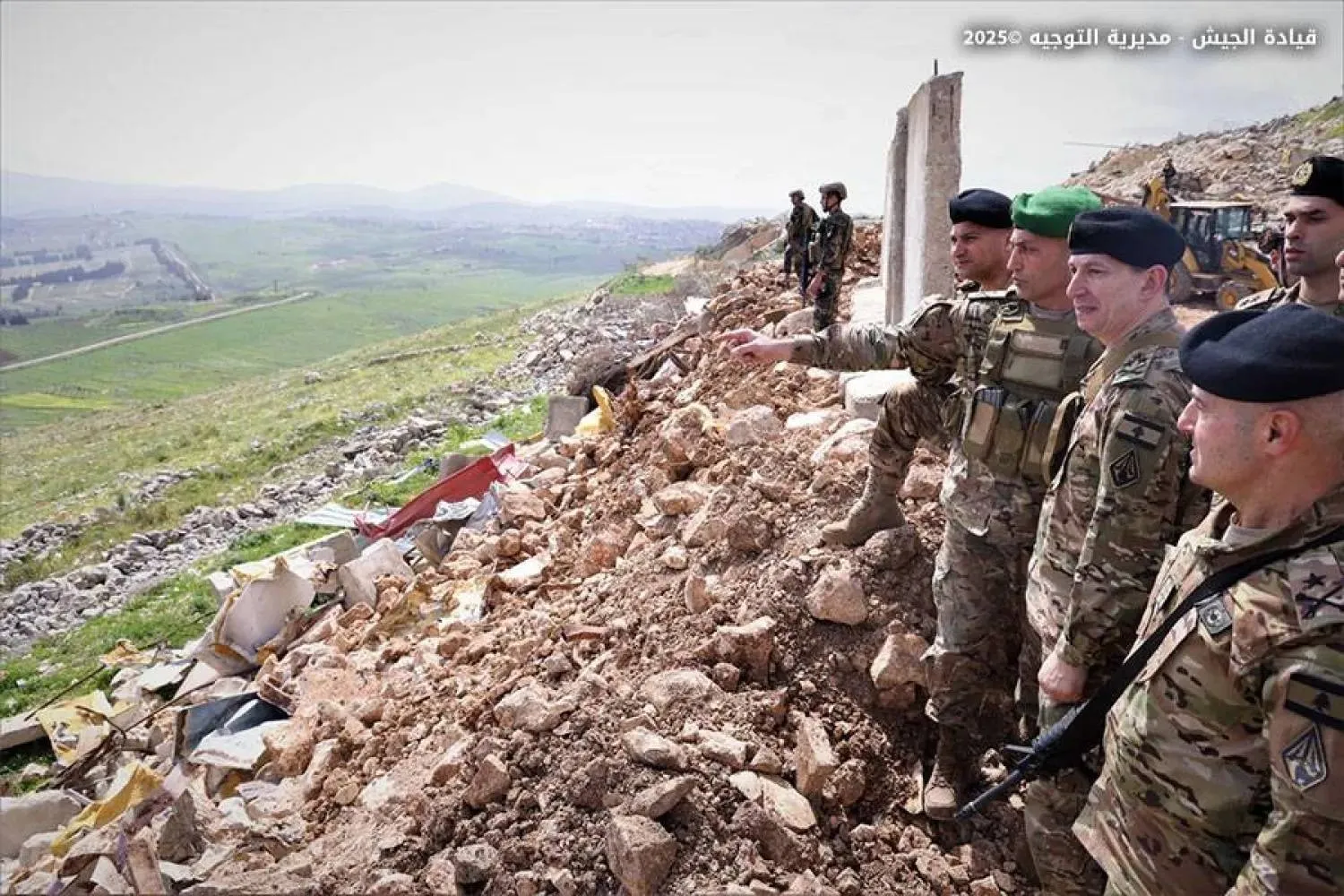
Lebanese Army Commander Rodolphe Haikal and troops inspect the border with Israel. (Army Command)
TT

Lebanese Army Faces Criticism over Delay in Enforcing Monopoly on Arms

Lebanese Army Commander Rodolphe Haikal and troops inspect the border with Israel. (Army Command)

Several Lebanese MPs from the Change parliamentary bloc and independent lawmakers launched a wave of criticism against Lebanese Army Commander General Rodolphe Haikal, suggesting that the army has been lenient in implementing government decisions regarding the disarmament of Hezbollah north of the Litani River.

The criticism prompted counter-reactions from other officials expressing solidarity with the army and voicing support for its role.

On Saturday, Haikal said that “Israeli attacks targeting Lebanon and its citizens are hindering the implementation of the army’s plan”.

He stressed that the “command makes its decisions in line with the complex circumstances on the ground, with the primary goal of preserving Lebanon, safeguarding its unity, and maintaining the military institution”.

He added that the “army is operating under severe internal and external pressure and with limited resources, while exerting every effort to protect domestic stability and national unity”.

Independent MPs and lawmakers from the Change bloc criticized Haikal.

MP Michel Moawad said the army’s stance contradicts its constitutional role and could undermine efforts by the government and the international community to move Lebanon out of the war and reinforce a clear separation between the state and Hezbollah.

MP Mark Daou also expressed surprise at the stance of the Lebanese army command, saying it should have clearly affirmed its commitment to government decisions and explicitly stated that the military wing of Hezbollah is now an outlaw under those decisions.

MP Waddah Sadek said the Lebanese army command is not a political body that expresses opinions on developments or proposes solutions. Rather, he stressed, it is responsible for an institution tasked with implementing the decisions of the executive authority, including the recent government’s decision declaring Hezbollah an outlaw.

The army command is required to implement government decisions immediately. It does not have the authority to assess them, according to Sadek.

The criticism of the army also drew backlash from other MPs.

Former MP Fares Souaid said attacks on the military at this stage are irresponsible, stressing that any mistakes should be addressed within state institutions rather than through public criticism of a body that safeguards civil peace.

Meanwhile, Lebanon and France postponed an international conference to support the Lebanese Army and Internal Security Forces that had been scheduled in Paris on March 5, citing unsuitable conditions amid the ongoing regional tensions linked to the Iranian–US–Israeli confrontation.


Pro-Iran Factions in Iraq Welcome New Supreme Leader as Symbol of Continuity

 Protesters wave Iranian flags as another holds up an image of Supreme Leader Ali Khamenei, who was killed by a US airstrike in Tehran, during a symbolic funeral in Baghdad, Iraq, Friday, March 6, 2026. (AP)
Protesters wave Iranian flags as another holds up an image of Supreme Leader Ali Khamenei, who was killed by a US airstrike in Tehran, during a symbolic funeral in Baghdad, Iraq, Friday, March 6, 2026. (AP)
TT

Pro-Iran Factions in Iraq Welcome New Supreme Leader as Symbol of Continuity

 Protesters wave Iranian flags as another holds up an image of Supreme Leader Ali Khamenei, who was killed by a US airstrike in Tehran, during a symbolic funeral in Baghdad, Iraq, Friday, March 6, 2026. (AP)
Protesters wave Iranian flags as another holds up an image of Supreme Leader Ali Khamenei, who was killed by a US airstrike in Tehran, during a symbolic funeral in Baghdad, Iraq, Friday, March 6, 2026. (AP)

Iraq's pro-Iran groups welcomed on Monday the appointment of Mojtaba Khamenei as Iran's new supreme leader after his predecessor and father was killed in US and Israeli strikes.

The Badr organization said the new leadership represents a "blessed continuity of the path of the Islamic revolution".

The Asaib Ahl al-Haq faction said choosing Mojtaba Khamenei shows continuity and "reinforcement of the Islamic republic's role as a central pillar in the axis of resistance".

Armed faction Kataeb Hezbollah said it reflects a profound understanding "of the existential challenges confronting the nation".

"The best successor to the best predecessor," said Kataeb Hezbollah, which is part of the Islamic Resistance of Iraq -- a pro-Iran alliance that has been claiming attacks on US bases since the start of the war in the Middle East.

Iran wields significant influence in Iraqi politics, and also backs armed groups whose power has grown both politically and financially.

Iraq has for decades been a proxy battleground between the US and Iran.

Senior Iraqi politician and moderate cleric Ammar al-Hakim wished the new supreme leader "success in following the path of his martyred father".


US Only Guarantees Security of Beirut Airport, Road Leading to it

 Departures area inside Beirut–Rafik Hariri International Airport, following an escalation between Hezbollah and Israel, amid the US-Israel conflict with Iran, in Beirut, Lebanon, March 4, 2026. (Reuters)
Departures area inside Beirut–Rafik Hariri International Airport, following an escalation between Hezbollah and Israel, amid the US-Israel conflict with Iran, in Beirut, Lebanon, March 4, 2026. (Reuters)
TT

US Only Guarantees Security of Beirut Airport, Road Leading to it

 Departures area inside Beirut–Rafik Hariri International Airport, following an escalation between Hezbollah and Israel, amid the US-Israel conflict with Iran, in Beirut, Lebanon, March 4, 2026. (Reuters)
Departures area inside Beirut–Rafik Hariri International Airport, following an escalation between Hezbollah and Israel, amid the US-Israel conflict with Iran, in Beirut, Lebanon, March 4, 2026. (Reuters)

An official Lebanese source revealed to Asharq Al-Awsat that the only guarantee the United States has offered Lebanon in the latest war with Israel is the safety of Rafik Hariri International Airport and the road leading to it.

The Americans “are not responding to Lebanese contacts because they have grown convinced that the Lebanese authorities are incapable of meeting their pledges,” it added.

The source said Washington informed Lebanese officials that “lessons are learned from implementing decisions, not taking them,” a reference to the government’s decision last week to ban Hezbollah’s military and security activities.

Lebanon was dragged into conflict with Israel after Hezbollah fired rockets at Israel last week in support of Iran, its main backer.

Lebanon's health minister Rakan Nassereddine said on Sunday that Israeli strikes on Lebanon had killed 394 people over the past week, including 83 children and 42 women.


HRW Accuses Israel of 'Unlawfully' Using White Phosphorus in New Lebanon Attacks

A picture taken from Israel, along the border with southern Lebanon on March 4, 2024, shows smoke billowing following Israeli bombardment on the Lebanese village of Markaba. Jalaa Marey, AFP
TT

HRW Accuses Israel of 'Unlawfully' Using White Phosphorus in New Lebanon Attacks

A picture taken from Israel, along the border with southern Lebanon on March 4, 2024, shows smoke billowing following Israeli bombardment on the Lebanese village of Markaba. Jalaa Marey, AFP

Human Rights Watch on Monday accused Israel of "unlawfully" using white phosphorus over residential parts of a southern Lebanese town last week.

"The Israeli military unlawfully used artillery-fired white phosphorus munitions over homes on March 3, 2026, in the southern Lebanese town of Yohmor," the New York-based rights group said in a report.

HRW added that it "verified and geolocated seven images showing airburst white phosphorus munitions being deployed over a residential part of the town and civil defense workers responding to fires in at least two homes and one car in that area".

White phosphorus, a substance that ignites on contact with oxygen, can be used to create smokescreens and to illuminate battlefields, said AFP.

But the munition can also be used as an incendiary weapon and can cause fires, horrific burns, respiratory damage, organ failure and death.

Israel -- which kept up strikes targeting Hezbollah despite a 2024 ceasefire -- launched multiple waves of strikes across Lebanon since last week and sent ground troops into border areas after the Iran-backed group attacked it.

The Israeli army has since repeatedly called on people living south of the Litani River, around 30 kilometers (20 miles) north of the Israeli border, to leave.

At least 394 people have been killed in Israeli attacks, Lebanese authorities said, registering more than half a million people as displaced.

"The Israeli military's unlawful use of white phosphorus over residential areas is extremely alarming and will have dire consequences for civilians," Ramzi Kaiss, Lebanon researcher at HRW, was quoted saying in the report.

"Israel should immediately halt this practice and states providing Israel with weapons, including white phosphorus munitions, should immediately suspend military assistance and arms sales and push Israel to stop firing such munitions in residential areas," he added.

Lebanese authorities and HRW have over the past years accused Israel of using controversial white phosphorus rounds, in attacks authorities say have harmed civilians and the environment.

Lebanon's state-run National News Agency on Sunday said Israeli forces targeted the towns of Khiam and Tal Nahas, near the border with Israel, "with artillery and phosphorus shelling".

Last month, Lebanon accused Israel of spraying the herbicide glyphosate on the Lebanese side of their shared border, with President Joseph Aoun decrying it as a "crime against the environment".