


Ongoing Strikes in Iraq Expose Political, Security Divisions

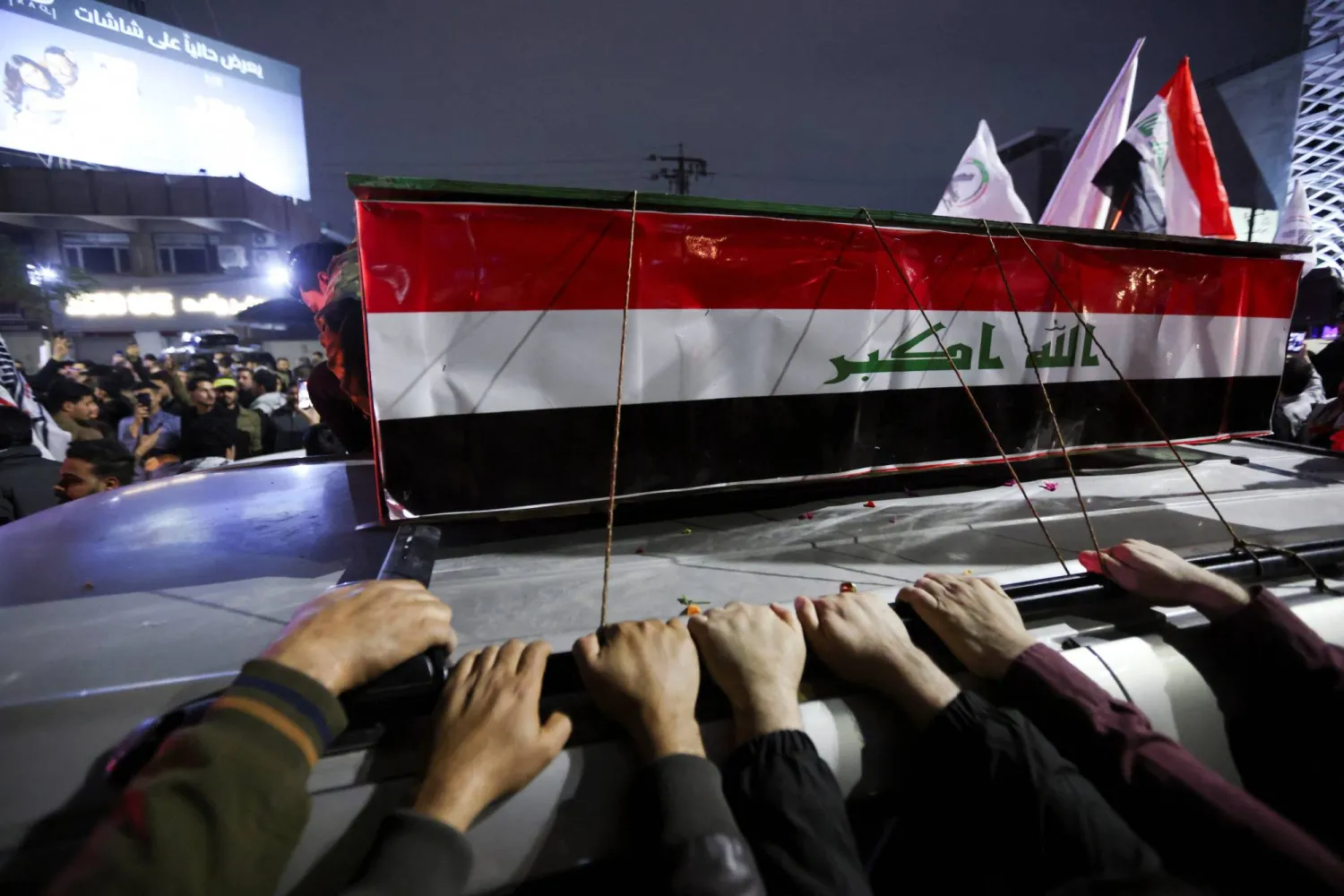
Mourners attend the funeral of members of Iraq's PMF, who were killed in an airstrike in the town of al‑Qaim near the Syrian border, amid heightened regional tensions due to the US-Israel conflict with Iran, in Baghdad, Iraq, March 12, 2026. REUTERS/Stringer
TT

Ongoing Strikes in Iraq Expose Political, Security Divisions

Mourners attend the funeral of members of Iraq's PMF, who were killed in an airstrike in the town of al‑Qaim near the Syrian border, amid heightened regional tensions due to the US-Israel conflict with Iran, in Baghdad, Iraq, March 12, 2026. REUTERS/Stringer

Strikes targeting armed groups in Iraq are continuing amid the US-Israel war on Iran, piling pressure on decision-makers in Baghdad to maintain a unified stance even as factions declare their participation in the fighting alongside Tehran.

Over the past two weeks, the Iraqi government has repeatedly called for “distinguishing targets” and avoiding “mixing up the cards,” a reference to the need not to target Iraqi state institutions or official forces. The stance clashes with announcements by prominent armed factions declaring their involvement in military operations supporting Iran.

Those factions include Kataib Hezbollah, Harakat al-Nujaba and Ansar Allah al-Awfiya. In statements, they said “collaborators” were providing coordinates to what they described as the “enemy.”

Akram al-Kaabi, leader of Harakat al-Nujaba, said in a statement that recent strikes resulted from information provided by “informants,” without identifying them.

A leader in one of the factions fighting alongside Iran, however, claimed the person in question could be linked to a security agency.

Popular Mobilization sites

According to faction statements, some recent strikes targeted sites linked to the Popular Mobilization Forces (PMF), a security institution that includes several brigades affiliated with armed factions.

Observers say strikes on PMF-linked sites, alongside locations belonging to other factions, have created confusion in the political discourse over the nature of the targets and whether the strikes are aimed at specific factions or at an official security structure.

The Iraqi presidency and the prime minister’s office issued statements in recent days stressing the need to avoid dragging Iraq into the regional conflict, while reaffirming their rejection of using Iraqi territory as an arena for settling scores.

Political divisions

At the same time, divisions are widening among the armed factions themselves and between some factions and the government. Analysts say the rifts appear on two levels: military, over the extent of involvement in the war, and political, over the future of power in Baghdad.

Some factions have announced direct participation in military operations. Others have limited themselves to statements of support for Iran, while a third group has remained silent, awaiting developments in the confrontation.

The divisions are also visible within the Coordination Framework alliance, which includes the main Shiite political forces, particularly over the selection of the next prime minister.

Government formation

Iraqi politicians say the regional military escalation is further complicating an already deadlocked political scene, with parties still unable to agree on a new prime minister.

Former Prime Minister Nouri al-Maliki is the declared candidate of the Coordination Framework alliance. But sources say international objections, including from the United States, are hindering his nomination to form a government.

According to those sources, Maliki has stipulated that if he withdraws from the race, neither the current Prime Minister, Mohammed Shia al-Sudani, nor the former Prime Minister, Haider al-Abadi, should be tasked with forming the government.

Analysts say rising regional tensions could push some political forces to exploit the war to strengthen their negotiating positions inside Iraq, particularly as pressure on Tehran grows, and prospects for regional understandings that previously influenced power arrangements in Baghdad diminish.

Additional complications

The picture is further complicated by ongoing disagreements among Kurdish parties over who should be named the presidential candidate. Under the constitution, the president appoints the nominee of the largest parliamentary bloc to form the government.

Observers say delays by Kurdish parties in agreeing on a presidential candidate are effectively obstructing the formation of a new government, while some political forces are using the delay to justify postponing a decision on the premiership.

Tensions have also risen after reports that areas in the Kurdistan region were struck in connection with the escalation between armed factions and their opponents, potentially adding a new dimension to political disputes between Baghdad and Erbil.



Lebanon President Thanks Rubio During Phone Call for US Efforts to Reach Ceasefire

FILED - 16 February 2026, Lebanon, Beirut: Lebanese President Joseph Aoun speaks during a joint press conference with German President Steinmeier (not pictured) at the presidential palace. Photo: Markus Lenhardt/dpa
TT

Lebanon President Thanks Rubio During Phone Call for US Efforts to Reach Ceasefire

FILED - 16 February 2026, Lebanon, Beirut: Lebanese President Joseph Aoun speaks during a joint press conference with German President Steinmeier (not pictured) at the presidential palace. Photo: Markus Lenhardt/dpa

Lebanese President Joseph Aoun on Thursday thanked US Secretary of State Marco Rubio for Washington's efforts to reach a ceasefire in Lebanon.

Aoun received a telephone call from Rubio and "thanked him for the efforts Washington has been making to reach a ceasefire", a statement from the Lebanese president's office said.

It did not mention any possible call with Israeli Prime Minister Benjamin Netanyahu, after US President Donald Trump said the Lebanese and Israeli "leaders" would speak on Thursday, with an Israeli minister saying Netanyahu and Aoun would talk.


Israeli Strike Severs Last Bridge Linking Southern Lebanon to Rest of Country

Smoke rises following an Israeli strike in Nabatieh, Lebanon, April 16, 2026.  REUTERS/Stringer
Smoke rises following an Israeli strike in Nabatieh, Lebanon, April 16, 2026. REUTERS/Stringer
TT

Israeli Strike Severs Last Bridge Linking Southern Lebanon to Rest of Country

Smoke rises following an Israeli strike in Nabatieh, Lebanon, April 16, 2026.  REUTERS/Stringer
Smoke rises following an Israeli strike in Nabatieh, Lebanon, April 16, 2026. REUTERS/Stringer

An Israeli strike has severed the last bridge linking southern Lebanon to the rest of the country, a senior Lebanese security official told Reuters on Thursday, adding that the strike “shattered” the bridge and left no possibility of repairing it.

The state-run National News Agency (NNA) reported that “enemy warplanes carried out two consecutive strikes targeting the Qasmieh bridge, the remaining crossing linking the Tyre area to the city of Sidon, completely destroying it.”

The agency also said that Lebanon’s main highway linking Beirut and Damascus was closed on Thursday after an air strike targeted a car, killing one person.

Since March 2, the Israeli army has successively destroyed four main bridges over the Litani River, which divides southern Lebanon into two parts.

Two days ago, the ambassadors of Lebanon and Israel in Washington met at the US State Department to discuss announcing a ceasefire and setting a date to begin negotiations between Lebanon and Israel under US auspices.

Lebanon’s president had launched an initiative on March 9 based on a full truce, a halt to all Israeli attacks, support for the Lebanese army, the army’s control over areas of tension and confiscation of all weapons there, and the start of negotiations with Israel.

Israeli Prime Minister Benjamin Netanyahu said the talks would focus on disarming Hezbollah and establishing peaceful relations between the two neighboring countries.


In Lebanon Shelters, Women Care for Tiny Babies, Face Pregnancy

Mariam Zein (R) brings her son to a mobile health clinic run by charity Caritas Lebanon. Joseph EID / AFP
TT

In Lebanon Shelters, Women Care for Tiny Babies, Face Pregnancy

Mariam Zein (R) brings her son to a mobile health clinic run by charity Caritas Lebanon. Joseph EID / AFP

Mariam Zein cradled her 11-week-old son on a mattress on the floor where she and her family have sheltered near Beirut since the Israel-Hezbollah war upended her young family's life.

"I was really excited when I was in my ninth month of pregnancy... I never thought he'd be born and there'd be war," said Zein, 26, clutching baby Hussein.

"I haven't been able to enjoy my son -- my first child... to see him getting bigger in his own bed, in his own home."

"I was very sad, and I'm still sad," she told AFP, nappies and baby formula wedged near a photocopier, clothes hanging on an improvised line.

Zein fled with her husband, their baby and other relatives when war erupted between Israel and Hezbollah on March 2, drawing Lebanon into the Middle East conflict, said AFP.

She does not know if her home in south Lebanon is still standing.

Israel has kept up strikes despite a fragile US-Iran ceasefire, a landmark meeting this week between Israeli and Lebanese officials in Washington, and reports that leaders from both countries would talk for the first time in decades.

Lebanese authorities say the war has killed more than 2,100 people and displaced more than one million others.

Some 140,000 people are in overcrowded shelters like the center in Beirut's suburbs housing Zein's family and around 500 other people, among them five pregnant women and others with young babies.

Zein said she stopped breastfeeding because there was no privacy, and now struggles to buy baby formula, while Hussein is outgrowing his clothes.

"Whatever happens I just want my son near me," she said.

- Pregnancy -

According to the United Nations Population Fund (UNFPA), an estimated 620,000 women and girls are displaced, including some 13,500 pregnant women, of whom "1,500 are expected to give birth within the next 30 days".

The agency and other organizations have sought to support women as the authorities struggled to cope.

In a small tent containing a portable ultrasound, obstetrician and gynecologist Theresia Nassar has checked on women including Zein as part of a mobile health clinic run by charity Caritas Lebanon with support from UNFPA.

Displaced pregnant women risk missing important tests and scans, she said, and they are trying to fill the gaps.

"We're not just worried about physical health but also their mental health," she said.

"They don't know if they can go home, they don't have their medication, they're not being properly followed."

Elsewhere, at a school-turned-shelter in central Beirut, heavily pregnant Ghada Issa, 36, is due to deliver a baby girl in a few weeks.

But "this place, this environment, is not for pregnant women", said Issa, who was displaced from south Lebanon with her husband, their daughter Siham, five, and son Ali, four.

They live in a cramped tent, and she said even the basics are a problem, like having to make frequent trips to crowded, far-away communal toilets.

- Twins -

Her husband set up an improvised bed so she doesn't have to sleep on the floor.

Underneath are precious donated items like tiny socks and little blankets. A worker from charity Amel Association International brought them a "baby kit" including nappies and baby powder.

Without donations and other support, "there wouldn't be anything" for the baby, Issa said, as people playing football yelled, children squealed and washing hung on improvised lines.

The shelter's administration said some 20 pregnant women and two who had recently given birth were among more than 2,600 people staying there.

"I haven't got my head around the idea of having a baby here," Issa said.

"I'm still hoping that one day they'll tell me, let's go to the village, and I'll have the baby at home."

In a university classroom in south Lebanon's city of Sidon, Ghada Fadel, 36, cares for her tiny twin sons. Mohammed and Mehdi are just over one month old, and in blue jumpsuits and matching beanies.

The family has been there since she was eight months' pregnant, after fleeing their border village.

"After we left the house, they (Israel) bombed it. The house is gone" along with everything they had prepared for the twins, Fadel said.

"I was hoping to give birth and come home," she said sadly.

"Every mum hopes to take her kids home... no matter the circumstances."